


Travel software rarely fails on its own screens. It fails at the edges: a supplier API that times out during a fare search, a payment page that breaks after a script update, a booking engine that slows to a crawl when a flash sale lands.
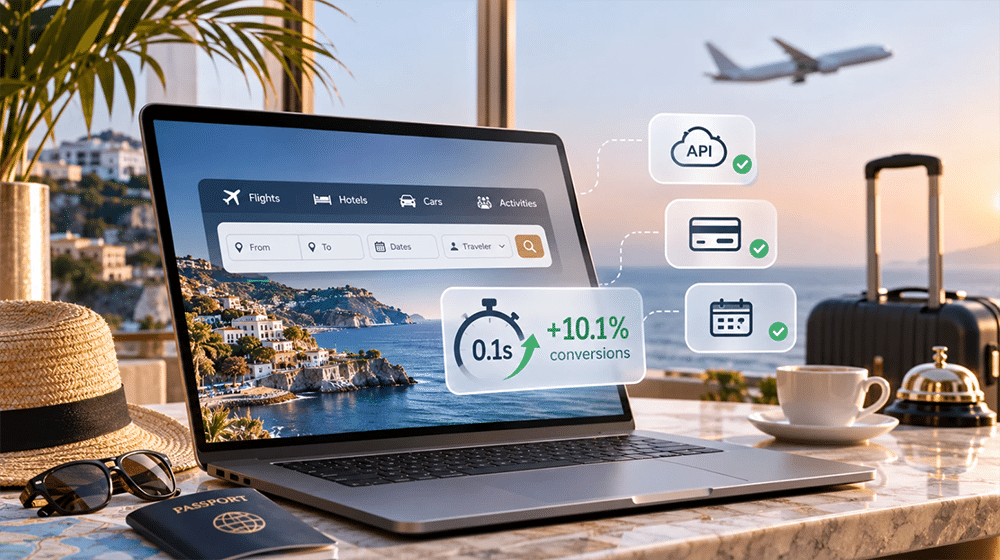
Those edges are where revenue sits. In a 2020 study commissioned by Google, Deloitte found that a 0.1-second improvement in mobile site speed lifted travel conversions by 10.1%. Choosing a development partner for a booking platform, an agency tool, or a hotel distribution product starts with checking how they handle those edges.
What Makes Travel Software Different
Most business software talks to a handful of systems the client controls. Travel software depends on dozens it doesn’t, and on customers who leave the moment a page hesitates.
1. Supplier Connectivity
Flights come through GDSs and, increasingly, airlines’ own NDC APIs. Hotel rooms arrive from bed banks, channel managers and direct property connections. Each source has its own data model, rate rules, and error codes.
Search volume adds another layer. Travelers run many searches for every booking, so a platform that queries suppliers live on every search burns through API quotas and slows down. Caching and smart refresh rules decide both speed and supplier costs.
2. Payments and Card Data
Travel platforms take large card payments, often in several currencies, and sometimes hold cards for later charges. That puts them squarely under the card industry’s security standard.
The PCI Security Standards Council notes that PCI DSS version 4 added 64 new requirements, 51 of which became mandatory on 31 March 2025. Two of them require online merchants to authorize every script on their payment pages, check its integrity, and monitor those pages for tampering.
3. Seasonal Peaks and Speed
Demand in travel arrives in bursts: school holidays, airline sales, a destination going viral. A system sized for an average Tuesday can fail on the busiest day of the year, which is also the day it matters most.
Speed also degrades quietly. Each extra supplier, script, or currency check adds a few milliseconds to a search, and nobody notices until the total reaches seconds. Tracking search response time from the first release, under realistic load, is the only reliable way to catch it.
What to Look for in a Travel Software Development Partner
A good partner doesn’t need to have built your exact product. They need to have solved the problems underneath it.
1. Proof of Supplier Integrations
Ask which GDS, NDC, bed bank, and channel manager connections the team has built, not just which ones it “supports.” Then ask how they handled a supplier changing its API, which happens more often than anyone plans for.
A credible answer includes certification steps with suppliers, test environments, and how failures are logged and retried. A vague answer usually means the integration work will be learned on your budget.
2. A Clear Plan for Payments and Data Protection
The partner should explain early how card data will flow through your system, or better, how it will avoid touching it through tokenization and a payment provider’s hosted fields. They should also cover how traveler data such as passport details is stored, who can see it, and how long it’s kept.
Ask for this as a simple data-flow diagram in the proposal. If a candidate can’t draw where card and passport data go, they haven’t thought about it yet.
3. Load Testing Against Your Real Peaks
Ask for a load-testing plan built on your own traffic history, including your worst day of the past year and a margin above it. A partner who tests only at average load is planning for the wrong day.
4. Discovery Before Code
The strongest teams start with a discovery phase that maps your suppliers, booking flows, and revenue model before estimating. That’s where hidden costs, such as supplier certification time or a missing test environment, surface while they’re still cheap to plan for.
Whether you hire a travel software development company or build a team of your own, insist on a written discovery output: a supplier map, an integration list, and a risk register you keep regardless of who builds the product.

Comparing Partner Types
The right type of partner depends on your product’s scope and on how much travel expertise you already have in-house. The table compares the five most common options.
| Partner type | Strengths | Risks | Fits best when |
| Freelancers | Low cost, fast start | Little capacity for supplier certification or peak testing | A prototype or a small, contained feature |
| Generalist development agency | Broad technical skills, solid process | Learns travel integrations on your project | Standard web or app work around an existing booking system |
| Travel-specialist development company | Supplier and payment experience, known pitfalls | Higher rates, fewer firms to choose from | A booking engine, distribution product or platform rebuild |
| In-house team | Full control, product knowledge stays inside | Slow to hire, hard to staff peaks | Travel software is your core long-term product |
| Customizing a booking platform | Fast launch, vendor handles connectivity | Limited to the vendor’s roadmap and data model | Standard booking flows with modest differentiation |
Many travel companies combine two of these, for example, a specialist partner for the first build and a growing in-house team that takes over afterward.
Questions for the First Call
Bring the same short list to every candidate so their answers can be compared side by side.
- Which supplier connections have you built and certified, and for which clients?
- How do you cache search results, and how do you keep cached prices accurate?
- How will card data and passport data flow through the system we build?
- What happened the last time a supplier changed its API on one of your projects?
- How do you load-test, and what traffic numbers would you use for us?
- What do we own at the end: code, documentation, and supplier credentials?
The fourth question is the most revealing, because every experienced travel developer has a story and every inexperienced one has a theory.
Making the Decision
Narrow the field to two or three partners whose answers covered suppliers, payments, and peaks with specifics. Then give each a small, paid discovery task based on one real supplier integration. The way they scope it will show you more than any portfolio, and you’ll keep the output from whichever partner you choose.
Choosing the right travel software development partner requires more than comparing technical skills or rates. Look for proven supplier integrations, secure payment architecture, realistic load testing, clear discovery work, and strong ownership terms so the finished platform can scale reliably.
More Tips to Grow Your Business
Revfine.com is the leading knowledge platform for the hospitality and travel industry. Professionals use our insights, strategies, and actionable tips to get inspired, optimize revenue, innovate processes, and improve customer experience.Explore expert advice on management, marketing, revenue management, operations, software, and technology in our dedicated Hotel, Hospitality, and Travel & Tourism categories.
Leave A Comment