

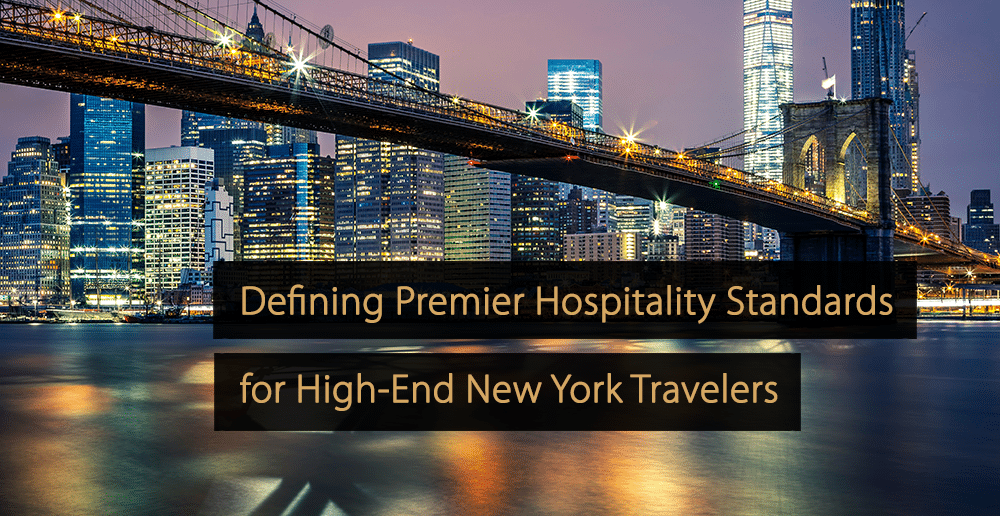
A luxury traveler lands at JFK after an overnight flight. The hotel room will be beautiful. The reservations are confirmed. The city is waiting. Yet in New York, the stay is often judged long before the guest reaches the lobby. In one of the world’s most demanding urban environments, premier hospitality is not defined by what is offered, but by how smoothly everything connects. For high-end explorers, luxury is experienced in motion. That reality has quietly reshaped what “premier” now means.
In this article, you’ll learn five modern hospitality standards shaping how high-end travelers experience luxury stays in New York today.
Five Standards Redefining Premier Hospitality for High-End New York Travelers
These five standards explain how leading hotels deliver seamless arrivals, personalization, reduced effort, invisible technology, and an authentic sense of place.
Standard #1: Orchestrated Arrival Sets the Tone
Discerning guests form their first impression not at check-in, but during the transition into the city: how clearly expectations are set, how predictable timing feels, and how little effort is required on their part. A premier hospitality standard today is arrival orchestration, where responsibility for the guest experience begins before the front desk ever comes into view.
This often includes smooth transitions from airport arrival to hotel and onward to dining or meetings, frequently supported by a professional chauffeured service that aligns with the property’s service standards. When transportation feels integrated rather than improvised, guests sense control—and control builds trust.
In a city defined by complexity, a calm arrival is the first signal of quality.
Standard #2: Predictive Personalization (Not Performative Service)
Personalization at the high end has become quieter—and smarter.
Luxury visitors do not want to explain themselves repeatedly, nor do they want service that calls attention to how personalized it is. The emerging standard is predictive personalization: service shaped by context and behavior rather than constant questions. This shows up in small but meaningful ways:
- A different communication style for a business visit versus a leisure stay
- Adjusted pacing for short, tightly scheduled trips
- Thoughtful timing that respects when guests want engagement—and when they do not
When personalization works, it rarely earns praise. It simply removes friction, which is exactly what high-end travelers value most.
Standard #3: Reducing Cognitive Load During the Stay
Once guests have arrived, a different standard takes over: mental ease. Many luxury properties are excellent at delivering standout moments—beautiful rooms, memorable dining, exclusive experiences—but fewer take responsibility for what happens in between. In a city like New York, the space between decisions can quickly become exhausting if it is left unmanaged.
Premier hospitality reduces this cognitive load by quietly shaping the rhythm of the stay. Instead of simply booking experiences, it anticipates sequencing, smooths timing, and limits the number of decisions guests must make in real time.
The difference is subtle but powerful. A great dinner followed by logistical stress feels fragmented, while a well-paced evening, where movement and timing feel considered, feels generous. Discerning guests ultimately judge the stay not by its highlights, but by how little effort it took to enjoy them.
Standard #4: Invisible Technology That Enables Confident Service
Technology is no longer a differentiator in luxury hospitality—it is an expectation. What matters now is how it is used.
The standard here is invisible enablement. Systems should compress response times, reduce repetition, and support staff decision-making without ever becoming the focus of the guest experience.
Strong implementations tend to share a few traits:
- Customers are never asked for the same information twice
- Staff appear informed without being intrusive
- Service feels coordinated across departments and shifts
When technology is successful, guests do not comment on it. They observe how smooth everything felt.
Standard #5: Curated Sense of Place Over Generic Luxury
New York is not a city guests need to be introduced to. That familiarity changes the role of luxury hospitality: the goal is no longer to impress with scale or drama, but to interpret the city intelligently. Increasingly, discerning visitors respond to curation over spectacle—to properties that help them navigate the city rather than compete with it.
This sense of place is created through restraint. It shows up in designs that reflect the neighborhood rather than overpower it, in partnerships that feel genuinely local, and in experiences that align with how the city actually functions. In New York, luxury is not about standing apart from the city; it is about demonstrating fluency in it.
Where These Standards Are Already Visible
Several New York properties already reflect these standards in different ways.
Aman New York is built around controlled arrivals, privacy, and pacing, offering a sense of retreat that reduces cognitive load from the moment guests enter. The Peninsula New York is often associated with disciplined coordination across arrivals, concierge planning, and mobility—less about spectacle, more about reliability. The Ritz-Carlton NoMad represents a more contemporary expression, blending sophisticated service with a strong neighborhood identity and curated local experiences.
Different styles, same principle: premier hospitality in New York is achieved through alignment, not abundance.
What Hospitality Leaders Should Take Away
For operators serving the luxury segment in New York, progress rarely comes from adding more. New amenities, new technologies, and new experiences matter far less than how well existing elements are coordinated.
The most effective hospitality leaders focus on:
- Designing the guest trip end-to-end, rather than optimizing isolated touchpoints
- Treating arrival, mobility, and pacing as core experiences, not secondary services
- Training teams to anticipate needs rather than wait for instructions
In a market as demanding as this city, enhancement beats expansion every time.
Redefining Luxury in a City That Never Slows Down
This urban environment does not reward excess. It rewards control.
Premier hospitality in the city is built on fluency—knowing when to intervene, when to simplify, and when to stay out of the way entirely. When everything moves smoothly, guests remember the feeling, not the effort behind it.
That is what luxury looks like in New York today.
Luxury hospitality in New York is no longer about excess, but orchestration. Hotels that reduce friction, anticipate needs, and align every moment of the journey create confidence, calm, and lasting loyalty. In a city defined by motion, true luxury is control.
More Tips to Grow Your Business
Revfine.com is the leading knowledge platform for the hospitality and travel industry. Professionals use our insights, strategies, and actionable tips to get inspired, optimize revenue, innovate processes, and improve customer experience.Explore expert advice on management, marketing, revenue management, operations, software, and technology in our dedicated Hotel, Hospitality, and Travel & Tourism categories.




Leave A Comment