

Monday morning. Last week was the busiest week of the quarter. Covers were up. Tickets were up. The dining room was full on Thursday, which never happens. Then the bank balance came in, and it didn’t agree with any of that. Busy and profitable aren’t the same thing. The number that usually explains the gap is your food cost percentage.
Quick answer: Food cost percentage is the share of your food sales spent on the ingredients that produced them. The food cost formula is: (opening inventory + purchases − closing inventory) ÷ food sales × 100. A bistro with $11,900 in food costs and $36,000 in food sales runs a 33.1% food cost.
What Is Food Cost Percentage?
Every dollar a guest spends on food has to cover the ingredients, the staff, the rent, and, eventually, you.
This number tells you how much of that dollar went to ingredients. At 33%, every $1.00 of food sales leaves 67 cents for everything else.
It’s the restaurant version of cost of goods sold. COGS for restaurants is simply what you used up from inventory to make what you sold, measured here against food sales.
So what? When this one number drifts by three points, a $36,000 week loses about $1,080 that never shows up as a line item anywhere.
The Food Cost Formula
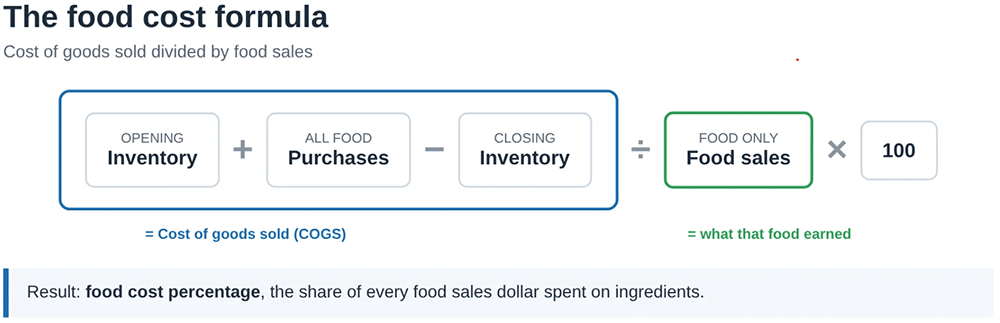
Here’s what goes into the food cost formula, and what trips people up in each part:
- Opening Inventory: the value of all food on hand at the start of the period. It’s last period’s closing count, not a new guess.
- Purchases: every food delivery received during the period, at invoice cost.
- Closing Inventory: the value of all food on hand at the end. Walk-in, dry store, freezer, line.
- Food Sales: food revenue only. Drinks go in their own calculation.
The top half of the formula is your cost of goods sold. The bottom half is what that food earned.
How to Calculate Food Cost Percentage, Step by Step
Here’s how to calculate food cost the same way every week, so the number means something.
- Count Opening Inventory. Use last week’s closing count. Same items, same units, same prices.
- Add Purchases. Total every food invoice received in the period, after credits and returns.
- Count Closing Inventory. Same day of the week, same time, same person if you can.
- Work Out COGS. Opening plus purchases minus closing.
- Divide by Food Sales and Multiply by 100. That’s the food cost percentage formula in one line.
Tip: Run it on a fixed sheet rather than a fresh calculation each week. A simple cost of goods sold spreadsheet keeps the inputs in the same cells, so week ten is as easy to compare as week one.
Worked Example: One Week at a Bistro
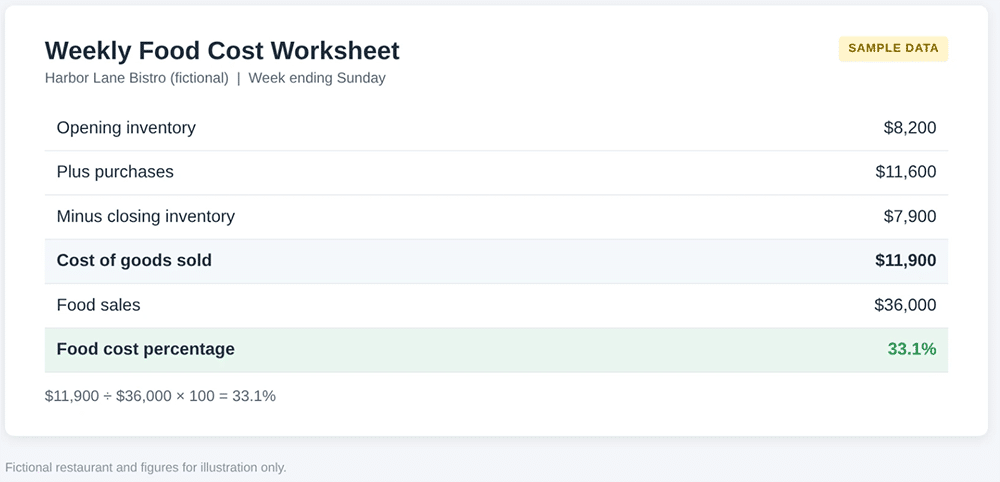
Harbor Lane Bistro (a fictional restaurant) runs the numbers for one week.
| Line | Amount |
| Opening inventory | $8,200 |
| Plus purchases | $11,600 |
| Minus closing inventory | $7,900 |
| Cost of goods sold | $11,900 |
| Food sales | $36,000 |
| Food cost | 33.1% |
$11,900 ÷ $36,000 = 0.331. So for every dollar of food sold that week, 33 cents went back into ingredients.
What Is a Good Food Cost Percentage?
Here’s the honest answer: the right target depends on what you sell.
A steakhouse buys expensive protein, so its ideal food cost percentage sits higher than a pizza place that sells flour, tomatoes, and cheese at a healthy markup. A café selling mostly coffee and pastries lives in a different world again. Industry averages blend all of these together, which is why they’re a weak target for any one restaurant.
So what is a good food cost percentage for a restaurant like yours? Build it from the bottom up:
- Cost your top-selling plates. Each one gets its own plate cost.
- Weight them by how often they sell. A dish ordered 400 times a week matters more than one ordered 12 times.
- That weighted figure is your theoretical food cost. It’s what you should be running if nothing is wasted.
- Compare it with your actual. The gap between the two is waste, over-portioning, theft, or counting errors.
A restaurant food cost percentage two points above its theoretical figure is telling you something. Find out what before you change a single menu price.
How to Calculate Food Cost Per Plate
Plate cost is the cost of every ingredient in one portion, as served. It’s where your menu pricing starts.
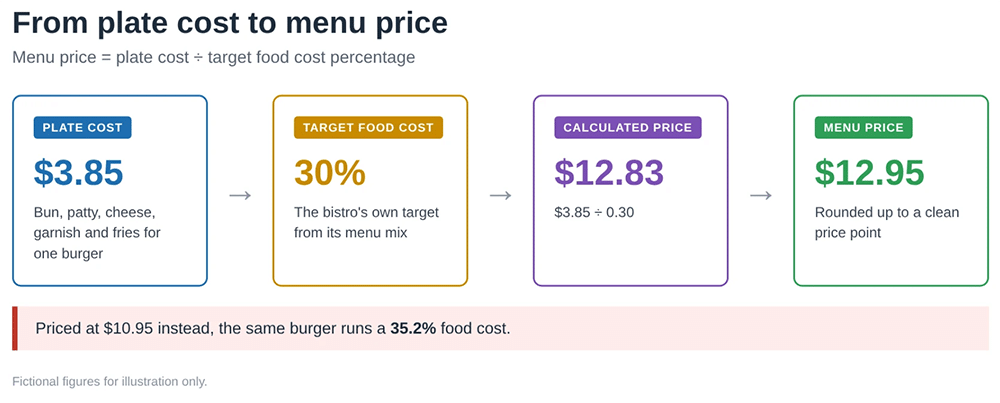
The menu pricing formula works backward from your target:
Menu price = plate cost ÷ target food cost percentage
Worked Example: Pricing a Burger
| Item | Amount |
| Plate cost (bun, patty, cheese, garnish, fries) | $3.85 |
| Bistro’s target food cost | 30% |
| Calculated price ($3.85 ÷ 0.30) | $12.83 |
| Menu price | $12.95 |
Price it at $10.95 because the place down the road does, and the same burger runs a 35.2% food cost. Every one sold pulls the whole kitchen’s number up.
Why Your Food Cost Jumps Week to Week
Sometimes nothing changed in the kitchen, and the number moved anyway. The usual culprit is the count.
Worked Example: The Missing $1,500
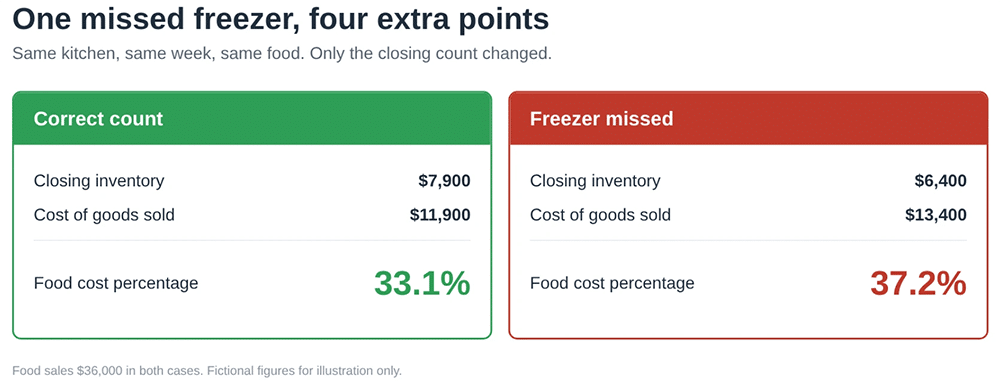
Same bistro, same week. But on Sunday night, nobody counted the second freezer, so closing inventory was recorded as $6,400 instead of $7,900.
| Correct count | Freezer missed | |
| Closing inventory | $7,900 | $6,400 |
| Cost of goods sold | $11,900 | $13,400 |
| Food cost | 33.1% | 37.2% |
Same kitchen. Same food. A four-point jump that sends the owner hunting for a problem that doesn’t exist.
Good restaurant inventory habits stop this before it starts. Accurate restaurant inventory counts come down to five rules:
- Count on the same day and time every period
- Use one fixed count sheet, laid out in the order of your shelves
- Count every storage area, every time
- Rotate stock first in, first out
- Keep a waste log so spoiled food has a record, not a mystery
How often should you count? Weekly suits most kitchens with fresh product. A monthly count hides problems for too long to fix them.
What Is Prime Cost in a Restaurant?
Prime cost is your cost of goods sold plus total labor cost, including payroll taxes and benefits. Together, they’re the two highest costs you can actually control week to week.
Worked Example: The Bistro’s Prime Cost
| Line | Amount |
| Cost of goods sold | $11,900 |
| Plus total labor | $10,800 |
| Prime cost | $22,700 |
| Food sales | $36,000 |
| Prime cost percentage | 63.1% |
That leaves 36.9 cents of every food sales dollar for rent, utilities, repairs, marketing, and profit. Track food cost and prime cost side by side. Cutting one by pushing up the other isn’t savings.
Common Mistakes
- Using Purchases Instead of Usage. A big delivery on Friday makes the week look terrible.
- Fix: Always adjust for opening and closing inventory.
- Mixing Food and Beverage. Drinks usually run a different cost, and blending them hides both.
- Fix: Calculate them separately.
- Counting On Different Days. A Tuesday count versus a Sunday count compares two different kitchens.
- Fix: Fix the day and time.
- Ignoring Waste. Food thrown away is still food bought.
- Fix: Log it, so it shows up as waste, not as a mystery.
Back to Monday
Same bistro. One week later. The count happened Sunday night, same time, same sheet, both freezers. The number came out at 33.1%, right next to last week’s. Busy and profitable finally agree. That’s what a number you can trust looks like.
Food Cost Numbers to Remember:
|
Frequently Asked Questions
Accurate food cost tracking helps restaurants understand whether busy periods are truly profitable. By counting inventory consistently, separating food from beverage costs, pricing dishes carefully, and comparing actual results with theoretical targets, operators can spot problems early and protect margins.
More Tips to Grow Your Business
Revfine.com is the leading knowledge platform for the hospitality and travel industry. Professionals use our insights, strategies, and actionable tips to get inspired, optimize revenue, innovate processes, and improve customer experience.Explore expert advice on management, marketing, revenue management, operations, software, and technology in our dedicated Hotel, Hospitality, and Travel & Tourism categories.





Leave A Comment