


On paper, everything looks fantastic. Occupancy is high, revenue is growing, and hotel teams are running at full speed. And yet… profitability still feels weirdly fragile. Many hotels’ results look great on paper, the kind you’d happily show in a meeting, but volume doesn’t always buy peace of mind.
In this article, you’ll learn why traditional hotel metrics fall short and how a profit-first mindset helps you protect margins, simplify decisions, and sleep a little better at night.
When “Good Performance” Doesn’t Feel Good
Feeling like you’re walking a financial tightrope? This tension is familiar to many hotel commercial teams. On the surface, the results look solid. But behind the scenes, pressure keeps building: from rising costs, complex operations, and distribution fees that quietly eat away your profit.
The problem doesn’t lie in your effort or ambition but rather in what you choose to measure and celebrate.
The Metrics You Celebrate and What They Miss
For years, occupancy and RevPAR have dominated revenue conversations. They’re easy to track, easy to benchmark, and easy to explain.
The logic was simple: if revenue goes up, performance must be improving. However, focusing only on top-line metrics pushes critical questions into the background:
- How much did it cost to get this reservation?
- What did it actually cost to deliver the guest experience you promised?
- Did this booking help or strain operations?
- How much profit did your hotel actually keep?
Revenue is visible…profit often isn’t. That disconnect leads to decisions that boost volume, but slowly weaken control.
Revenue Is Loud. Margin Tells the Truth
A strong revenue year doesn’t automatically mean a strong profit year.
In many markets, higher distribution fees, staffing challenges, wage inflation, and rising operating costs mean that more volume can actually hurt profitability.
That’s why revenue leadership is changing:
- From volume first → value-aware
- From “fill the house” → protect the margin
- From growth at any cost → growth that holds
Profitable revenue management is about choosing the right demand at the right time and price.
When Insight Doesn’t Turn Into Action
Knowing that margin matters is one thing, but acting on it, week after week, is another.
Most hotels already know that not all revenue is equal. They feel the pressure from rising costs and channel fees, and yet, behaviour often stays the same.
Why? Because insight without action isn’t strategy.
You see this most clearly in weekly commercial and revenue management meetings. As revenue management leader, Thibault Catala puts it in his LinkedIn post:
“If your hotel’s weekly meeting doesn’t drive revenue, you’re not having the right meeting.”
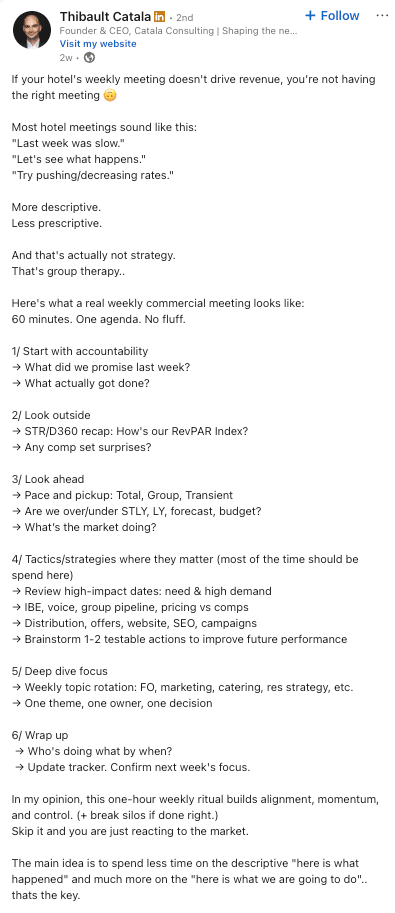
Strong commercial hotel teams spend less time explaining the past and more time shaping the future. They look outward at the market, forward at demand, and deliberately choose where to act.
Because this is where profitability is won or lost — not in dashboards, but in decisions.
And that’s why the first step toward profit-first revenue management is making profitability visible and actionable before those conversations even start.
Where Profit Quietly Leaks Away
Across different markets and property types, the same profit drains show up again and again:
1. Discount-Driven Occupancy Growth
Lower rates may fill rooms in the short term, but they shrink contribution and leave little room to absorb higher costs.
2. High Cost-to-Serve Segments
Some guests bring revenue but also extra staffing pressure, complaints, or service recovery.
3. Margin Squeeze at High Occupancy
The fuller your hotel gets, the more expensive the last rooms can become to run: housekeeping needs extra hours to turn rooms, more guests can mean more requests, more complaints, more time invested by receptionists, maintenance issues pile up…
4. Unbalanced Channel Mix
Letting high-cost channels dominate when lower-cost channels (like direct bookings) are available eats into your margins.
5. Too Much Rate Complexity
Endless rate codes, packages, and exceptions make it harder to consistently execute profit-driven decisions.
6. Outdated Contracted Rates
Corporate or group rates that haven’t moved with today’s costs quietly lose relevance.
7. Weak Restriction and Mix Controls
Without smart length-of-stay rules or group displacement calculations, you can often fill up too early and block higher-value bookings that arrive later.
8. High Cancellation Exposure
Very flexible cancellation rules can leave you with empty rooms at the last minute and force you to sell them cheaper than planned.
9. Underpriced Premium Rooms
Your best rooms often sell too cheaply, even when guests are willing to pay more.
10. “Zombie Revenue”
Looks alive in reports. Quietly eats profit in the background.
“Zombie revenue” bookings look good on paper but deliver little or no profit once all costs are counted, such as:
- Group business with heavy inclusions and flexible clauses
- Deeply discounted advance sales that later block high demand
- Long-standing corporate agreements are disconnected from today’s cost reality.
From RevPAR to Profit per Available Room
Two bookings at the same rate can deliver very different outcomes once acquisition and delivery costs are included. RevPAR alone cannot show this difference.
A profit-first approach asks better questions:
- Which type of booking truly contributes?
- When does this booking make sense?
- When should it be constrained or declined?
Step 1: Make Profitability Visible
Profitability gets easier to manage once you can actually see it.
Start simple:
Average Daily Rate – distribution costs – variable operating costs = contribution per booking
Then add a few real-world signals:
- Overtime and staffing pressure
- Guest complaints and service recovery
- Cancellation and no-show patterns
When these are visible, decisions stop being reactive and start becoming repeatable.
Step 2: Challenge Old Assumptions
Take a fresh look at:
- Long-standing corporate rates
- Group business that disrupts operations
- Channels that bring volume but hurt margin
The goal is to qualify the demand.
Step 3: Right-Size Demand for Profit
Right-sizing means matching pricing, availability, and demand mix to what your hotel can actually deliver profitably.
Instead of asking: “How do we maximise occupancy?”, ask:
- Which demand fits our cost structure?
- At what price does it make sense?
- When does extra occupancy start hurting the margin or operations?
That’s the shift from volume-driven execution to profit-led leadership.
A Simple Scenario
Two outcomes, same hotel.
Scenario A
- 95% occupancy
- 180€ ADR
- High-cost channel mix
→ €110 kept per room
Scenario B
- 85% occupancy
- 210€ ADR
- Stronger direct mix
→ 140€ kept per room
That 30€ difference per room can mean 75,000+€ more profit per year for a 100-room hotel, with less pressure on your team and fewer “can someone please cover this shift?” moments.
Free Guide: The Benefits of Revenue Management
By reading this guide, you will gain valuable insights into how revenue management impacts every department and learn how to implement pricing strategies that boost revenue, streamline operations, and improve guest experiences.
Click here to download the guide “The Benefits of Revenue Management”.
There will always be pressure to fill rooms. But long-term confidence comes from knowing why you’re saying yes and when it’s better to say no. Once you start seeing the difference, you can focus on the bookings that actually move the needle.
More Tips to Grow Your Business
Revfine.com is the leading knowledge platform for the hospitality and travel industry. Professionals use our insights, strategies, and actionable tips to get inspired, optimize revenue, innovate processes, and improve customer experience.Explore expert advice on management, marketing, revenue management, operations, software, and technology in our dedicated Hotel, Hospitality, and Travel & Tourism categories.





Leave A Comment