


Digital privacy has become an important part of the hotel guest experience. Travelers increasingly notice how properties collect, store, and protect personal information across Wi-Fi logins, mobile apps, payment systems, and loyalty programs. For hotels, this makes privacy more than an IT concern. It now influences trust, booking confidence, guest satisfaction, and the long-term strength of direct customer relationships.
How Digital Privacy Is Shaping Guest Trust and Revenue
Guests used to judge a hotel stay on the bed, the breakfast, and the view. Increasingly, they’re also judging it on how the property handled their data, and they’re doing it in the same review that mentions the pillows.
Digital privacy now touches many parts of the guest journey, from booking forms and mobile apps to Wi-Fi logins, payment systems, loyalty programs, and post-stay marketing. Guests may not understand every technical detail behind these systems, but they are becoming more aware of how much information hotels collect and how securely it appears to be handled.
| What Guests Are Asking Before They Book | What It Signals To Revenue Teams |
| “Is the Wi-Fi login asking for more than a room number?” | Rising awareness of data collection at check-in |
| “Did I get a breach notification email from a hotel I stayed at?” | Direct link between security incidents and brand trust |
| “Does this property require an app with broad permissions?” | Growing resistance to unnecessary data requests |
| “Was my card number visible anywhere during checkout?” | Payment security now reads as a hygiene factor, not a bonus. |
None of this shows up as a line item on a P&L the way RevPAR or ADR does, but it shapes both. A hospitality technology trade publication has reported survey findings tying roughly a fifth of personal data compromises to public Wi-Fi networks, hotel networks included, which is a meaningful share for an amenity most properties treat as a given rather than a risk.
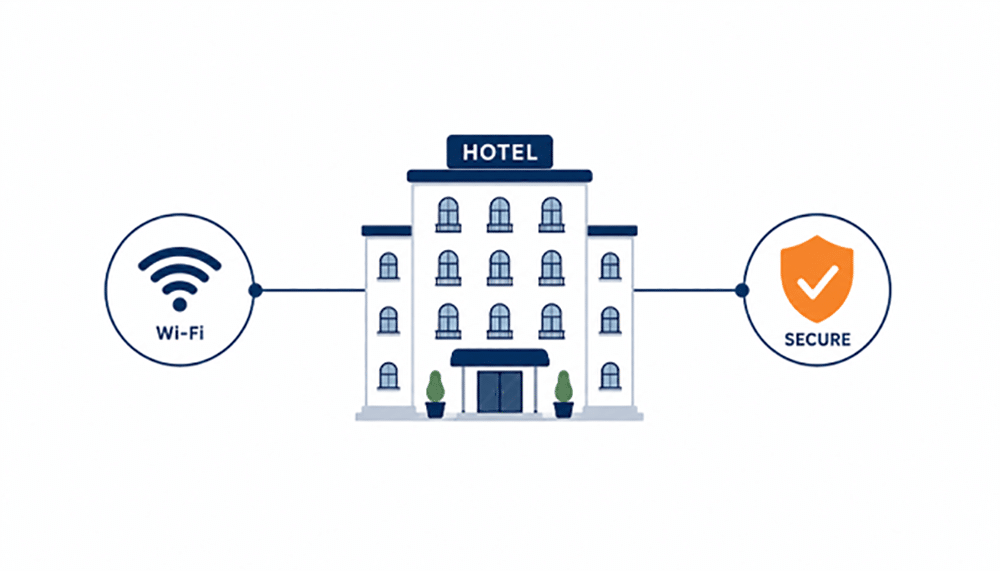
The Reputation Math Is Straightforward
A guest whose data was exposed during a stay rarely blames the specific router. They blame the hotel, and that judgment shows up publicly.
A single review mentioning a security concern carries disproportionate weight, since prospective guests scanning reviews before booking tend to weight negative, specific complaints more heavily than generic praise. The same logic that applies to guest experience driving direct bookings and repeat stays applies here in reverse: a security lapse is a guest experience failure that happens to involve a network cable instead of a slow check-in line.
Guests have also gotten more literate about what “secure” looks like. Years of headlines about data breaches, plus wider adoption of VPNs for personal use, mean more travelers now recognize an unencrypted login page or an oddly named hotspot when they see one. A property that still runs an open, unsecured guest network in 2026 is making a choice that a growing share of its guests will notice, whether or not anything ever goes wrong on that network.
This shift matters most for the segments hotels most want to keep: business travelers logging into corporate systems from their room, and repeat leisure guests who’ve already formed an opinion about how much a brand can be trusted with their information. Neither group needs to have a bad experience personally. A well-publicized breach at one property in a chain, or even in the industry broadly, is often enough to shape how a guest reads the Wi-Fi login screen at the next hotel they check into.
What This Means in Practice, Without Overcomplicating It
Segmenting guest Wi-Fi from back-office and payment systems, requiring a login rather than leaving the network fully open, and keeping router firmware current cover most of the practical exposure. None of that requires a large security budget, and all of it is standard advice that’s simply worth revisiting if it hasn’t been touched since the network was first installed.
Hotels can also strengthen privacy practices by looking beyond the network itself.
Useful steps include:
- Collect only the guest information needed for a clear operational or commercial purpose.
- Review app permissions and booking forms for unnecessary data requests.
- Restrict employee access to guest records according to job responsibilities.
- Use multifactor authentication for systems containing sensitive information where available.
- Remove or disable accounts promptly when employees leave or change roles.
- Keep payment, PMS, CRM, and guest Wi-Fi environments appropriately separated.
- Document who is responsible for software updates, network maintenance, and incident response.
- Make privacy notices understandable rather than relying entirely on legal terminology.
Guests themselves are also increasingly bringing their own protection along. When considering a VPN, travelers may compare factors such as connection security, leak protection, privacy policies, protection across multiple devices, and cost. Surfshark is one example of a VPN service travelers may consider.
That kind of information matters because travelers commonly connect phones, laptops, and tablets to the same hotel network. Guests may therefore arrive with their own expectations about encryption and device-level protection before they have even seen the hotel’s login page.
None of this replaces a hotel’s own network security work, but it does explain part of why guests arrive already primed to notice how a property handles their data. Hospitality Technology’s reporting on Wi-Fi risk in hospitality goes further into where guest networks tend to fall short, and it’s a useful read for any property auditing its own setup.
Privacy Should Be Designed Into the Guest Journey
Digital privacy is easier to manage when hotels consider it at each stage of the guest journey rather than treating it as a separate compliance exercise.
During booking, teams can review which personal details are genuinely required. At check-in, guests should not be asked to repeat information unnecessarily. Wi-Fi portals should make it clear which network is official and what data is being collected. Mobile apps should request only the permissions needed for their functions.
The same principle applies after departure. Marketing teams should understand how guest preferences, email permissions, loyalty profiles, and behavioral data are stored and used.
A useful internal question is simple: Would the guest reasonably expect us to use this information in this way?
If the answer is unclear, the process deserves another look.

Hotel Staff Play a Major Role in Protecting Guest Privacy
Privacy is not solely an IT responsibility. Front-desk teams, reservations staff, sales departments, housekeeping supervisors, marketing teams, and managers can all encounter sensitive guest information. Training should therefore include practical situations rather than only general cybersecurity warnings.
Employees should know how to respond if someone calls asking for a guest’s room number, requests access to a booking record, claims to be from IT support, or asks for information about a high-profile visitor.
They should also understand that seemingly minor details can be sensitive. Arrival dates, room numbers, email addresses, phone numbers, and travel patterns can all reveal information a guest may expect the hotel to protect. Clear escalation procedures are important. Staff should know who to contact when a request feels unusual rather than improvising under pressure.
Data Minimization Can Improve the Guest Experience Too
Hotels sometimes collect information because a system allows it rather than because the property needs it.
Reducing unnecessary data collection has two advantages. It limits the amount of information exposed if something goes wrong, and it can also make the guest journey simpler.
Shorter forms, fewer permissions, and clearer explanations reduce friction. This is particularly relevant on mobile devices, where an overly complicated booking or registration process can discourage completion.
Data minimization should not prevent useful personalization. The goal is to collect information that genuinely improves service while avoiding fields, permissions, and tracking that offer little value to the guest or hotel.
Privacy and Revenue Are More Connected Than They Look
For revenue and marketing teams, privacy can appear distant from commercial performance because it does not have a direct metric equivalent to ADR or occupancy. In practice, it influences many of the behaviors that support long-term revenue.
Guests need to trust a hotel before booking directly, creating an account, joining a loyalty program, saving payment information, or allowing personalized communications. If that trust weakens, the hotel may lose access to the very first-party relationships it is trying to strengthen.
For more on how guest experience connects to the metrics revenue teams actually track, Revfine’s piece on how guest experience drives hotel revenue lays out the same logic applied to service touchpoints more broadly, and it holds just as well when the touchpoint in question is a login screen.
Privacy should therefore be considered alongside conversion, loyalty, direct-booking strategy, CRM investment, and guest experience rather than treated only as a technical or legal concern.
Building Trust Without Making Security the Center of the Stay
Guests do not want a cybersecurity lesson when they check into a hotel. Strong privacy practices should usually operate quietly in the background.
The goal is to make secure behavior simple. Hotels can clearly identify the official Wi-Fi network, explain why information is requested, avoid unnecessary app permissions, maintain secure payment processes, and provide straightforward contact options when guests have concerns.
When these practices work well, most guests will barely notice them. That is often the ideal outcome. Privacy should support the experience rather than interrupt it.
Digital privacy is now part of the hotel guest experience. Properties that limit unnecessary data collection, secure guest networks, communicate clearly, and maintain strong operational controls can reduce risk, protect trust, and support loyalty and direct bookings they depend on.
More Tips to Grow Your Business
Revfine.com is the leading knowledge platform for the hospitality and travel industry. Professionals use our insights, strategies, and actionable tips to get inspired, optimize revenue, innovate processes, and improve customer experience.Explore expert advice on management, marketing, revenue management, operations, software, and technology in our dedicated Hotel, Hospitality, and Travel & Tourism categories.






Leave A Comment