

Customer Lifetime Value (CLV) estimates the economic value a customer generates across their full relationship with your hotel, rather than from one reservation. For commercial decisions, CLV is useful only when you calculate it by segment and distinguish lifetime revenue from the contribution the relationship actually produces.
Key Takeaways:
|
Table of Contents:
What Is Customer Lifetime Value (CLV) in Hotels?
Customer lifetime value stops valuing a customer at one transaction and starts measuring the relationship. The following three labels describe the same idea, and the inconsistency causes real reporting problems.
- CLV (Customer Lifetime Value) carries the deepest research literature and works best as your primary reporting term.
- LTV (Lifetime Value) is the generic business abbreviation imported from software and retail.
- Guest Lifetime Value is hospitality’s own wording for the identical calculation, favored by vendors.
HSMAI’s glossary defines CLV using repeat spending, booking frequency, gross profit, and churn rate instead of room revenue alone.
For example, if your 90-room boutique reports LTV as cumulative room revenue while marketing reports CLV after costs, two teams are discussing different metrics under similar names. One of them will lose the budget argument for the wrong reason.
Choose one definition, document it, and apply it before you benchmark anything between segments.
Video: What is Customer Lifetime Value (CLV)? | Marketing Analytics
Why Does CLV Matter for Hotel Profitability?
CLV helps you look beyond the value of a single booking and focus on the total value a guest can bring over time. A guest paying the highest ADR today is not always your most profitable guest if another customer returns more often and spends more across several stays.
A Cornell study of two independent hotel groups found that guests who enrolled in a rewards program increased annual room nights by 45 percent and 49 percent, while average revenue per night changed by only 4 percent and 1 percent. The figures show why repeat stays can matter more than rate alone.
You can use CLV to make sharper decisions about:
- Acquisition Spending: How much can you afford to spend to win a customer?
- CRM Investment: Which customer groups justify more personalized communication?
- Loyalty: Which repeat behaviors are worth rewarding?
- Direct Bookings: Which guests should you encourage to book directly?
- Segmentation: Which guest groups create the most long-term value?
- Retention: Which customers are economically worth re-engaging?
- Personalized Offers: Where will an upgrade or targeted offer increase contribution rather than simply move revenue between products?
Without CLV, every one of those calls defaults to first-transaction value.

Michael J. Goldrich, Founder & Chief Advisor, Vivander“From my work with hotels on direct channel growth, I’ve found that while ROAS is important, it’s only one piece of the strategy. The most valuable KPIs combine commercial impact with insights into the customer journey. I focus on Direct Channel Contribution and the Direct vs. OTA booking ratio to assess channel health. Customer Lifetime Value (CLV) from digital channels, paired with repeat booking rates, shows if we’re bringing in the right guests. For website effectiveness, I track revenue per visitor and look-to-book conversion rates by segment and review personalization lift metrics to validate targeting. Composite metrics add real insight. I recommend a “Direct Channel Health Score” that benchmarks performance against both local and similar hotels worldwide. This approach helps hotels gauge not only their direct booking success, but also their market position.” Click here to learn more from our Hotel Marketing Expert Panel. |
How Do Hotels Calculate Customer Lifetime Value?
Start with a calculation your team can reproduce consistently.
Revenue CLV = Average Stay Value x Stay Frequency x Relationship Period
Consider a repeat leisure guest who spends €420 per stay, stays 1.5 times per year, and maintains a relationship for four years:
€420 x 1.5 x 4 = €2,520 estimated lifetime revenue
That calculation is useful for understanding purchasing volume, but it isn’t yet a profit measure. Track the two numbers separately and name them separately: lifetime revenue and lifetime contribution. Calling both “CLV” creates false precision that collapses the first time finance examines it.
For commercial decisions, move to:
Contribution CLV = Average Stay Value x Stay Frequency x Relationship Period x Contribution Margin
Contribution margin should reflect the costs relevant to your decision, such as distribution costs and variable stay costs. A more advanced predictive model can incorporate the probability of future visits and discount future cash flows.
Hospitality researchers Webb, Cho, and Legg built a CLV approach that uses customer behavior, expected trip cycles, transition probabilities, and discounted future value. Their work shows why predictive CLV becomes more sophisticated once a hotel moves beyond historical averages.
Don’t start there unless the added complexity will change a commercial decision.
Why Should Hotels Calculate CLV by Segment?
A property-wide CLV average combines customer relationships that behave differently. A transient leisure visitor, weekly corporate traveler, annual conference account, and tour operator shouldn’t share one assumed lifetime.
Ranking by spend per stay will actively mislead you. Analyzing 331 loyalty customers over 12 years, Webb, Cho, and Legg found the highest per-visit spenders were not the most valuable long-term once visit frequency and lapse probability entered their model. That data came from a casino, so treat it as a structural warning rather than a hotel benchmark.
You can start with commercially meaningful groups such as:
- Direct leisure
- OTA leisure
- Corporate transient
- Negotiated corporate accounts
- Groups and MICE
- Loyalty members or established repeat guests
Then refine only when the additional split changes an action.
For example, a Rotterdam business hotel could find that an engineering account produces a moderate ADR but returns throughout the year and fills Monday-to-Thursday need dates. Combining that account with weekend leisure customers would hide the very pattern that makes it valuable.
Segment before you calculate.
Which Factors Drive Hotel Customer Lifetime Value?
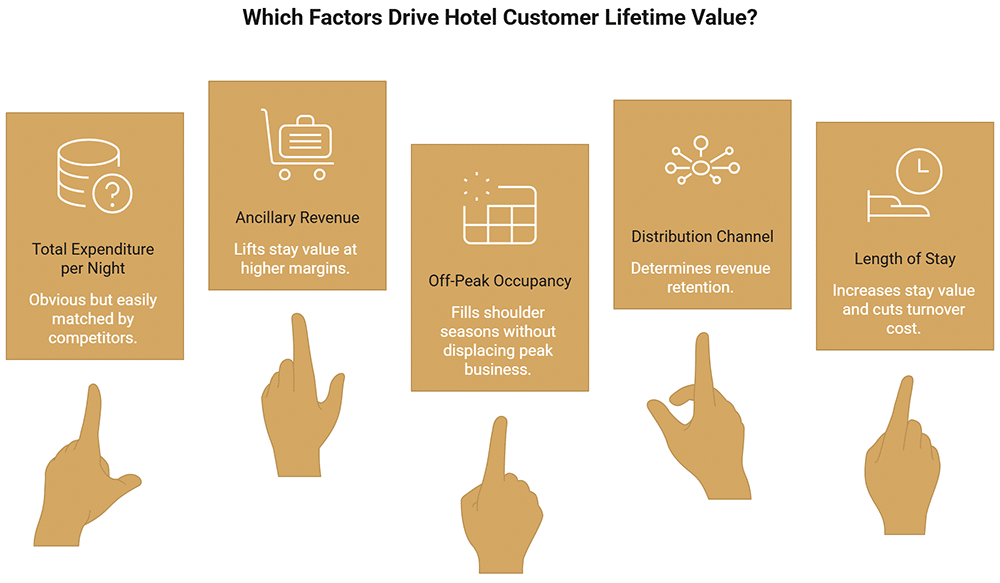
Hotel CLV should reflect more than frequency and room rate. A Tourism Review study used a cross-regional focus group and a Delphi study involving 21 executives from international hotel chains, finding expert consensus around five core hotel CLV drivers.
What changes in the list is scope. CLV stops being a repeat-booking calculation and becomes a question about the quality of demand:
- Total expenditure per night is the obvious lever and the weakest, because competitors match rate moves.
- Ancillary revenue lifts stay value at margins that frequently beat rooms.
- Off-peak occupancy matters because a guest who books shoulder season isn’t displacing business you’d have won anyway.
- Distribution channel determines what you keep from identical revenue.
- Length of stay raises stay value and cuts turnover cost simultaneously.
The off-peak factor deserves particular attention. Two customers can generate identical annual revenue while one fills sold-out Saturdays and the other repeatedly books soft Tuesdays.
Their revenue is equal. Their commercial value to the hotel may not be.
This is where CLV starts connecting customer relationship management with revenue management rather than sitting only inside a marketing dashboard.
Customer Lifetime Value Versus Guest Acquisition Cost
Customer Lifetime Value tells you what a relationship is worth. Customer Acquisition Cost (CAC), called Guest Acquisition Cost (GAC) in hotel reporting, tells you what you paid to create it. The two metrics should be reviewed together.
Use:
CLV: CAC = Contribution CLV Before Acquisition Cost ÷ CAC
Keep acquisition cost outside the CLV numerator when calculating this ratio. Otherwise, you deduct the same cost twice.
A peer-reviewed study used customer-level data from a large U.S. hotel brand. The researchers found that customers acquired through intermediaries had 19.94% lower CLV than customers acquired through brand-owned channels in their dataset, while still retaining positive lifetime value.
The finding does not mean OTAs are automatically bad business. However, the same researchers’ allocation model found that intermediary channels can remain part of an optimal acquisition mix depending on acquisition efficiency, accessible demand, and capacity.
That is exactly why CLV and GAC belong together.
As Pablo Delgado, CEO of Mirai, told PhocusWire,
“While costs are clearly increasing on the first booking, a solid retention strategy can reduce the effective cost significantly by driving repeat stays through the direct channel. Unfortunately, most hotels still lack this long-term view.” Source
Our “Guest Acquisition Cost guide” covers the cost side of this calculation in detail.
What Is a Healthy CLV to CAC Ratio for a Hotel?
An absolute CLV figure is difficult to act on until you compare it with what you paid to acquire the customer.
There is no universal hospitality CLV to CAC target in the hotel research used for this article. Treat the following as a planning interpretation, not an industry benchmark:
| CLV to CAC ratio | What It Signals | What To Do Next |
| Below 1 to 1 | You lose money on every guest acquired | Cut the channel or raise contribution before adding volume |
| 1 to 3 | Acquisition is covering itself with no margin for error | Fix retention first, not acquisition spend |
| 3 to 5 | Acquisition is paying for itself with headroom | Hold spend, shift mix toward the highest ratio sources |
| Above 5 | You are almost certainly underspending on acquisition | Test increased budget on your best-performing source |
Don’t turn 3 to 1 into a hotel target simply because it appears in broader marketing practice. Your acceptable ratio depends on contribution margin, capacity, customer type, repeatability, and how much incremental demand is actually available.
Replace generic ratios with your own trailing customer economics as soon as your data allows it.
The CLV Reality Check
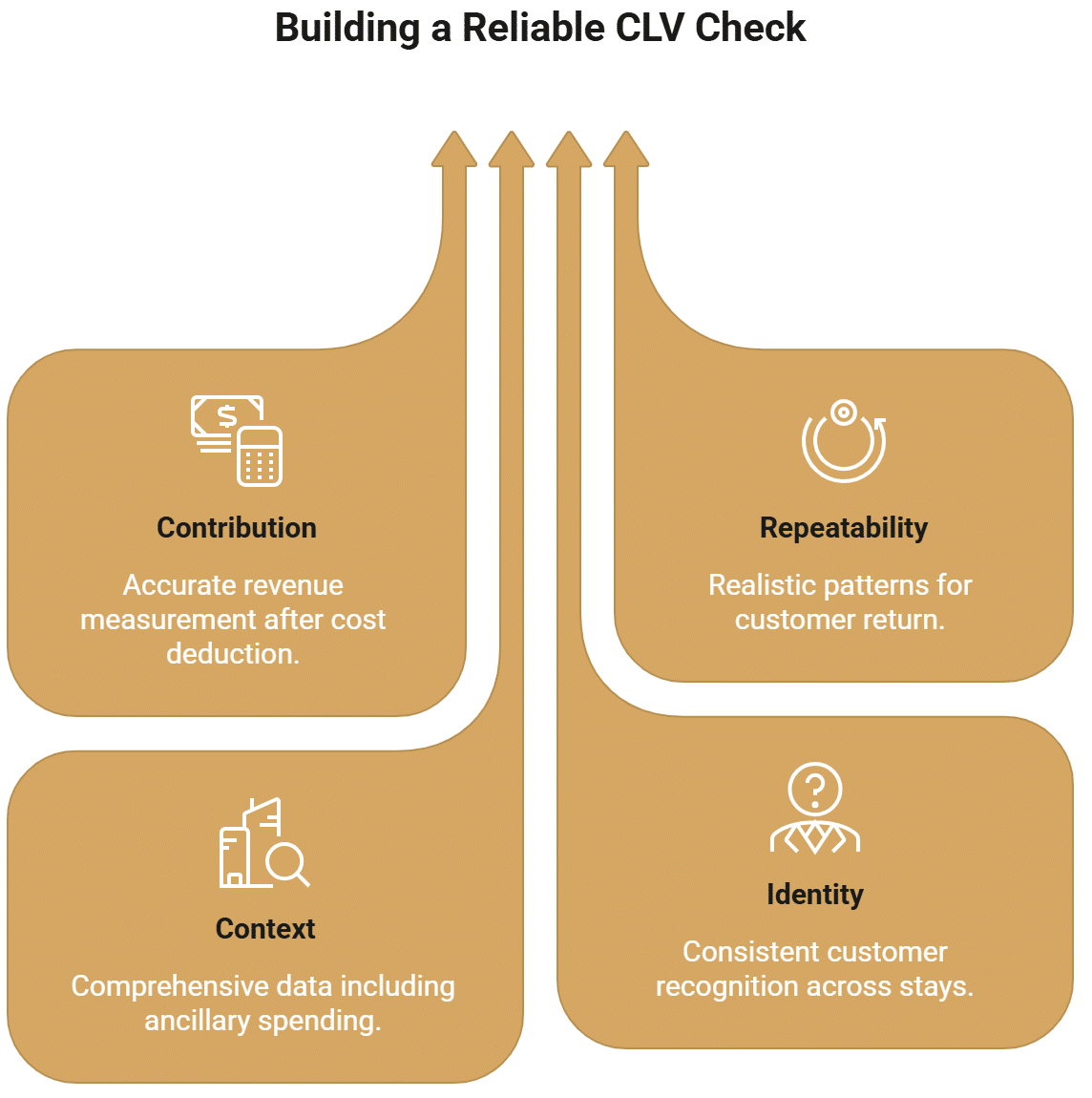
Before using CLV to set acquisition budgets or loyalty investment, run the number through four checks:
- Contribution: Are you measuring revenue, or what remains after relevant costs?
- Repeatability: Does this segment have a realistic reason and pattern for returning?
- Context: Have you captured ancillary spending, channel cost, stay length, and value on need dates?
- Identity: Can your PMS and CRM recognize the same customer across separate stays?
Fail the first check and your CLV is a revenue forecast. If you fail the second and the lifetime assumption is speculative. Fail the fourth and the underlying guest history is unreliable.
The data problem is real. The hotel CLV research found that restricted identifiable customer data, fragmented Revenue Management and Customer Relationship Management systems, and limited analytical maturity constrain CLV-informed decisions.
Use CLV for decisions only when the underlying relationship can survive this test.
How Can Independent Hotels Grow CLV Without a Chain Loyalty Program?
Independent hotels don’t need an enterprise loyalty platform to improve CLV. Their advantage is flexibility. They can recognize returning guests and personalize the next stay without relying on a standardized points program.
Hotels can use the following Independent CLV Loop:
- Identify: Deduplicate your PMS records using email, phone, and booking history.
- Understand: Track first-stay channel, segment, contribution, frequency, and preferences.
- Recognize: Use known preferences to make repeat stays feel more personal.
- Rebook: Contact guests around their observed return cycle rather than sending generic campaigns.
Consider a 60-room property serving 4,000 unique guests annually with a 22% repeat rate. That equals about 880 returning guest relationships to protect.
Recognition doesn’t need to mean discounts. Stored room preferences, priority room allocation, or flexible late checkout can add value without reducing rate.
Track repeat booking frequency, direct-booking share among returning guests, contribution per repeat stay, and time between stays alongside your other hotel KPIs. For independent hotels, strong guest recognition can be more valuable than complicated loyalty mechanics.
FAQs About Customer Lifetime Value (CLV) in Hotels
Customer Lifetime Value (CLV) becomes useful when it measures realistic, segment-specific contribution instead of simply adding up future room revenue. Treat it alongside acquisition cost, stay behavior, and channel economics, and even a small hotel can make better decisions about which customer relationships deserve more investment.
Did You Like This Article About Customer Lifetime Value (CLV) in Hotels?
You might also be interested in the following articles:
- What Is RevPAM in Hotels and How Do You Calculate It
- What Is Average Length of Stay (ALOS) in Hotels?
- What Is eNPS in Hotels? The Metric That Predicts Turnover
More Tips to Grow Your Business
Revfine.com is the leading knowledge platform for the hospitality and travel industry. Professionals use our insights, strategies, and actionable tips to get inspired, optimize revenue, innovate processes, and improve customer experience.Explore expert advice on management, marketing, revenue management, operations, software, and technology in our dedicated Hotel, Hospitality, and Travel & Tourism categories.
This article is written by:

Hi, I am Martijn Barten, founder of Revfine.com. With 20 years of experience in the hospitality industry, I specialize in optimizing revenue by combining revenue management with marketing strategies. I have successfully developed, implemented, and managed revenue management and marketing strategies for individual properties and multi-property portfolios.




Leave A Comment