

RGI, or Revenue Generation Index, measures your hotel’s RevPAR against the average RevPAR of your competitive set, market, or submarket. It tells you whether you are winning or losing revenue share in your market, which absolute RevPAR alone cannot show. The number only becomes useful when the competitive set behind it is honest.
Key Takeaways:
|
Table of Contents:
- What Is Revenue Generation Index (RGI) in Hotels?
- How Do You Calculate Revenue Generation Index?
- Why Does RGI Matter More Than RevPAR on Its Own?
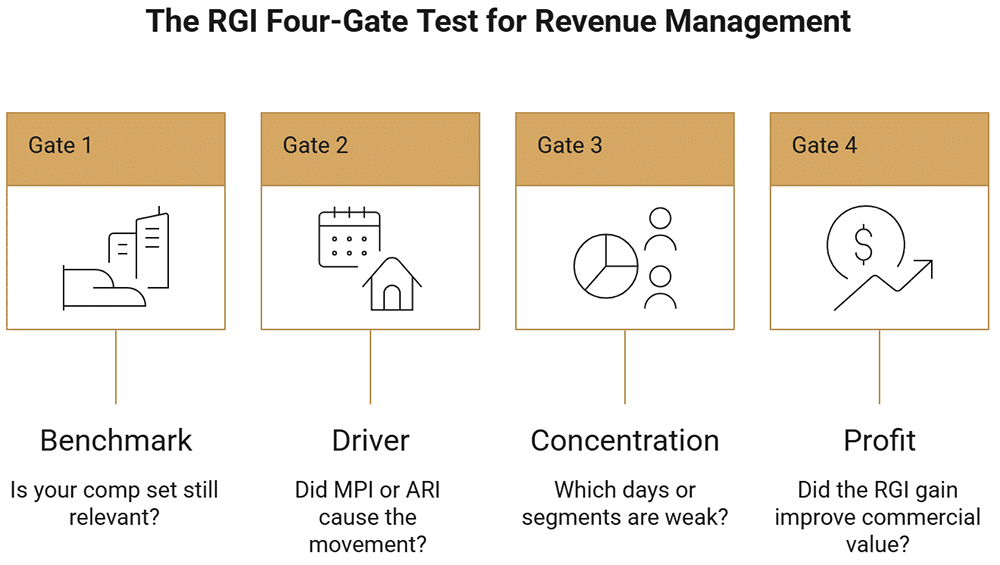
- The RGI Four-Gate Test
- How Does Your Competitive Set Affect RGI?
- RGI, MPI, and ARI Compared
- What Should You Do When Your RGI Drops?
- When Can Revenue Generation Index Mislead You?
- FAQs About Revenue Generation Index (RGI) in Hotels
What Is Revenue Generation Index (RGI) in Hotels?
Revenue Generation Index is a hotel benchmarking KPI that compares your property’s RevPAR with the average RevPAR of an aggregated group of hotels.
The metric appears under slightly different names. CoStar’s STR Benchmark glossary uses Revenue Generating Index. Benchmarking reports commonly use RevPAR Index, while HSMAI refers to Revenue Generation Index and notes that it was formerly known as RevPAR Index or RPI.
An index of 100 represents expected or fair-share RevPAR performance. Above 100 means your hotel generated more RevPAR than the benchmark represented by 100, while below 100 means it generated less.
That is the distinction RevPAR alone cannot provide.
RGI answers a more useful competitive question: How effectively is your hotel generating room revenue compared with the market it competes against?
How Do You Calculate Revenue Generation Index?
The Revenue Generation Index formula is:
RGI = Hotel RevPAR / Competitive Set RevPAR x 100
CoStar uses this calculation for the RevPAR Index, or RGI. Its published example shows a hotel generating 60 dollars in RevPAR against a comp set at 50 dollars, scoring 120, and the same hotel at 40 dollars, scoring 80.
Now run this calculation on a real property. Consider a 90-room independent hotel in Lisbon’s Chiado district that closed last month at 74 percent occupancy and an ADR of 165 euros and generated RevPAR of 122.10 euros. Its comp set averaged 130.20 euros.
122.10 / 130.20 x 100 = 93.8
The hotel captured roughly 94 percent of its fair share. Read that number carefully, because RGI is an index, not a currency value or a growth rate. An RGI of 105 does not mean RevPAR grew 5 percent. It means your RevPAR sits 5 percent above the benchmark an index of 100 represents.
Use the same reporting period and availability basis for both figures. Otherwise, the comparison becomes unreliable before you start interpreting it.
Why Does RGI Matter More Than RevPAR on Its Own?
RevPAR tells you how much room revenue you generated per available room. It cannot tell you whether your hotel performed better or worse than the market around it.
U.S. hotel RevPAR fell 0.3% in 2025, which CoStar described as the first non-recessionary RevPAR decline recorded in the U.S. hotel industry.
Consider a hotel whose RevPAR falls 2% while its competitive set falls 6%. Looking only at RevPAR suggests weaker performance. Looking at RGI shows that the hotel actually improved its relative RevPAR position.
The reverse can happen too. Your RevPAR may increase while RGI falls because competitors grew faster. That is why RGI should sit beside RevPAR in your revenue management review. RevPAR shows the absolute result. RGI tells you how that result compares with the market.
The RGI Four-Gate Test
A single RGI number should not trigger a pricing decision. Run it through the RGI Four-Gate Test and stop at the first one it fails.
| Gate | Question | What a Failure Means |
| 1. Benchmark | Is your comp set still relevant? | You may be measuring against the wrong competitors. |
| 2. Driver | Did MPI or ARI cause the movement? | You may treat an occupancy problem as a rate problem. |
| 3. Concentration | Which days or segments are weak? | A property-wide response may fix the wrong period. |
| 4. Profit | Did the RGI gain improve commercial value? | You may have bought revenue share too expensively. |
Gate one is where most indexes break. In a CoStar article, Gary Isenberg of LWHA Asset and Property Management Services documented a 200-plus-room limited-service airport hotel whose RGI read 110 against the comp set chosen when it opened. Rebuilt around the limited-service properties that had opened since, the same hotel scored 90.
Its actual revenue never changed. Only the mirror did. That is why the gates belong inside your revenue management routine rather than in an annual review.
How Does Your Competitive Set Affect RGI?
A technically correct Revenue Generation Index can still produce a poor commercial decision when the competitive set is wrong.
CoStar’s current STR Benchmark guidelines require at least four participating properties, excluding the subject hotel, with further rules covering company, brand, and property concentration.
Don’t select competitors on distance alone. Compare location, hotel class, ADR position, service level, guest profile, demand pattern, and the occasions when guests genuinely choose between you.
STR Senior Analyst Hannah Smith made the limitation clear at the Hotel Data Conference:
“If you take one thing away, it’s that one single comp set isn’t necessarily going to be the answer to all of the ways that you’re benchmarking.”
For an independent hotel with limited comparable reporting properties, a market, submarket, or class benchmark may be more useful than padding a comp set with irrelevant hotels.
Before trying to improve RGI, make sure the benchmark represents the competition you actually face.

Matthias Dybing, Founder and Director, Nuvho | Hotel Services & Management Company“We compete against the market, not just a few direct competitors. We measure RGI (RevPAR market share) in comparison to last year against multiple sets of competitors (location-based, class-based, aspirational) and the overall market.” Click here to learn more from our Hotel Marketing Expert Panel. |
RGI, MPI, and ARI Compared
RGI shows your overall RevPAR performance against your competitive set. MPI and ARI help explain why your RGI is high or low. CoStar uses these three indexes to compare RevPAR, occupancy, and ADR performance against the same benchmark.
MPI (Market Penetration Index, also called Occupancy Index): Measures occupancy performance against your competitive set.
Formula: MPI = Your Occupancy / Comp Set Occupancy x 100.ARI (Average Rate Index, also called ADR Index): Measures rate position against your competitive set.
Formula: ARI = Your ADR / Comp Set ADR x 100.
| Index | What It Measures | What a Score Below 100 Tells You |
| RGI | Revenue share | You capture less revenue than your room count entitles you to |
| MPI | Occupancy share | Fewer guests choose you than choose comparable hotels |
| ARI | Rate position | You sell the same demand cheaper than your competitors do |
Consider the Lisbon hotel again. Against a comp set running 70 percent occupancy at 186 euros ADR, its MPI is 105.7, and its ARI is 88.7. The property is capturing more occupancy than its benchmark but at a weaker relative rate. That tells you where to investigate first. The issue is rate performance rather than a lack of occupancy demand.
Our guide to revenue management KPIs sets out how these metrics interact across a full reporting pack.
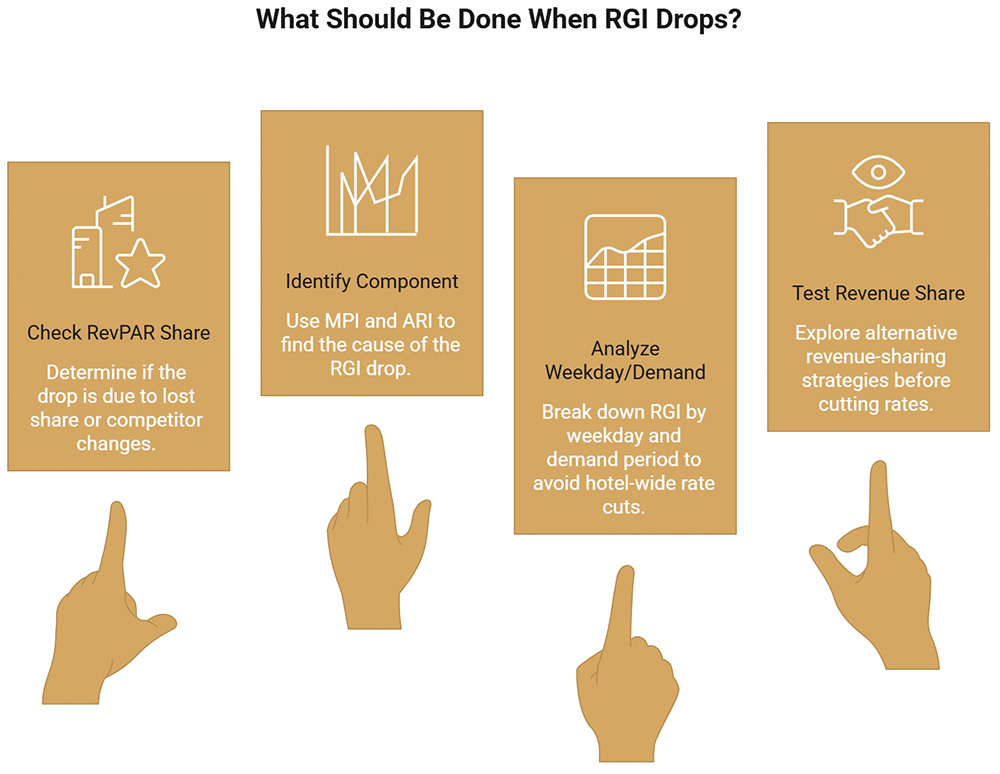
What Should You Do When Your RGI Drops?
First, check whether your hotel lost RevPAR share or whether the comparison changed. A competitor reopening, repositioning, or entering the comp set can alter your index even when your own RevPAR remains stable.
Then identify which component moved. Use MPI and ARI to find the cause:
- MPI down, ARI stable: Investigate demand capture, sales, distribution, and availability.
- ARI down, MPI stable: Review pricing, discounting, and rate positioning.
- MPI and ARI down: Look at positioning, demand generation, distribution, and pricing together.
- RevPAR up, RGI down: Your hotel improved, but competitors improved faster.
Next, break RGI down by weekday and demand period. A monthly RGI of 96 may hide an RGI of 112 on weekends and 78 on Tuesdays. Don’t respond to that with a hotel-wide rate cut.
Before cutting rates, test whether revenue share can be recovered another way. Cornell researchers analyzing more than 4,000 European hotels found that properties priced above direct competitors achieved stronger relative RevPAR despite lower occupancy, although the relationship was stronger for chains than independents.
When Can Revenue Generation Index Mislead You?
Revenue Generation Index can be mathematically correct and still lead to the wrong commercial decision. The main risks are a weak competitive set, reading RGI without MPI and ARI, and assuming that stronger revenue share automatically means stronger profitability.
A weak comp set can distort the result. RGI can also hide the reason behind performance. An RGI of 98 may come from strong occupancy and weak ADR, or weak occupancy and a strong rate premium. Those situations require different actions.
Profitability is another limitation. CoStar and Tourism Economics project U.S. GOPPAR to rise 4 percent in 2026 while expenses grow faster than inflation, a gap STR President Amanda Hite described as “worrisome”. A hotel can achieve RGI above 100 while paying heavily for that revenue through OTA commissions, promotions, labor, or other operating costs.
Treat RGI as a competitive RevPAR signal, not a complete hotel performance score. Before acting, check the comp set, review MPI and ARI, and confirm that stronger revenue share is producing worthwhile commercial value.
FAQs About Revenue Generation Index (RGI) in Hotels
Revenue Generation Index (RGI) shows whether your hotel is winning or losing RevPAR share against competitors, but the number isn’t the strategy itself. Read RGI with MPI, ARI, day-of-week performance, and a credible competitive set so you can identify the real revenue gap before changing rate or demand strategy.
Did You Like This Article About Hotels Revenue Generation Index (RGI)?
You might also be interested in the following articles:
- What Is RevPAM in Hotels and How Do You Calculate It
- What Is Average Length of Stay (ALOS) in Hotels?
- What Is eNPS in Hotels? The Metric That Predicts Turnover
More Tips to Grow Your Business
Revfine.com is the leading knowledge platform for the hospitality and travel industry. Professionals use our insights, strategies, and actionable tips to get inspired, optimize revenue, innovate processes, and improve customer experience.Explore expert advice on management, marketing, revenue management, operations, software, and technology in our dedicated Hotel, Hospitality, and Travel & Tourism categories.
This article is written by:

Hi, I am Martijn Barten, founder of Revfine.com. With 20 years of experience in the hospitality industry, I specialize in optimizing revenue by combining revenue management with marketing strategies. I have successfully developed, implemented, and managed revenue management and marketing strategies for individual properties and multi-property portfolios.



Leave A Comment