

RevPAM (Revenue per Available Square Meter) measures the revenue each square meter of hotel space generates, from meeting rooms and restaurants to the lobby and the parking deck. It is important to calculate because RevPAR says nothing about the parts of your building that aren’t guest rooms, and those parts still carry energy, labor, and debt.
Key Takeaways:
|
Table of Contents:
What Is RevPAM / Revenue per Available Square Meter?
RevPAM measures how productively your floor area earns rather than how efficiently your rooms sell. You’ll see it written as Revenue per Available Meter, and as Revenue per Available Meeting Space when the discussion covers function rooms only.
A ballroom, a boardroom, and a conference suite each carry their own number, because revenue attaches to a sellable area. A corridor doesn’t.
Space productivity is settled ground in hotel accounting. The eleventh revised edition of the Uniform System of Accounts for the Lodging Industry (USALI) carries 20 operating metrics from the AH&LA Food and Beverage Council, and banquet revenue per square foot of function space is one, as Agnes DeFranco of the Conrad N. Hilton College set out for CoStar.
This makes RevPAM a natural part of total revenue management, where the commercial focus expands beyond guestrooms to banqueting, conferencing, food and beverage, spa, and other revenue sources.

Massimiliano Terzulli, Revenue Management Consultant, Franco Grasso Revenue Team“I consider RevPAM (Revenue per available square meter) to be particularly promising in terms of its potential adoption. This metric views the hotel as a real estate asset, where every usable space, beyond just guest rooms, can generate revenue (lobby, parking, meeting room, gym, etc.). It provides a comprehensive perspective on profitability by encompassing various revenue sources. It is a KPI (Key Performance Indicator) that is technically easy to calculate and, together with TrevPAR (Total Revenue per Available Room) and GOPPAR (Gross Operating Profit per Available Room), reflects the true profitability of a property in a holistic manner.” Click here to learn more from our Hotel Revenue Management Expert Panel. |
How Do You Calculate RevPAM?
RevPAM is calculated by dividing the revenue generated by a space by its available square meters. HSMAI Academy’s glossary uses the same formula and gives an example of $60,000 in revenue across 2,000 square meters, which equals $30 per square meter.
The basic formula is:
RevPAM = Revenue generated by the space ÷ Available square meters
For example, imagine an independent hotel has 400 square meters of event space and earns $48,000 from it in one month:
$48,000 ÷ 400 = $120 RevPAM
If a 150-square-meter meeting room produces $24,000 during the same month, its RevPAM is $160. Despite generating less total revenue, the smaller room produces more revenue per unit of space.
$24,000 ÷ 150 = $160 RevPAM
The meeting room earns less total revenue, but it generates more revenue per square meter. This can reveal whether a larger space is underpriced, poorly configured, or not being used effectively.
Keep the calculation consistent by checking three things:
- Use the same revenue definition: Decide whether you include room rental only or rental plus catering and other event revenue.
- Measure sellable space only: Exclude corridors, storage areas, and other space you don’t sell.
- Compare equal selling periods: Don’t treat a room closed for renovation as underperforming.
RevPAM works best when used alongside your wider hotel revenue management strategy rather than as a stand-alone KPI.
Video: RevPAR Explained: How to Calculate Revenue Per Available Room
Where Does RevPAM Work Best and Where Does It Fall Short?
RevPAM is a space allocation and pricing tool, not a profit measure. Its real value is making rate discipline visible. CBRE Hotels Research found public room rental revenue up 9.5 percent per occupied room in the first half of 2025, a gain its authors attribute to catering managers enforcing charges planners had treated as negotiable.
| Where It Works Best | Where It Falls Short |
| Comparing meeting rooms using the same revenue definition and period | Comparing unrelated outlets with different operating economics |
| Finding large spaces producing disproportionately little revenue | Determining profitability when labor, catering, and setup costs vary |
| Testing whether subdividing or repurposing space improves productivity | Capturing differences in event duration and daypart demand |
| Measuring performance before and after pricing or configuration changes | Replacing RevPAR, profit measures, utilization, or demand forecasting |
Treat RevPAM as a diagnostic metric. It tells you where to investigate, not automatically what to accept, reject, renovate, or reprice.
A higher RevPAM can therefore be good news without being the whole story.
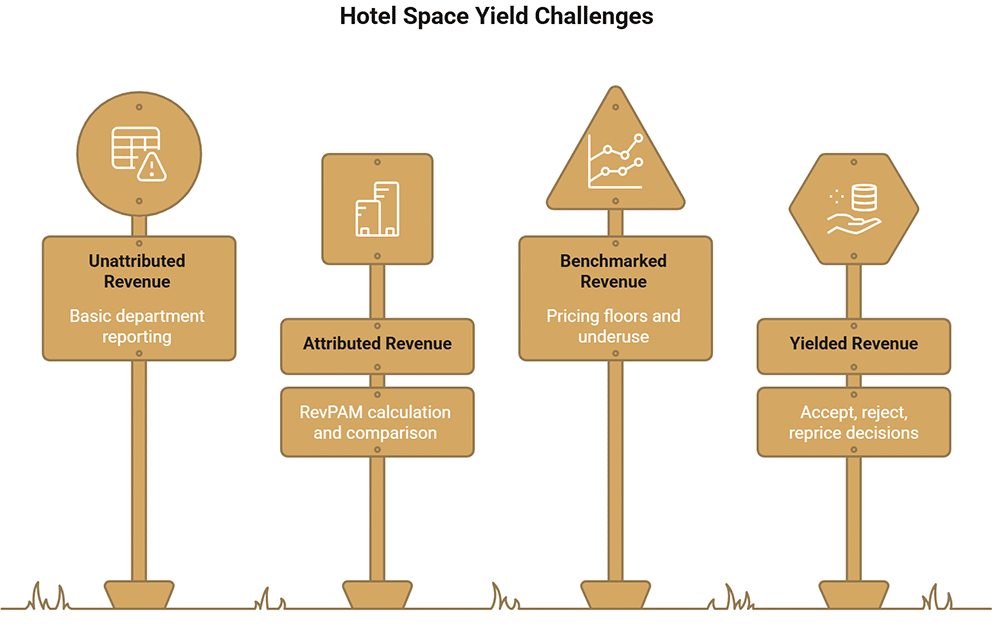
The Four Levels of Hotel Space Yield
A useful way to operationalize RevPAM is to move through four levels of space measurement rather than jumping directly into complex dynamic pricing.
| Level | What You Measure | What It Supports |
| 1. Unattributed | Event revenue without individual space allocation | Basic department reporting |
| 2. Attributed | Revenue plus square meters for each space | RevPAM calculation and space comparison |
| 3. Benchmarked | RevPAM by space, period, weekday, or daypart | Pricing floors and underuse diagnosis |
| 4. Yielded | RevPAM plus demand, contribution, time, and displacement | Accept, reject, reprice, and configuration decisions |
The jump from Level 2 to Level 3 matters because one annual average hides demand patterns.
That matters even more when booking windows shorten. In August 2026, STR and Tourism Economics reported that traditional U.S. group lead times of 60, 45, and even 30 days had compressed to two or three weeks for substantial in-quarter business.
For an independent hotel, Level 3 doesn’t require an enterprise commercial stack. A spreadsheet containing space, revenue, date, weekday, and event type is enough to establish useful patterns.
Level 4 becomes easier when sales, catering, rooms forecast, and profitability data can be reviewed together.
What Is a Good RevPAM Benchmark for Your Hotel?
A useful RevPAM benchmark starts with your own comparable history, not an arbitrary number copied from another property.
Build a trailing 12-month baseline for each sellable space, then split it by weekday, month, daypart, or event type where demand changes materially.
Cornell’s function-space teaching material shows why that segmentation matters. In one convention-space example, contribution per available day part per square foot for the same ballroom was $1.20 on Saturday and $0.30 on Tuesday, a fourfold difference.
The figures measure contribution rather than RevPAM, but the lesson transfers directly: averaging performance across demand periods can hide both pricing power and weak periods. A single property-wide average would hide that difference.
For your hotel, set three internal RevPAM reference points:
- Peak target: What the space should earn during compressed high-demand periods.
- Normal target: What represents acceptable productivity under typical demand.
- Floor: The minimum acceptable space value before contribution and displacement checks.
Cross-property comparisons become useful only when revenue scope, usable-area definitions, event mix, and reporting periods are genuinely comparable.
Can Chasing RevPAM Hurt Your Profit?
Yes. RevPAM measures revenue, not profit. A booking can increase revenue per square meter while still delivering a weak financial result after labor, setup, utilities, and other event costs are included.
CBRE Hotels Research reported an average food and beverage department profit margin of 29.1% across its sample in the first half of 2025. This shows why strong banquet revenue does not automatically mean strong profit.
For example, an event might increase RevPAM by 8%, but require extra setup staff and block the ballroom for two days. It could still reduce overall profitability and put pressure on GOPPAR.
Use two checks before accepting the business:
- Check contribution: Include setup, service, catering, and other variable costs before deciding whether the booking is worthwhile.
- Check displacement: Ask what other business you could lose by accepting the event. A €900 ballroom booking may be poor value if it prevents you from taking a profitable 40-room wedding group.
RevPAM is useful only when it leads to a decision. That could mean raising a minimum rate, changing how a space is used, or rejecting business that looks good on revenue but performs poorly on profit.
FAQs Related to RevPAM
RevPAM converts hotel floor space into a measurable revenue-management unit, making underused function areas harder to ignore. The strongest decisions come from using it alongside time, utilization, and contribution rather than treating revenue per square meter as a stand-alone measure.
Did You Like This Article About RevPAM?
You might also be interested in the following articles:
- The Most Used Revenue Management KPIs for Hotels
- Calculate RevPAR and Maximize Your Hotel’s Revenue
- What Is TRevPar?
More Tips to Grow Your Business
Revfine.com is the leading knowledge platform for the hospitality and travel industry. Professionals use our insights, strategies, and actionable tips to get inspired, optimize revenue, innovate processes, and improve customer experience.Explore expert advice on management, marketing, revenue management, operations, software, and technology in our dedicated Hotel, Hospitality, and Travel & Tourism categories.
This article is written by:

Hi, I am Martijn Barten, founder of Revfine.com. With 20 years of experience in the hospitality industry, I specialize in optimizing revenue by combining revenue management with marketing strategies. I have successfully developed, implemented, and managed revenue management and marketing strategies for individual properties and multi-property portfolios.





Leave A Comment