

Average Length of Stay (ALOS) is the average number of nights represented by each hotel stay during a defined period. It matters because stay duration changes how inventory is consumed and how frequently rooms turn over, so two hotels with identical occupancy can have very different operating and revenue patterns.
Key Takeaways:
|
Table of Contents:
What Is Average Length of Stay (ALOS)?
Average length of stay, written as ALOS or average LOS, is total room nights sold divided by total bookings across a defined period. It describes the shape of your demand rather than its size.
CoStar’s STR Benchmark glossary defines length of stay as the number of nights a guest stays and identifies it as a metric that feeds both revenue management and staffing decisions.
That dual role is the whole point of the metric.
One distinction gets treated as a technicality when it should be a reporting standard. Booked ALOS is what guests reserved and stayed ALOS is what they consumed after cancellations, early departures, and extensions. Report only the first, and you overstate stay length in high-cancellation markets, with your housekeeping forecast wrong in the same direction.
How Do You Calculate ALOS?
Consider a hypothetical 90-room independent hotel in Porto that records 1,620 occupied room nights across 620 completed room-stays during one month:
Formula: ALOS = Total occupied room nights ÷ Completed room-stays
1,620 ÷ 620 = 2.61 nights
The hotel’s stayed ALOS is therefore 2.6 nights.
Consistency matters more than complexity. Don’t calculate one month using reservations and the next using individual guests, because a double-occupancy room would suddenly change the denominator without changing the stay itself.
For better decision-making, don’t stop at property-wide ALOS. Calculate it separately for direct bookings, online travel agencies (OTAs), corporate accounts, groups, leisure guests, weekday arrivals, and weekend arrivals.
A hotel averaging 2.6 nights overall may discover that direct leisure guests stay 3.4 nights while OTA guests stay 1.8 nights. That difference is far more actionable than the headline average.
ALOS is rarely read alone. It belongs beside occupancy rate and the rest of your revenue management KPIs, because by itself it shows the shape of demand without showing what you earned from it.
Video: Calculating the Average Length of Stay
What Is a Good Average Length of Stay for a Hotel?
There is no universal target, and any source offering you one is selling something. Your ceiling is set by market, segment mix, and travel purpose before your commercial strategy gets a vote.
Eurostat data shows how wide the range runs: trips by EU residents to another EU country averaged 6.8 nights, from 3.1 nights for trips to Estonia to more than 8 nights for trips to Greece, Spain, and Cyprus. Those are whole trips rather than single hotel stays, which is exactly why they matter: they bound what any property in that market can realistically reach.
Judge your figure against three references instead of a national average. Your own ALOS for the same month last year, your ALOS by channel, and the practical floor your market imposes.
A Lisbon city hotel running 1.9 nights in October has a different problem from a Crete resort running 4.5. Neither number is good or bad without rate, occupancy, and demand context.

Heiko Rieder, Senior Vice President Commercial & Distribution, Step Partners Europe“Length of Stay (LOS) restrictions are quite stringent, especially when applied at house level. Therefore, it’s crucial to ensure that demand is sufficiently high, as these restrictions are likely to lead to turning away potential business. The higher the Minimum Length of Stay (MLOS) requirement, the more business is turned away. A softer restriction that can achieve a similar effect is implementing no-arrivals policies. To mitigate the risk of turn-aways, balancing Day of Week (DOW) patterns in less predictable markets with higher rates can be effective. Guests are usually more willing to pay a higher rate than to book an extra, unnecessary night. This principle applies to all property types, including resort destinations. Ideally, if demand supports selling out every day with an ML7 strategy, that’s perfect. However, if this strategy results in low occupancy, it is often more profitable to accept some nights with low occupancy while others sell out, also considering the potential loss of ancillary revenues.” Click here to learn more from our Hotel Revenue Management Expert Panel. |
Where a Longer Stay Pays and Where It Costs You
Here is the gap a standard KPI dashboard hides. An extra night on an existing reservation and a new one-night booking can produce the same room revenue and very different profit.
The first night carries the full acquisition cost, plus arrival labor, a departure clean, and a check-in. Nights two and three carry a stayover service and nothing else. That gap explains why CoStar’s STR Benchmark treats extended stay as its own segment, where properties quote weekly rates and guests average 4 to 7 nights.
Operators there treat stay length as a discipline, not an outcome. Helene Okabe, Senior Vice President of Business Development at Concord Hospitality, told CoStar News Hotels:
“Success depends on segmentation discipline and “making sure you capture that right length of stay and stick to the model”.
| Where a Longer Stay Pays | Where a Longer Stay Costs You |
| Shoulder nights either side of a sold-out date | Compression dates you would fill at a higher rate |
| Segments with real ancillary spend, such as F&B or spa | Long-stay discounts applied to nights already booked |
| Properties with high turnover cost per departure | Properties where ancillary revenue is driven by arrivals, not nights |
| Low season, when arrival volume is the binding constraint | Peak dates where a minimum stay rule turns away full-rate demand |
Notice the pattern on the right. Each scenario displaces demand you would have captured at full rate without the discount.
The Extra Night Test
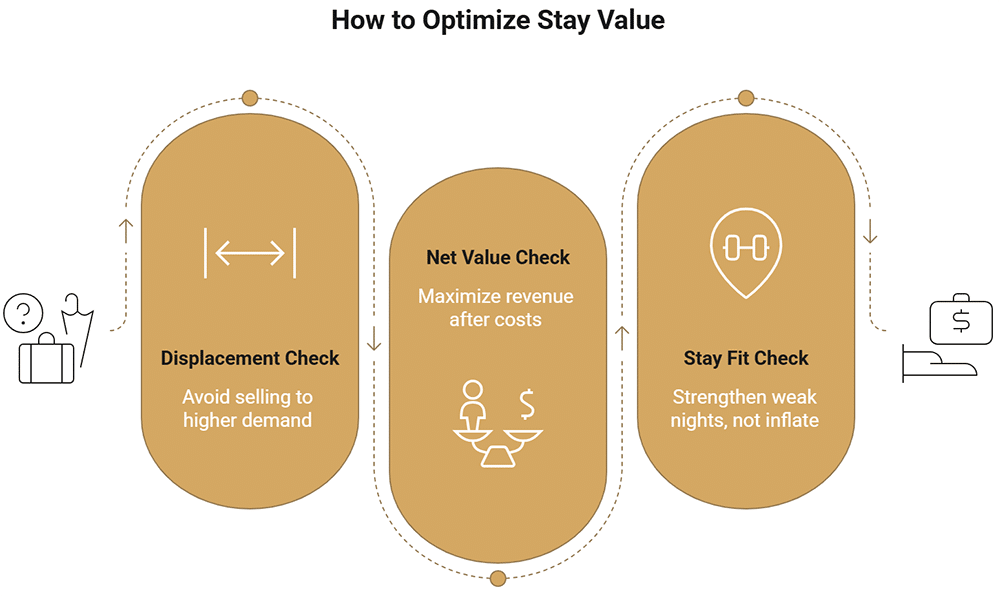
Before spending rate or inventory to extend a stay, run the proposed extra night through three checks.
| Check | Question | Metric to Review | Warning Signal |
| Displacement | Would you have sold this night to higher-value demand anyway? | Forecast occupancy and RevPAR | Extra night crosses a compression date |
| Net Value | What revenue remains after discount and variable servicing costs? | Incremental room contribution and CPOR | Discount applies to nights already sold |
| Stay Fit | Does the longer booking strengthen weak nights rather than just inflate ALOS? | Occupancy by arrival date and LOS | Strong night fills while shoulder night remains weak |
Length-of-stay restrictions make the displacement check especially important. Cornell’s eCornell guidance explains that MLOS controls can help around high-demand periods when they push bookings across weaker adjacent nights, but they can hurt RevPAR when sufficient longer-stay demand isn’t available.
That gives you the governing principle: Don’t optimize ALOS. Optimize the economic value of the nights ALOS represents.
How Do You Increase ALOS Without Giving Away Rate?
Start with rate architecture before using stay restrictions. Charge more for one-night stays instead of heavily discounting three-night stays. This can encourage longer bookings without reducing the rate on nights guests were already willing to buy.
Watch your ADR while doing this. If ALOS increases but ADR falls too much, the extra nights may not be improving revenue. Restrictions are the blunt instrument, and they cost you something every time you apply them.
Cornell’s eCornell revenue management guidance is blunt about the downside of getting this wrong. A minimum stay requirement set without enough multi-night demand behind it can hurt RevPAR instead of helping it. Most independent properties don’t have a cluster revenue manager watching restriction settings daily, which is exactly why the rule needs to be simple enough to run without one.
You don’t need revenue management software for any of this: a weekly PMS export of stay date, channel, ADR, and room revenue is enough. Set stay-length rules on ten to fifteen dates a year, calendar the review, and let price do the rest of the work.
Video: How to Increase Average Length of Stay (ALOS) at Your Hotel
FAQs Related to Average Length of Stay (ALOS)
Stay length is a cost lever wearing the costume of a demand metric, and properties that manage it deliberately turn the same occupancy into better margin. Put ALOS beside cost per occupied room in your monthly reporting rather than beside occupancy, and the question of which extra nights are worth buying answers itself.
Did You Like This Article About Average Length of Stay (ALOS)?
You might also be interested in the following articles:
- What Is RevPAM in Hotels and How Do You Calculate It
- Calculate RevPAR and Maximize Your Hotel’s Revenue
- What Is TRevPar?
More Tips to Grow Your Business
Revfine.com is the leading knowledge platform for the hospitality and travel industry. Professionals use our insights, strategies, and actionable tips to get inspired, optimize revenue, innovate processes, and improve customer experience.Explore expert advice on management, marketing, revenue management, operations, software, and technology in our dedicated Hotel, Hospitality, and Travel & Tourism categories.
This article is written by:

Hi, I am Martijn Barten, founder of Revfine.com. With 20 years of experience in the hospitality industry, I specialize in optimizing revenue by combining revenue management with marketing strategies. I have successfully developed, implemented, and managed revenue management and marketing strategies for individual properties and multi-property portfolios.






Leave A Comment