

An AI-ready PMS is a property management system that AI agents can read from and act on safely through documented interfaces, controlled permissions, and an audit trail. The real test is not whether your PMS advertises AI, but whether an authorized agent can reach live hotel data and take approved actions without another custom integration.
Key Takeaways:
|
Table of Contents:
- What Is an AI-Ready PMS?
- What Is the Difference Between an AI-Enabled and an AI-Ready PMS?
- Why Do AI Agents Stall Without an AI-Ready PMS?
- Where Does MCP Fit Into an AI-Ready PMS?
- What Makes a Hotel PMS Ready for AI Agents?
- Four Permission Rules for AI Agents in Your PMS
- Six Tests to Run Before Choosing an AI-Ready PMS
- Is an AI-Ready PMS Worth Prioritizing Before Agents Mature?
- How Should Independent Hotels Approach an AI-Ready PMS?
- FAQs About AI-Ready PMS
What Is an AI-Ready PMS?
An AI-ready PMS is a property management system that exposes hotel data and functions to AI agents in a structured, permissioned, and auditable way. The agent can check availability, read a guest profile, or update a room status without anyone copying data between screens. Readiness belongs to the PMS, not to the AI tool you plug into it.
The line between a chatbot and an agent is action. McKinsey’s report on agentic AI in travel describes agents as systems that can call on external tools, APIs (application programming interfaces), and systems to carry out tasks. In a hotel, those calls land on your PMS or on a system that syncs with it.
The category is young. Apaleo described it as the hospitality industry’s first property management platform with a Model Context Protocol (MCP) server, so the market has had about a year to respond. That makes “AI-ready” a claim you test, not a feature you tick on a comparison sheet.
What Is the Difference Between an AI-Enabled and an AI-Ready PMS?
These terms should not be used interchangeably. An AI-enabled PMS has AI features built in, while an AI-ready PMS lets outside AI agents work inside it under your control.
| Criterion | AI-Enabled PMS | AI-Ready PMS |
| Where the AI runs | Inside the vendor’s own screens | In any agent you authorize |
| What it can do | Features the vendor chose to build | Documented read and write actions through APIs or MCP |
| Access control | A setting per feature | A scoped credential per agent, read separate from write |
| Audit trail | Depends on the feature | Every agent action logged with before and after values |
| Choice of AI provider | Set by the vendor | Any agent that connects through MCP or the API |
A PMS can be both. But hotels should not assume one automatically means the other. When evaluating a new PMS, ask vendors to demonstrate agent readiness rather than show an AI-generated dashboard and stop there.
Why Do AI Agents Stall Without an AI-Ready PMS?
Hotels do not have an AI-agent problem first. They have an infrastructure problem.
An agent is only useful if it can reach live reservations, rates, room status, guest data, and folio actions without a new custom build every time. When the PMS cannot expose those functions through stable interfaces, every AI project becomes another integration project.
The industry is still early. In McKinsey and Skift’s survey of 86 travel executives, 22% said generative AI was widely used, but only 2% said the same for agentic AI. McKinsey identifies technology foundations, including data readiness and scalable infrastructure, as prerequisites for adoption.
Consider a 140-room Manchester hotel automating late checkout requests. The agent may need the departure list from the PMS, room status from housekeeping, loyalty information from the customer relationship management (CRM) system, and access to post an approved fee.
If every connection requires separate development, the workflow quickly becomes an integration project. Track integration lead time: the time from choosing an AI tool to giving it reliable live PMS access. If that period grows each time you introduce another agent, your technology stack is setting the pace.

Daniel Zelling, Managing Director & Founder, Opensmjle“The clearest measurable returns today come from revenue management automation, guest communication orchestration — and increasingly, what’s happening directly inside the PMS. Where I see the most immediate human impact, though, is at the front desk. Agentic AI at PMS level is transforming how staff spend their day. Check-in prep, room assignment logic, guest history summaries — tasks eating 20–30 minutes per shift are being automated. Staff arrive at guest interactions already briefed, already prepared. The result isn’t just efficiency; it’s better hospitality. Guests feel seen, staff feel less overwhelmed, and that shows up in review scores before it shows up in a spreadsheet.” Click here to learn more from our Hotel Revenue Management Expert Panel. |
Where Does MCP Fit Into an AI-Ready PMS?
Model Context Protocol (MCP) provides a standard way for AI applications to discover and use tools exposed by another system. For hotels, a hotel MCP server can sit between an AI agent and PMS functions.
A simplified flow looks like this:
AI agent → MCP server → PMS API → hotel data or approved action
Instead of teaching every AI agent how one PMS API works, the MCP server can expose understandable tools such as get_reservation, check_availability, or modify_booking.
The current MCP specification allows servers to expose tools that language models can discover and invoke. Its July 28, 2026 release strengthened authorization and changed the protocol architecture to support more scalable deployments.
Apaleo provides a current hospitality example. Its AI integration documentation says its MCP server exposes roughly 230 tools across booking, finance, inventory, and operations.
But native MCP should not become a checkbox that replaces proper PMS evaluation. A PMS can still support AI agents through strong APIs and an external MCP or integration layer. Likewise, a vendor can advertise MCP while exposing only a limited set of useful tools.
When a vendor says it supports MCP, ask two questions:
- Which tools can read live hotel data?
- Which tools can actually change hotel operations?
That distinction tells you more than the MCP label.
What Makes a Hotel PMS Ready for AI Agents?
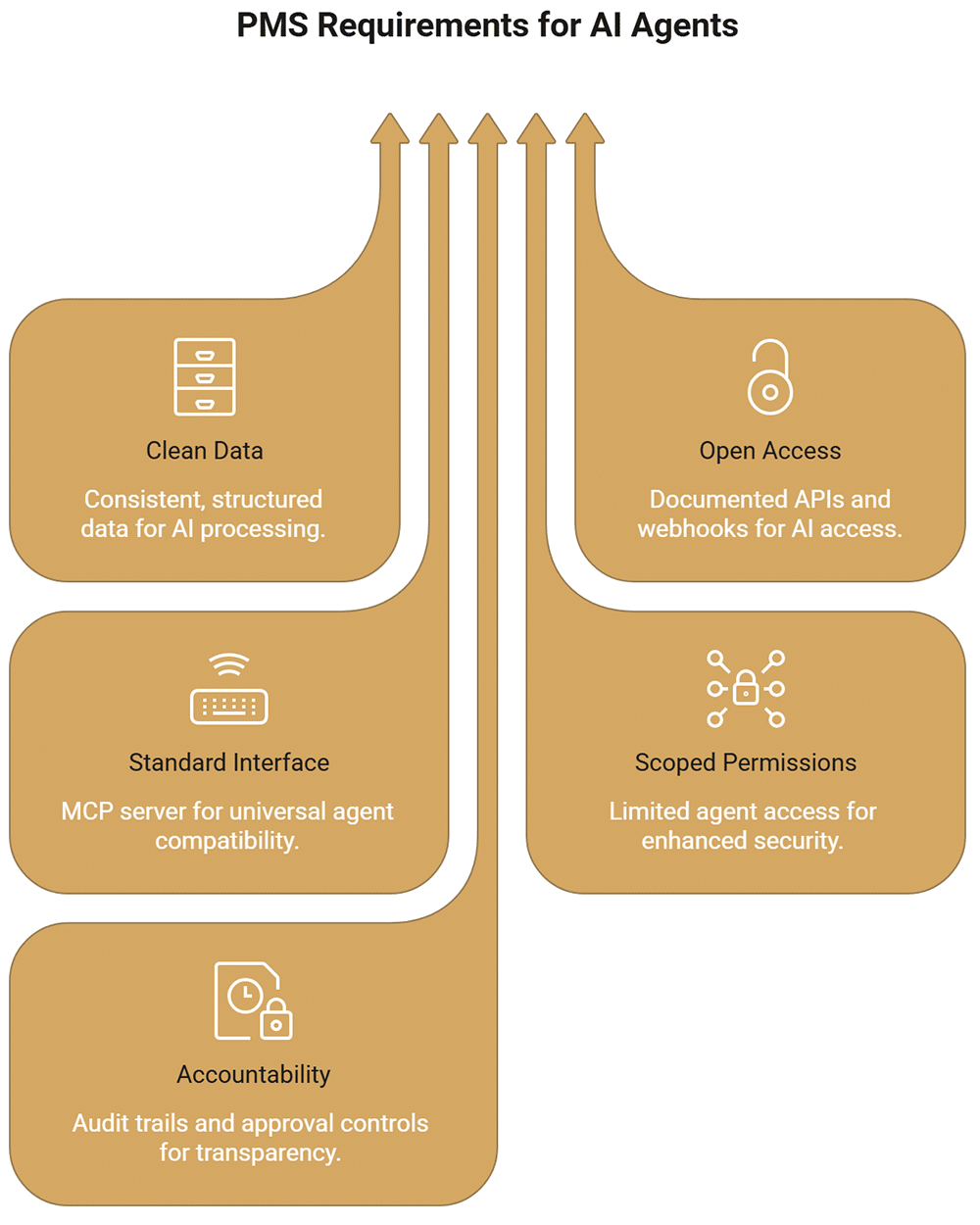
A hotel PMS is ready for AI agents when it can prove five things: clean structured data, open read and write access, a standard agent interface, permissions scoped to each agent, and an audit trail with approval controls.
The pressure is building on the software side. Gartner predicts that 40% of enterprise applications will be integrated with task-specific AI agents by the end of 2026, up from less than 5%. Your PMS will be one of them, whether the agent comes from your PMS vendor, your messaging provider, or your revenue system.
These are the PMS requirements for AI agents in operational terms:
- Clean, Structured Data: Reservations, profiles, rates, and room status held in consistent fields and codes, not in free-text notes.
- Open Access: Documented APIs for reading and writing, plus webhooks, the event notifications that tell an agent the moment a booking changes.
- A Standard Agent Interface: An MCP server, native or vendor-supported, so one agent works without a custom build.
- Scoped Permissions: A separate credential per agent, with read and write rights split and limited to the properties it serves.
- Accountability: A log of every agent action with before and after values, plus an approval hold on cancellations, refunds, and rate overrides.
When you evaluate a PMS, don’t stop at “Do you have an API?” Ask “Which hotel data can an AI agent access, and which actions can it safely perform?”
Vendor demos showcase the interface. Data quality and logging are harder to judge because neither shows up in a demo, so ask for evidence on those two before anything else.
Four Permission Rules for AI Agents in Your PMS
Giving an AI agent access to your PMS means giving it access to guest data, revenue decisions, and financial actions. That is why permissions should be controlled carefully before the agent goes live.
Gartner predicts that over 40% of agentic AI projects will be canceled by the end of 2027 because of escalating costs, unclear business value, or inadequate risk controls. Risk controls are the one item on that list you can fix before go-live.
The MCP tools specification recommends keeping a person in the loop who can deny any tool call, and it requires servers to validate inputs, apply access controls, and rate-limit tool use. For remote servers, MCP authorization builds on OAuth 2.1, the open authorization standard, and requires servers to reject tokens that weren’t issued for them.
Turn those principles into four simple rules:
- Switch on write tools one at a time. Start every agent read-only, enable a single write tool such as room moves, and review a week of logs before adding the next.
- Hold money and promises for approval. Cancellations, refunds, rate overrides, and complimentary stays wait for a named staff member.
- Keep card data out of agent scope. Agents send tokenized payment links instead of handling card numbers, which limits your exposure under PCI DSS (Payment Card Industry Data Security Standard).
- Give every agent its own identity. A separate credential per agent means the audit log shows which agent changed what, and you can revoke one without stopping the rest.
Track the percentage of agent write actions that required approval each week. If that percentage changes without a planned permission update, investigate why.
Six Tests to Run Before Choosing an AI-Ready PMS
AI vendor claims are moving faster than the technology. Gartner estimates that only about 130 of the thousands of agentic AI vendors are genuine, and warns about agent washing, where chatbots or automation tools are marketed as AI agents.
Anushree Verma, Senior Director Analyst at Gartner, put the risk plainly:
“Many use cases positioned as agentic today don’t require agentic implementations.”
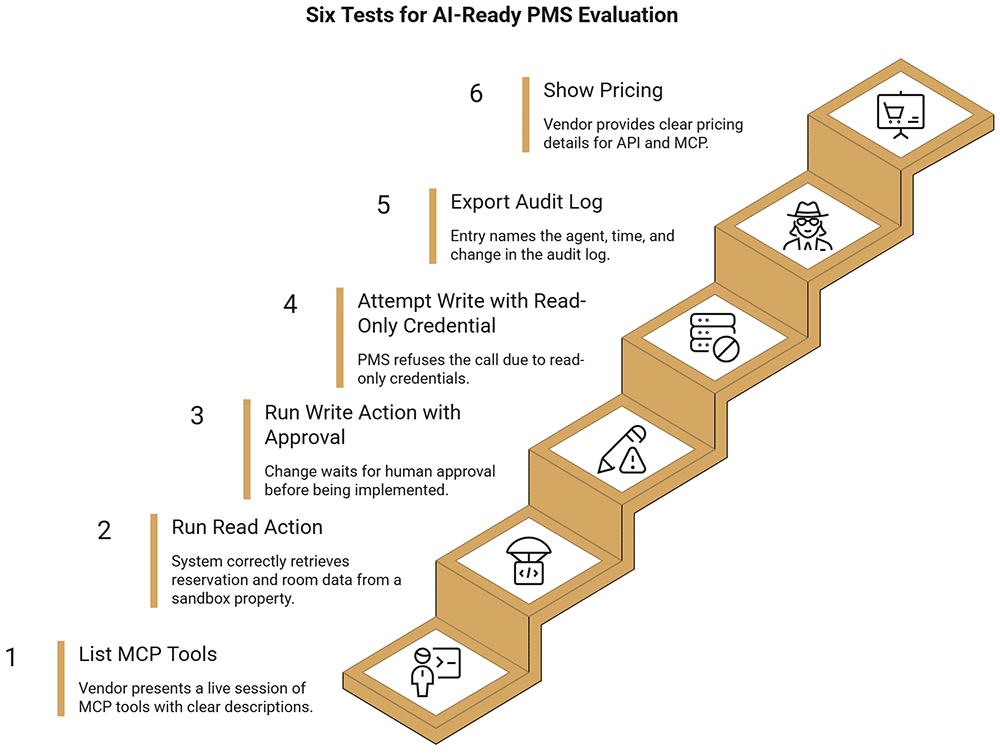
Do not rely on a polished sales demo. Before signing, ask the vendor to prove the system on a sandbox property. Include your front office manager, because they know the real situations that can break a workflow.
| Step | Ask the Vendor To | Pass Sign |
| 1 | List the MCP tools in a live session | Named tools with plain-language descriptions |
| 2 | Run a read action on a sandbox property | Correct reservation and room data returned |
| 3 | Run a write action that needs approval | The change waits until a person approves it |
| 4 | Attempt a write with a read-only credential | The PMS refuses the call |
| 5 | Export the audit log | The entry names the agent, the time, and the change |
| 6 | Show API and MCP pricing | Call fees, rate limits, and caps in writing |
Score each step as pass or fail. If all six pass, you can move on to features and price. If Step 4 or Step 5 fails, stop the deal. A platform that cannot block unauthorized actions or show who changed what is not ready for AI agents.
Is an AI-Ready PMS Worth Prioritizing Before Agents Mature?
Not every hotel needs to change PMS because AI agents are developing. Embedded AI may be enough if most of your workflows stay inside one PMS.
For example, Oracle’s OPERA Cloud Assistant release added AI features such as room assignment support, rate descriptions, and staff guidance directly inside OPERA Cloud. Hotels can use these features without connecting an outside AI agent.
The limitation is that embedded AI only works inside that vendor’s system and develops at the vendor’s pace. Screen-based agents can work without APIs, but they may break when the interface changes. If they use a staff login, it may also be difficult to tell whether a change was made by the employee or the AI agent.
The right choice depends on your technology stack:
- Simple stack: If one PMS handles most operations and you have limited need for cross-system agents, use useful embedded AI and evaluate broader agent readiness during your next renewal.
- Connected stack: If workflows regularly cross the PMS, customer relationship management system, housekeeping, revenue, payments, or several properties, start treating APIs, permissions, and accountability as buying criteria now.
You do not need to replace a good PMS just because AI agents are still developing. But if your hotel already depends on several connected systems, waiting too long can make future integrations harder and more expensive.
How Should Independent Hotels Approach an AI-Ready PMS?
For an independent hotel, AI readiness should be a vendor selection requirement, not a technology project you build yourself. You do not need your own developers or a custom hotel MCP server. You need a PMS that can provide reliable data access, secure connections, clear permissions, and records of what each AI agent changes.
Smaller operators can already access this type of technology. Hospitable’s help center explains how users can connect ChatGPT or Claude through MCP and recommends starting with read-only access.
Consider a 48-room independent hotel in Bruges with no IT department. Its first AI agent could simply produce a morning briefing showing arrivals, VIP guests, out-of-order rooms, and unpaid deposits.
Start with read-only access and measure how accurate the briefing is. Track how many items your front-office team needs to correct. Once errors are very low, you can test one limited write action, such as changing a room assignment.
Be careful with integrations that require a staff username and password. Make sure permissions, data protection, and audit logs are covered in your agreement. For independent hotels, the goal is not to build AI infrastructure. It is to choose technology that will not block you when you are ready to use AI agents.
FAQs About AI-Ready PMS
An AI-ready PMS gives hotels a safer foundation for using AI agents across real operations. The priority is to make sure agents can reach reliable data, work within clear permissions, and leave a traceable record of every action before you expand automation further.
Did You Like This Article About AI-Ready PMS?
You might also be interested in the following articles:
- AI Agents for Hotels: Benefits, ROI, and Implementation Strategy
- What Is Agentic Hotel Booking and How Should Hotels Prepare
- AI Agents for Hotel Marketing Are Picking Winners Already
More Tips to Grow Your Business
Revfine.com is the leading knowledge platform for the hospitality and travel industry. Professionals use our insights, strategies, and actionable tips to get inspired, optimize revenue, innovate processes, and improve customer experience.Explore expert advice on management, marketing, revenue management, operations, software, and technology in our dedicated Hotel, Hospitality, and Travel & Tourism categories.
This article is written by:

Hi, I am Martijn Barten, founder of Revfine.com. With 20 years of experience in the hospitality industry, I specialize in optimizing revenue by combining revenue management with marketing strategies. I have successfully developed, implemented, and managed revenue management and marketing strategies for individual properties and multi-property portfolios.


Leave A Comment