


Hotel algorithmic pricing antitrust risk is real but specific. It arises when pricing software that competing hotels share stops informing each property’s rates and starts coordinating them. Using a revenue management system (RMS) is lawful, yet federal appeals courts now disagree on where that line sits, so how you feed and govern your tool decides your exposure.
Key Takeaways:
|
Table of Contents:
- What Is Hotel Algorithmic Pricing and Why Does Antitrust Law Matter?
- Where Does Hotel Algorithmic Pricing Antitrust Law Stand in 2026?
- Is Dynamic Pricing Legal Risk the Same as Algorithmic Collusion?
- When Does Hotel Algorithmic Pricing Antitrust Risk Increase?
- How Is Hotel Pricing Algorithm Regulation Changing?
- What Should You Ask Your RMS Provider About Antitrust Risk?
- How Can Revenue Managers Reduce Algorithmic Pricing Legal Risk?
- What Is the RMS Antitrust Risk for Independent Hotels?
- FAQs About Hotel Algorithmic Pricing Antitrust
What Is Hotel Algorithmic Pricing and Why Does Antitrust Law Matter?
Hotel algorithmic pricing uses software to read demand signals such as booking pace, occupancy, events, and competitor rates, then recommend or automatically set room rates.
These systems can make revenue management faster and more accurate. Using them is not inherently anticompetitive. The antitrust question starts when technology affects how supposedly independent competitors make pricing decisions.
Section 1 of the US Sherman Act prohibits agreements that unlawfully restrain competition. In the Atlantic City hotel litigation, the Department of Justice (DOJ) and Federal Trade Commission (FTC) argued that competitors can’t avoid those rules simply by placing an algorithm between themselves. The agencies said direct hotel-to-hotel communication isn’t always necessary when a common provider allegedly facilitates coordinated pricing.
For your revenue team, the real question is whether competing hotels still price independently. Two 120-room hotels facing each other in Austin’s convention district can share an RMS vendor, but if each one’s live occupancy feeds the other’s recommendations, they’ve stopped competing on price.
Where Does Hotel Algorithmic Pricing Antitrust Law Stand in 2026?
Hotel algorithmic pricing antitrust law now rests on two federal appeals rulings that point in opposite directions, both involving Cendyn and its Rainmaker revenue management products. Both cases were brought under Section 1 of the Sherman Act.
Hotel Algorithmic Pricing Antitrust Case Examples
| Case | What Was Alleged | What the Court Did | Revenue Management Lesson |
| Gibson v. Cendyn, Las Vegas | Competing hotels independently licensed the same software, but plaintiffs did not allege that one hotel’s confidential information was pooled into recommendations for another. | The Ninth Circuit affirmed dismissal in August 2025, and the Supreme Court denied review in April 2026. | Common software use alone does not establish unlawful coordination. |
| Cornish-Adebiyi v. Caesars, Atlantic City | Plaintiffs alleged that hotels supplied real-time, nonpublic pricing and occupancy data that was combined through the platform and used in recommendations delivered back to competitors. | The Third Circuit reversed dismissal in July 2026 and allowed the claim to proceed. | Current competitor-sensitive data and common recommendations deserve much closer review. |
The Ninth Circuit specifically observed that its analysis could have been different if confidential hotel information had been shared among competing licensees.
The Third Circuit then confronted allegations that went further. It emphasized alleged real-time nonpublic information exchange, pricing recommendations based on that information, and an alleged 90 percent adherence rate to those recommendations. The court allowed the complaint to move forward but made no finding that Cendyn or the hotel defendants actually violated antitrust law.
Neither court said algorithmic pricing is illegal. What separates them is what each complaint alleged about shared data and who really set the rates, so those two facts are where your review starts.
Is Dynamic Pricing Legal Risk the Same as Algorithmic Collusion?
No. Dynamic pricing legal risk stays low when your system reprices from your own pickup, forecasts, and competitors’ public rates captured by rate shopping, because that’s unilateral conduct. The Ninth Circuit put it plainly:
“Pricing rooms to maximize profit is how hotels compete, and software that helps you do it doesn’t remove that rivalry.”
Algorithmic collusion is different. It means competitors coordinating through software, either by agreeing to follow its prices or by letting it pool their confidential data and hand each of them rates built on the others’ information.
In a 2017 speech, the Federal Trade Commission’s (FTC) acting chair imagined a person named Bob who collects confidential pricing strategy from every competitor in a market and tells each of them how to price. According to Maureen K. Ohlhausen, then Acting Chairman of the US Federal Trade Commission,
“If it isn’t ok for a guy named Bob to do it, then it probably isn’t ok for an algorithm to do it either.”
Run the Bob test yourself. List who receives your nonpublic rate and occupancy data, then list whose nonpublic data shapes the rates you see; if a competitor appears on the second list, you’ve found your exposure.
When Does Hotel Algorithmic Pricing Antitrust Risk Increase?
There is no single input or software feature that determines whether a hotel has an antitrust problem. Revenue teams should instead examine the complete data and decision flow.
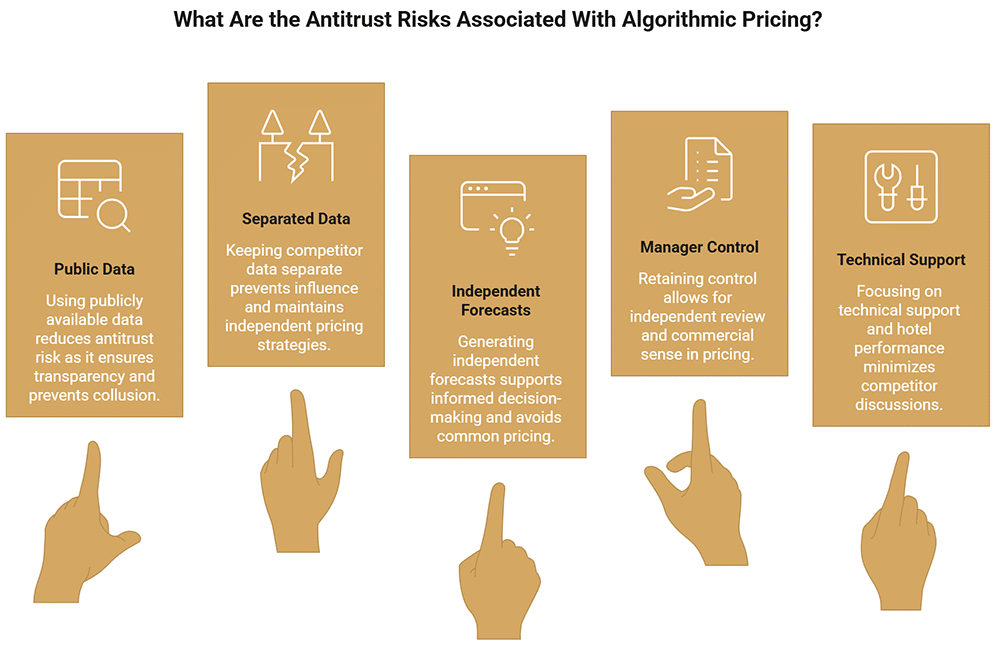
A useful starting point is this five-question RMS antitrust risk check.
| Question | Lower Concern | Higher Concern |
| 1. What competitor data enters the platform? | Publicly displayed room rates and broad market indicators | Current or future nonpublic rates, occupancy, booking pace, inventory, restrictions, or pricing plans |
| 2. Is data from competing hotels pooled? | Property data remains separated, and competitors cannot influence one another’s recommendations. | Competitor information is combined and used to generate recommendations for hotels in the same market. |
| 3. What does the system produce? | Forecasts, alerts, and information supporting an independent decision | Common or closely linked pricing recommendations distributed across competitors |
| 4. How much control does the hotel retain? | Revenue managers independently review inputs and decide whether a rate makes commercial sense. | Rates publish automatically, overrides are discouraged, or managers are measured on adherence to recommendations. |
| 5. What happens around the software? | Vendor conversations focus on technical support and the hotel’s own performance. | Competitors discuss future rates, occupancy, capacity, pricing intentions, or strategy through vendor meetings or groups. |
A “yes” in the higher concern column does not prove that a violation has occurred. It tells the hotel which areas deserve deeper legal and technical review.
How Is Hotel Pricing Algorithm Regulation Changing?
Hotel pricing algorithm regulation is moving on two tracks in the US: federal enforcement that defines acceptable data use through settlements, and state laws that make private lawsuits easier to file. Neither track bans revenue management software.
Federal Enforcement Shows What Regulators Are Examining
The DOJ Antitrust Division’s November 2025 settlement with apartment-rental software provider RealPage is the template.
It requires the vendor to stop using competitors’ nonpublic data to set prices at runtime, remove features that limited price decreases or aligned pricing among users, and stop discussing pricing strategy or nonpublic market trends in its software meetings.
According to Abigail Slater, who led the Justice Department’s Antitrust Division when the settlement was announced,
“Competing companies must make independent pricing decisions, and with the rise of algorithmic and artificial intelligence tools, we will remain at the forefront of vigorous antitrust enforcement.”
Translate those concerns into hotel questions: Does your vendor combine client data? Can software discourage downward pricing? What happens in customer advisory groups? Those are governance questions even before they become legal ones.
California AB 325 Raises the Stakes for Shared Pricing Tools
California’s AB 325 became effective January 1, 2026, and added algorithmic-pricing provisions to the state’s Cartwright Act.
The law addresses the use or distribution of a common pricing algorithm as part of an unlawful restraint-of-trade agreement and addresses coercion to adopt algorithm-recommended pricing or commercial terms. It also changed the pleading standard for Cartwright Act conspiracy claims so a complaint does not need to allege facts excluding independent action.
For a California hotel, this means vendor review shouldn’t stop at asking whether competitor information is confidential. The statute’s common-pricing-algorithm definition focuses on the use of competitor data, so counsel should review how shared pricing tools use both public and nonpublic competitor inputs.
UK Scrutiny Extends the Question to Hotel Benchmarking
Pricing recommendations aren’t the only systems under scrutiny.
The UK Competition and Markets Authority (CMA) opened an investigation in February 2026 into suspected sharing of competitively sensitive information among Hilton, IHG, and Marriott through CoStar’s hotel data services. As of the CMA’s August 2026 update, the investigation remains open, and the CMA has not reached a finding that competition law was infringed.
That matters because benchmarking products can affect revenue decisions without directly setting a room rate.
Don’t ask only, “Does this platform price for us?”
Ask, “What competitor information does this platform allow us to learn, and what information about us can competitors indirectly learn?”
What Should You Ask Your RMS Provider About Antitrust Risk?
Generic assurances that a platform is “antitrust compliant” aren’t enough. You need to understand the data path behind the rate displayed on your screen.
Start with these questions:
- What competitor data enters the system? Separate publicly available rates from confidential occupancy, pickup, future rates, restrictions, capacity, and forecasts.
- Can information supplied by our hotel influence recommendations delivered to competing hotels? Ask the reverse question too.
- How current is competitor-derived information? Understand whether inputs are live, recent, historical, aggregated, or delayed.
- How are competitor groups constructed? Your RMS competitive set may not operate exactly like the comp set used for STR benchmarking.
- Can we exclude specific data sources? Find out what happens to the recommendation when competitor-derived inputs are removed.
- How does automated publishing work? Document which recommendations require review and which can flow directly into your property management system (PMS), central reservation system (CRS), or distribution channels.
- How are overrides treated? Check whether overrides affect staff scores, system performance measurements, or vendor recommendations.
- What records are retained? You should be able to reconstruct the information and approval path behind a material pricing decision.
The lesson extends to benchmarking tools: data governance matters even when the system doesn’t directly set your rate.
How Can Revenue Managers Reduce Algorithmic Pricing Legal Risk?
Revenue managers should not be expected to become antitrust lawyers. They should, however, understand enough about the hotel’s pricing workflow to identify issues that require review.
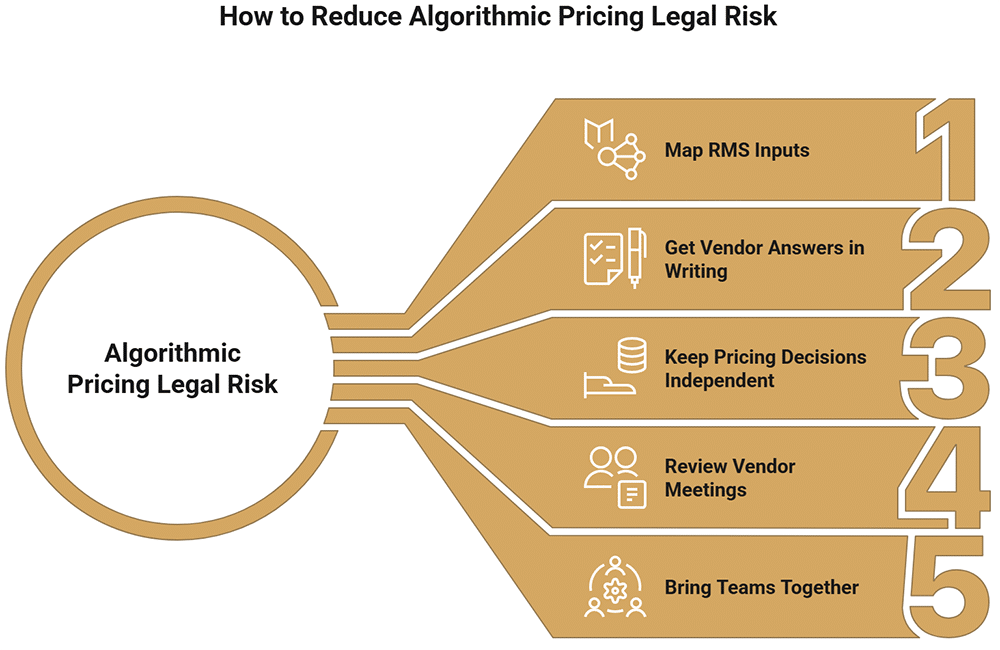
A practical process includes:
- Map every RMS input. Record whether each input comes from your hotel, public sources, market research, a third-party provider, or competing hotels. Pay particular attention to forward-looking pricing, occupancy, inventory, and booking pace data.
- Get your vendor’s answers in writing. Send your RMS provider the questions above. Do not stop at “the data is anonymized.”
- Keep pricing decisions independent. Revenue teams should be able to explain the hotel’s own reasons for a material pricing decision, including demand, inventory, events, pickup, segmentation, and commercial objectives.
- Review vendor meetings and user groups. Staff should know not to discuss future rates, occupancy forecasts, inventory strategy, planned restrictions, or similar sensitive subjects with competitors.
- Bring legal, technology, and revenue teams together. Counsel cannot evaluate a platform properly without knowing how it actually works, while revenue teams may not recognize which data flows carry competition risk.
The goal is not to remove automation. It is to make sure automation supports independent hotel revenue management rather than replacing it with market coordination.
What Is the RMS Antitrust Risk for Independent Hotels?
RMS antitrust risk for an independent hotel usually comes from limited visibility into how the system uses competitor data rather than from the hotel’s size. A smaller property may rely heavily on automated recommendations because it has no dedicated revenue manager, cluster team, or legal department reviewing the pricing process.
Consider a 95-room independent hotel that allows its RMS to publish rates automatically. If the general manager cannot explain whether the system uses public competitor rates, aggregated market data, or nonpublic information from rival hotels, the property has a governance gap. The same applies if overrides are difficult, rarely used, or require vendor approval.
The practical response is simple. Document which systems influence pricing, what data each one receives, who can approve or reject recommendations, and whether your hotel’s information can affect competing properties. Independent hotels do not need enterprise-level compliance structures, but they do need enough visibility to confirm that pricing decisions remain genuinely independent and commercially explainable.
FAQs About Hotel Algorithmic Pricing Antitrust
Hotel pricing technology becomes an antitrust concern when automation begins to weaken genuine competitive independence, not simply because an algorithm recommends a rate. Your strongest safeguard is operational visibility. Know which data shapes the recommendation, retain independent commercial judgment, and treat competitor information flows as a governance question before they become a legal one.
Disclaimer: This article provides general business information, not legal advice. Involve qualified competition counsel when reviewing specific pricing systems, contracts, or data-sharing practices.
Did You Like This Article About Hotel Algorithmic Pricing Antitrust?
You might also be interested in the following articles:
- Pricing Strategies to Increase Your Hotel Revenue
- What Is Agentic Hotel Booking and How Should Hotels Prepare
- What Makes a Hotel PMS Ready for AI Agents?
More Tips to Grow Your Business
Revfine.com is the leading knowledge platform for the hospitality and travel industry. Professionals use our insights, strategies, and actionable tips to get inspired, optimize revenue, innovate processes, and improve customer experience.Explore expert advice on management, marketing, revenue management, operations, software, and technology in our dedicated Hotel, Hospitality, and Travel & Tourism categories.
This article is written by:

Hi, I am Martijn Barten, founder of Revfine.com. With 20 years of experience in the hospitality industry, I specialize in optimizing revenue by combining revenue management with marketing strategies. I have successfully developed, implemented, and managed revenue management and marketing strategies for individual properties and multi-property portfolios.




Leave A Comment