

Free Wi-Fi stopped being a differentiator years ago. Every property offers it, guests expect it without asking, and most never think about what’s actually running underneath the login screen. That’s precisely the gap that’s made hotel networks a recurring target rather than an occasional one.
Hotels Have Been a Documented Target for Over a Decade
This isn’t a hypothetical risk. Kaspersky’s security researchers first identified a campaign known as DarkHotel in 2014, which used compromised hotel Wi-Fi networks specifically to target traveling business executives, tricking guests into installing malware disguised as a routine software update after they connected.
The campaign demonstrated why hospitality environments can be attractive to sophisticated attackers. Hotels bring together transient guests, business travelers, personal devices, payment activity, and valuable data in one location.
More recent hospitality-focused attacks have taken different forms. RevengeHotels, for example, has targeted hotels through reservation-related phishing and malware aimed at accessing sensitive guest and payment information. This distinction matters because cybersecurity threats do not always begin with the Wi-Fi network itself. Email, booking workflows, staff accounts, third-party systems, and poorly protected endpoints can provide alternative routes into a hotel’s digital environment.
The tactics may change, but the underlying issue remains: hotels handle a concentration of valuable information while supporting large numbers of devices and users whose security configurations the property does not control.
That does not mean public hotel Wi-Fi should automatically be considered unsafe. It means hotel operators should treat wireless access as part of a broader cybersecurity strategy rather than as a simple guest amenity.
Practical Steps That Don’t Require Rebuilding the Network From Scratch
Hotels do not necessarily need a complete infrastructure replacement to reduce common risks. Several practical controls can significantly improve the way guest access is managed.
- Segment guest Wi-Fi completely from payment processing and property management systems, so a compromised guest device can’t reach either.
- Require a room number and last name, or another simple login, rather than leaving the network fully open to anyone nearby.
- Patch router and access point firmware on a set schedule rather than only when something breaks.
- Brief front-desk staff on basic social engineering red flags, since attackers targeting hotel systems often start with a phone call rather than a network exploit.
- Change default administrative credentials and restrict access to network-management interfaces.
- Review the name and configuration of guest networks. Hotels should clearly tell guests which network is legitimate and train front-desk staff to provide consistent instructions.
These measures are especially valuable because cybersecurity failures are rarely caused by one weakness in isolation. A poorly configured network may become more dangerous when combined with an unpatched device, a reused password, or a member of staff responding to a convincing phishing message.
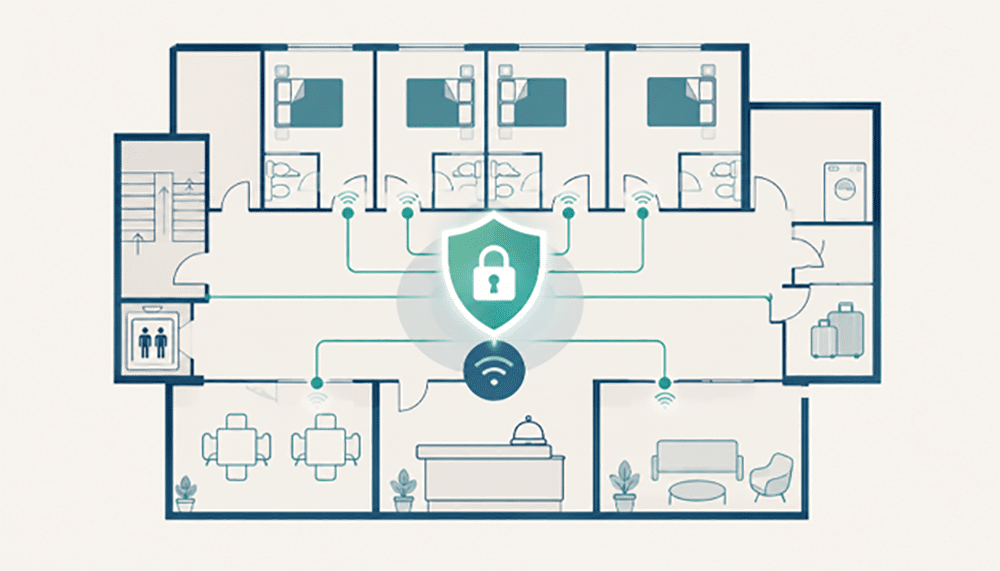
Where the Network and the Guest’s Own Habits Meet
| Layer | Who’s Responsible | What it Covers |
| Network segmentation and firmware updates | The property’s IT team or provider | Whether a breach on one system can spread to others |
| Login requirements on guest Wi-Fi | The property | Basic access control, not full encryption |
| Device-level protection (VPN, updated software) | The guest | Whether the guest’s own traffic is exposed on a shared network |
| Staff awareness of social engineering | The property | Whether attackers can bypass technical controls entirely |
Properly securing a network is squarely the hotel’s responsibility, but it isn’t the whole picture. A guest running a VPN adds a layer that holds up even against a network the hotel hasn’t fully secured yet, which matters given how unevenly network security is actually implemented across the industry.
VPNpro’s security research into how these tools perform on realistic public Wi-Fi setups, rather than idealized lab conditions, has emphasized factors such as encryption and reliable kill-switch behavior. A kill switch is designed to stop internet traffic if the VPN connection unexpectedly drops rather than allowing the device to continue communicating without the VPN tunnel.
For hotel professionals, the practical point is straightforward: guest-side tools can provide an additional layer, but the hotel’s first priorities remain sound network architecture, maintained infrastructure, appropriate access controls, and staff awareness.
Help Guests Identify the Correct Hotel Network
Some properties have started referencing this directly in guest communications, whether through a line in the welcome email or a note on the Wi-Fi login page suggesting guests use their own VPN for sensitive work.
Hotels can go one step further by clearly identifying the property’s legitimate network name. Guests should not have to guess whether “Hotel_Guest”, “Hotel-Free-WiFi”, or a similarly named network is the official connection.
A short message can communicate:
- The exact guest Wi-Fi network name
- How guests should authenticate
- Whether any software download is required
- Who to contact if a login page looks unusual
- That staff will never ask guests to install software simply to access Wi-Fi
This is a relatively simple operational measure, but it can make fake or lookalike networks easier for guests to recognize.
Properties serving a large number of corporate travelers may also want to include concise security guidance in pre-arrival information. It costs the hotel nothing and signals the kind of attention to guest data that increasingly factors into how travelers, particularly business travelers, choose where to stay.
Hotel Wi-Fi Security Is Only One Part of the Cybersecurity Picture
The threat itself hasn’t gone away either. Kaspersky’s own reporting on the DarkHotel campaign is over a decade old at this point, but the firm’s more recent research into follow-on campaigns targeting hotel systems suggests the underlying incentive for attackers, a dense concentration of valuable data behind one network, hasn’t changed even as the specific tactics have.
The important lesson for hoteliers is not to prepare exclusively for a repeat of DarkHotel. Threats evolve.
A modern attack might begin with:
- A phishing email sent to reservations or front-desk staff
- Stolen credentials for a hotel system
- An inadequately protected third-party account
- Unpatched network equipment
- A compromised employee device
- A malicious or poorly secured guest device
- A fraudulent Wi-Fi access point designed to resemble the hotel’s legitimate network
This makes layered security particularly important. Protecting guest Wi-Fi while leaving staff accounts or booking systems poorly secured simply moves the weakness elsewhere.
Hotels should therefore include wireless-network security within wider practices covering account permissions, multifactor authentication, software updates, backups, staff training, incident response, third-party access, and data protection.

Security Supports the Wider Guest Experience
For hotels weighing where security spending fits against everything else competing for budget, Revfine’s piece on how guest experience drives hotel revenue makes the case that guest experience influences commercial outcomes such as satisfaction, loyalty, and future bookings.
Network security belongs within that wider experience even though guests rarely notice it when everything works properly.
Fast, reliable Wi-Fi is visible. Good cybersecurity usually is not. But trust can be damaged quickly when a guest encounters an obviously suspicious network, receives an unexpected security warning, or believes sensitive information may have been exposed during a stay.
The objective is not to alarm guests with technical warnings at every step. It is to make secure behavior easy: clearly identify the correct network, maintain the underlying infrastructure, separate sensitive hotel systems from guest traffic, and provide concise guidance when it is genuinely useful.
Protecting Guests Requires Shared Awareness, Not Shared Responsibility
Hotel Wi-Fi security works best when responsibilities are clear.
The property should control the network architecture, segmentation, access points, updates, administrative permissions, monitoring, and incident response. Guests can strengthen their own protection by keeping devices updated, confirming that they are joining the correct network, using secure websites and applications, and using additional security tools when appropriate.
Those roles complement one another, but they are not interchangeable.
For hotel operators, the central question is therefore not simply whether free Wi-Fi is available. It is whether the network has been designed and maintained in a way that supports the same level of care the property applies to physical safety, payments, guest privacy, and other operational risks.
A secure network may never become the feature that convinces a guest to leave a five-star review. But dependable connectivity, sensible security, and responsible handling of guest data all contribute quietly to the trust on which a strong hospitality experience depends.
Protecting hotel guests on public Wi-Fi requires layered security, clear network separation, regular updates, staff awareness, and guest guidance. When hotels treat connectivity as part of cybersecurity and guest care, they can reduce risk while strengthening privacy, confidence, and trust.
More Tips to Grow Your Business
Revfine.com is the leading knowledge platform for the hospitality and travel industry. Professionals use our insights, strategies, and actionable tips to get inspired, optimize revenue, innovate processes, and improve customer experience.Explore expert advice on management, marketing, revenue management, operations, software, and technology in our dedicated Hotel, Hospitality, and Travel & Tourism categories.






Leave A Comment