

Agentic hotel booking is a reservation made by an AI agent that searches, compares, and books a room for a traveler, who approves the final payment. The traveler still reviews the terms and authorizes payment. With Google’s AI Mode now offering hotel checkout for eligible U.S. bookings, hotels need accurate property facts, bookable rates, clear booking paths, and dependable guest support.
Key Takeaways:
|
Table of Contents:
- What Is Agentic Hotel Booking?
- Why Does Agentic Booking Matter Now?
- How Do AI Agents Book Hotels?
- How Does Google AI Mode Hotel Booking Work?
- Where Else Can AI Agents Book Hotels Today?
- How Should Hotels Prepare for AI Agent Bookings?
- Which Agentic Booking Mistakes Should Hotels Avoid?
- FAQs About Agentic Hotel Booking
What Is Agentic Hotel Booking?
Agentic hotel booking is a reservation journey in which an AI system takes actions toward a guest’s goal. It may interpret a request, compare suitable properties, check current rates, present booking terms, and help submit a reservation through an authorized booking connection.
The word agentic describes the system’s ability to act, rather than simply produce an answer. A conventional chatbot might explain that a hotel offers parking. An AI booking agent may use that requirement to find an eligible room for specific dates, check its price, and guide the traveler through the next booking step.
That does not mean every AI assistant can independently reserve any hotel. Its actions depend on the tools, websites, booking partners, permissions, and payment methods available to it.
For hotels, the useful question is therefore more precise than “Can AI see us?” Ask whether an assistant can describe your property accurately, find a bookable offer, explain its conditions, and complete or hand off the reservation without confusing the guest. For agents your own teams can deploy, see how AI agents work across hotel departments.
Why Does Agentic Booking Matter For Hotels Now?
Hotels have reason to prepare, but growth in AI planning queries does not measure booking volume.
In May 2026, Google reported that planning-related AI Mode queries had grown 80% faster than AI Mode queries overall over the preceding six months. That measures relative growth in planning questions, not hotel reservations. On August 27, Google began rolling out hotel booking within AI Mode in the U.S. in English. The change is a path from comparison to checkout.
Trust still limits adoption. Expedia Group’s study found that 68% of more than 5,700 surveyed adults in the U.S., U.K., and India preferred a trusted travel brand over an AI chatbot or agent for booking, even when AI booking was available.
These are stated preferences, not a forecast of hotel booking share.
Xavi Amatriain, Expedia Group’s Chief AI and Data Officer, put it plainly:
“Travelers don’t have a technology problem with AI. They have a trust problem.”
Choice Hotels’ launch announcement provides a concrete example: eligible offers lead from comparison to room selection and Google Pay checkout. It reports a booking route, not a booking uplift. Hotels should clarify the seller, terms, confirmation, and support route.

Ric van Holthe tot Echten, Founder & Managing Partner, Revenue Guru“AI will make the market more transparent and more competitive. Travellers will be able to compare hotels instantly on price, reviews, location, and value, so pricing mistakes will be exposed much faster. That means hotels need sharper dynamic pricing and stronger rate parity controls. For example, if our hotel is selling at €220 on the direct website, but an AI tool finds the same room for €205 through an OTA or reseller, the guest will likely be directed there immediately. That not only costs us margin through commission, but also weakens the direct channel. From a distribution perspective, success will depend less on being everywhere, and more on having consistent pricing, strong content, great reviews, and the right channel mix.” Click here to learn more from our Hotel Revenue Management Expert Panel. |
How Do AI Agents Book Hotels?
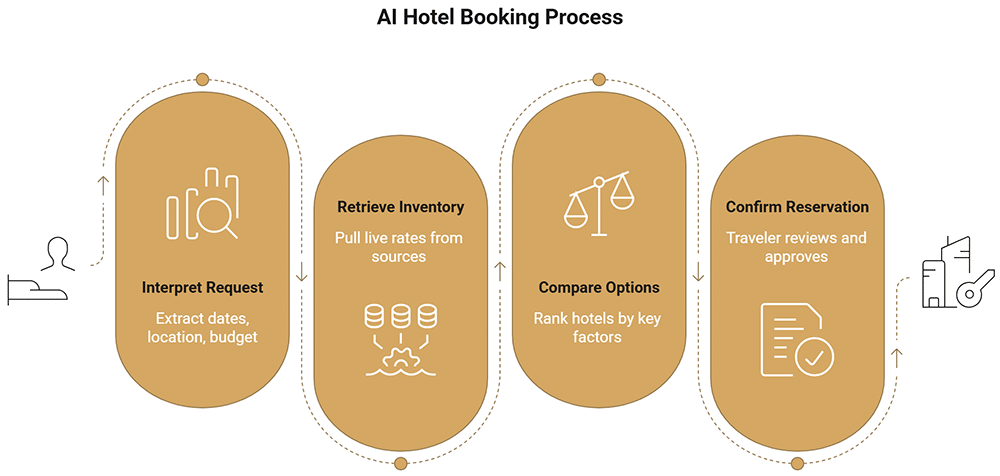
AI agents book hotels by turning a request into queries, pulling live inventory, and passing the confirmed reservation to the supplier. The flow runs in five steps:
- Interpret: The agent turns the request into dates, location, budget, and amenities.
- Retrieve: It pulls live rates from OTAs, chains, or a central reservation system (CRS).
- Compare: It ranks options on price, reviews, location, and cancellation terms.
- Confirm: The traveler reviews the room and policy, then approves payment.
- Hand off: The supplier receives the reservation and handles service.
Step 2 is where hotels win or lose.
An agent can only book inventory it can reach, so Google built Universal Commerce Protocol (UCP) for Lodging to connect hotels to AI Mode, interoperating with Model Context Protocol (MCP), Agent Payments Protocol (AP2), and Agent2Agent (A2A). Count the channels an agent can book you through, and the share you own.
James Byers, Group Product Manager for Google Search, told PhocusWire:
“As we scale, we will rely on UCP as the sort of common platform and protocol for scaling this up.”
How Does Google AI Mode Hotel Booking Work?
Google AI Mode hotel booking lets a traveler find and reserve a room inside Google Search’s AI Mode.
“Continue on Google” appears for eligible integrated partners. The guest selects a room, reviews terms, and pays through Google Pay. “Visit site” leads to a partner website when integrated checkout is unavailable. The hotel or booking platform processes payment, confirms the stay, and handles changes and refunds.
The initial rollout covers select U.S. properties in English. Integrated checkout currently lacks child-occupancy selection, partner promo codes, reward-point redemption, and loyalty-number attachment. Keep your own booking path usable for these guests.
Google says UCP for Lodging will power AI Mode hotel booking over the coming months. A planned connection is not an active checkout option or a ranking boost. Google says integration does not affect property or rate ranking.
Run your hotel through AI Mode monthly and log which booking options appear: your brand, an OTA, or none.
Where Else Can AI Agents Book Hotels Today?
Outside Google, most hotel supply inside AI agents comes from OTAs rather than individual hotels.
| Platform | Hotel Supply | How Booking Completes | Status |
| Google AI Mode | Five OTA brands and five hotel groups | In chat, with Google Pay | Live in the U.S. since August 27, 2026 |
| ChatGPT apps | Booking.com and Expedia | Checkout runs in the partner’s app (since March 2026) | Launched October 2025, initially excluding most of Europe |
| Meta Muse | Expedia | In chat, with Expedia as merchant of record | Announced September 24, 2026, coming soon to the U.S. |
How Should Hotels Prepare for AI Agent Bookings?
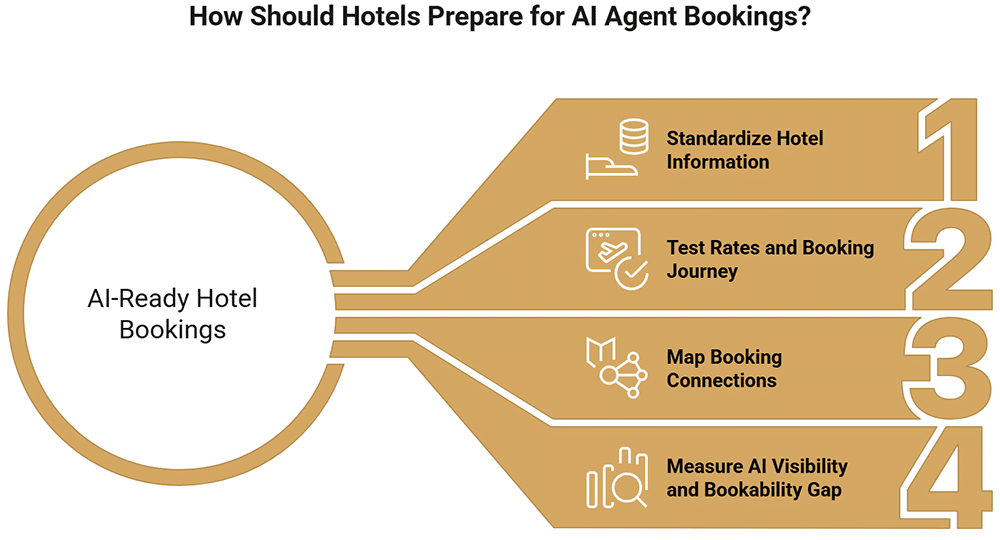
Start with the booking journey you already control. Accurate property facts, bookable offers, and clear service responsibilities help guests today and make new AI connections easier to assess.
Step 1: Standardize Your Hotel Information
Create one approved record of the facts guests choose on, such as parking, breakfast, pet rules, fees, and cancellation terms, and give each field an owner. Check it against your website, booking engine, OTA listings, and Google Business Profile, where verified hotels can edit amenities directly. Track the share of facts that match everywhere, quarterly.
Our hotel GEO guide covers the wider task of keeping property information consistent across the sources AI search may use.
Step 2: Test Rates and the Booking Journey
Trace your best-selling room and rate combinations from inventory to payment. Check dates, occupancy, inclusions, taxes, mandatory fees, and cancellation terms against the final booking page.
For Hotel Ads and free booking links, Google’s price accuracy policy requires an accurate, bookable total that includes mandatory charges. Its free booking link guidance says guests should find the selected room and rate easily after clicking through.
Check usability as well as price. Label date and occupancy fields clearly, use recognizable buttons, and test checkout on a phone. Google’s website guidance for browser agents recommends semantic HTML, labeled inputs, and stable layouts. These improvements make a site easier to navigate; they do not establish eligibility for integrated AI Mode checkout.
Step 3: Map the Booking Connections You Already Have
The prices and booking links on your Google hotel profile come from Hotel Ads and free booking links. An independent hotel doesn’t need to build a protocol, only three answers from its booking engine or channel manager:
- Which of our rate plans reach Google and each OTA?
- Can we tell a standard Google referral from an AI Mode booking?
- What is your plan, and our cost, for UCP for Lodging?
Step 4: Measure AI Visibility and the Bookability Gap
Track whether travelers can book through your own channel when an AI result mentions your hotel. The Bookability Gap is an internal audit measure:
Bookability Gap = (mentions without your own booking option ÷ total hotel mentions) × 100
For example, a hypothetical Charleston hotel appears in eight of ten test prompts. Its own booking option appears in two of those eight results, giving it a 75% gap. Record “Visit site” links and integrated AI checkout separately: both may lead to your channel, but they offer different guest journeys. Also record the platform, search dates, occupancy, seller, and final rate.
Review the results monthly. A high gap is a reason to check your direct booking links, rate coverage, and provider connections. It does not measure lost revenue or prove why an option was absent. Google says UCP integration itself does not change listing rankings.
Which Agentic Booking Mistakes Should Hotels Avoid?
Avoid these four mistakes as AI agents start booking rooms:
- Calling every AI-assisted reservation direct. Identify the merchant and booking partner before assigning the booking to a channel. For example, an AI Mode booking fulfilled by Booking.com is an OTA booking.
- Treating a mention as a confirmed booking opportunity. Check whether the property has a live offer, a working booking link, and an eligible checkout path.
- Publishing attractive rates with incomplete terms. Mandatory fees, occupancy rules, and cancellation policies must survive the move from recommendation to payment.
- Assuming all guests can use today’s AI checkout. Google’s current child-occupancy and loyalty limitations leave important journeys dependent on partner websites, so keep that path working on your own booking engine.
- Buying “AI visibility” fixes without checking the basics. Google says ordinary SEO foundations remain relevant and that special AI files or schema are not required to appear in its generative search features. Structured data should match visible page content, but it is no guarantee of an AI citation or booking.
FAQs About Agentic Hotel Booking
Agentic hotel booking creates another route from discovery to reservation. Start by making property facts consistent, offers accurate, checkout usable, and service ownership clear. Then check which partner actually takes each booking and measure whether AI visibility leads to valid offers and confirmed reservations.
Did You Like This Article About Agentic Hotel Booking?
You might also be interested in the following articles:
- ChatGPT Hotel Ads Explained Before the Auction Heats Up
- AI Agents for Hotel Marketing Are Picking Winners Already
- AI Agents for Hotel Front Desks and What to Automate First
More Tips to Grow Your Business
Revfine.com is the leading knowledge platform for the hospitality and travel industry. Professionals use our insights, strategies, and actionable tips to get inspired, optimize revenue, innovate processes, and improve customer experience.Explore expert advice on management, marketing, revenue management, operations, software, and technology in our dedicated Hotel, Hospitality, and Travel & Tourism categories.
This article is written by:

Hi, I am Martijn Barten, founder of Revfine.com. With 20 years of experience in the hospitality industry, I specialize in optimizing revenue by combining revenue management with marketing strategies. I have successfully developed, implemented, and managed revenue management and marketing strategies for individual properties and multi-property portfolios.


Leave A Comment