

AI agents for hotel front desks are software systems that understand a guest’s request in plain language and complete it directly in the property management system, from a check-in to a late checkout, without a staff member relaying every step. They are becoming important now because missed calls and after-hours gaps cost hotels bookings that a person was never available to answer.
Key Takeaways:
|
–
Table of Contents:
- What Are AI Agents for Hotel Reception?
- Why Should Hotels Use AI Agents at the Front Desk?
- The Front Desk AI Autonomy Ladder
- What Should Hotels Automate First?
- Where Do AI Agents at the Front Desk Still Fall Short?
- How Do AI Agents Affect Front Desk Labor Costs?
- How Should AI Agents Connect to PMS, Payments, and Guest Messaging?
- What Should Independent Hotels Consider Before Adding an AI Agent?
- FAQs
What Are AI Agents for Hotel Reception?
An AI agent at the front desk is software that takes a guest’s request in plain language and finishes the job inside your existing systems. It doesn’t just answer. It acts.
A rule-based chatbot can tell a guest what time breakfast starts, then stop there. An agent can pull up that guest’s reservation, process a late checkout, and apply a room change, logging all of it in the property management system without a staff member retyping anything afterward.
OpenAI’s developer documentation defines agents as applications that
“plan, call tools, collaborate across specialists, and keep enough state to complete multi-step work.”
That shift from answering to acting is recent enough that the vendor market is still catching up to its own marketing.
Today’s front-desk agents run on a big language model trained on a property’s own policies, room types, and FAQ content, then connected to the PMS through an API. That connection is what separates an agent from a chatbot, and it’s also the part that takes the most setup time.
A bot that can talk but can’t act will frustrate guests as much as no bot at all. Maybe more, since it raises an expectation it can’t meet.
For a wider view of how AI agents are changing hotel operations, guest service, and revenue decisions, read our guide “AI Agents for Hotels: Benefits, ROI, and Implementation Strategy.”
Why Should Hotels Use AI Agents at the Front Desk?
Hotels should use AI agents at the front desk when routine questions and requests are pulling staff away from guests who need personal attention. The problem is not that receptionists are inefficient. The problem is that one person is often expected to answer calls, check in arrivals, manage guest messages, process payments, calm complaints, and coordinate housekeeping.
AHLA reported that 65 percent of surveyed hotels still faced staffing shortages, even after pay increases and improved benefits. That makes front desk AI a labor productivity tool.
For example, a 95-room independent hotel in Chicago may have one evening associate handling arrivals, parking questions, restaurant requests, digital key issues, and towel requests between 5 p.m. and 8 p.m. An AI agent can absorb repeated questions and route simple tasks.
Hotels can see results through response time, missed calls, messages resolved without staff help, check-in queue time, and arrival satisfaction. The goal is fewer interruptions before the smile.

Michael J. Goldrich, Founder & Chief Advisor, Vivander“AI agents learn to understand and anticipate unique customer needs by acting as digital receptionists across voice, chat, web, and messaging apps. They remember guests, maintaining context and continuity. Eventually, they will remember you across devices. If a guest asks about pet policies on WhatsApp, the AI suggests pet-friendly rooms when they visit the website later. With real-time access to inventory, pricing, and PMS data, these AI agents will move beyond simple Q&A to perform transactions. They instantly check room availability, verify prices, and confirm services like late check-outs on any channel. This frictionless interaction means that guests don’t have to repeat themselves; each engagement builds on the last. This personalization enhances sales interactions and boosts conversion rates. Guests receive customized experiences, making them more likely to engage with offers and complete bookings. Achieving this requires strong API integrations plus strict data privacy and security measures to protect guest information and build trust.” Click here to learn more from our Hotel Marketing Expert Panel. |
The Front Desk AI Autonomy Ladder
Not every front-desk task carries the same risk if an AI agent gets it wrong. A wrong answer about pool hours is a shrug. A wrong answer about a wheelchair-accessible room is a real problem.
The Front Desk AI Autonomy Ladder sorts front-desk tasks by how much independence an agent should have, based on how often the task happens and how much guest sentiment rides on getting it right.
Table: The Four Levels at a Glance
| Level | What It Means | Front-Desk Tasks at This Level | Who’s in Control |
| 1. Scripted Assist | Rule-based answers to common questions, no write access to the PMS | Pool hours, Wi-Fi codes, parking instructions | Agent suggests, staff acts |
| 2. Guided Lookup | Agent retrieves reservation and account details, but needs staff sign-off to change anything | Confirming a reservation, answering billing questions | Agent informs, staff executes |
| 3. Autonomous Routine Resolution | Agent completes standard requests on its own and writes directly to the PMS | Check-in, late checkout, date changes, simple upsells | Agent acts alone on routine requests |
| 4. Escalation-Aware Autonomy | Agent does everything in Level 3 and recognizes when a request needs a person | Complaints, accessibility needs, anything outside policy | Agent acts alone and knows its limits |
The ladder isn’t really about how advanced the technology is. A vendor can sell a property a Level 3 system, but if staff configure it to handle every complaint without an escalation path, they’ve built a Level 1 problem with a Level 3 price tag.
Research summarized by EHL Insights backs up the logic behind the top rung. People are more willing to share information with AI in low-emotion situations, but still prefer a person once a situation turns emotionally charged. A guest checking in after a 14-hour flight to find their reservation missing is not a low-emotion situation.
Today, the typical AI agent deployment sits at Level 2 or may be the early edge of Level 3. Level 4, the rung where the agent reliably knows what it doesn’t know, is where the real return lives. It is also the rung where deployments tend to come up short.
What Should Hotels Automate First?
Properties that get real value from a front-desk agent don’t start by automating everything. They start with the highest-volume, lowest-judgment work and expand from there.
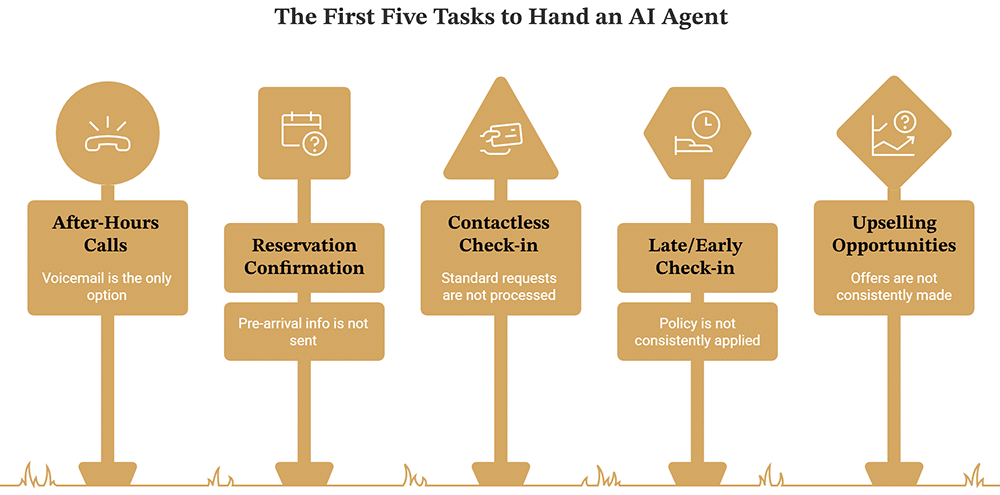
Here are the five tasks that are worth handing over first to AI agents, in rough order of payoff:
- Answering the phone after hours and during peak check-in, so calls stop going to voicemail.
- Confirming reservation details and sending pre-arrival information.
- Processing standard contactless check-in and checkout for guests without special requests
- Handling late checkout and early check-in requests against a published policy
- Offering upsells like room upgrades or breakfast packages at a consistent moment in the guest journey.
Each of these shares two traits: a hotel handles them constantly, and getting one wrong rarely upsets anyone.
If mobile arrival is part of your AI rollout, our article on “mobile check-in apps“ for hotels explains the benefits for guests, staff, and operational flow.
Where Do AI Agents at the Front Desk Still Fall Short?
An agent is only as good as the situations it’s been trained to recognize, and hospitality produces a steady stream of situations nobody scripted for. A guest whose flight got canceled, a service animal that wasn’t flagged on the reservation, a complaint that’s really about something that happened three nights ago.
The bigger risk isn’t that an agent refuses a request. Instead, an AI agent answers confidently when it should have said: “Let me get someone for you.” OpenAI’s agent guidance recommends guardrails and human review to define when an agent should continue, pause, or stop. It specifically describes human-in-the-loop approval before side effects such as cancellations, edits, or sensitive actions. For hotels, that means refunds, reservation changes, identity conflicts, and compensation decisions should pause for staff approval.
A front-desk agent also struggles with anything that requires judgment about exceptions. A loyalty member who’s three points short of a free night, a same-day request that technically violates policy but obviously shouldn’t. Staff make these calls using context that an agent doesn’t have access to and shouldn’t be trusted to invent.
None of this is a permanent ceiling. Models keep improving, and so does the quality of hotel-specific training data. It’s a reason to set the boundary deliberately today, not a reason to wait.
How Do AI Agents Affect Front Desk Labor Costs?
The honest answer is that labor costs were already moving before AI agents showed up, and the technology is responding to a trend that started years earlier.
CBRE Hotels Research found that hours worked at the typical hotel in its sample fell 7.4 percent, while total compensation paid rose 22.1 percent over the same stretch. This means hotels are paying more for fewer hours worked, which is exactly the kind of gap an AI agent is built to fill without adding another body to the schedule.
An agent can manage after-hours calls, standard late-checkout questions, pre-arrival messages, and basic task routing. But it still carries costs, including software fees, PMS integration, staff training, transcript review, and ongoing content updates.
The clearest return comes when hotels use AI to cover an existing service gap, such as overnight phone coverage or multilingual support, rather than simply cutting one front-desk shift. Measure labor impact through missed calls, response time, staff interruptions, task accuracy, and guest satisfaction before and after launch.
How Should AI Agents Connect to PMS, Payments, and Guest Messaging?
A hotel reception AI agent should connect to operational systems through limited, auditable permissions. If the agent can read everything and change everything, the hotel has created a risk layer, not an efficiency layer.
Start with read-only PMS access. Let the agent verify reservation dates, room type, arrival status, and approved policy information. Then allow narrow write actions, such as adding a note, creating a task, or sending a standard link.
Payments require stricter handling. PCI SSC states that PCI DSS provides technical and operational requirements designed to protect payment account data and applies to entities that store, process, or transmit cardholder data. A reception AI agent should never invite guests to type card details into an uncontrolled chat thread.
Table: What to Connect First, System by System
Every action the agent takes needs a timestamp, a channel, and a name attached, so a manager can trace what happened without guessing.
Because PMS connectivity decides what an AI agent can safely read or update, our guide to “Hotel PMS: Customization and Automation” is useful for understanding the operational backbone behind front desk automation.
What Should Independent Hotels Consider Before Adding an AI Agent?
The technology argument for independent hotels is actually stronger than the one for big chains, even though the marketing rarely talks to this audience. One owner can decide on a Tuesday and have an agent live within weeks, without an enterprise contract to negotiate first.
HVS reports that only around 28 percent of hospitality and travel companies currently qualify as AI leaders, meaning most of the industry, branded and independent alike, is still figuring this out. Scale isn’t the advantage it looks like from the outside, though HVS points to cost, legacy systems, and a shortage of skilled staff as the obstacles smaller properties cite most often.
“AI adoption in hospitality is accelerating, but most hotel chains are still experimenting,”
Michaela Papenhoff, managing director of the research firm h2c, told PhocusWire. An independent property willing to move with intention can close that gap faster than its size would suggest.
For a 45-room independent inn outside Asheville, the practical starting point is confirming the PMS has an open API, picking the single highest-volume task, and running it for 90 days before adding a second one.
FAQs Related to AI Agents For Hotel Front Desks
AI agents have moved past scripted chatbots into systems that can finish a check-in or fix a reservation on their own. The properties getting real value aren’t replacing the front desk. They’re handing the agent the repetitive, high-volume work so staff have more time for the guest standing in front of them.
Did You Like This Article About AI Agents for Hotel Reception?
You might also be interested in the following articles:
- AI Agents in the Travel Industry: Use Cases, ROI, and Strategy
- AI Agents in the Hospitality Industry: Use Cases, ROI, and Strategy
- Discover Examples of Artificial Intelligence (AI) in the Hotel Industry
More Tips to Grow Your Business
Revfine.com is the leading knowledge platform for the hospitality and travel industry. Professionals use our insights, strategies, and actionable tips to get inspired, optimize revenue, innovate processes, and improve customer experience.Explore expert advice on management, marketing, revenue management, operations, software, and technology in our dedicated Hotel, Hospitality, and Travel & Tourism categories.
This article is written by:

Hi, I am Martijn Barten, founder of Revfine.com. With 20 years of experience in the hospitality industry, I specialize in optimizing revenue by combining revenue management with marketing strategies. I have successfully developed, implemented, and managed revenue management and marketing strategies for individual properties and multi-property portfolios.




Leave A Comment