

AI agents in the travel industry are autonomous software systems that are able to work independently to achieve specific goals. They do not require human intervention and can make decisions and learn from outcomes over time. Within the travel industry, AI agents are useful as the industry currently faces key challenges that they can assist with. These agents can simplify booking processes, meet traveler demands for personalization, and optimize pricing.
In this article, you’ll learn about the role of AI agents in the travel industry, how they are delivering business value, and the types of agents that are being deployed.
Quick Definition:
Key Takeaways:
|
–
Table of Contents:
- What Are AI Agents in the Travel Industry?
- Why Are AI Agents in the Travel Industry Becoming More Important?
- How AI Agents Impact Your Travel Business Segment
- How AI Agents Are Changing Consumer Booking Behavior
- Types of AI Agents That Deliver Travel Business Value
- 1. Flight Search and Booking AI Agents
- 2. Operations and Disruption Management AI Agents
- 3. Hotel and Accommodation AI Agents
- 4. Itinerary Planning AI Agents
- 5. Dynamic Pricing and Revenue Management AI Agents
- 6. Customer Service and Support AI Agents
- 7. Loyalty and Personalization AI Agents
- 8. Fraud Detection and Security AI Agents
- 9. Sustainability AI Agents
- Implementation Strategies for AI Agents in Your Travel Business
- Common Challenges When Deploying AI Agents in the Travel Industry
- Global Outlook: AI Agents in the Travel Industry (2026-2036)
- Robots in the Travel Industry With Real-World Examples
- How Artificial Intelligence is Changing the Travel Industry
- AI Agents in the Travel Industry FAQs
What Are AI Agents in the Travel Industry?
In simple terms, AI agents in the travel industry are intelligent, autonomous systems capable of advanced reasoning. They go beyond chatbots because they do not require continuous prompts from humans to perform tasks.
Instead, agentic AI for travel industry settings can use data, contextual understanding, and the results of previous outcomes to make decisions. As a result, it can complete complex operations autonomously, from beginning to end.
The use of AI agents is expected to grow significantly in the coming years, assisting businesses and travelers with everything from simplifying booking processes and itinerary planning, through to revenue management and price optimization. AI agents can also reduce workloads and help businesses achieve revenue growth.
Will Tate, Partner, GoldSpring Consulting, discusses how autonomous AI will permeate every part of travel business operations:
“Agentic AI is going to touch it all: the sourcing, the customer experience, the messaging, the booking, the individual traveler, the data. “It’s going to weave its way through the entire ecosystem in a way that’s just beginning, so to be thinking about that as you move into the next five years is critical.”
Video: AI Agents, Clearly Explained
Why Are AI Agents in the Travel Industry Becoming More Important?
The role of AI agents in the travel industry is growing because they can help with the major challenges the industry faces right now. In particular, businesses need to hit financial targets and deliver hyper-personalization.
Many businesses in the travel industry face constraints when it comes to resources, including personnel. AI-powered agents for travel can ensure service standards remain high and issues can be resolved without disrupting staff.
Unlike more conventional chatbot-style AI systems, which respond to prompts, AI agents are able to take initiative and make contextual decisions without relying on humans. At the same time, AI agents can power frictionless booking systems, which deliver on customer expectations and use data to personalize travel experiences.
As Brian Chesky, CEO of Airbnb, states:
“From a business standpoint, I think AI is the best thing that ever happened to Airbnb. The founder-led companies and the companies that are prepared to change and transform are the companies that are going to benefit from AI, because AI means everyone changes. And if you don’t change, you’re going to be disrupted.”
Video: How AI is Transforming the Travel Industry
How AI Agents Impact Your Travel Business Segment
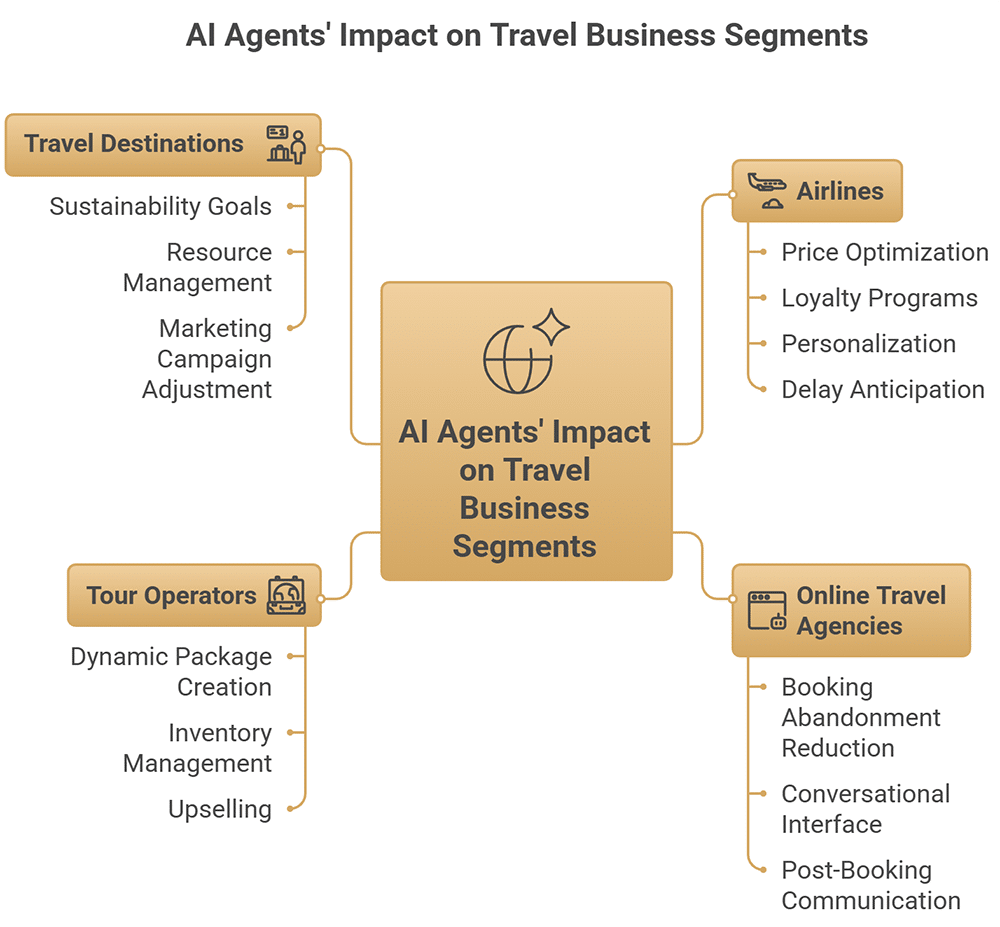
The various operational benefits associated with AI agents in the travel industry vary depending on business type. In the following sections, you can explore some of the main ways AI agents are impacting key segments:
1. Airlines
Airlines have some of the biggest uses for AI agents in the travel industry. These agents can assist with price optimization, loyalty programs, personalization, anticipating delays, and dealing with travel disruptions.
AI agents are valuable here because they use data and patterns to anticipate issues and take action quickly. AI technology can also dynamically adjust the price of airplane seats based on demand changes.
Using customer data, AI can personalize rewards for repeat customers and manage basic communication across the customer life cycle. This can result in superior engagement and customer retention.
2. Online Travel Agencies
AI agents in the travel industry are assisting OTAs in overcoming booking abandonment issues. The agents can guide customers through complex booking decisions and make intelligent decisions for them when asked.
Many OTAs experience a high number of abandoned bookings, as self-service booking engines can be confusing for some customers. An agentic user interface is more conversational, making booking easier.
AI can also handle much of the post-booking communication, reducing pressure on individual employees.
If you want to learn more about OTAs, read the ” 17 Online Travel Agents (OTAs) to Increase Your Hotel Bookings” article.
3. Tour Operators
Some of the most exciting uses of AI agents in the travel industry relate to tour operators and experience providers. These businesses are able to use agentic AI to create dynamic, personalized packages quickly.
AI agents can access vast amounts of internal and external data, allowing them to optimize inventory management and upsell at the right times. Meanwhile, customer preferences can be used to specifically tailor packages.
The result is an improved experience for travelers and better profit margins for tour operators. Delivering a similar level of personalization and revenue optimization manually would require multiple staff and many hours of work.
4. Travel Destinations
Travel destinations and destination marketing organizations are able to use AI agents for travel goals, including sustainability. An AI agent can analyze demand patterns and booking data so resources can be managed effectively.
AI agents in the travel industry can push marketing messages that promote sustainable travel practices. They can also automatically adjust marketing campaigns in order to increase or reduce visitor numbers at specific times.
All of this means AI agents have a role to play in managing tourism and protecting the local population.
As Max Starkov, Hospitality and Travel Technologist, puts it:
“This isn’t about AI assistants anymore; it’s about fully autonomous agent networks that execute complex workflows in real time. The presumption is that AI agents can research, plan, and book travelers’ vacations autonomously, thus circumventing online travel agents and other intermediaries.”
How AI Agents Are Changing Consumer Booking Behavior
AI agents in the travel industry are changing consumer booking behavior by providing a conversational booking experience, which coordinates travel needs. This provides the benefits of in-person and self-service booking.
When booking through an AI agent, customers get the advantages of not having to deal with a human, such as the ability to take their time and think. Yet, they also benefit from intelligent recommendations, as they would get from a real agent.
A growing number of people are turning to AI to help them with travel decisions. This is a fundamental shift in booking behavior, away from true self-service. Crucially, it can result in easier booking processes without sacrificing good decision-making. This convenience means businesses stand to gain a competitive edge by implementing travel industry AI agents, while customers stand to benefit from efficiency and personalized travel plans.
Video: We Booked Our Vacation Itinerary Using AI Travel Agents – Here’s Where it Sent Us
Types of AI Agents That Deliver Travel Business Value
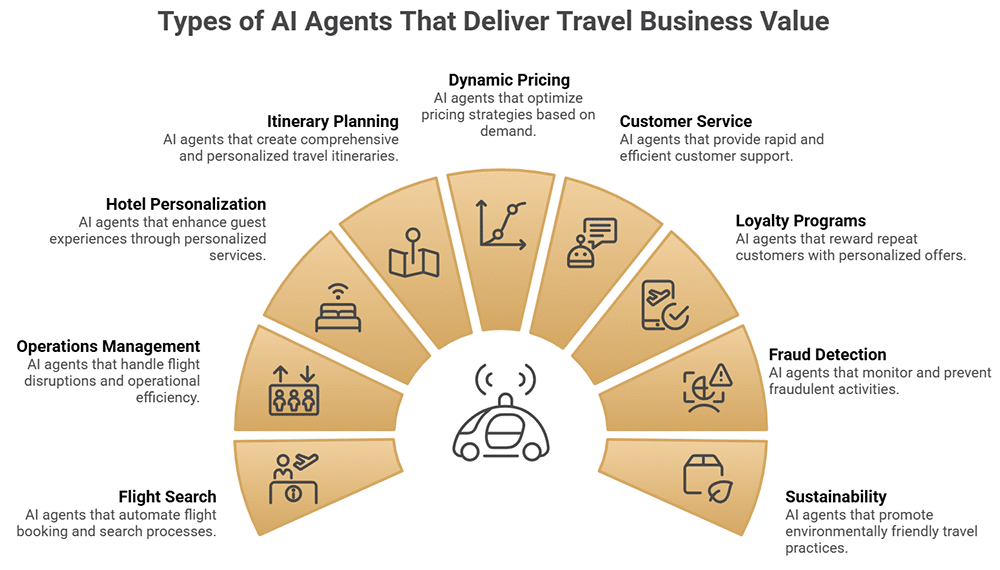
Now that you understand what AI agents in the travel industry are and what they do, it is important to dive deeper. Here, you can explore the specific types of AI agents and the ways they are being used by travel businesses:
1. Flight Search and Booking AI Agents
Flight search and booking AI agents in the travel industry provide customers with a means of booking flights, hotels, or other products and services using natural conversational language. This can be easier than self-service booking engines.
Giving customers easier options to complete a booking can reduce frustration and lower the risk of them backing out of a booking. An early example of this is Perplexity Comet, an AI-powered web browser that automates travel planning.
AI agents are able to search across distribution systems and can understand contextual information. So, if the customer requests “the cheapest non-stop flight to London,” the agent will be able to identify and book it.
2. Operations and Disruption Management AI Agents
AI agents in the travel industry can help businesses react when things go wrong. In an airline, they might monitor air traffic and flight availability and automatically re-book customers who are scheduled for delayed or cancelled flights.
Automation in this area can be invaluable because disruption often causes panic among staff. An AI agent can use data and robust logic to make decisions without emotions, helping to bring order to the chaos.
American Airlines is already using generative AI technology to help customers navigate disruptions to their travel plans. You can expect AI agents in travel settings to take this to the next level in the years to come.
3. Hotel and Accommodation AI Agents
Hotel and accommodation AI agents in the travel industry are primarily used to enhance personalization. They use customer data to understand preferences and requirements, then connect customers with relevant options.
This is especially important within modern hospitality, where personalization is one of the biggest ways a hotel can stand out from rivals. AI can analyze data and identify preferences more quickly than humans.
AI agents handle bookings, special requests, and provide support when guests arrive. This can make the entire guest experience smoother and reduce the amount of time hotel staff needs to spend dealing with requests and complaints.
If you want to learn more about the AI agents in the hotel industry, read “AI Agents for Hotels Are Shaping the Next Generation of Hospitality.”
4. Itinerary Planning AI Agents
Itinerary planning agents are popular AI agents in the travel industry because they allow businesses to offer comprehensive services. These agents can coordinate across channels to plan complete travel experiences.
Agentic AI can progressively learn user preferences, making itineraries increasingly relevant. They can also help users book experiences and identify the cheapest ways to gain entry to events.
An early example of AI being deployed in this way is Expedia’s AI assistant, Romie, which can be integrated into group chats. It progressively learns about users and can assist with planning, booking, and more.
5. Dynamic Pricing and Revenue Management AI Agents
Dynamic pricing and revenue management agents use data to automatically anticipate demand and adjust pricing accordingly. These agents are increasingly being used by airlines, hotels, cruise lines, and OTAs to maximize revenue.
Many businesses within the travel industry use dynamic pricing to charge more during high-demand periods and offer low prices to avoid vacancies in low-demand periods. AI agents can automate this process.
The use of AI agents in the travel industry business types listed can also ensure prices are adjusted at the ideal time. As a result, rates can change hundreds of times per day, without the need for human control.
6. Customer Service and Support AI Agents
AI agents in the travel industry that are focused on support and customer service are able to respond to queries and complaints quickly. They can also cover multiple channels, including voice, messaging apps, and email.
Response times are an area where there is often a huge disconnect between customer expectations and operational realities. AI agents help businesses bridge this gap, delivering rapid responses.
AI technology is able to automatically handle common questions and deal with simple interactions. It can also gather valuable information and hand a more complex customer request off to a human agent.
7. Loyalty and Personalization AI Agents
Loyalty and personalization AI agents are often designed to reward repeat customers. They use data gathered from travelers over multiple trips to understand preferences and deliver suitable options to meet individual needs.
These personalization-focused AI agents in the travel industry can allow businesses to deliver tailored experiences. This results in travelers who feel genuinely valued, further enhancing your business’s reputation.
Historically, travel industry businesses have had to offer personalization through market segmentation. With AI-powered loyalty programs, they can offer hyper-personalization, focused on individuals rather than segments.

Thom de Graaf and Kamila Zawadzka, The Orange Studio“AI presents a tremendous opportunity for the travel and leisure industry to harness technology and innovation to deliver personalised solutions. As the industry shifts towards a more technologically driven approach, hotels stand at the forefront, crafting tailored experiences to meet the evolving expectations of their guests. With consumers seeking personalised experiences more than ever, it’s essential for the hospitality industry to leverage AI to better understand their customers and anticipate their needs. For example, hotels can partner with AI-driven platforms to provide customised jet-lag recovery programs based on guests’ travel journeys prior to arrival, enhancing their stay and creating a rejuvenating experience.” Click here to learn more from our Hotel Marketing Expert Panel. |
8. Fraud Detection and Security AI Agents
Fraud detection and security AI agents are able to continuously monitor activity, including bookings and payments. They can then detect suspicious activity, block transactions, or alert human employees.
Security AI agents in the travel industry are going to become commonplace, as the industry faces new cyber attacks. They can protect travel businesses on a 24/7 basis, even when human staff is unavailable.
Over time, machine learning means the AI agents improve and identify new attack methods. This can ensure businesses are equipped to tackle the latest threats, without adding unnecessary friction for genuine customers.
9. Sustainability AI Agents
Some businesses are also deploying AI agents that are focused on sustainability. These agents track carbon emissions, optimize journeys to reduce pollution, and help to minimize energy consumption.
AI agents can help businesses to achieve greater transparency with energy usage and meet sustainability targets. The specific ways sustainability AI agents in the travel industry work will vary depending on the sector.
For example, in hotels, AI agents may optimize heating and air conditioning, turning systems off when they are not needed. In airlines, they can optimize flight loads and routes to reduce fuel consumption.
Video: 10 Use Cases for AI Agents: IoT, RAG, & Disaster Response Explained
Implementation Strategies for AI Agents in Your Travel Business
AI agents in the travel industry have many uses, but successful implementation requires a strategic approach. Here, you can explore valuable implementation strategies to assist your business:
- Ecosystem Connectivity: Using API-enabled software, including booking systems, distribution systems, and customer databases, allows AI agents in the travel industry to connect, exchange data, and trigger actions.
- Data Governance: Make sure you have privacy protocols and quality standards in place, so AI agents are accessing safe, structured data to use for decision-making purposes.
- Phased Deployment: Begin by introducing one function, like AI-powered customer service or AI-powered booking. Expand to more complex functions gradually, making sure each new phase is functioning well first.
- Change Management: Provide training for staff, so they know how and when to work with AI agents in the travel industry. Involve staff in implementation to prevent resistance and reduce anxiety about AI.
- Security and Compliance: Comply with regulations and implement fraud detection, encryption, and access controls.
- Performance Measurement: Establish KPIs like conversion rates and customer satisfaction. Use these to continuously monitor AI agent performance and fine-tune business operations.
Common Challenges When Deploying AI Agents in the Travel Industry
The use of AI agents in the travel industry can deliver operational and financial benefits, but there are challenges along the way, too, and it can be helpful to understand these in advance:
- Legacy System Integration: Older software and systems may not have the modern APIs needed for true integration, meaning systems may need to be replaced to get the most from AI agents.
- Customer Trust: While some travelers use AI regularly, many do not. Trust and acceptance, especially with making booking decisions, may take time, and you may need to provide evidence of your AI agents’ worth.
- Multi-Supplier Coordination: Providing services that coordinate offerings from airlines, hotels, and other businesses can require complex integration with brands that may all use different systems.
- Legal Liability: As AI agents in the travel industry are an emerging technology, questions remain about liability. Frameworks are needed, especially around bookings and who is responsible if AI agents make errors.
- Dynamic Pricing: AI agents must handle real-time dynamic pricing changes without making booking errors.
- Lack of Human Touch: It is essential to maintain a human service element. AI agents in the travel industry need to be balanced with high-quality customer service from real people.
Video: Risks of Agentic AI: What You Need to Know About Autonomous AI
Global Outlook: AI Agents in the Travel Industry (2026-2036)
The outlook over the next 10 years for AI agents in the travel industry is extremely positive. During this time, agentic interfaces are expected to progress from experimental to established technology, especially for booking processes.
For travelers, one of the biggest ‘next steps‘ is the emergence of AI agents that can handle complete travel arrangements from start to finish. This includes arranging flights, hotels, transportation, activities, dinner reservations, and more, all from a relaxed conversation, which the AI will understand and contextualize.
In the United States, 32% of travelers would already allow an AI assistant to book flights and a hotel for them. As agentic AI interfaces become more common and widely understood, this number will increase.
Autonomous AI agents for travel industry businesses are also going to improve operations and alleviate staffing pressures. AI will be able to understand big picture pricing strategies and forecasting to reliably make adjustments to rates. This can be done on a 24/7 basis, without continuous human oversight.
By offering an alternative to online self-service booking engines, which currently result in a large number of potential travelers backing out during the process, AI agents in the travel industry will boost conversions. As an added benefit, the AI will understand how and when to upsell and what messages to push to extract maximum value from a traveler.
Satya Nadella, CEO of Microsoft, says on the future role of AI agents:
“AI agents will become the primary way we interact with computers in the future. They will be able to understand our needs and preferences, and proactively help us with tasks and decision-making.”
Robots in the Travel Industry With Real-World Examples
Aside from AI agents in the travel industry, one of the biggest technological developments has been the continued emergence of robotics solutions. Robots are able to make use of AI technology to automatically perform tasks ranging from luggage delivery and room cleaning to airport security tasks and customer service.
In the “Robots in the Travel Industry: 20 Real-World Examples” article, you can find much more on the ways robotics technology is being deployed across the transportation, accommodation, food, and entertainment sectors.
How Artificial Intelligence is Changing the Travel Industry
While AI agents in the travel industry are still emerging, AI usage in general is already widespread. It currently includes chatbots for customer service, AI flight forecasting, data analytics, facial recognition, and employee scheduling. When used effectively, AI can improve travel experiences and business operations.
In the “How Artificial Intelligence is Changing the Travel Industry” article, you can fully explore the transformative impact AI technology is having on travel, complete with examples of AI in action.
AI Agents in the Travel Industry FAQs
AI agents in the travel industry are having a transformative impact on customer experiences and business operations. The ability for agentic AI to make decisions, learn from outcomes over time, and use advanced reasoning means the technology can be deployed to handle processes from beginning to end, without human intervention.
Did You Like This Article About AI Agents in the Travel Industry?
You might also be interested in the following articles:
- Discover Examples of Artificial Intelligence (AI) in the Hotel Industry
- How to Use Artificial Intelligence in the Hospitality Industry
- 21 Key Technology Trends Emerging in the Travel Industry
More Tips to Grow Your Business
Revfine.com is the leading knowledge platform for the hospitality and travel industry. Professionals use our insights, strategies, and actionable tips to get inspired, optimize revenue, innovate processes, and improve customer experience.Explore expert advice on management, marketing, revenue management, operations, software, and technology in our dedicated Hotel, Hospitality, and Travel & Tourism categories.
This article is written by:

Hi, I am Martijn Barten, founder of Revfine.com. With 20 years of experience in the hospitality industry, I specialize in optimizing revenue by combining revenue management with marketing strategies. I have successfully developed, implemented, and managed revenue management and marketing strategies for individual properties and multi-property portfolios.





Leave A Comment