

AI agents for hotel revenue management are software systems that pursue revenue goals by taking actions, such as adjusting rates, updating forecasts, and monitoring demand, with limited human input. They are becoming important now because revenue technology is shifting from recommending decisions to executing them, and hotels that define autonomy boundaries early can reprice faster than hotels that wait.
Key Takeaways:
|
–
Table of Contents
- What Are AI Agents for Hotel Revenue Management?
- How Are AI Agents Different From Revenue Management Systems?
- Which Revenue Tasks Should AI Agents Handle First?
- The Revfine Agent Autonomy Ladder
- How Should You Govern an AI Agent’s Pricing Decisions?
- Revenue Agent Readiness Checklist
- How Should Independent Hotels Use AI Agents?
- What Are the Limits and Risks of AI Agents?
- What Skills Do Revenue Managers Need When Working With AI Agents?
- How Do You Start With AI Agents in Revenue Management?
- Frequently Asked Questions
What Are AI Agents for Hotel Revenue Management?
An AI agent is software that works toward a goal you set, such as growing RevPAR (Revenue Per Available Room) over the next 90 days, by planning tasks, using your systems, and taking actions on its own. That separates it from a chatbot, which answers questions, and from a copilot, which drafts work for you to finish.
In revenue management, an AI agent connects to your property management system (PMS), rate shopping feed, and channel manager. It can monitor competitor rate moves overnight, apply dynamic pricing adjustments to your best available rate within limits you define, refresh the demand forecast when pickup shifts, and draft the variance summary before your morning meeting.
The shift is already underway outside hospitality. In McKinsey’s Global Survey on AI, 62 percent of respondents said their organizations are at least experimenting with AI agents.
Hotel revenue technology is following the same path, and the companies behind established revenue management systems are building agent capabilities into their platforms as of 2026. The question you need to answer isn’t whether this technology reaches your property. It’s how much pricing authority you’re prepared to delegate and under what rules.
How Are AI Agents Different From Revenue Management Systems?
A Revenue Management System (RMS) usually supports forecasting, pricing, and availability decisions. An AI agent works across tasks. It may pull data from the PMS, RMS, channel manager, event calendar, reputation platform, and booking engine, then coordinate a workflow that would otherwise require manual checking.
That difference changes your daily role. With an RMS, you review and approve recommendations. With an agent, you define boundaries and audit outcomes.
Fergus Boyd, Hospitality Consultant at HFTP, noted on Hospitality Net that:
“Predictive AI (P-AI) has been core to revenue management/pricing systems for decades.”
The new shift is not that AI can forecast. It is that agentic systems can plan and execute multi-step workflows around that forecast.
The table below shows where the two differ on the dimensions that affect your operation.
| Dimension | Traditional RMS | AI Agent |
| Core output | Rate and inventory recommendations | Completed tasks toward a defined revenue goal |
| Scope of action | Pricing and forecasting within one platform | Work across PMS, RMS, channel manager, and reporting tools |
| Your role | Reviewing and approving each recommendation | Setting boundaries and reviewing exceptions |
| Adaptation | Models updated on the vendor’s schedule | Behavior adjusts as outcomes and instructions change |
| Typical failure mode | Sound recommendations that nobody acts on | Wrong actions executed quickly and at scale |
Neither replaces the other. The strongest setups pair an RMS’s pricing science with an agent’s execution layer, so you should evaluate agents as an addition to your stack rather than a substitute for it.
Which Revenue Jobs Should AI Agents Handle First?
A revenue AI agent should be judged by where it acts, not by how impressive the product demo looks. The best early workflows are high-frequency, data-heavy, measurable, and easy to review if the recommendation is wrong.
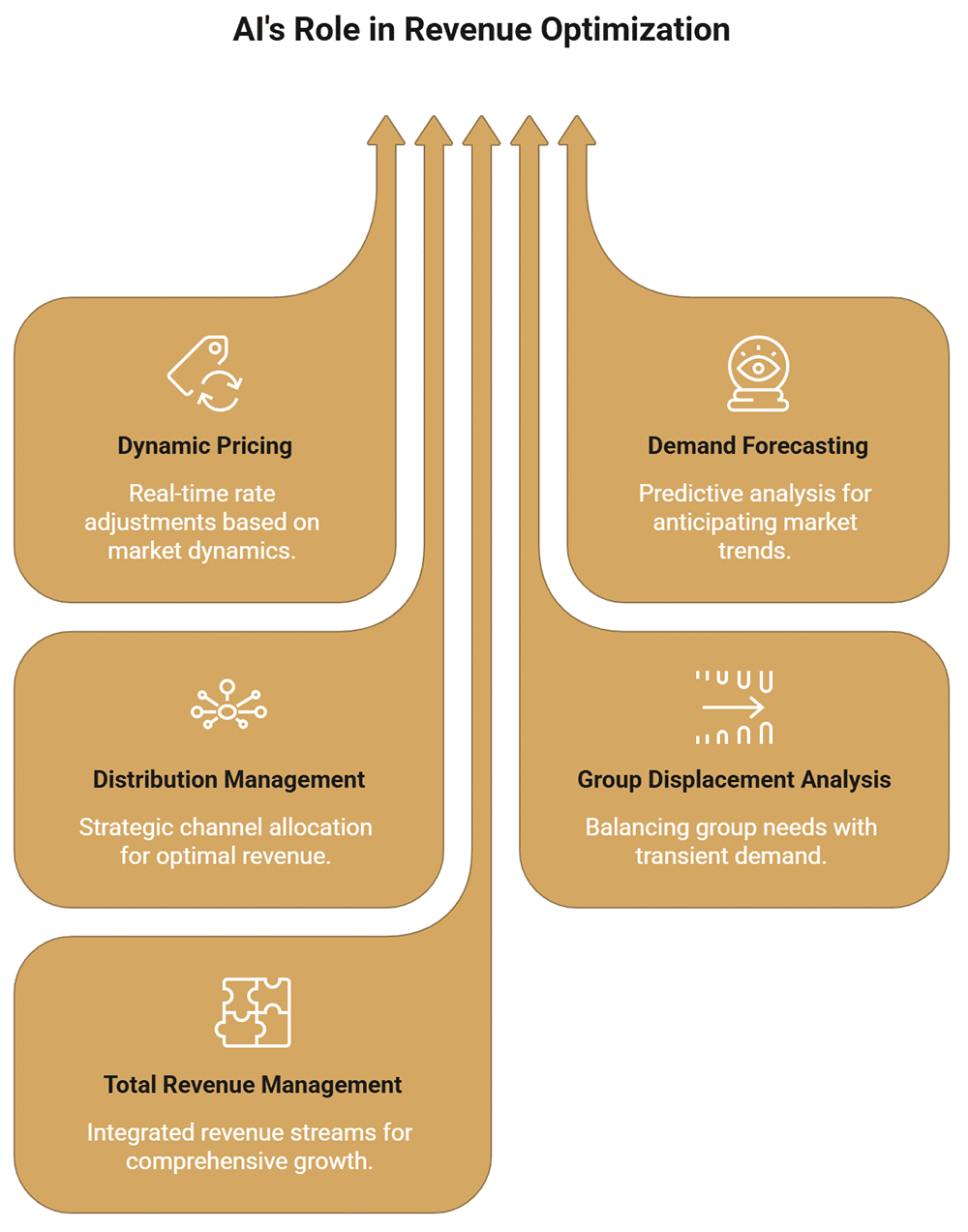
The most practical revenue jobs include:
- Dynamic Pricing: Adjusting rates through the day as pickup, demand, and competitor pricing shift.
- Demand Forecasting: Detecting earlier movement from pickup, local events, search interest, and booking windows.
- Distribution Management: Checking where demand is coming from and whether channel cost supports the rate decision.
- Group Displacement Analysis: Comparing the group value against the transient demand it may push out.
- Total Revenue Management: Connecting room pricing with parking, food and beverage, spa, events, and package revenue.
Across all five jobs, the split should stay clear. The agent handles continuous monitoring and structured execution. Your revenue leader sets the commercial intent, approval limits, and risk boundaries.
If your team is still doing three of these by hand every morning, that’s the time you’re spending now that an agent is built to give back.
The Revfine AI Agent Autonomy Ladder
The Revfine Agent Autonomy Ladder gives your team a shared language for pricing authority. “We use AI” is too vague. A revenue team needs to know exactly who approves a rate change, who reviews a restriction, and when the system can act without waiting.
- Level 1: Advisory. The agent analyzes data and recommends actions, but your team executes every change.
- Level 2: Supervised Execution. The agent prepares the action and completes it only after explicit approval.
- Level 3: Bounded autonomy. The agent acts inside hard limits, such as rate floors, rate ceilings, maximum daily changes, or defined room types.
- Level 4: Orchestrated autonomy. Specialized agents coordinate pricing, forecasting, distribution, and reporting tasks while revenue leadership governs the system.
The ladder works per task, not per system. Your setup might run at Level 3 for weekday transient pricing while staying at Level 1 for group quotes, and that split is a sign of discipline rather than distrust.
Promotion should be earned. A workable rule is that a task moves up one level after eight consecutive weeks in which you have approved every action the agent proposed.
How Should You Govern an AI Agent’s Pricing Decisions?
Governance is where AI agent projects live or die, and the evidence beyond hospitality is blunt. McKinsey’s report on agentic AI found that about 90 percent of function-specific AI use cases remain stuck in pilot mode, and the same research names uncontrolled autonomy and weak traceability among the risks that agents introduce.
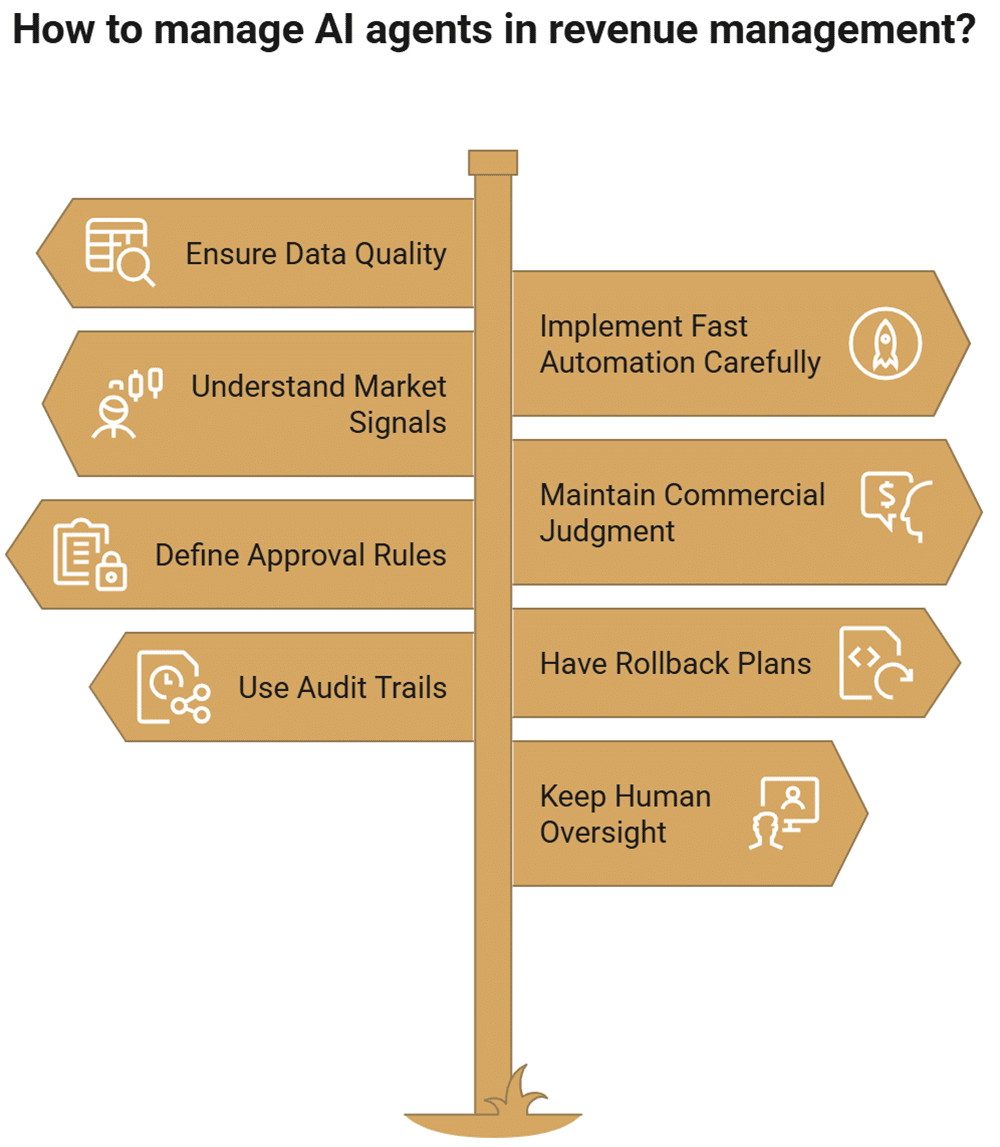
For a hotel, that translates into three controls you should establish before granting any autonomy. You should set approval rules that state which tasks the AI agent may execute at which ladder level, and you should require source traceability, meaning every action gets logged with the signal that triggered it so you can reconstruct why a rate moved.
The third control is a rollback plan that can restore yesterday’s rates across every channel within minutes. Hard guardrails sit underneath all three: rate floors, rate ceilings, and a maximum change per day that no instruction can override.
Your early-warning metric is the override rate, meaning the share of agent actions you reverse or correct each week. A stable, low override rate tells you the boundaries fit your market. A rising one tells you the agent’s model and your demand reality have diverged, and autonomy should step back down the ladder.
Revenue Agent Readiness Checklist
A hotel should not give an AI agent pricing access just because the technology can technically execute a rate change. The practical question is whether your property can control, audit, and reverse the action if the recommendation is wrong.
Hoteliers can use this checklist before moving a workflow from advisory mode to supervised execution or bounded autonomy:
If three or more areas are weak, keep the agent in reporting mode. If the checklist is mostly strong, test one low-risk workflow for four to eight weeks before expanding access.
How Should Independent Hotels Use AI Agents Without Enterprise Tech?
Independent hotels should use AI agents as narrow commercial assistants, not as enterprise transformation projects. A property without a dedicated revenue analyst, data engineer, or cluster revenue manager cannot copy the operating model of a global brand. That is not a disadvantage if the scope is tight.
McKinsey’s AI survey found that companies with less than $100 million in revenue were less likely to have reached AI scaling than larger firms, with 29 percent in the scaling phase. For independents, this points to workflow design before platform ambition.
A 55-room city hotel in Porto can begin with one agentic workflow. Every morning, the agent compares yesterday’s pickup with the forecast, identifies three dates where the pace changed, and drafts a short recommendation for the owner or general manager. The human decision remains local, but the analysis becomes faster and more consistent.
The property owner should measure three things: hours saved per week, accepted recommendations, and RevPAR change on reviewed dates. If the agent saves time but produces recommendations your team rejects, the problem is not adoption. The problem is decision quality.
As Chris Crowley, chief revenue officer at Duetto, told PhocusWire,
“In five years, generative AI tools will be the ‘norm’ and more accessible, which could lead to the ‘democratization’ of revenue management, where everyone will benefit from revenue management tools regardless of skill or experience.”
What Are the Limits and Risks of AI Agents in Revenue Management?
AI agents are limited by data quality, commercial rules, system access, and the judgment they are allowed to apply. They can misread a citywide event, overreact to competitor discounting, or recommend a rate move that protects ADR while damaging channel relationships. The credible objection is simple: bad automation can scale bad revenue decisions.
That objection is valid.
McKinsey and Skift’s travel report found that 90 percent of surveyed travel executives said their organizations used generative AI in some capacity, but only 2 percent said agentic AI was widespread across their organizations. The current market is early, not mature.
The safest approach is to separate recommendation authority from execution authority. A revenue agent can suggest increasing the Saturday rate from $189 to $209 because pickup is ahead of forecast. It should not change public rates across all channels unless the approval rule, rollback plan, and audit trail are already defined.
Measure risk through exception logs. Track incorrect recommendations, unauthorized actions, channel conflicts, and guest-facing rate complaints. If the agent creates noise, narrow the workflow before expanding access.
What Skills Do Revenue Managers Need When Working With AI Agents?
Revenue managers need stronger interpretation skills when AI agents enter the workflow. The job becomes less about collecting data and more about judging whether the recommendation fits the hotel’s market position, owner goals, channel strategy, and guest mix.
The most useful skills include:
- Commercial Interpretation: Judging whether the recommendation fits the hotel’s positioning.
- Data Discipline: Spotting weak inputs before they create weak actions.
- Channel understanding: Knowing when OTA pickup is useful and when it becomes margin leakage.
- Forecast judgment: Deciding when historical demand patterns no longer apply.
- Governance thinking: Setting approval rules, limits, and rollback processes.
- Communication: Explaining agent-supported decisions to owners, sales teams, and operations.
For independent hotels, these skills may sit with the general manager or owner rather than a full-time revenue manager. That makes clear explanations essential.

Massimiliano Terzulli, International Business Developer, Franco Grasso Revenue Team“Anyone choosing to work in this field will definitely need to have a strong familiarity with AI—understanding how AI “thinks” in order to provide personalised responses to specific prompts, what kind of data it takes into account, where it can fail, where it needs improvement, and where it requires more data and training. Today, it is hard to imagine working without AI. From simple analysis and summarisation of very long texts or large datasets, to the transformation and generation of customised reports, there are countless activities that AI enables to be carried out infinitely faster than before—or even tasks that were previously impossible to imagine.” Click here to learn more from our Hotel Revenue Management Expert Panel. |
How Do You Start With AI Agents in Revenue Management?
Starting well matters more than starting big, because what kills these projects isn’t bad technology. It’s a pilot that never earns its way into production. McKinsey’s survey found that nearly two-thirds of organizations have not yet begun scaling AI across the enterprise, and hotels treating agents as a side experiment will join that group.
Your first move is an inventory. You should list every recurring revenue task your team performs weekly, then mark the ones that follow repeatable rules and cost little when a mistake slips through.
From that shortlist, you should pick a single workflow, such as overnight comp-set monitoring with a morning summary, and run it at Level 1 of the autonomy ladder for four to eight weeks. During that window, you should record your agreement rate, the share of agent recommendations you would have executed unchanged.
An agreement rate above your comfort threshold earns that task a promotion to supervised execution. One that doesn’t tell you to fix the inputs first.
Data quality, not model quality, is the constraint to test early. Clean PMS records, a reliable rate shopping feed, and consistent segment coding decide whether the agent’s view of your market matches reality.
FAQs About AI Agents in Hotel Revenue Management
AI agents can improve hotel revenue management when they are treated as controlled commercial workflows rather than independent decision-makers. The hotels that benefit first will define the tasks, owners, approval rules, and performance measures before giving agents access to pricing execution.
Did You Like This Article About AI Agents in Hotel Revenue Managment?
You might also be interested in the following articles:
- AI Agents for Hotel Marketing Are Picking Winners Already
- AI Agents for Hotel Front Desks and What to Automate First
- AI Agents in the Travel Industry: Use Cases, ROI, and Strategy
More Tips to Grow Your Business
Revfine.com is the leading knowledge platform for the hospitality and travel industry. Professionals use our insights, strategies, and actionable tips to get inspired, optimize revenue, innovate processes, and improve customer experience.Explore expert advice on management, marketing, revenue management, operations, software, and technology in our dedicated Hotel, Hospitality, and Travel & Tourism categories.
This article is written by:

Hi, I am Martijn Barten, founder of Revfine.com. With 20 years of experience in the hospitality industry, I specialize in optimizing revenue by combining revenue management with marketing strategies. I have successfully developed, implemented, and managed revenue management and marketing strategies for individual properties and multi-property portfolios.





Leave A Comment