


Hotel AI search optimization is the practice of making a property’s website, listings, and public facts easy for AI search systems to discover, interpret, verify, and cite. A hotel AIO strategy turns that practice into a repeatable operating process. It helps your hotel earn visibility in conversational answers without replacing proven search engine optimization.
Key Takeaways:
|
Table of Contents:
What Is Hotel AI Search Optimization?
Hotel AI search optimization is the discipline of improving how your property is represented when an AI system researches, compares, summarizes, or recommends accommodation. It applies to ChatGPT search, Google AI Overviews and AI Mode, Microsoft Copilot, Perplexity, Claude, and other systems that retrieve information before generating an answer.
AIO (AI Optimization, sometimes called AI search optimization): The discipline of managing every machine-readable signal about your property across owned, structured, third-party, and earned sources.
Your hotel may need to appear when a traveler asks: Which hotel near the convention center has secure parking? Which boutique property works for two adults and two children? Which airport hotel accepts arrivals after midnight?
Generative AI platforms such as ChatGPT reached 33 percent usage for trip research among U.S. travelers, five times the 2024 level, according to Phocuswright’s The AI Surge research update.
Consider a hypothetical 110-room property near the Amsterdam RAI convention center. Ranking for “hotel near Amsterdam RAI” remains valuable, but a broad location page may not explain parking security, family-room capacity, late check-in, or tram access.
Hotel AI search optimization closes that decision gap.
What Is a Hotel AIO Strategy?
A hotel AIO strategy is the operating plan used to manage hotel AI search optimization across your website, structured data, local profiles, distribution channels, reviews, and analytics. It specifies what needs attention, who owns each task, how facts are approved, and how performance is measured. That work stays invisible to the guest.
AIO is not yet a standardized search-industry term. In this article, it means artificial intelligence optimization, while the broader and clearer discipline remains hotel AI search optimization.
The weak approach is to add several frequently asked questions, rewrite headings, and call the project complete. That treats AIO as a content format rather than an information-management process.
A practical hotel AIO strategy therefore assigns clear responsibility. Marketing manages traveler questions, destination content, and website answers. Revenue and distribution teams maintain room categories, rates, and booking conditions.
The hotel’s website or technology partner manages crawling, indexing, page rendering, canonical URLs, and structured data. One commercial owner should coordinate the complete process, track changes, and resolve contradictions between channels.
AIO fails when nobody owns factual accuracy.
Video: 94% of Hotels Are Invisible in AI Search: How You Fix That
How Is Hotel AI Search Optimization Different From SEO and GEO?
Search engine optimization competes for a rank position among links. Hotel AI search optimization competes for accurate representation inside a single generated answer, which is a data governance problem before it is a content problem.
Google’s official position is that its generative search experiences remain rooted in core search ranking and quality systems. Google describes AEO and GEO as commonly used industry terms but says that, from its perspective, optimizing for generative search is still part of SEO.
GEO (Generative Engine Optimization): The narrower practice of structuring content so generative engines extract and cite it inside an answer.
AEO (Answer Engine Optimization): The practice of formatting content so a single, extractable answer can be lifted cleanly from your page.
AIO is the umbrella that includes both, plus the third-party sources you don’t host. It doesn’t replace the rest of your hotel marketing strategy. It governs the data layer underneath it.
Hotel GEO can therefore operate as a focused part of a broader hotel AIO strategy. GEO concentrates on generated answers and citations, while AIO coordinates the full information environment that influences those answers.
Do not create separate SEO, GEO, and AIO teams that maintain competing versions of the same hotel facts. Use one source of truth and different measurements for each discovery outcome.
If citations are your immediate problem rather than your whole footprint, our article “How Can Hotel GEO Help Your Property Win AI Visibility” covers that answer layer in detail.
The Four Signal Surfaces of Hotel AIO
Assistants assemble answers from four surfaces. Hotels manage the first one well and treat the other three as somebody else’s job.
- Owned: Your website copy, room pages, policies, and FAQ content.
- Structured: Schema markup, Google Business Profile, connectivity feeds carrying live rates and availability.
- Borrowed: OTA listings, metasearch entries, and directory records you don’t control but do supply.
- Earned: Reviews, press coverage, destination guides, and third-party lists that corroborate your claims.
Hotels lead the travel sector in machine readability, with homepage visibility scoring 63 percent and product pages 73 percent, though Adobe found that more than a third of those pages stay unreadable to AI systems.
Sébastien Felix, Founder of Influence Society, put the retrieval logic bluntly in Hospitality Net:
“An AI agent has to answer from whatever gives it a confident signal.”
Here is the trade-off worth naming. Strengthening your borrowed surface deepens the OTA dependence your direct booking strategy exists to reduce. The counter is to make your own sources so specific and current that an assistant has a reason to cite you alongside the intermediary.

Nicolas Fissendjidis, Founder, The Orange Studio“The most important skill is thinking about marketing as a connected system rather than a collection of separate channels. AI is making execution faster, and the value lies more and more in the strategy and positioning. Understanding how AI-driven campaign types work is becoming essential. Google and Meta are moving everything behind automated targeting. If you do not understand what these systems optimise for, and where platform interests diverge from yours, you will waste budget without knowing why. AI visibility is another big one. Search is moving toward curated, conversational answers. Hotels need to understand what makes a brand recommendable to AI assistants, and that is a brand positioning and PR challenge as much as it is an SEO one. And then there is the creative side. When every team uses the same AI tools with the same prompts, output starts to look the same. Use AI to handle the repetitive production work. Spend your human energy on original thinking and genuine guest understanding. That is where distinction comes from.” Click here to learn more from our Hotel Marketing Expert Panel. |
How Do You Make Your Hotel Website Accessible to AI Search?
A hotel website must be technically accessible before its content can influence an AI-generated answer. That means important pages should load correctly, remain indexable, use clear canonical URLs, and avoid unintentionally blocking relevant search crawlers.
OpenAI’s crawler documentation states that sites opted out of OAI-SearchBot will not be shown in ChatGPT search answers, though they can still appear as navigational links.
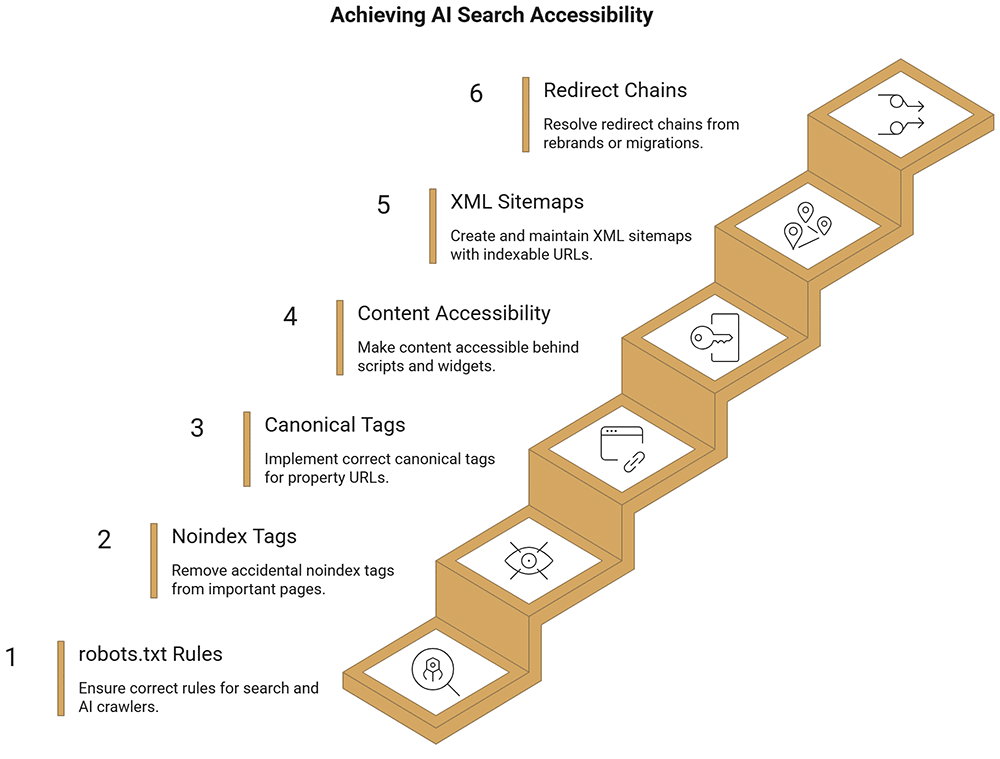
You need to audit six things before publishing anything new:
- robots.txt rules for search and AI crawlers, including OAI-SearchBot, which OpenAI recommends allowing.
- Accidental noindex tags on room, amenity, offer, and destination pages.
- Canonical tags pointing to the correct property URL.
- Content trapped behind scripts, consent tools, or booking widgets.
- XML sitemaps listing current, indexable URLs.
- Redirect chains left from a rebrand or migration.
Consider a hypothetical resort that explains its children’s club entirely inside a JavaScript booking widget. Guests can see the information after interacting with the page, but a retrieval system may receive little useful text from the main URL.
Track your Eligible Page Rate monthly: Indexable, canonical hotel pages ÷ total commercially important hotel pages × 100
A low score indicates an access problem. Publishing more content before resolving it creates inventory that search systems may never retrieve reliably.
The Hotel AIO Measurement Panel
There’s no Search Console for AI assistants, so measurement means disciplined sampling rather than a dashboard. Three numbers cover the three ways this fails: EPR for whether crawlers reach you, AAR for whether assistants name you, FAR for whether they get you right.
What Should You Track Monthly?
AAR (AI Appearance Rate): Measures how visible your property is in AI-generated hotel recommendations for your market.
Formula: AAR = Appearances / Prompts Tested x 100, tracked against your comp set.
FAR (Fact Accuracy Rate): Measures whether assistants describe your property correctly when they do name it.
Formula: FAR = Correct facts / Facts checked x 100.
Build a fixed panel of 20 prompts across four groups: discovery (“best boutique hotel in Porto”), suitability (“family hotel in Porto under 180 euros”), feature-led (“Porto hotel with EV charging”), and comparison (“compare Hotel A and Hotel B for three business nights”).
Suppose you appear in five of the 20. Your AAR is 25 percent. If three of the five describe your parking wrongly, visibility is growing faster than information quality.
Which Tools Report AI Citations?
Microsoft’s AI Performance report in Bing Webmaster Tools reached public preview in February 2026 and expanded in June with citation share and comparison views, showing which pages get cited and which queries trigger the citation. Google launched Search Generative AI performance reports in Search Console on June 3, 2026, covering impressions, pages, countries, and devices for AI Overviews, AI Mode, and Discover.
Neither report shows clicks. Impressions and citations tell you a page was used, not that it shaped the recommendation.
Referral data understates AI influence. Pew Research Center found Google users clicked a result link 8 percent of the time when an AI summary appeared, against 15 percent without one, in an analysis of 900 U.S. adults’ browsing.
Pair AAR with branded search volume and direct traffic.
Video: How to Optimize Content for AI Search Engines
What Does a Hotel AIO Strategy Mean for Independent Hotels?
Enterprise groups fund AIO with central data teams, schema templates deployed across hundreds of properties, and direct connectivity partnerships. You have none of that, and you don’t need it.
Independents hold an advantage that scale can’t replicate: specificity. A chain page describes a category, while you can state that 14 of your 40 rooms face a quiet courtyard, that check-in runs from 14:00, and that your two accessible rooms have roll-in showers. Those are the retrievable facts that let an assistant match you to a constrained request.
Among U.S. travelers, price comparisons drove the most action on AI recommendations at 44 percent, followed by summarized reviews at 33 percent and recognized brands at 32 percent, Phocuswright reported.
Read that ranking carefully. Brand recall is the weakest of the three drivers, which means an independent property with clean rate data and well-answered reviews competes on the two levers that matter more.
Consider a 40-room guesthouse in Ghent with strong reviews and a website that lists amenities only as icons. It’s invisible to text retrieval on the exact attributes guests filter for.
Is a Hotel AIO Strategy Worth the Investment Yet?
The strongest objection to hotel AIO is valid: AI remains a smaller source of initial hotel discovery than OTAs and traditional search. Moving a large performance budget away from channels that already produce bookings would be difficult to justify.
SiteMinder’s Changing Traveler Report, based on 12,000 travelers across 14 countries, found that 4% planned to begin hotel discovery with AI. The share had risen from 1% in the previous report, but it remained well below OTA and search-engine starting points. Four percent is not a channel. It’s a trend line moving fast enough to plan for.
As Trent Innes, Chief Growth Officer at SiteMinder, said in that release,
“The hotel discovery landscape is more dynamic than it’s ever been before.”
The right response is to fund hotel AI search optimization from duplicated work and information hygiene, not by cutting proven conversion activity. Accurate amenity fields can improve OTA listings. Correct structured data supports traditional search. Better policy pages reduce unsuitable inquiries. Review analysis can expose operational problems.
Do not buy guaranteed AI rankings. No major platform publishes a fixed hotel recommendation formula, and capabilities continue changing.
A hotel AIO strategy earns investment when it improves information quality across channels even before AI referrals become a major booking source.
FAQs About Hotel AIO Strategy
A hotel AIO strategy is the discipline of keeping every machine-readable fact about your property accurate, consistent, and corroborated, so assistants can recommend you with confidence. The properties gaining ground treat it as a quarterly commercial routine with an owner and a number attached, not as a website project with an end date.
Did You Like This Article About Hotel AI Search Optimization?
You might also be interested in the following articles:
- How Can AI Agents Improve Hotel Revenue Management
- AI Agents for Hotel Marketing Are Picking Winners Already
- ChatGPT Hotel Ads Explained Before the Auction Heats Up
More Tips to Grow Your Business
Revfine.com is the leading knowledge platform for the hospitality and travel industry. Professionals use our insights, strategies, and actionable tips to get inspired, optimize revenue, innovate processes, and improve customer experience.Explore expert advice on management, marketing, revenue management, operations, software, and technology in our dedicated Hotel, Hospitality, and Travel & Tourism categories.
This article is written by:

Hi, I am Martijn Barten, founder of Revfine.com. With 20 years of experience in the hospitality industry, I specialize in optimizing revenue by combining revenue management with marketing strategies. I have successfully developed, implemented, and managed revenue management and marketing strategies for individual properties and multi-property portfolios.


Leave A Comment