


Rate shopping is the practice of collecting the published rates of competing hotels across the channels where guests actually book, so that pricing decisions rest on the live market rather than on last year’s assumptions. Nearly every revenue management system now includes it, and nearly every revenue manager has at some point been shown a competitor rate that turned out to be wrong.
The data is rarely wrong because a system is broken. It is wrong because a hotel room is not a single product with a single price, and the collection method quietly flattens distinctions that matter. In this article, you will find the eight failures that appear most often, and what to change in each case.
8 Common Reasons Hotel Rate Shopping Data Goes Wrong
These eight common rate shopping failures show why competitor pricing can mislead hotel teams and how stronger collection methods improve accuracy and revenue decisions consistently.
1. The Competitive Set is Wrong Before Any Data is Collected
A comp set assembled from properties of similar star rating and proximity is a starting point, not an answer. What matters is which hotels a guest genuinely considers alongside yours, and that varies by segment. The property competing for your corporate midweek business is frequently not the one competing for your leisure weekend.
Running two or three comp sets by segment produces a slightly larger data bill and a much smaller number of pointless discussions. Review the composition twice a year, because renovations, brand conversions, and new supply change the picture faster than most annual processes allow for.
2. The Rate Matches But the Product Does Not
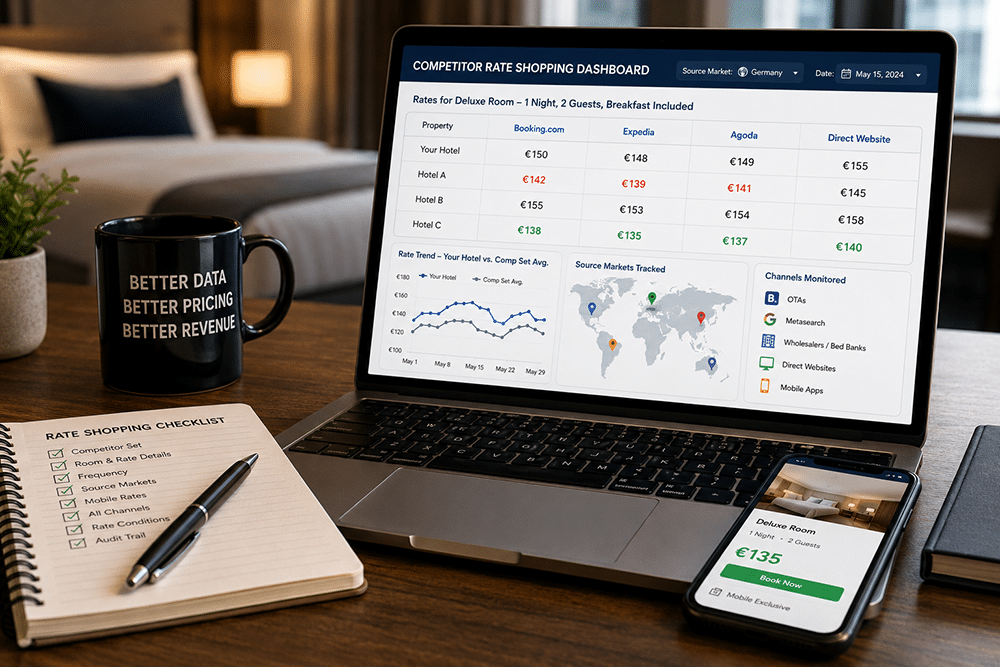
A competitor showing a rate 12 percent below yours may be quoting a smaller room, a non-refundable condition, a room-only rate against your breakfast-inclusive one, or double occupancy against your single. Comparing the headline number alone produces a conclusion that is confidently wrong.
Rate shopping data becomes reliable when every record carries the room category, the meal plan, the cancellation policy, and the occupancy it was captured for. If your tool does not expose those fields, treat its output as a directional signal rather than as evidence.
3. Sampling Too Rarely to See What Is Happening
A once-daily snapshot of a market that reprices several times a day tells you where competitors were, not where they are. In compressed periods, or around events, rates can move by double digits between morning and evening.
Increasing frequency across the whole calendar is expensive and unnecessary. The workable compromise is a tiered schedule: high frequency for the next fourteen days and for known demand periods, daily for the following ninety, weekly beyond that.
4. Every Rate Collected From A Single Point of Origin
This is the failure that surprises hoteliers most. Online travel agencies and hotel booking engines commonly vary what they display according to the market the request comes from. Currency, tax presentation, member pricing, and in some markets the availability of particular rate plans all depend on where the visitor appears to be.
If all of your rate data is collected from servers in one country, you are seeing one market’s view of your competitors and treating it as universal. For a resort drawing guests from six source markets, that is a material distortion. The rate a German guest sees for a competitor in January is the number that matters when you are competing for German guests.
Rate shopping providers solve this by sending each query from an address inside the source market being modeled. At the volume required, which is thousands of queries per hotel per day across dozens of markets, that means buying bulk residential proxies from a network such as ProxyWing, so each request looks like an ordinary consumer connection in the relevant country rather than a data center in a single location. If you are evaluating a rate shopping vendor, asking how they handle point of sale is one of the more revealing questions you can put to them.
5. Mobile and App Exclusive Rates Are Missed Entirely
A significant share of leisure bookings now happens in an app, and several major channels run mobile-only discounts that never appear on the desktop site. Collection built purely around desktop pages therefore misses the actual lowest rate in market, which is precisely the number a rate parity discussion depends on.
Ask your provider explicitly whether mobile rates are captured. If they are not, a manual spot check on a phone once a week for your top five competitors is a crude but honest substitute.
6. Parity is Checked On One Channel and Assumed Everywhere
Rate parity problems rarely originate on the channel where they are visible. A wholesale rate contracted years ago gets repackaged, appears on a metasearch result at a price below your own direct rate, and the OTA landing page you were monitoring shows nothing unusual.
| Where to look | What tends to appear there | How often to check |
| Major OTA landing pages | Contracted rates, member discounts | Daily |
| Metasearch results | Wholesale leakage, unfamiliar sellers | Weekly |
| Bed banks and wholesalers | The original source of most leakage | Monthly review of contracts |
| Package and opaque channels | Rates bundled below floor | Monthly |
| Your own booking engine | Whether direct is genuinely cheapest | Daily |
| Corporate and negotiated portals | Rates below public floor in error | Quarterly |
7. The Conditions Attached to a Rate Are Discarded
Length of stay restrictions, closed-to-arrival rules, and minimum advance purchase all change what a rate means. A competitor at a low rate with a three-night minimum is not competing with you for a one-night stay, and pricing down to match them costs revenue for no reason.
Any rate record worth acting on should carry its restrictions. Where the data does not include them, a quick check of the competitor’s own booking engine before making a significant pricing decision takes two minutes and prevents the common mistake.

8. No Audit Trail, So Disagreements Cannot Be Settled
When a general manager says a competitor was cheaper last Tuesday and the system says otherwise, the conversation should take thirty seconds. It usually takes an hour, because nobody stored what was actually seen.
Retain the raw capture, including the timestamp, the source market, the device type, and the channel. Storage is inexpensive, and the alternative is a recurring argument in which the loudest recollection wins.
What Better Data Is Worth in Revenue Terms
The argument for fixing collection is usually made in terms of accuracy, which rarely moves a budget conversation. The commercial version is more persuasive. A property selling one hundred rooms at an average rate of 150 euros loses 5,475 euros a year for every single euro of average rate given away unnecessarily on one third of its nights.
Rate decisions taken on incomplete data give away considerably more than one euro. The most common pattern is matching a competitor’s non-refundable rate with a flexible one, which surrenders both rate and condition at once. The second most common is holding a rate for a date where a competitor has closed out entirely, leaving demand unpriced.
Set against that, the cost of better collection is small and largely fixed. It does not scale with the size of the property, which is why independent hotels often see a larger proportional benefit than chains with established central systems.
Putting This Into Practice
Start by auditing what your current data actually contains. Take one arrival date, pull every competitor rate your system holds for it, and compare against a manual check on the same day from two source markets. Where the numbers disagree, the reason will almost always be one of the eight above.
Fixing the collection layer is considerably cheaper than the pricing mistakes it prevents, and it changes the tone of commercial meetings. Discussions move from whether the data is right to what to do about it.
FAQs
Accurate rate shopping depends on context, frequency, source markets, device types, restrictions, and auditability. When hotels improve how competitor data is collected and interpreted, revenue teams can price with confidence, protect margins, resolve parity issues, and capture demand more effectively.
More Tips to Grow Your Business
Revfine.com is the leading knowledge platform for the hospitality and travel industry. Professionals use our insights, strategies, and actionable tips to get inspired, optimize revenue, innovate processes, and improve customer experience.Explore expert advice on management, marketing, revenue management, operations, software, and technology in our dedicated Hotel, Hospitality, and Travel & Tourism categories.






Leave A Comment