

AI agents for hotels represent the next evolution of artificial intelligence in hospitality. Unlike traditional AI tools or chatbots that respond to prompts, AI agents can analyze data, make decisions, and take action across departments automatically. This will enable hotels to contend with staffing challenges and continue to meet and exceed guest expectations.
In this article, you’ll learn what AI agents for hotels are, how they work, where they deliver the highest ROI, and how they will shape the future of the hospitality industry.
Quick Definition:
Key Takeaways:
|
–
Table of Contents:
- What Are AI Agents for Hotels?
- Why Hotels Are Adopting AI Agents
- Where Hotels Are Today With AI
- 9 AI Agents that Are Shaping the Future of Hotels
- 1. Revenue Management AI Agents
- 2. Operations and Housekeeping AI Agents
- 3. Guest Communication AI Agents
- 4. Energy Management AI Agents
- 5. Upselling and Ancillary Revenue AI Agents
- 6. Food and Beverage AI Agents
- 7. Reputation Management AI Agents
- 8. Maintenance and Predictive AI Agents
- 9. Call Center and Voice AI Agents
- How AI Agents Impact Different Hotel Business Models
- Common Challenges When Deploying AI Agents for Hotels
- Global Outlook: AI Agents for Hotels (2026 to 2036)
- How Artificial Intelligence is Changing the Travel Industry
- How to Use Artificial Intelligence in the Hospitality Industry
- AI Agents for Hotels FAQs
What Are AI Agents for Hotels?
AI agents for hotels are autonomous software systems that are used to carry out a variety of automated tasks. They are powered by artificial intelligence, but unlike AI chatbots, can perform actions without needing human prompts.
One of the defining features of an AI agent is the ability to reason through problems and make decisions on behalf of a business. This can include optimizing real-time pricing, sending offers to guests, and planning work schedules.
The use of agentic AI for hotels is becoming more popular, as the technology can offer many of the benefits associated with human staff. Yet, at the same time, AI agents can operate on a 24/7 basis, make decisions in the ideal moment, and coordinate with other systems to ensure decisions benefit the entire hotel.
Video: AI Agents, Clearly Explained
Why Hotels Are Adopting AI Agents
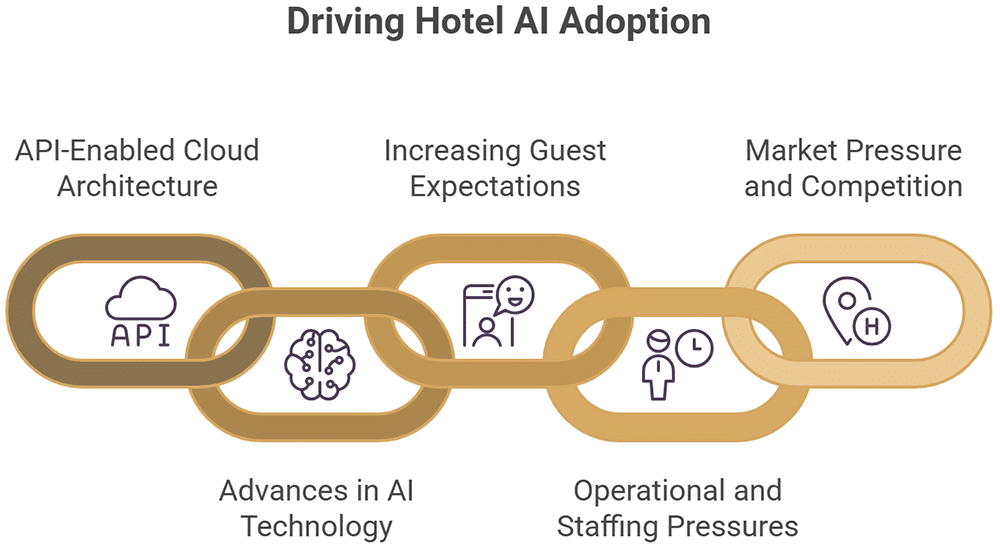
AI agents for hotels are in high demand today, driven by advances in technology and the very real pressures being faced by hotels. In the sections below, you can explore why leaders are investing in hotel AI agents:
1. API-Enabled Cloud Architecture
The rise of API-enabled cloud architecture is one of the biggest driving forces behind AI agents for hotels. An API, or application programming interface, allows different software systems to communicate with each other.
For hotel AI agents, this is essential for enabling revenue management, property management, customer relationship management, and booking software to share data. As a result, the agents can coordinate on a cross-departmental basis.
Through API-enabled cloud architecture, modern AI agents can be ready to automate entire workflows 24/7, relying on data and insights from multiple sources, before taking action at the ideal time.
2. Advances in AI Technology
Artificial intelligence is continually improving and has experienced significant advances in recent years, especially with large language models. These advances allow AI to understand human language and interpret responses.
In other words, AI agents for hotels are now better equipped to understand nuance and intent. They can also learn from past actions, deal with complicated tasks, and reason their way to logical conclusions.
The agents can also go beyond simply responding to questions assisting with complex operational decisions.
As Max Starkov, Hospitality and Travel Technologist, puts it:
“Transitioning travel from mobile-first to AI-first will be the greatest transformation of our industry since the advent of the internet. Within this AI transformation, I believe agentic AI like the Gemini AI agent will have the single biggest impact on our industry.”
3. Increasing Guest Expectations
Guests increasingly want ‘low touch‘ experiences. Research from Oracle shows 73% of travelers want technology to minimize contact with hotel staff, while 74% want hotels to use AI to better tailor services and offers.
For hotels, there is a pressing need to respond to this in order to meet guest expectations and avoid losing guests to more tech-driven hotels. Next-generation hotel AI is one of the ways properties can deliver this.
AI agents for hotels can process orders, deliver mobile check-ins and check-outs, and offer data-driven recommendations.
Video: AI Agent for Hotel Booking (The Future of Hospitality is Here!)
4. Operational and Staffing Pressures
Hotels face growing operational complexity and are doing so while dealing with staffing pressures. According to an AHLA survey, 65% of hotels are facing staff shortages, and 71% have job openings they are unable to fill.
Among the challenges are financial pressures that make it hard to remain competitive and the allure of remote and hybrid working in other industries. Combined with rising complexity, this can potentially cause service standards to fall.
AI agents for hotels can plug some of the skills gaps and reduce pressure on staff, while saving hotels money.
5. Market Pressure and Competition
The rise of agentic AI in hospitality has also been driven by market pressures and competition. Guests compare hotel experiences with other hotels, but also with the service they receive at banks, supermarkets, and more.
This places pressure on hotels to be able to deliver seamless self-service options. It also increases the need for personalization and to use data-driven insights to meet and exceed guest expectations.
With the rise of AI agents for hotels, properties that fail to adopt the technology risk being left behind.
Where Hotels Are Today With AI
Implementing AI agents for hotels may feel like a big step, but most hotels are already using some form of artificial intelligence. However, at present, many are relying on reactive or siloed AI solutions.
For example, AI-powered chatbots are reactive in that they respond to messages from customers. Many AI-powered predictive modeling tools operate autonomously, but are isolated from other hotel systems.
Research from H2C shows that 78% of hotel chains are already using AI, and 89% of hotels plan to expand the use of AI within the next two years. However, only 6% of hotel chains have a company-wide AI strategy.
The use of AI agents for hospitality will take things to the next level for many properties. The agents can deliver fully integrated AI systems, which share data seamlessly and interpret information to make reasoned decisions. They will be able to act both proactively and reactively and coordinate operations across departments.
This will allow for company-wide AI strategies, rather than siloed AI systems performing relatively simple actions.
If you want to learn more about how AI is being used in the hotel industry, read the “Discover Examples of Artificial Intelligence (AI) in the Hotel Industry” article.
Daniel O’Sullivan, Senior Director Analyst, Gartner Customer Service & Support states:
“Agentic AI has emerged as a game-changer for customer service, paving the way for autonomous and low-effort customer experiences.”
Video: 6 Best AI Agents for Hotels 2026 (+ PROOF)
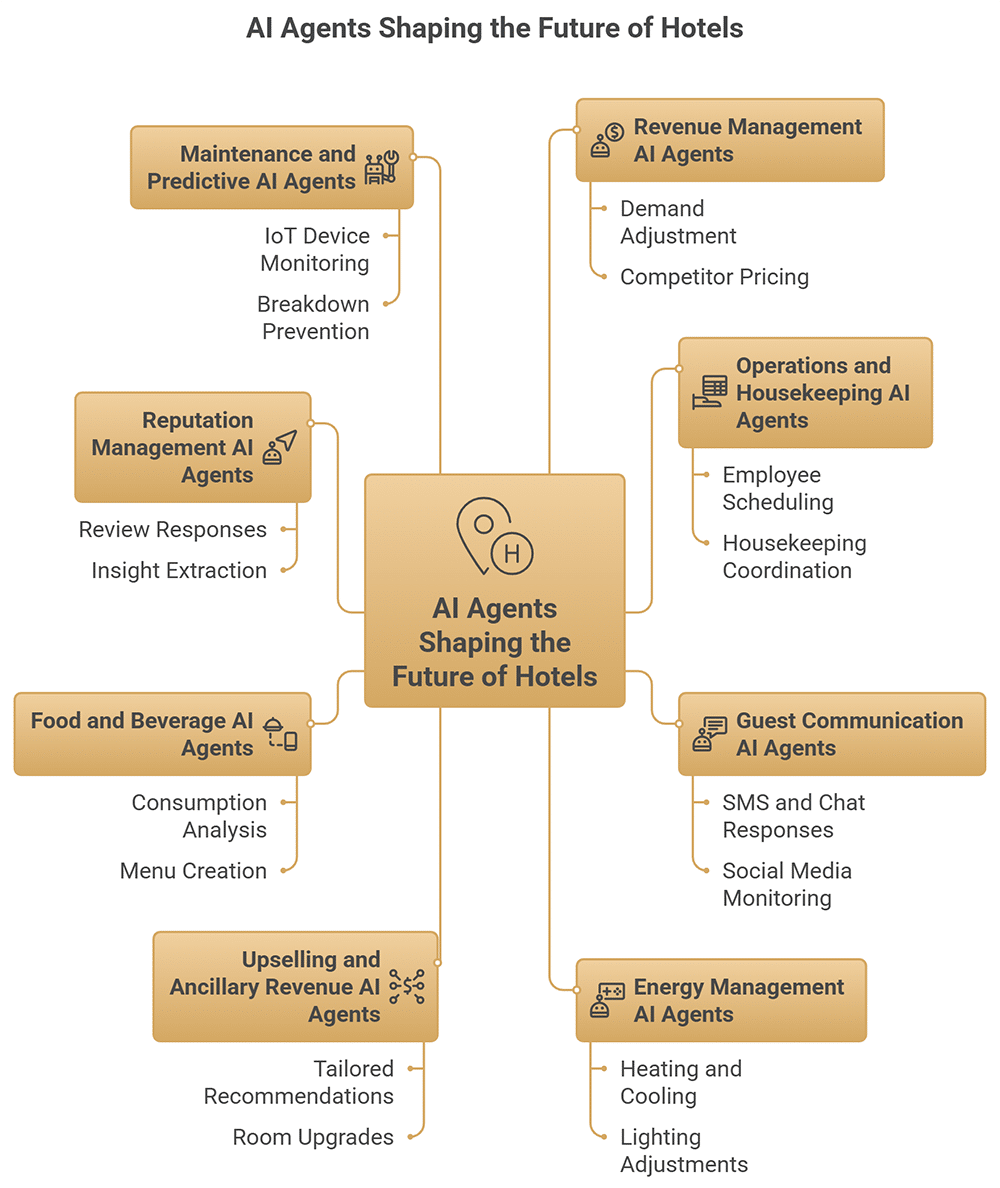
9 AI Agents that Are Shaping the Future of Hotels
Understanding the different AI agents for hotels and what they have to offer can help you make more informed decisions about where to invest and which systems are going to deliver the best return on investment:
1. Revenue Management AI Agents
Revenue management AI agents are able to automatically adjust room rates based on factors like demand and competitor pricing strategies. This allows hotels to maximize income and profits.
These AI agents for hotels can even outperform human revenue management professionals. After all, the AI-powered software can make adjustments at any time of the day, delivering swift responses to new contextual information.
In fact, one mid-sized hotel achieved a 10% increase in revenue per available room (RevPAR) when compared to manual methods simply by switching to an AI system that updates rates frequently and precisely.
2. Operations and Housekeeping AI Agents
Operations and housekeeping AI agents for hotels assist with the day-to-day running of the hotel. This can include managing employee schedules, coordinating housekeeping teams, and alerting maintenance staff to problems.
The software can potentially draw from a variety of data points, including hotel occupancy, long-term demand patterns, and status information from internet-connected devices. This data can then be used to inform actions.
Crucially, AI-powered hotel agents used in this way can reduce human error with scheduling, flag maintenance issues quickly, and help to ensure resources are directed to the right places at the right time.
3. Guest Communication AI Agents
Communication-focused AI agents for hotels can respond to guest interactions across channels. This can include answering SMS, online chat, and WhatsApp messages, as well as responding to social media posts.
Guests have high expectations when it comes to response times, and AI agents can help to meet these demands. The agents can also remember questions and responses, and use this to inform future conversations.
The most advanced systems can respond across any language, will greatly reduce workloads for customer service staff, and can intelligently decide when a more complex query should be passed on to a human.

Michael J. Goldrich, Founder & Chief Advisor, Vivander“AI agents learn to understand and anticipate unique customer needs by acting as digital receptionists across voice, chat, web, and messaging apps. They remember guests, maintaining context and continuity. Eventually, they will remember you across devices. If a guest asks about pet policies on WhatsApp, the AI suggests pet-friendly rooms when they visit the website later. With real-time access to inventory, pricing, and PMS data, these AI agents will move beyond simple Q&A to perform transactions. They instantly check room availability, verify prices, and confirm services like late check-outs on any channel. This frictionless interaction means that guests don’t have to repeat themselves; each engagement builds on the last. This personalisation enhances sales interactions and boosts conversion rates. Guests receive customised experiences, making them more likely to engage with offers and complete bookings. Achieving this requires strong API integrations plus strict data privacy and security measures to protect guest information and build trust.” Click here to learn more from our Hotel Marketing Expert Panel. |
4. Energy Management AI Agents
Energy management AI agents are able to work autonomously in the background, making constant adjustments to reduce energy consumption. This can include adjusting heating, air conditioning, lighting, and more.
For hotels, effective energy management can help to greatly reduce operating costs. At the same time, AI adjustments to heating, cooling, and other hotel controls can create a more appealing environment for guests.
AI can make small changes throughout the day, based on guest preferences, the current conditions within a room, and whether the room is occupied or empty. An example of an energy management AI system in action is Hilton’s AI-driven LightStay solution, which helped to achieve over $1 billion in energy cost savings.
5. Upselling and Ancillary Revenue AI Agents
Some AI agents for hotels are designed to assist with upselling and ancillary revenue. These systems will make tailored recommendations to guests, highlight unique special offers, and automatically offer room upgrades.
Upselling and ancillary revenue are crucial for hotels aiming to maximize financial outcomes. This involves persuading customers to buy upgrades or convincing guests to pay for additional products or services.
AI systems can push these messages at the ideal time, to the right guests, based on data. This makes it more likely for a hotel to earn additional revenue and can minimize disruption caused by less relevant marketing.
Video: This AI Agent is Boring… But it Saves Hotels $30,000 / Year
6. Food and Beverage AI Agents
Some AI agents for hotels are focused on the food and beverage sector, analyzing consumption patterns and revenue data. This can enable the agents to anticipate demand, predict financial outcomes, and adjust pricing.
An effective F&B AI agent can assist with everything from menu creation to supply management. The AI system may be able to identify the ideal time to place orders or assess how many guests order each menu item.
For food and beverage managers, AI can help to reduce waste, anticipate spikes in demand, and identify menu items that are performing well or poorly. This can improve the profitability of the department while boosting guest satisfaction.
7. Reputation Management AI Agents
Reputation management AI agents are designed to monitor trends about guest feedback and take appropriate action. This may include responding to reviews and extracting valuable insights from guests.
When AI agents for hotels are trained to focus on reputation management, they can automatically thank guests for positive reviews. They can also learn from negative reviews by identifying common complaints.
When integrated with other systems, the agents may even be able to take steps to solve problems that are impacting your reputation online. This can lead to an upturn in reviews on platforms like Google and TripAdvisor.
8. Maintenance and Predictive AI Agents
Predictive maintenance AI agents use data from IoT devices and other relevant information to identify the ideal time to initiate repairs or maintenance work. This helps to focus maintenance efforts where they are most needed.
Breakdowns, malfunctions, and other problems that cause downtime can hurt hotel revenue and profits. By deploying AI that can anticipate issues and alert staff to them quickly, any disruption can be minimized or avoided.
AI agents for hotels can monitor the status of hundreds of devices in real-time. They can also be trained to spot even subtle signs of issues with elevators, automatic doors, or heating and air conditioning systems.
9. Call Center and Voice AI Agents
Call center and voice AI agents are designed to answer phone calls and respond intelligently to what is said. This may include answering questions, taking bookings, and describing hotel facilities and amenities.
In many ways, this can be seen as the next evolution of AI chatbots. However, here, AI is replicating verbal communication, instead of text-based communication, offering greater convenience and faster resolutions.
A study from Canary Technologies found that 40% of all front desk calls go unanswered. By deploying AI technology, hotels could make up for any associated loss of revenue or reputational harm.
How AI Agents Impact Different Hotel Business Models
The ways AI agents for hotels are actually used can depend on a number of factors, including the size and business model of a hotel. Here, you can explore how AI agents are able to assist different hotel types:
AI Agents for Independent and Small Hotels
In small and independent hotels, staff are often stretched, and response times can be a major challenge. AI agents for hotels of this kind can help to alleviate workloads and speed up these response times.
The primary benefit of AI agents in these workplaces is not to replace staff, but to supplement the workforce. The agents free up staff time to focus on important matters and can aid with data-driven decision-making.
AI Agents for Multi-Property Groups or Chains
Within multi-property hotel chains and groups, artificial intelligence technology can be used to standardize processes. AI agents for hotels and resorts can apply shared rules and optimize pricing across a large portfolio.
The use of AI agents has the potential to reduce staffing needs, helping chains that face pressures in this area. Agents can also continually learn from situations and apply those lessons to similar hotels automatically.
Video: How Hospitality (Hotels, Resorts, Restaurants) Businesses Can Benefit from AI Agents
Common Challenges When Deploying AI Agents for Hotels
Although AI agents for hotels can deliver a number of positives, there are some obstacles to overcome, too. Here, you will find an overview of some of the most common challenges hotels face with implementation:
- High Upfront Costs: While most hotels are able to report a positive ROI after around one year, the upfront costs of software, hardware, training, and implementation are often very high.
- Resistance to Change: There is an understandable resistance to the kind of large-scale change that AI agents for hotels can deliver, especially from employees who may fear for their jobs and need reassurance.
- Integration Complexity: Many hotels will still be using legacy systems, which may lack API capabilities. This can make integration complex and time-consuming, requiring upgrades and replacements.
- Privacy and Security: AI-powered hotel agents can deliver personalization through the use of customer data. Yet, this brings with it concerns about how data is collected, stored, and used.
- Guest Acceptance: While research shows a general trend towards ‘low touch’ models, some guests still crave human-to-human contact, and hotels may still need to provide options to appeal to this market.
- Maintaining Quality: Implementing AI agents for hotels can take months. Hotels need to maintain quality standards in the meantime by rolling out the technology gradually and having contingency plans in place.
Global Outlook: AI Agents for Hotels (2026 to 2036)
The vast majority of hotels are already using AI. However, just 5% of enterprise applications were integrated with task-specific AI agents in 2025, while Gartner forecasts this will increase to 40% by the end of 2026.
Gartner anticipates this leading to a rapid shift, from task-focused AI systems designed to support individual productivity, to entire agentic AI ecosystems. It is believed this will facilitate autonomous cross-departmental collaboration.
The next stage of rollout for AI agents for hotels will be the implementation of multiple AI agents, each focused on a specific area, like housekeeping or revenue management. Each will have the ability to share and receive data from one another, interpret that data, and make decisions in the best interests of the hotel as a whole.
The decisions made by agentic AI systems will be based on information gathered from numerous sources, and the AI systems will be able to remember past decisions and their consequences, in order to continually learn. By the 2030s, AI agents will continually tailor offerings for each guest, offering hyper-personalization.
With that being said, there are still some challenges ahead for AI adoption in the next decade. Right now, according to a joint research project from McKinsey and Skift, 90% of customers have some confidence in the accuracy of AI-generated travel information, but just 2% trust it to make and modify travel bookings without human oversight.
This highlights a remaining degree of skepticism and also suggests, for travelers at least, that AI is still seen primarily as a responsive tool to aid decision-making, rather than a tool trusted to make big decisions by itself.
Furthermore, hotels are likely to encounter resistance from hotel staff, who see AI as a threat to employment.
How Artificial Intelligence is Changing the Travel Industry
Artificial intelligence is a transformative technology that is reshaping the way we think about travel. In addition to AI agents for hotels, travel companies are increasingly turning to responsive AI chatbots for customer service, AI facial recognition for security, and AI-driven personalization to improve guest experiences.
In the “How Artificial Intelligence (AI) is Changing the Travel Industry” article, you can explore more about the role of AI within travel businesses and how it is changing experiences for employees and customers alike.
How to Use Artificial Intelligence in the Hospitality Industry
Artificial intelligence can be used in a number of key ways to enhance hospitality. Examples range from using AI agents for hotels to improve business operations to using simple AI chatbots to deliver faster responses. At the same time, AI has the potential to alleviate staffing pressures and reduce human error in certain situations.
In the “How to Use Artificial Intelligence in the Hospitality Industry” article, you can gain deeper insights into the specific ways AI can be deployed to benefit your business, your staff, and your guests.
AI Agents for Hotels FAQs
AI agents for hotels represent the next level of AI technology within hospitality. Rather than awaiting prompts, these systems are able to use artificial intelligence to make real-time decisions in the best interests of a hotel. Despite high initial costs, they can deliver long-term savings and are able to function on a 24/7 basis.
Did You Like This Article About AI Agents for Hotels?
You might also be interested in the following articles:
- Hotel Technology Trends: 26 Upcoming Innovations You Must Know for 2026
- Hotel Robots: An Overview of Different Robots Used in Hotels
- 20 Hot Digital Trends in the Hotel Industry
More Tips to Grow Your Business
Revfine.com is the leading knowledge platform for the hospitality and travel industry. Professionals use our insights, strategies, and actionable tips to get inspired, optimize revenue, innovate processes, and improve customer experience.Explore expert advice on management, marketing, revenue management, operations, software, and technology in our dedicated Hotel, Hospitality, and Travel & Tourism categories.

Leave A Comment