


Hotel competitor analysis is a systematic process where you evaluate rival properties. This allows you to get a clear sense of their strengths, weaknesses, reputation, unique selling proposition, and overall market position. Analyzing competitors is important because it allows you to make more strategic decisions about your own pricing, marketing, and hotel services. It can also help to alert you to changes in competitors’ approach.
In this article, you can explore tried and tested methods for carrying out an analysis of hotel competitors. You will also learn about the essential metrics to track and the best techniques and tools to use so you can gain a competitive edge.
Quick Definition:
Key Takeaways:
|
–
Table of Contents:
- What is Hotel Competitor Analysis?
- Why is Hotel Competitor Analysis Necessary for Hoteliers?
- 7 Key Metrics to Track in Your Hotel Competitor Analysis
- How to Perform Effective Hotel Competitor Analysis
- 1. Define Your Competitive Set Accurately
- 2. Monitor Pricing Strategies and Rate Parity
- 3. Analyze Service and Amenity Offerings
- 4. Evaluate Digital Presence and Marketing Strategies
- 5. Assess Reputation and Guest Satisfaction
- 6. Benchmark Key Performance Indicators
- 7. Implement Strategic Intelligence Gathering
- The Best Tools for Conducting Hotel Competitor Analysis
- How AI is Transforming Hotel Competitor Analysis
- Real-World Example: AI-Powered Competitor Monitoring
- Common Mistakes in Hotel Competitor Analysis (and How to Fix Them)
- How to Create the Perfect Hotel Competitor Report
- Global Outlook for Hotel Competitor Analysis Over the Next Decade
- An Essential Guide to Hotel Invoices
- Exploring Hotel Industry Challenges
- FAQs Related to Hotel Competitor Analysis
What is Hotel Competitor Analysis?
Hotel competitor analysis is a structured approach to evaluating competing accommodation properties. It involves assessing their pricing models, services, marketing strategies, and customer feedback.
It is essentially a kind of hospitality competitor research, allowing you to get a better sense of rivals’ strengths, weaknesses, unique selling propositions, and reputation. This helps you to understand their market position.
An effective hotel competitor analysis strategy will monitor multiple distribution channels and review platforms. This allows you to build a sense of guest satisfaction, reputation, and pricing behaviors.
Why is Hotel Competitor Analysis Necessary for Hoteliers?
Hotel competitor analysis is vital because it provides insights into the current state of the hotel market. As a result, it drives strategic decision-making and helps you to identify areas of opportunity, so you gain a competitive advantage.
By building an understanding of what rivals are doing right and wrong, hoteliers can identify effective strategies and gaps in the market. Doing so helps with market placement and service differentiation.
Hotel competitive intelligence strategies also make it easier to spot shifts in the hotel market, such as the emergence of new technology, changes in pricing approach, and up-to-date marketing tactics. Therefore, you can respond quickly to shifts, avoid falling behind rival hotels, and identify emerging opportunities and threats.
“To succeed in the competitive landscape, standard revenue management won’t be enough. Hotels need to focus on a cross-disciplinary approach to generate demand and methodically measure each strategy — deploying effective sales and marketing strategies and keeping up with consumer trends are pivotal.”
CBRE Hotels Advisory Team — Key Trends in Hotel Revenue Management
Video: Competition in the Hospitality Industry – Examples, Features, Direct & Indirect Competitors
7 Key Metrics to Track in Your Hotel Competitor Analysis
A comprehensive hotel competitor analysis should focus on some key components that help you to understand the competitive landscape. Here, you can explore seven of the most essential metrics or areas to focus on:
- Market Position: Where does your hotel stand in the market, relative to your competitors? Where do their hotels rank? Consider aspects like star ratings, location, brand recognition, and reputation.
- Pricing Strategy: Assess competitors’ pricing across all seasons. Compare weekend prices and weekday prices, as well as pricing across multiple distribution channels, so you can fine-tune your strategy.
- Target Audience: Identify the types of customers your competitors appeal to through marketing campaigns and hotel services. This can help you identify underserved markets to focus your efforts on.
- Guest Experience: Monitor online reviews and feedback to get a sense of customer satisfaction. Identify the strengths and weaknesses of their guest experience, as these influence booking decisions and customer loyalty.
- Marketing & Branding: Analyze competitors’ marketing campaigns and overall positioning. Explore their use of promotional offers, social media, and advertising, so you can differentiate your approach.
- Distribution Channels: Explore the booking channels used by rivals, including OTAs and hotel websites. Build a strategy that maximizes reach and revenue, while minimizing commission fees.
- Unique Selling Point: Be clear on what sets rival hotels apart, such as their brand positioning, amenities, and service quality. Use your hotel competition analysis to refine your own USP.
Video: How To Conduct a Competitive Analysis (FREE Template)
How to Perform Effective Hotel Competitor Analysis
Hotel competitor analysis is a systematic process, so you need to follow some defined steps. Here, you can access a breakdown of how to analyze hotel competitors, so you can gather valuable insights:
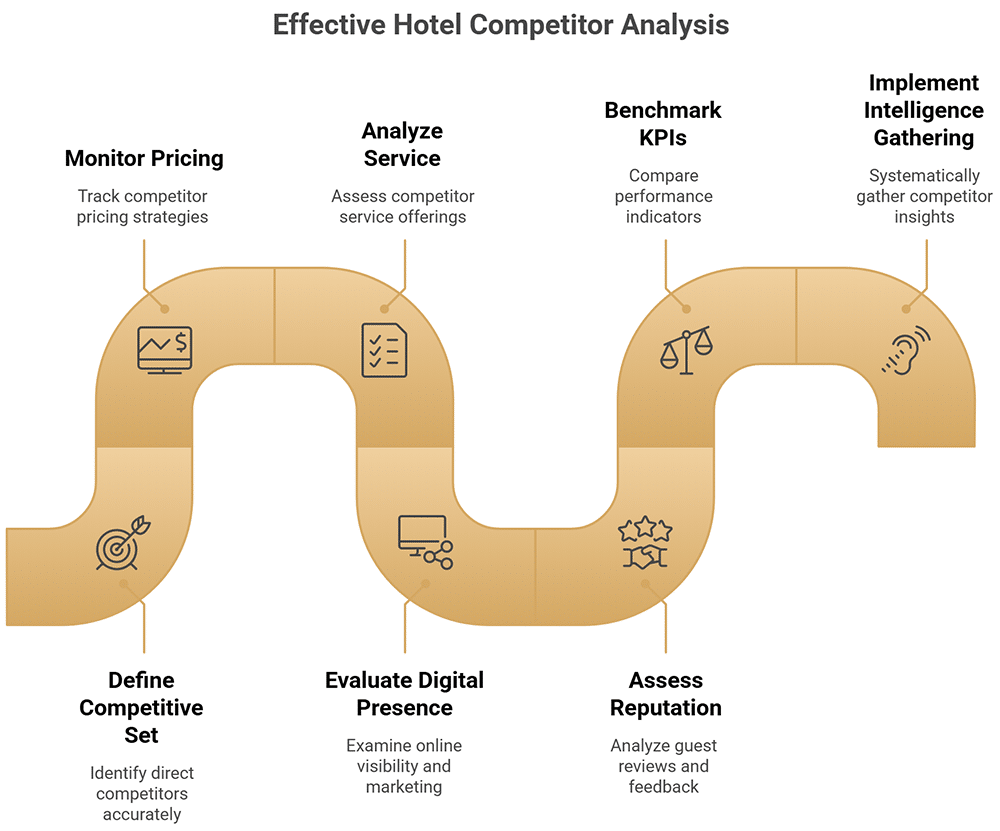
1. Define Your Competitive Set Accurately
The first step in your hotel competitor analysis strategy is to accurately identify your competitive set. These are the properties that are directly competing with your hotel for your target market.
Defining your competitive set is essential for a useful hotel competitive analysis because you do not want to compare your property to irrelevant businesses. Focus on the most relevant hotels.
Your competitive set is likely to include hotels with similar star ratings, price points, and target demographics. They are often in the same geographical location, but your competitive set may include hotels in other places, too.
2. Monitor Pricing Strategies and Rate Parity
Tracking competitor pricing is a key component of any useful hotel competitor analysis. This should include monitoring prices across all available distribution channels and observing the level of rate parity.
Analyzing pricing information helps you to understand patterns in pricing behavior and can allow you to understand promotional strategies. It can also provide useful insights about demand and how rivals respond to fluctuations.
Tracking competitor pricing is one of your most useful tools for hotel competitor benchmarking. You can use pricing information to set your own prices and better understand your own position within the market.

Tanya Hadwick, Group Revenue & Yield Leader, SunSwept Resorts“I would typically suggest looking at guest feedback and benchmarking. Internally, looking at guest satisfaction and perceived value for money, it’s good to use tools such as Reviewpro or Revinate for this. Also, it’s useful to test a little price elasticity, i.e., implement a slight rise in price, and then monitor the impact. Externally, one can use STR and Rategain to compare pricing and performance. Ultimately, our pricing is typically aligned with our brand, our offering, and the perceived value to the guests. It’s also about ensuring that we are maintaining the expected standards of service and delivery, especially with high repeat clientele numbers.” Click here to learn more from our Revenue Management Expert Panel. |
3. Analyze Service and Amenity Offerings
A complete hotel competitor analysis must also include an assessment of the services, amenities, and guest experience on offer. For instance, do they offer Wi-Fi, breakfast, on-site entertainment, and wellness programs?
Knowing the services your competitors offer can help you optimize your own offerings. Try to create a comprehensive picture of the services of all hotels in your competitive set, so you can spot gaps in the market.
Building an understanding of what your rivals are offering guests makes it easier to identify areas where you can differentiate. In the process, you can develop a stronger, unique selling proposition and increase your appeal.
If you want to learn more about how to meet guest expectations, read the article “Hotel Amenities: Meet and Exceed Your Hotel Guests’ Expectations”.
4. Evaluate Digital Presence and Marketing Strategies
Online visibility can have a major impact on hotel success, so your hotel competitor analysis should evaluate this. Examine your competitors’ hotel websites, social media presence, ad campaigns, and content strategies.
Evaluating these aspects can help you know the market segments they are targeting and the messages they are putting out there. You can also get a sense of the messages that resonate most with guests.
Check rival hotels’ placement on search engine results pages for key industry terms and compare them with your own. Understanding SEO performance can potentially help you boost your own online visibility.
As Josh Ramsey, SSP Revenue Management Industry Expert, shares his insights:
“Revenue strategy and storytelling only work when they speak to the right guest. If you don’t understand what your customer segments value about your offering, you risk telling the wrong story and chasing the wrong business.”
5. Assess Reputation and Guest Satisfaction
Make sure you are getting a sense of the reputation of each hotel in your competitive set. Pay attention to feedback on platforms like Google, TripAdvisor, and major OTAs and look for patterns in guest reviews.
Analyzing review data and identifying trends helps you to get a clearer sense of what customers actually think. It can tell you where rivals are excelling and where they are falling short.
Cornell’s research found that a 1% increase in a hotel’s online reputation score leads to up to a 0.89% increase in ADR, a 0.54% increase in occupancy, and a 1.42% increase in RevPAR, which gives you a very strong business case for tracking review sentiment in competitor analysis.
Create a sentiment analysis framework so you can sort feedback based on key hotel service touchpoints. This can make it easier to understand guest sentiment on staff interactions, check-ins, housekeeping, dining, etc.
6. Benchmark Key Performance Indicators
When carrying out your hotel competitor analysis, you should obtain key performance indicators from rival hotels. You can use this information to benchmark your own hotel’s performance against these properties.
This is important because it provides much-needed context when assessing your own performance and the performance of competitors. It also enables you to directly compare specific aspects of hotel performance.
Using benchmarking tools like STR, you can access hotel industry competition insights more easily. It then becomes much easier to track KPIs like ADR and RevPAR and compare these with performance data from your hotel.
If you want to learn more about RevPAR, read the article “Calculate RevPAR and Maximize Your Hotel’s Revenue.”
7. Implement Strategic Intelligence Gathering
Develop systematic processes for gathering intelligence on competitors. This could include training sales, front desk, and customer service staff to naturally gather insights from interactions with guests.
While publicly available information can help with your hotel competitor analysis, you want to get to the heart of what people really think. Some of the best insights may come naturally through routine interactions.
Make sure you have processes in place for gathering intelligence and validating it. Train all relevant hotel staff to report intelligence properly, so information can be consolidated and looked into further.
The Best Tools for Conducting Hotel Competitor Analysis
Using the right tools can significantly improve the quality of your hotel competitor analysis. Here, you can find an overview of the best tools to invest in:
- Rate Shopping Tools: Systems like RateGain and OTA Insight can automatically track your competitors’ room rates across multiple channels, offering real-time pricing information.
- Benchmarking Platforms: Services like Smith Travel Research (STR) offer performance data, like occupancy, average daily rate, and RevPAR, so you can benchmark your performance and assess performance gaps.
- Reputation Management Systems: ReviewPro, Revinate, and other similar tools can aggregate feedback from multiple sources, allowing you to conduct a sentiment analysis and understand the reputation of rival hotels.
- Social Listening Tools: Platforms like Mention and Brandwatch help you to monitor social media sentiment and audience engagement, so you can understand your competitors’ digital strategies and effectiveness.
- Market Intelligence Services: Specialist solutions like HotStats and Kalibri Labs provide detailed intelligence that can help you to understand wider market dynamics. HotelTechReport says Four Views Hotels used rate and market intelligence tools to better position the hotels and improve commercial decision-making.
- Website Analysis Tools: SEMrush, SimilarWeb, and other tools can help you gain insights about web traffic, search engine rankings, and the effectiveness of your rivals’ digital marketing campaigns.
How AI is Transforming Hotel Competitor Analysis
Artificial intelligence has fundamentally changed the speed, depth, and accuracy of competitive intelligence available to hoteliers. AI is moving competitor analysis from a periodic manual exercise to a continuous automated function.
1. AI-powered Rate Intelligence
Modern rate shopping platforms now use machine learning to track competitor pricing across hundreds of OTA channels simultaneously, refreshing data in near-real time. Tools like Lighthouse (formerly OTA Insight) and RateGain deploy AI to identify pricing patterns, predict competitor behavior during demand surges, and recommend optimal rate positioning before the market moves.
2. Automated Sentiment Analysis
Natural Language Processing (NLP) tools now automatically scan thousands of reviews across Google, TripAdvisor, Booking.com, and social media to identify recurring themes in competitor feedback. Rather than manually reading reviews, revenue managers receive structured sentiment reports categorized by service dimension. They are enabling rapid identification of competitive weaknesses to exploit and service gaps to close.
3. Predictive Competitive Modeling
AI-driven Revenue Management Systems (RMS) now incorporate competitor pricing, demand signals, local events, and macroeconomic indicators into predictive models that recommend room rates hours or days before competitors have adjusted theirs. This moves competitor analysis from reactive to proactive.
As Stan van Roij, VP of Product Strategy, Infor Hospitality, notes:
“AI separates valuable data from irrelevant information, enabling more precise modeling of guest behavior and competitive positioning — transforming raw competitive signals into actionable pricing decisions.”
Real-World Example: AI-Powered Competitor Monitoring
A practical example of AI-driven competitor analysis comes from Lavender Heights Resort in Tuscany, which implemented a machine-learning-powered revenue management system that monitored both internal data, such as occupancy and seasonal booking patterns, and external signals, including local events, competitor pricing, and search pressure. According to Atomize, the resort reported a 15% increase in revenue and a noticeable rise in off-peak bookings after deployment. While this is a vendor-backed example, it still shows how AI-powered competitor monitoring can help independent hotels react faster to market changes and improve pricing decisions.
Video: What Investors Look For in a Competitor Analysis
Common Mistakes in Hotel Competitor Analysis (and How to Fix Them)
Understanding what not to do is as strategically important as knowing best practices. These are the most damaging and most common errors in hotel competitor analysis.
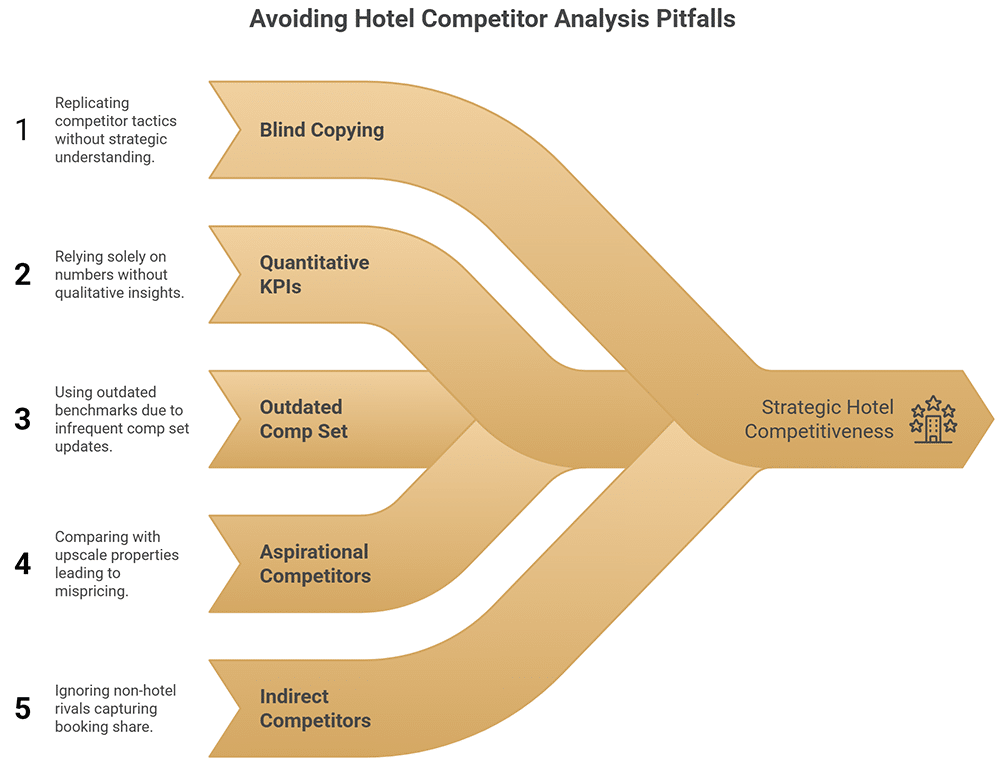
Mistake 1: Copying Competitors Blindly
The most common pitfall is mimicking competitors’ offerings and marketing without understanding their underlying strategy. What works for one hotel may actively harm another. For example, operational costs, business mix, brand identity, and target demographics can differ dramatically even within the same comp set.
✓ The Fix:
Use competitor data to understand their strategy, not to replicate their tactics. Ask why they are doing what they are doing and whether your hotel has the operational foundation to achieve the same result.
Mistake 2: Relying Solely on Quantitative KPIs
RevPAR, ADR, and occupancy data tell you what is happening, but not why. Ignoring review sentiment, social media feedback, and direct guest intelligence produces an incomplete and often misleading competitive picture.
✓ The Fix:
Pair every KPI review with a qualitative review scan. Ask your frontline staff what guests are saying about competitor properties they considered. Numbers explain outcomes; people explain reasons.
Mistake 3: Not Updating Your Competitive Set
The hotel landscape changes quickly. New openings, renovations, rebrands, and ownership changes can shift competitive dynamics significantly in just a few months. An outdated comp set produces benchmarks that no longer reflect reality.
✓ The Fix:
Review your comp set formally at least once per year and informally whenever a significant local market event occurs, such as a new hotel opening, a major renovation, or a change in pricing strategy by a rival property.
Mistake 4: Choosing Aspirational Rather Than Actual Competitors
Including properties that are significantly more upscale, better located, or better resourced than your hotel produces benchmarks that lead to mispricing and unrealistic performance targets. It is natural to want to compare up, but it creates a distorted competitive picture.
✓ The Fix:
Build your comp set around properties where you are genuinely competing for the same guest on the same booking occasion. Include one or two aspirational properties as a separate “aspirational benchmark,” but keep them separate from your primary comp set analysis.
Mistake 5: Ignoring Indirect Competitors
Many hotels analyze only direct hotel rivals while Airbnb listings, serviced apartments, and OTA loyalty programs quietly capture meaningful booking share. Indirect competitors are gaining ground fastest in the leisure and extended-stay segments.
✓ The Fix:
Expand your competitive intelligence to include Airbnb and VRBO supply data in your market (available via AirDNA), OTA bundled deal activity, and extended-stay property openings that target your core guest segments.
How to Create the Perfect Hotel Competitor Report
Here, you can find some essential tips for creating high-quality reports on hotel competitors:
- Executive Summary: Begin your report with a concise overview, highlighting key findings and priority actions.
- Visual Data Presentation: Use charts and graphs to make market trends, pricing patterns, and shifts in market share easier for all stakeholders to understand at a glance.
- Competitive Gap Analysis: Identify where you outperform rivals and where you lag behind, using clear metrics.
- Action Recommendations: For each of the major findings gathered from your hotel competitor analysis, pinpoint specific steps you can take. Include information on implementation requirements and the expected impact.
- Regular Schedule: Create a consistent schedule for competitor reports: weekly for pricing, monthly for key performance metrics, and quarterly for more complete strategic reviews with hotel leaders.
- Targeted Distribution: Customize reports for different stakeholders and hotel departments.
Global Outlook for Hotel Competitor Analysis Over the Next Decade
Over the next decade, hotel competitor analysis is likely to become even more important as the global market grows more uneven and more competitive.
In the United States, STR and Tourism Economics’ first 2026 forecast projects only 0.6% full-year RevPAR growth, suggesting a softer trading environment where small differences in pricing, reputation, and market positioning can have a bigger effect on results.
At the same time, PwC’s U.S. Hospitality Directions report points to slower, more normalized growth rather than a broad-based surge, meaning hotels may need sharper strategies to outperform rivals.
The global picture, however, is more mixed than negative. According to CBRE’s Global Hotel Outlook, urban hotels are expected to benefit from stronger international, group, and business travel, while regions such as Latin America, Europe, and the Middle East continue to show solid demand momentum. Cities like Dubai and Abu Dhabi have posted strong RevPAR gains. Major events such as the 2026 FIFA World Cup and the 2028 Olympics are likely to create localized demand spikes.
For hoteliers, this means competitor analysis will need to move beyond simple rate comparisons and focus more on segment shifts, review performance, traveler behavior, and market-specific opportunities.
An Essential Guide to Hotel Invoices
Your hotel competitor analysis can help to set you on a path where you can make more strategic decisions around pricing. However, guest satisfaction is also reliant on the quality of your hotel invoices. These documents break down the charges a guest has incurred and need to be accurate, transparent, and easy to understand.
In the “Hotel Invoice Guide: Essential Tips & Best Practices for Hotel Professionals” article, you can find out much more about what invoices are, the key elements, and the best practices you should follow.
Exploring Hotel Industry Challenges
You can add some additional context to your hotel competitor analysis by staying up-to-date with the latest challenges in the hotel industry. Examples that are relevant right now include pressures around sustainability, contending with staff shortages, and maintaining cybersecurity.
In the “Hotel Industry Challenges: A Guide for Hoteliers” article, you will find a detailed overview of the major challenges hoteliers face today and steps that can be taken to tackle them.
FAQs Related to Hotel Competitor Analysis
A hotel competitor analysis can provide useful insights to assist with strategic decision-making. By knowing your rivals’ strengths, weaknesses, and market position, you can better understand your own place, identify gaps in the market, find areas of opportunity, and optimize your offering to appeal to underserved demographics.
Did You Like This Article About Hotel Competitor Analysis?
Yu might also be interested in the following articles:
- PMS Integration Strategies to Streamline Hotel Management
- How Food and Beverage Management Drives Hotel Profitability
- Best Hotel Loyalty Programs to Turn Visitors into Loyal Guests
More Tips to Grow Your Business
Revfine.com is the leading knowledge platform for the hospitality and travel industry. Professionals use our insights, strategies, and actionable tips to get inspired, optimize revenue, innovate processes, and improve customer experience.Explore expert advice on management, marketing, revenue management, operations, software, and technology in our dedicated Hotel, Hospitality, and Travel & Tourism categories.
This article is written by:

Hi, I am Martijn Barten, founder of Revfine.com. With 20 years of experience in the hospitality industry, I specialize in optimizing revenue by combining revenue management with marketing strategies. I have successfully developed, implemented, and managed revenue management and marketing strategies for individual properties and multi-property portfolios.






Leave A Comment