


Hotel profit margin calculations are of immense importance within the hospitality industry. Your profit margin is generally defined as the percentage of revenue left after operating expenses have been subtracted. However, you can also adapt the concept to account for individual factors. Understanding your profit margin allows for better resource allocation and growth as you’re able to better plan for weather, seasonal changes, improvements, etc.
In this article, you’ll learn techniques to calculate your profit margin, integrate it with industry benchmarks, and strategically leverage those metrics.
Quick Definition:
Key Takeaways:
|
–
Table of Contents:
- What is Hotel Profit Margin and How Does It Impact Your Business?
- Why Understanding Hotel Profit Margin is Important for Hoteliers
- How to Calculate Hotel Profit Margin
- Essential Factors That Influence Hotel Profit Margins
- 5 Strategic Approaches to Improve Hotel Profit Margins
- How Independent Hotels Can Boost Their Profit Margins
- Industry Benchmarks for Hotel Profit Margins
- Common Mistakes to Avoid When Analyzing Hotel Profit Margins
- Global Outlook of Hotel Profit Margins Over the Next Decade
- Business Trip Trends for Hotels to Maximize Profit
- Hotel Maintenance Tips to Optimize & Increase Profitability
What is Hotel Profit Margin and How Does It Impact Your Business?
Your hotel profit margin is the actual profit of your property, as a percentage, after operating expenses have been removed. While there are three main types of profit margins, they’re all valuable metrics to show the overall performance of your property.
The first type is gross profit margin, which excludes the operating expenses. It instead only uses revenue minus the cost of goods sold (COGS). The second type, operating profit margin, includes utilities and salaries along with other operating costs. Finally, the net profit margin includes every expense, including interest and taxes.
Net profit calculations offer the most expansive overview of your profits. A hotel’s profit margin averages around 10% to 30%. The type of hotel, location, and management strategies all have an additional impact on averages.
Why Understanding Hotel Profit Margin Is Important for Hoteliers
The most obvious feature of a hotel profit margin calculation comes from what it says about your property’s overall performance. On the surface, a strong value shows equally solid operational efficiency and financial vigor. The value also shows how much of a foundation you have for further growth or the ability to hold up during unexpected fluctuations.
As you monitor your hotel operating profit, you’re also monitoring every element related to it. This provides measurable data to help you identify financial issues, correct underperforming areas, plan targeted improvements, and optimize resource allocation. Having both plans and data to back them up helps you become more profitable and attract investors with strong financing options.
Video: Understanding Hotel P&L Statements for Maximum Profitability | Hotel Marketing
How to Calculate Hotel Profit Margin
The hotel profit margin calculation is easy to follow. Simply use this formula with your own data.
Profit Margin (%) = (Net Profit / Total Revenue) × 100
Now that you know how to calculate the standard profit margin, you can consider how to tailor it to account for the level of margin. There are three forms to consider.
Operating Profit Margin = (Operating Income / Revenue) × 100
Gross Profit Margin = (Revenue – COGS) / Revenue × 100
Net Profit Margin = (Net Profit / Revenue) × 100
Your operating profit margin provides a metric of your daily operation’s financial strength. The gross profit margin weighs the performance of your core services. Finally, the net profit margin provides a larger picture view, which accounts for what you’re earning after all other financial considerations are adjusted for.
Another value, the hotel profit and loss (P&L) statement, is the foundational element for all of these margins. The P&L report gives a rundown of expenses, income, and the net earned value over specific periods. You can gain significant strategic advantages through regular evaluation of the report.
Video: How Do You Calculate Your Net Profit Margin?
Essential Factors That Influence Hotel Profit Margins
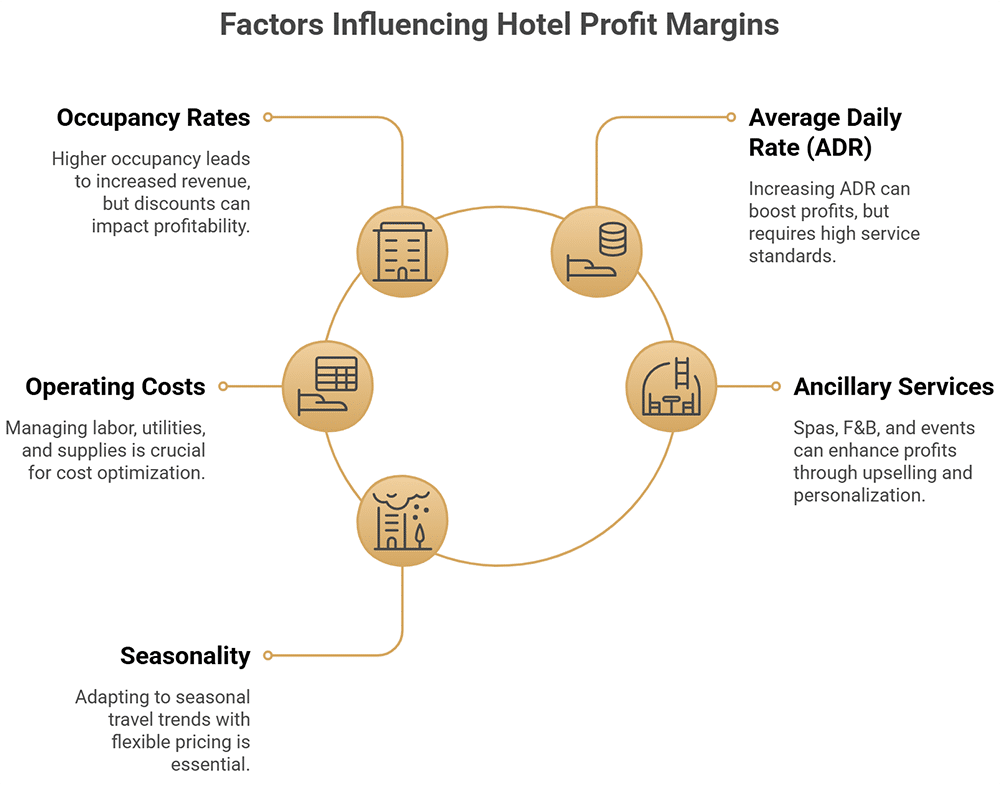
Your hotel profit margin is a powerful tool that can help you narrow in on your revenue stream. The following are the major elements of your profit margin.
1. Occupancy Rates
The hotel’s earning margins and profit are directly tied to occupancy in a number of ways. This is usually a benefit as a higher occupancy rate means additional points of income. Every guest spends on the room and will typically put money into separate options as well. However, discounts can complicate matters as they might even make some elements a net loss. The optimal strategy for maintaining a strong hotel profit margin with occupancy involves balancing pricing strategies with room availability and secondary revenue options like dining.
If you want to learn more about occupancy rates, read the article “What Is an Occupancy Rate?”
2. Average Daily Rate (ADR)
In addition to knowing the average hotel profit margin, you should also consider the individual elements. The average daily rate (ADR) is the average income generated by each room per day. Minor changes to your ADR can have a significant impact on your overall profit. However, ADR requires careful strategizing, or it can backfire. High ADR without equally high service standards can lead to dissatisfied guests. If you upsell premium rooms and stay competitive, then you can keep a high, stable ADR.
3. Operating Costs and Overheads
Labor, repairs, utilities, supplies, and similar elements are all categorized under your operating expenses. According to CBRE’s Trends® in the Hotel Industry survey of 2,600 U.S. hotels, the number of hours worked at the typical hotel is down 7.4% since 2019, while total compensation costs are up 22.1%. These are the elements that keep your property running, and as such, they’re an essential part of your larger hotel revenue margin. In other words, you have to spend money to make money.
You can optimize the profit over expense by implementing energy-saving strategies, optimizing workflow, and ensuring you have exactly as many staff as needed for any task. You should also perform regular audits to tweak your plan for operational cost optimizations.
4. Revenue from Ancillary Services (F&B, Spa, Events)
Services like spas, parking, event hosting, and food services can boost a hotel’s profit margin if carefully leveraged. These options are best used by upselling specific packages, creating loyalty point systems, and offering personalized experiences. Value is the key element. If the quality is low or inconsistent, then revenue from ancillary services will suffer. You should use data-driven strategies and pricing, along with implementing cross-departmental collaboration, to ensure that these options are valuable to guests.
5. Seasonality and Market Trends
Anyone in the hospitality industry can attest to its seasonal nature. Travel for both business and pleasure is influenced by the weather and the time of year. Off-season occupancy and the hotel profit margin often see a significant dip compared to peak travel seasons. Trends, macroeconomic changes, and even larger-scale events like pandemics provide additional weight to seasonal trends. Properties should use flexible pricing, historical information, predictive analysis, and similar tools to proactively mitigate these factors for a steady profit margin.
5 Strategic Approaches to Improve Hotel Profit Margins
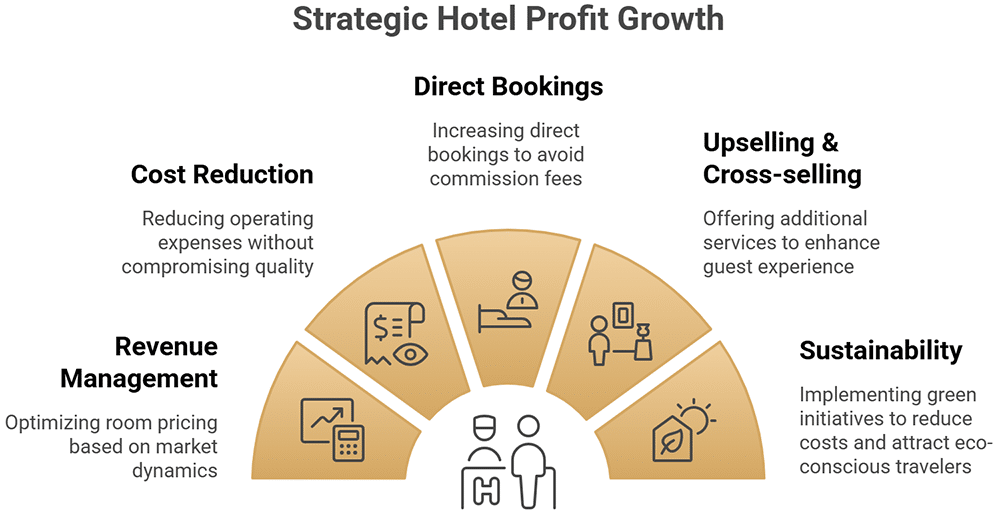
You’ve seen how important strategy is to a healthy hotel profit margin. The following five strategic approaches will ensure your sustainable growth.
1. Optimize Room Pricing Using Revenue Management Systems
You can use a revenue management system (RMS) to make dynamic changes to your pricing structure to match market conditions, demand, competition, and similar factors. An RMS allows for fast optimization of room prices that can match demand. You can also be more proactive by forecasting demand trends or seasonal variations. This increases revenue while still ensuring customer satisfaction. You’ll typically find an increase of 5% to 10% of the hotel profit margin. Using targeted promotions and channel distribution will further optimize your success.
2. Reduce Operating Costs Without Compromising Quality
Cultivating a hotel’s net profit or margin is heavily dependent on continual monitoring of your expenses. Operating costs like waste management, staffing, and energy concerns are essential but often subject to variability. This means expenses can go up, but it also means optimization can lower them. Consider tactics like negotiating contracts with vendors, using automation for back-office functionality, and generally trimming the fat off your operational processes. A seemingly minor improvement in, for example, inventory procurement or laundry operations can build up over time. These forms of optimization can often result in improved margins of around 3% to 7%.
3. Boost Direct Bookings to Avoid High Commission Fees
A common thread for improving hotel profit margin calculations involves third-party services. Reducing additional charges for services can streamline your net income. This is especially true for commission fees. The more direct bookings you have, the more you’re saving on the associated third-party fees. You can increase direct bookings by incentivizing the use of your website with specific offers, tailored booking engines, and loyalty programs. Even marketing with SEO and PPC ads can push traffic from travel agencies to your site. These strategies can often save you 15% to 26% on distribution costs.
4. Upsell and Cross-Sell Ancillary Services
Dining options, late check-out, spa services, and airport-related options are all powerful methods to boost hotel earnings margin numbers. These ancillary services can be extended to cross-selling during check-in, such as through room upgrades. You can further refine the process through departmental tracking. CRM tools can provide even more information to let you tailor the process to both individual guests and demographics. This can result in a 10% to 15% increase in revenue per guest without increasing occupancy.
If you want to learn more about ancillary services, read the article “Ancillary Revenue Guide: Grow Your Hotel Revenue Smartly.”
5. Implement Sustainable Cost-Saving Initiatives
Green initiatives can boost profit, reduce environmental impact, and open up new demographics of environmentally conscious travelers. Water-saving elements, waste reduction initiatives, and energy-efficient systems for lighting can all turn into direct savings. However, you can build on that foundation by using it in marketing to demonstrate value. Eco-aware travelers prefer to vote with their wallets, and green corporate clients often seek out compatible partners. Combined, these measures often result in 5% to 10% reductions in operating costs.
As McKinsey hospitality expert Matteo Pacca frames it:
“The demand for sustainability will cover everything: the materials from which hotels are built, the way the food is processed and served, and so on. Sustainability will be a big segmentation factor for winners and losers.”
How Independent Hotels Can Boost Their Profit Margins
While independent hotels have undeniable challenges, they also have uniquely beneficial opportunities. The following strategies can help you leverage your flexibility alongside regular hotel profit margin calculations.
1. Leverage Local Market Knowledge
The flexibility and adaptability of independent properties let you hone in on the local market. Your hotel profit margin can improve dramatically by noting changes in local attractions and featuring them within your own business. You can establish partnerships and highlight specific areas for further growth. This flexibility in local strategizing often results in 10% to 15% higher RevPAR when compared to the major brands.
2. Develop Unique Brand Identity
Branding for independent properties is just as important as it is for larger chains. Your brand can evoke narratives that tie into the local culture. Integrate traditions, history, architecture, food, and more to provide true experiential travel. This creates a differentiation strategy that eases price concerns among guests. Having a strong brand can generate up to 15% to 20% higher rates of direct booking, which leads to an improved hotel profit margin.
3. Optimize Operating Costs
An independent hotel typically has far more freedom than a larger corporate entity. You can streamline your business plan with dynamic policies like cross-training staff for multiple roles or adjusting service levels to scale with demand. This means you can better allocate resources as needed. You can also make more strategic partnerships with local, cost-effective services that can provide better rates. By ensuring your strategy is optimized and streamlined, you can typically improve operating profits by 8% to 12%.
4. Implement Niche Marketing Strategies
Targeting specific demographics and market segments can boost your hotel’s profit margin in a number of ways. Niche markets like digital nomads, wellness travelers, and more will tend to go where their needs are recognized and met. Marketing in niche markets reduces your competition and provides a higher ROI. Likewise, satisfied guests within those markets are likely to provide a social media presence and even influencer partnerships. These strategies can boost direct bookings by around 20% to 25% and daily rates by 10% to 15%.

Stephanie Smith-Sparks, Founder, Cogwheel Marketing
This differs depending on whether it is B2B or B2C and how much existing brand awareness already exists.” Click here to learn more from our Hotel Marketing Expert Panel. |
5. Develop Strategic Partnerships
Independent hotels can offer comparable or superior services to larger brands by teaming up with local businesses. Entertainment venues, attractions, tour operators, restaurants, and more can provide exciting experiences to guests without requiring significant investment or facilities. Ancillary income can get an additional push by using revenue-sharing with these entities. By using collaborative strategies, you can create unique experiences for guests, promote repeat bookings, and typically increase your hotel’s profit margin by 5% to 10%.
Video: How Much Profit Do Hotels Actually Make Per Room? | James Sinclair
Industry Benchmarks for Hotel Profit Margins
Hoteliers can best analyze their economic performance by understanding the hotel profit margin benchmarks. These items are used to measure your property’s performance on the market.
- Average Hotel Profit Margins: Variables like location, market segment, and property influence the average, but net profit margins are typically around 5% to 15%.
- Luxury Hotel Performance: Luxury properties can use higher-end pricing options to achieve margins of 10% to 15%, even with higher standards for service and operational expenses.
- Budget Hotel Margins: A budget hotel profit margin of 5% to 10% is maintainable through cost management options like automated services and operational optimizations.
- Departmental Profit Targets: F&B operations usually aim for 20% to 30% profitability over the service outlets, while the room division will sit within a hotel profit margin of 70% to 80%.
- Hotel Operating Profits: A full-service hotel is an industry standard for benchmarking operational efficiency and averages around an EBITDA margin of 25% to 35%.
- Regional Variations: Resorts typically see around 12% to 18% margins, while urban properties have 8% to 12%. The resort’s combination of ancillary services and premium rates helps boost the overall profit margin.
Common Mistakes to Avoid When Analyzing Hotel Profit Margins
You can ensure you have a sound strategy and accurate assessment of your financial data by avoiding these common mistakes.
- Ignoring Hidden Costs: Don’t overlook indirect expenses when calculating margins, as issues like opportunity costs, employee turnover, and maintenance deferrals can make a big impact.
- Misinterpreting RevPAR as Profit: Revenue per available room does provide data on top-line performance, but operational costs that impact full profitability aren’t accounted for.
- Failing to Update Pricing Seasonally: Non-variable, static strategies for your pricing mean you’re not optimizing for peak periods and seasonal declines to balance occupancy.
- Overlooking Department Cross-Subsidization: Departments are often invisibly linked, driving traffic elsewhere while seemingly unprofitable, so implement a holistic analysis.
- Neglecting Competitive Benchmarking: If you fail to compare your hotel’s profit margin to your direct competition, then you might misprice services or miss out on profitable options.
- Underestimating Technology Costs: Fees related to ongoing use of or training for technologies like system upgrades or service subscriptions are easily forgotten but are often significant.
Global Outlook of Hotel Profit Margins Over the Next Decade
The global hotel industry is expected to keep growing over the next decade, but stronger revenue will not always mean stronger profit margins. According to the Research and Markets report, the global hospitality market is expected to grow from $5.82 trillion in 2026 to $7.47 trillion by 2030. Even so, hotels are facing rising costs in areas like labor, insurance, and energy.
CBRE’s Global Hotel Outlook says the industry is moving into its third straight year of margin pressure because costs are rising faster than revenue. HVS also makes the point that higher room rates alone will not be enough to restore margins. Hotels will need much stronger day-to-day cost control and operational management.
Technology is likely to play a major role in protecting hotel profit margins. BCG’s AI-First Hotels report says AI is already helping hotels improve productivity, increase revenue, and lower costs. Mews’ Hospitality Outlook also suggests that by 2035, many hotel interactions could be handled through AI.
At the same time, sustainability is becoming more important financially, not just from a branding point of view. The hotels that perform best over the next ten years are likely to be those that manage margins actively, control costs carefully, and use technology in smarter ways.
In that sense, the future of hotel profitability will depend less on topline growth alone and more on operational precision.
Business Trip Trends for Hotels to Maximize Profit
When someone asks how to increase hotel profit margin values, there’s usually a variety of possible answers. However, business travel encompasses a variety of different, related, and effective strategies. For example, business travel usually involves more expensive room options, services, etc. You can help cultivate this important demographic by forming corporate relationships and business packages. Discover methods to tap into the corporate market in the article “Business Trip Trends For Hotels to Maximize Profit.”
Hotel Maintenance Tips to Optimize & Increase Profitability
It’s best to be proactive rather than just reactive within most business endeavors. However, this is especially true in the hospitality industry. Hotel profitability is tied to how well you can mitigate risks and solve problems before they have a chance to escalate. For example, careful maintenance of your property will increase your hotel’s profit margin by improving guest satisfaction and reducing downtime. You can learn some of the best proactive optimization methods in the article “Hotel Maintenance Tips to Optimize & Increase Profitability.”
FAQs Related to Hotel Profit Margin
Hotel profit margin calculations and optimizations do take active effort and need to be updated over time. However, you now know the most effective strategies to make it easier and more effective within your larger business strategy. The next step is simply turning theory into practice.
Did You Like This Article About Hotel Profit Margin?
You might also be interested in the following articles:
- How Hotel Competitor Analysis Can Improve Your Market Position
- PMS Integration Strategies to Streamline Hotel Management
- Revenue Management Strategies to Grow Your Hotel Business
More Tips to Grow Your Business
Revfine.com is the leading knowledge platform for the hospitality and travel industry. Professionals use our insights, strategies, and actionable tips to get inspired, optimize revenue, innovate processes, and improve customer experience.Explore expert advice on management, marketing, revenue management, operations, software, and technology in our dedicated Hotel, Hospitality, and Travel & Tourism categories.
This article is written by:

Hi, I am Martijn Barten, founder of Revfine.com. With 20 years of experience in the hospitality industry, I specialize in optimizing revenue by combining revenue management with marketing strategies. I have successfully developed, implemented, and managed revenue management and marketing strategies for individual properties and multi-property portfolios.






Leave A Comment