


PMS integration refers to the capacity for a property management system (PMS) to connect with other hotel systems. By connecting your PMS to systems like booking engines, CRM software, and channel managers, you can share data. Sharing this data between systems can boost efficiency, reduce data duplication, and prevent inconsistencies. It can also reduce or eliminate the need for manual data entry, improve accuracy, and create a more unified ecosystem.
In this article, you can find out what PMS integration is, why it matters, and how it works. Along the way, you will discover the key benefits and the main systems to focus your integration efforts on.
Quick Definition:
Key Takeaways:
|
–
Table of Contents:
- What is PMS Integration for Hotels?
- Why is PMS Integration Important for Hotels?
- How PMS Integration Works for Hotels
- Key Systems You Should Integrate With Your PMS
- 5 Key Benefits of a Fully Integrated PMS
- Emerging Trends in PMS Integration
- How Hoteliers Can Implement Integrated PMS Solutions
- How to Choose the Right PMS Integration Partner
- Global Outlook of PMS Integration Over the Next Decade
- Hotel PMS: The Importance of Customization and Automation
- Hotel CRM System: A Guide to Customer Relationship Management
- PMS Integration FAQs
What is PMS Integration for Hotels?
PMS integration is the process of connecting a property management system with other hotel systems. Common examples include CRM software, booking engines, channel managers, and revenue management systems.
Property management system integration allows for the creation of a combined ecosystem, where data is shared freely between different applications. This works through application programming interfaces (APIs).
With this approach, relevant data can be updated across all systems in real-time. For example, if a guest makes a reservation using the booking engine, it can automatically update room availability in your PMS too.
Video: Hotel Property Management System (PMS): Functions, Modules & Integrations
Why is PMS Integration Important for Hotels?
Hotel PMS integration is important because it can have a direct impact on the efficiency of a hotel through the real-time sharing of data. This, in turn, can influence financial outcomes and the guest experience.
By integrating other systems with your PMS, you can avoid data duplication and keep information up-to-date throughout your hotel. This prevents situations where departments are working from different data sets.
Integration makes it easier to achieve cross-departmental collaboration and reduces the need for manual data entry. This can also reduce human error and other data issues that may lead to problems like overbooking.
As Max Starkov, a hospitality technology expert, notes:
“Hotels must move toward fully integrated tech stacks to compete in a data-driven environment.”
How PMS Integration Works for Hotels
To make more informed decisions about PMS integration, it is important to understand the underlying technology. In these sections, you can learn how integrated systems share information, with a focus on three key mechanisms.
1. API-Based Data Exchange
The primary technology used to achieve PMS integration is an application programming interface. APIs serve as protocols that govern the way different systems are able to communicate with each other.
The use of APIs is important for achieving synchronized information sharing. For example, when a guest books a room using your booking engine, the API knows to update this information for your PMS and channel manager too.
Cloud-based hotel systems are often able to facilitate hundreds or even thousands of integrations, meaning you can build an extensive network of interconnected systems, all acting as one vast API-driven ecosystem.
According to Market Growth Reports, more than 76% of mid-to-large hotel chains now rely on cloud-based property management systems to automate guest reservations, housekeeping, and billing processes.

Massimiliano Terzulli, Revenue Management Consultant, Franco Grasso Revenue Team“There is no doubt that well-integrated software systems (ideally via APIs) lead to far more efficient results. Integrations allow for the exchange and collection of significantly more data between two systems than manual copy-paste or upload processes ever could. Furthermore, manual work—due to natural human limitations—cannot provide real-time updates across systems. Real-time communication is essential for achieving 100% efficiency in certain operations, especially in an era where AI—which depends on constant, accurate data to perform optimally—plays a crucial role in streamlining processes and enhancing the guest experience. Just think about dynamic pricing in fast-paced city destinations with frequent events, some of which are announced at very short notice. Or consider upselling and cross-selling opportunities shown on a guest’s device at just the right moment—for example, while they’re at the restaurant or spa. To achieve this, systems must be able to “talk” to each other in real time and automatically. Unfortunately, not all vendors in the market are open to integrating with others, and this resistance significantly slows down the potential for innovation.” Click here to learn more from our Revenue Management Expert Panel. |
2. Real-Time Two-Way Communication
With PMS integration, your property management system creates a two-way flow of information with another system. This allows data to travel in both directions, resulting in seamless sharing and real-time updates.
This real-time communication is essential for ensuring everyone in your hotel is working from the same information. It also helps to avoid situations like two different guests both booking the same room.
With real-time integrated PMS solutions, room status, availability, and pricing information can all be updated easily, using a single system. It prevents data discrepancies and can ensure smooth operations.
3. Centralized Data Management
PMS integration can also help to turn your property management system into a central hub, where data from all systems is gathered. This can include payment information, room availability data, customer profiles, and more.
Centralizing data in this way makes it easier to find, reducing unnecessary delays. It also eradicates data silos, so all departments have access to identical information, which is updated in real-time.
Consolidating information is one of the biggest advantages of PMS integration for hotels, as it can provide greater clarity and improve coordination. This is especially important when different departments need to work together. Deloitte notes that connecting a hotel PMS with a CRM enables more effortless personalized communication.
Video: Mews PMS Review: Features, Pricing & Expert Analysis
Key Systems You Should Integrate With Your PMS
When learning how to integrate a property management system effectively, understanding the systems to focus on is critical. In this section, you will find an overview of the most important PMS integration options:
- Channel Manager Integration: Offers real-time updates for room rates and availability information across all booking channels, including online travel agencies. Aids distribution, while reducing the risk of overbooking.
- Booking Engine Integration: Facilitates direct reservations via your hotel website, reducing reliance on online travel agencies and other third-party platforms that charge commission fees.
- CRM and Email Marketing Integration: Makes it easier to personalize guest communications, access customer profiles, and view important information about guest preferences, past stays, and loyalty program membership.
- Revenue Management System Integration: Helps to forecast demand and create a dynamic pricing strategy based on real-time information. Makes it easier to optimize pricing to maximize revenue and profitability.
- Housekeeping and Maintenance App Integration: Improves cross-departmental communication and provides real-time visibility into room status updates and maintenance requests.
- POS System Integration: Centralizes charges from different areas of your hotel, including the restaurant, bar, and leisure facilities. Simplifies the billing process to reduce errors and improve the check-out experience.
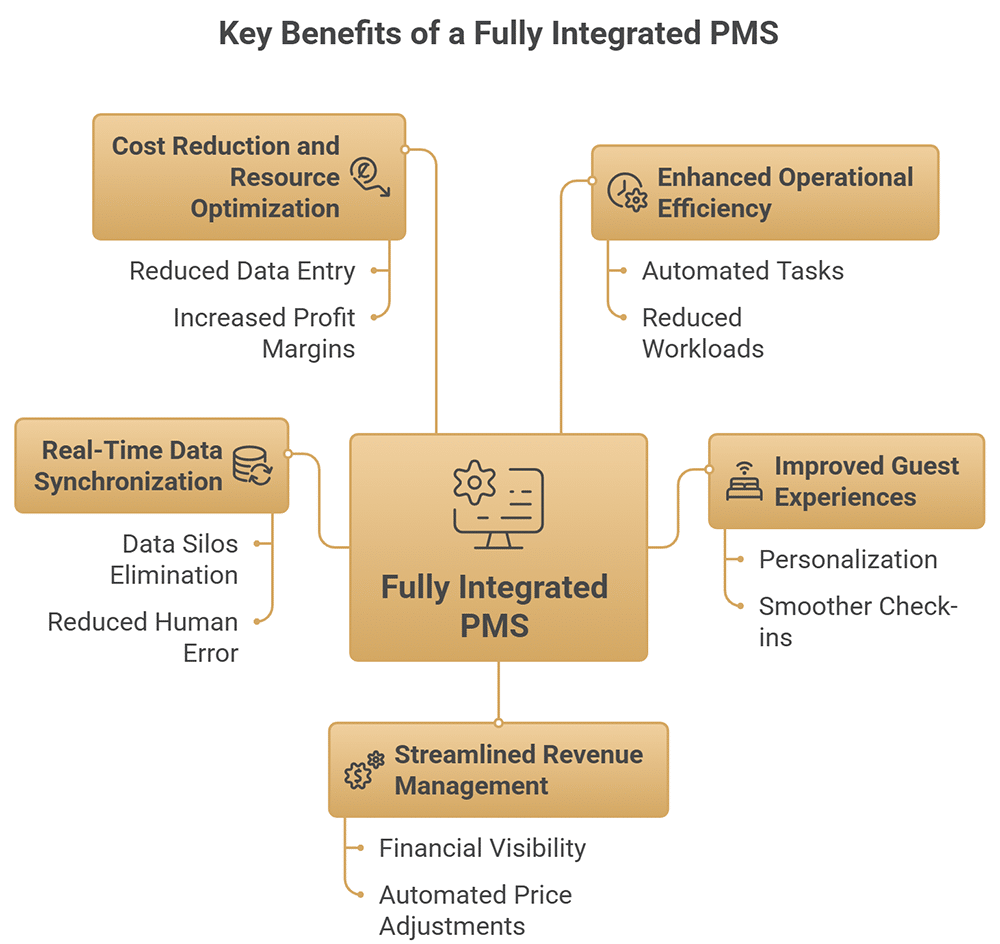
5 Key Benefits of a Fully Integrated PMS
There are a number of significant advantages associated with PMS integration. In the following sections, you can explore how having a fully integrated property management system can benefit your hotel:
1. Enhanced Operational Efficiency
PMS integration can improve the efficiency of hotel operations by automating predictable or repetitive tasks. Many of these tasks have conventionally required manual intervention, using multiple independent systems.
Boosting operational efficiency is important because it allows hotel staff to focus on the tasks that require human intelligence. It can ease staff workloads and potentially reduce labor costs for your hotel.
An example of how PMS integration can boost efficiency is the housekeeping department being automatically alerted when a guest checks out. This means the room can be cleaned immediately, boosting housekeeping efficiency.
According to Market Growth Reports, automated PMS systems have reduced front desk workloads by 40% and increased occupancy rates by 18% through better reservation coordination, according to industry analysis.
2. Improved Guest Experiences
PMS integration makes it easier to make effective use of customer data. This may include past communications, guest preferences, previous purchases, special requests, and other relevant details.
Accessing this data through your property management system can aid with personalization. Integration also helps to ensure the customer data is continually updated, so you are always working from the latest information.
Other benefits of PMS integration include smoother check-in and check-out experiences, including offering mobile check-ins. An integrated system can also make it easier for guests to extend their stay.
3. Streamlined Revenue Management
Using integrated PMS solutions can offer better visibility into the financial circumstances of your hotel. The best PMS integration tools will allow you to consolidate data from all of your revenue streams.
According to Market Growth Reports, around 90% of PMS platforms currently interoperate with channel managers and revenue management tools, while mobile check-in adoption stands at approximately 35% across mid-to-large hotels.
By streamlining revenue management efforts, you can make it easier to put effective strategies into action. You may also be able to automate price adjustments and other tactics, so changes happen at the ideal time.
If you want to learn about the recent revenue management trends, read the “Revenue Management Trends: Latest Developments” article.
4. Real-Time Data Synchronization
Through PMS integration, you can achieve real-time data synchronization. This helps to ensure your PMS, CRM system, channel manager, revenue management system, and other relevant systems never have conflicting data.
Eliminating data silos and consolidating information in one place is important for creating a single source of truth in your hotel. Automated synchronization also removes human error or delays in updating a particular system.
Ultimately, this reduces the chance of confusion occurring when two systems contain contrasting information. It can help to boost efficiency, prevent avoidable mistakes, and reduce complaints from guests.
Jordan Hollander, CEO of HotelTechReport, notes that,
“Hotel management software has evolved from transactional systems of record to the strategic command hub of modern hotels and systems of action.”
“When you add up those hours across dozens of employees, you’re talking about thousands of hours per year in reclaimed labor. The PMS is no longer a cost center — it’s an operational time machine.”
“When the PMS is connected to payments, CRM, and distribution, it becomes a commercial weapon. The best-run hotels now see their PMS as a growth driver — not just an operating system.”
5. Cost Reduction and Resource Optimization
Your hotel can lower operating costs by implementing PMS integration. This is achieved by removing the need for unnecessary data entry, reducing human error, automating processes, and reducing labor costs.
It is essential to explore cost reduction strategies in the current age of rising hotel costs and growing guest expectations. By optimizing resource usage, you can lower day-to-day running costs and increase profit margins. McKinsey has documented how automation can lower costs and accelerate routine processing in service environments.
Automation can help to provide more time for your employees to focus on revenue-generating activities. Resource optimization can also mean fewer staff are needed on certain shifts.
Emerging Trends in PMS Integration
PMS integration is changing quickly. These trends show where hotel technology is heading and what hoteliers should watch closely.
- AI-Powered Integration: Modern PMS platforms increasingly use AI for forecasting, pricing support, and guest journey insights. This helps hotels make faster and more data-driven decisions.
- IoT-Enabled Integration: PMS platforms are connecting with smart locks, energy systems, and in-room controls that allow hotels to automate more of the guest experience.
- Open API Ecosystems: Hotels are moving away from closed systems and toward open APIs, which make it easier to connect booking, CRM, revenue, housekeeping, and POS tools.
- Cloud Migration: More hotels are replacing on-premise systems with cloud PMS platforms to improve flexibility, scalability, and integration options.
- Modular Tech Stacks: Hotels increasingly want the freedom to add, remove, or replace tools without rebuilding the full system architecture.
- Deeper Automation: PMS integration is no longer just about sharing data. It is increasingly used to trigger workflows automatically across departments.
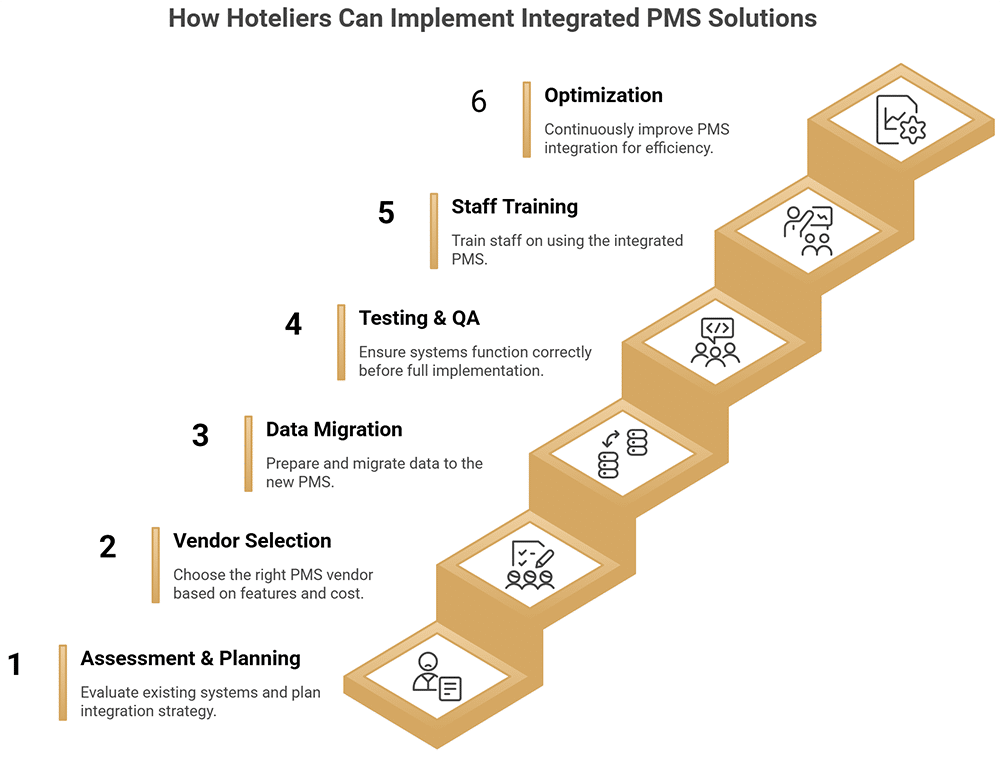
How Hoteliers Can Implement Integrated PMS Solutions
Actually implementing PMS integration successfully requires hoteliers to follow some basic steps. In the following sections, you can explore the process for integrating your various hotel systems:
Step 1: Assessment and Planning
First, it is important to carry out an audit of your existing systems and workflows. Try to pinpoint inefficiencies you need to address and determine whether you have inconsistencies with data.
Assessment is crucial because it helps you to understand what you actually need to achieve through any PMS integration efforts. From there, you can plan the specific actions you will take with your systems.
Planning can also help to ensure your approach complies with regulations around data handling.
Step 2: Research and Vendor Selection
You will need to conduct research and carefully select the right vendor for your property management system. Consider issues like how robust the API is, how much it will cost to implement, and how viable it will be in the long term.
Research and a careful selection process are important for ensuring you spend your PMS integration budget wisely. You need to make sure the various systems in your hotel are actually able to be integrated.
You should also carefully explore customer feedback and focus on issues like user-friendliness and support.
Step 3: Data Migration and System Preparation
Next, you should create a comprehensive strategy for migrating data to your PMS. This will need to include backup protocols and a plan for gathering information from all of the other relevant hotel systems.
A plan for data migration is critical for maintaining the integrity of your data. You need to make sure information is retained in full, is not compromised by changes in format, and is kept secure during the entire process.
Preparing for PMS integration in advance can also help with business continuity while data migration is in process.
Step 4: Testing and Quality Assurance
Prior to implementing your new PMS integration strategy, you need to run tests to make sure systems will function properly. Carry out testing in a controlled environment and try to identify potential issues.
Testing and quality assurance are crucial for effective change programs. You want to make sure your systems are going to work as intended, and it is better to address problems before you go live with your integrated systems.
Step 5: Staff Training and Change Management
PMS integration will require staff training, so hotel employees understand how to use the integrated systems. Create useful training materials, run workshops, and help workers to become familiar with new processes.
It is important to make sure all staff understand new workflows and how to amend data. This helps with operational efficiency and cross-departmental collaboration, while training can also prevent miscommunication.
Make sure access permissions are set up properly, too, so valuable data cannot be tampered with.
Step 6: Optimization of PMS Integration
Once your PMS integration strategy has been put into effect, it will require continuous optimization. Monitor the system, identify problems, address issues raised by employees, and make adjustments to your strategy.
Continuous optimization is especially valuable as your integrated systems continue to evolve and as the volume of data increases. What works at the beginning may not necessarily work as well after two or three years.
Make sure data is synchronizing properly, collaborate with system vendors, and perform regular updates.
How to Choose the Right PMS Integration Partner
You should carefully evaluate potential PMS integration partners, as choosing the right option is vital for long-term success. Here, you can explore some of the most essential criteria to focus on:
- Evaluate Technical Capabilities: How strong is the API? Can the partner provide systems that will facilitate real-time data exchange at the volume you need for your hotel?
- Assess Industry Experience: What is the company’s background? Have they worked with similar hotels before? Do they understand your specific needs? Can they provide testimonials from other hotels?
- Review Support Services: Is continuous support available? Is technical support on offer 24/7? What training can the company provide? Do they have extensive documentation, and will they help with the initial setup?
- Assess the Total Cost of Ownership: How much will the PMS integration cost to set up? Are there continuous fees associated with cloud hosting and data storage? How much will the software cost across its entire lifetime?
- Verify Security and Compliance: Does the company’s system meet all relevant industry standards? Will they comply with all regulations? Can you store data in a way that meets the needs of PCI DSS, GDPR, etc.?
- Test Scalability and Future-Proofing: Can PMS integration be scaled up and down? What if your hotel expands significantly or becomes multi-property? How regularly are systems updated with new features?
Video: 12 Best Hotel PMS for 2026: Find the Perfect Fit
Global Outlook of PMS Integration Over the Next Decade
The next decade is likely to be one of the biggest periods of change hotel technology has ever seen.
According to Business Research Insights, the global hotel PMS market was valued at approximately $2.94 billion in 2025 and is projected to reach $16.22 billion by 2035, growing at a CAGR of 16.8%. The figures show how quickly hotels are moving away from disconnected legacy systems and toward cloud-based, integrated platforms.
Research and Markets also projects the broader hotel property management software market will reach $17.18 billion by 2032, driven by demand for automation, scalability, and more flexible guest service models.
This change will not happen evenly across the world. North America and Europe currently lead adoption, but Research and Markets highlights strong growth in countries such as China, while wider hospitality expansion in Asia points to major future demand for integrated systems.
At the same time, Mews’ Hospitality Outlook argues that by 2035, much of hotel discovery, booking, and service could happen through AI-led interactions, with a large share of back-office work automated.
In that future, the PMS will not simply store reservations. It will act as the connected infrastructure that supports automation, personalization, and real-time hotel operations.
Richard Valtr, Founder of Mews, shares his thoughts on the future of PMS:
“From building complex and actionable guest profiles to enhancing operational efficiency, AI and smart technology will continue to drive the industry forward. This means that the days of traditional, room-centric PMSs are numbered. Instead, hoteliers will require a true property management system — one that allows them to easily manage and sell any type of space, service, and experience from the same platform.”
Hotel PMS: The Importance of Customization and Automation
In addition to PMS integration, it is important to customize your property management system. This can include both front-end customization, such as branding, and back-end customization, such as setting up data collection properly. This can also facilitate automation, reducing the workload of your employees.
In the “Hotel PMS: Customization and Automation” article, you can find a complete overview of how customization works, why it is beneficial, and how this links with automation options.
Hotel CRM System: A Guide to Customer Relationship Management
One of the most important systems to focus on with PMS integration is your customer relationship management (CRM) software. This software allows you to create guest profiles, segment your customer base into different groups, store guest communications, and manage feedback and your hotel’s reputation.
In the “Hotel CRM System: The Ultimate Guide to Customer Relationship Management” article, you can learn about the key features of a CRM system, the main benefits, and how to choose the best system for your needs.
PMS Integration FAQs
PMS integration is the process of facilitating communication and data sharing between your property management system and other key hotel software solutions. Used effectively, integration can enhance the guest experience, boost operational efficiency, reduce labor costs, and reduce human error.
Did You Like This Article About PMS Integration?
You might also be interested in the following articles:
- Pricing Strategies to Increase Your Hotel Revenue
- Revenue Management Strategies to Grow Your Hotel Business
- Smart Strategies for Buying Wholesale Hotel Supplies in Bulk
More Tips to Grow Your Business
Revfine.com is the leading knowledge platform for the hospitality and travel industry. Professionals use our insights, strategies, and actionable tips to get inspired, optimize revenue, innovate processes, and improve customer experience.Explore expert advice on management, marketing, revenue management, operations, software, and technology in our dedicated Hotel, Hospitality, and Travel & Tourism categories.
This article is written by:

Hi, I am Martijn Barten, founder of Revfine.com. With 20 years of experience in the hospitality industry, I specialize in optimizing revenue by combining revenue management with marketing strategies. I have successfully developed, implemented, and managed revenue management and marketing strategies for individual properties and multi-property portfolios.






Leave A Comment