

AI agents for hotel marketing are systems that can plan, recommend, and execute defined marketing workflows within limits set by the hotel. They matter because agents now influence both sides of demand: the campaigns hotels run and the AI assistants travelers use before they ever reach a booking engine.
Key Takeaways:
|
–
Quick Definitions
Agentic AI: “Agentic AI describes systems that can pursue goals, make decisions, and take actions across tools, rather than only generating content on request.”
Answer Engine Optimization (AEO): “AEO is the practice of structuring content and data so AI assistants can extract, summarize, and cite accurate answers.”
Generative Engine Optimization (GEO): “GEO is the practice of improving visibility inside generative AI recommendations, comparisons, summaries, and travel-planning responses.”
Table of Contents
- What Are AI Agents for Hotel Marketing?
- Why Are AI Agents Becoming Important for Hotel Marketing Now?
- The Two-Front Agent Model
- Which Hotel Marketing Tasks Should AI Agents Handle First?
- How Do You Make Your Hotel Visible to AI Agents?
- How Should Hotels Measure AI Agent Performance?
- What Data and Systems Do AI Agents for Hotel Marketing Need?
- What Should Independent Hotels Do Differently?
- What Controls Should Hotels Put Around AI Marketing Agents?
- FAQs Related to AI Agents for Hotel Marketing
What Are AI Agents for Hotel Marketing?
AI agents for hotel marketing are goal-driven systems that complete a sequence of marketing tasks after receiving a clear objective, rules, and data access. A chatbot answers a question and waits, while an agent completes a chain of work. It can identify a drop in direct booking conversion for weekend leisure searches, draft revised landing page copy, build two audience segments, prepare email variants, and route the campaign for human approval.
McKinsey describes agentic AI as more proactive than generative AI because agents can monitor situations, plan responses, and coordinate tasks with limited human involvement. In travel, McKinsey and Skift report that only 2 percent of surveyed travel executives say agentic AI is widespread across their organizations, so this is still an early deployment area rather than a settled industry standard.
The weak practice is using AI only to produce social captions. Hotel marketing leaders get more value when an agent owns a defined workflow, such as review analysis, abandoned booking follow-up, or weekly campaign reporting.
Marketing is one front in a much wider shift. If you want to see where autonomous systems are already delivering results across revenue, operations, and guest experience, our guide to “AI agents for Hotels“ maps the full landscape so you can place marketing agents in the bigger picture.
Why Are AI Agents Becoming Important for Hotel Marketing Now?
AI agents are becoming important because hotel discovery is moving from static search results toward AI-guided recommendations, itinerary planning, review summaries, and conversational comparison. If your property data, content, and reputation signals are fragmented, your hotel becomes harder for AI systems and guests to understand.
A 2026 algorithm audit of Google Gemini across 156 hotel queries in Tokyo found an “Intent-Source Divide”: experiential queries drew 55.9 percent of citations from non-OTA sources, compared with 30.8 percent for transactional queries. The finding is early and limited to one market, but the direction is commercially serious. AI discovery can reward hotels that publish useful, experience-led content.
Paarul Suri, co-founder of AI visibility platform DominateAI and formerly of Hyatt and IHG, put the stakes bluntly in a PhocusWire interview:
“If you’re not there on those AI recommendations, you’re out.”
For a 90-room boutique hotel in Lisbon, the marketing manager should not rely only on a generic “rooms and suites” page. Your first measurement is AI visibility by query type. Test ten traveler questions monthly and record whether your hotel, website, reviews, and local content appear in generated answers. Repeat the test after major campaign launches, seasonal package changes, and review spikes.

Luminita Mardale, General Manager, Ramada by Wyndham Bucharest Otopeni Airport“In hospitality, the biggest missed opportunities often come from disconnected systems. Marketing promotes one message, revenue management adjusts pricing separately, and operations deliver the experience—sometimes without full alignment. This AI agent would eliminate those gaps. A system that connects marketing, revenue management, CRM, and operations into a single, intelligent decision-maker it will be an ideal AI agent. This kind of AI agent would drive higher guest satisfaction, increased ancillary revenue, and much more efficient workflows, because it aligns every department around one goal: delivering the right experience to the right guest at the right time.” Click here to learn more from our Hotel Marketing Expert Panel. |
The Two-Front Agent Model
Agentic AI hits hotel marketing on two fronts at once, and treating them as a single strategy is the central argument of this article. You can think of this as the Two-Front Agent Model.
Front One is deployment. These are agents inside your marketing stack, working with CRM data, booking engine data, paid media, content, and reporting. Front Two is exposure. These are assistants inside ChatGPT, Gemini, Perplexity, Google AI Overviews, and other platforms that help travelers compare destinations, choose hotels, and shortlist options.
Hoteliers should staff both fronts deliberately, because a property that automates email while staying invisible to guest-side agents has optimized the middle of a funnel that is losing its top. The sections that follow work through both fronts in turn, starting with why the guest side now sets the stakes.
Which Hotel Marketing Tasks Should AI Agents Handle First?
You should begin with repetitive marketing tasks where the input data is clear, the approval path is short, and the commercial outcome can be measured within 30 days.
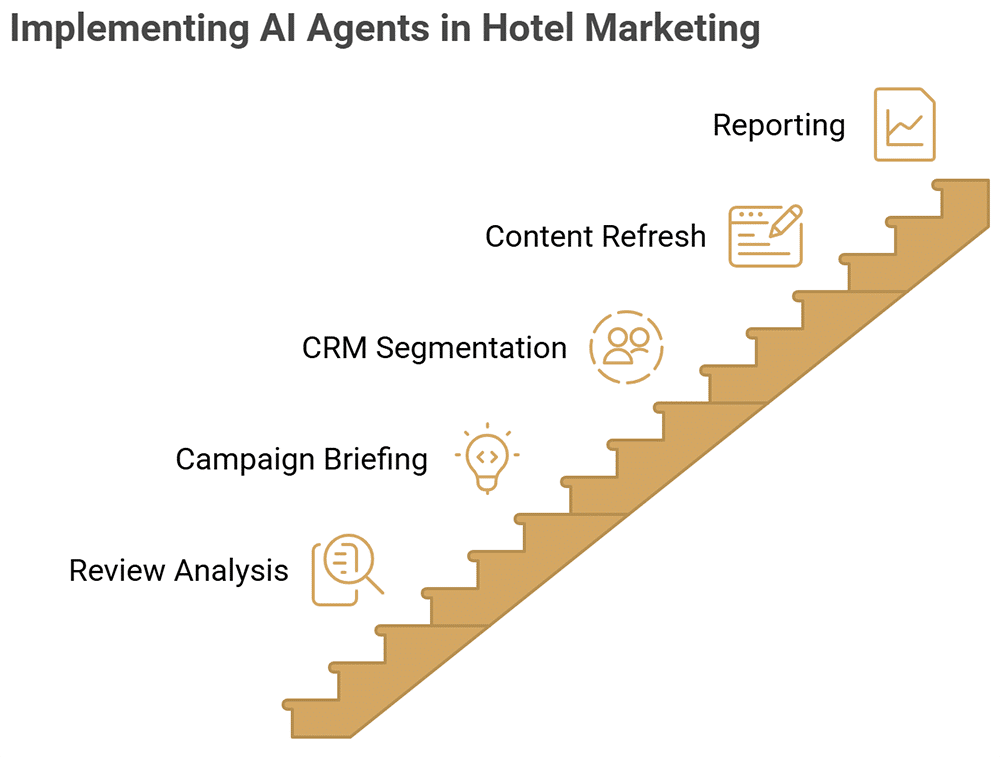
Best First Tasks for AI Agents
Good first tasks for AI agents for hotel marketing include:
- Review Analysis: The AI marketing agent should identify repeated praise, complaints, and missed experience signals.
- Campaign Briefing: The agent can turn booking patterns and guest segments into campaign ideas.
- CRM Segmentation: The agent groups past guests by value, stay purpose, and offer relevance.
- Content Refresh: The agent suggests updates for landing pages, package pages, and local content.
- Reporting: The agent explains changes in bookings, conversion, channel mix, and campaign cost.
Tasks That Need Human Approval
The hotel marketing manager or general manager should have human approval over brand claims, crisis communication, legal wording, rate promises, and sensitive guest data. A 140-room resort in Phuket could begin with an agent who checks reviews every Monday, identifies the top three guest intent themes, and creates one landing page brief. Then measure revenue per email against the manual baseline before expanding the agent’s role.
How Do You Make Your Hotel Visible to AI Agents?
Hotels become more visible to AI agents when property information is accurate, specific, structured, and consistent across public sources. Guest-side agents cannot recommend what they cannot confidently read. This is where AEO and GEO move beyond buzzwords and become operational marketing work.
The first priority is structured data, including schema markup for the property, room types, amenities, policies, location, and offers. The second is specificity. “Rooftop pool open May to October” is more useful than “relax in comfort” because AI systems extract facts better than adjectives. The third is consistency across the hotel website, Google Business Profile, online travel agencies, booking engine, and review platforms.
Robert Cole, senior research analyst for lodging and leisure travel at Phocuswright, warned in PhocusWire:
“Hotels must control their sources of truth or another party may fill the gap with a technology layer or tollgate and monetize it.”
The content owner should schedule a quarterly AI visibility audit. Pull amenity, parking, pet, breakfast, cancellation, and location details from every public surface, then correct contradictions before they become distribution problems.
How Should Hotels Measure AI Marketing Agent Performance?
Hotels should measure AI agents by commercial movement and workflow reliability, not by how much content they produce. A system that creates 40 weak email variants is less valuable than one that identifies one high-value guest segment and prepares a campaign your team can approve in 10 minutes.
McKinsey’s State of AI survey reports that no more than 10 percent of respondents are scaling AI agents in any individual function. That matters for hotels because agent performance should be tested with disciplined operating metrics before autonomy expands.
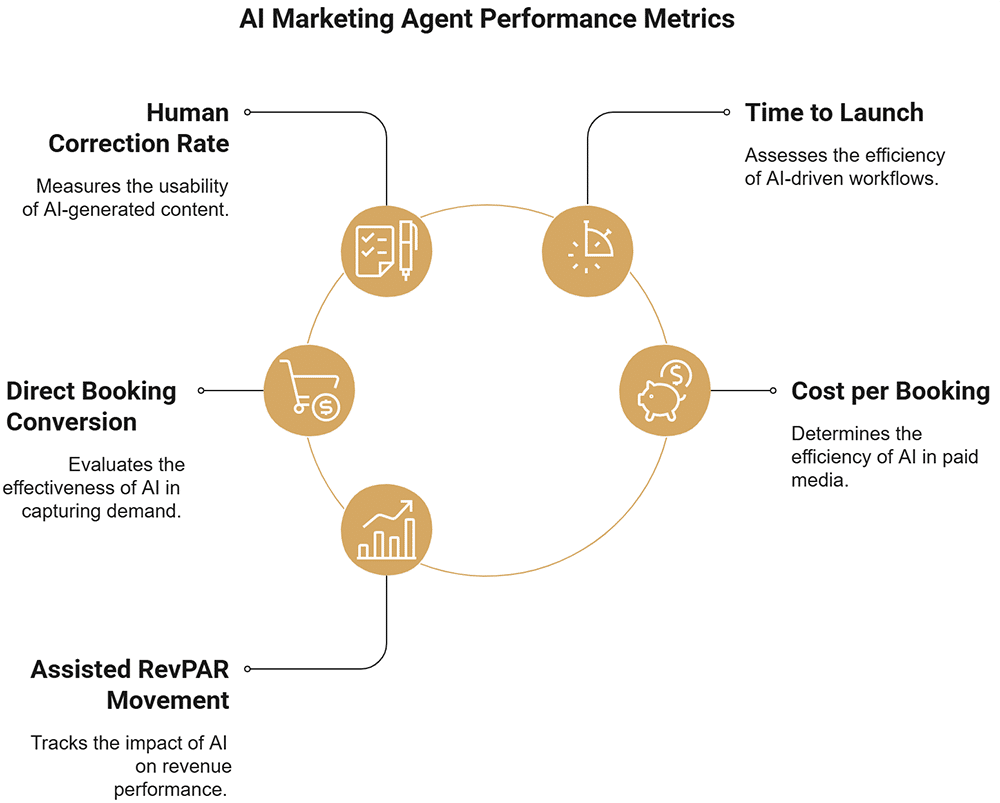
| Metric | What It Tells the Hotel | Review Rhythm |
| Human correction rate | Whether outputs are usable | Weekly |
| Time to launch the campaign | Whether workflows are faster | Per campaign |
| Direct booking conversion | Whether demand capture improves | Weekly |
| Cost per booking | Whether paid media efficiency improves | Weekly |
| Assisted RevPAR movement | Whether marketing supports revenue performance | Monthly |
The marketing owner should avoid full attribution claims unless the data supports them. RevPAR movement depends on rate, occupancy, demand, channel mix, and revenue strategy. A better early measure is whether agent-supported campaigns improve speed, quality, and direct booking contribution.
What Data and Systems Do AI Agents for Hotel Marketing Need?
AI agents need reliable access to your hotel systems before they can make useful marketing recommendations. The minimum stack is your PMS (Property Management System), booking engine, CRM platform, content management system, website analytics, paid media accounts, and review sources. Without those connections, the agent guesses from fragments.
McKinsey and Skift identify fragmented systems as a core barrier to agentic AI in travel because company data sits spread across legacy platforms, booking tools, and operational workflows.
The technology owner should define the required data fields for one workflow before connecting more systems. For a 75-room hotel in Valencia, an abandoned direct booking agent may need search date, room type, source market, price viewed, email permission, and final booking outcome. If three of those six fields are missing or unreliable, the agent will produce weak recommendations.
Data accuracy beats data volume in agentic marketing. A hotel without clean permissions, booking outcomes, and segment labels should begin with reporting and recommendation agents, not autonomous campaign execution. That approach protects guest trust while the data foundation improves.
Video: 6 BEST AI Agents for Hotels 2026
What Should Independent Hotels Do Differently?
If you run an independent property without a dedicated commercial team, the honest news is that the field hasn’t left you behind. McKinsey and Skift found that 38 percent of travel executives say their organizations are not using agentic AI at all. That is important for independent hotels because the market has not already moved beyond them. A smaller property can still compete by fixing source data, testing AI visibility, and adopting one agent inside existing software.
1. Fix Your Property Data First
You should make your property information accurate, structured, and consistent across your website, booking engine, and profiles before spending anything else, because this work feeds both fronts at once.
2. Run the Monthly AI Visibility Test
You should ask the major assistants your ideal guest’s questions monthly and record whether you appear against your comp set. This exercise takes an hour and requires no budget.
3. Adopt One Agent Tied to One Revenue Problem
Consider a family-owned hotel in York. Rather than copying a chain loyalty model, its first agent identifies past wedding inquiries, prepares anniversary stay offers, and flags high-value guests for manual review.
4. Track Direct Booking Share as Your Master Metric
You should measure both fronts against direct booking share, because that is the number both ultimately exist to move.
Small scope is not a weakness. For independent hotels, it is the control mechanism that keeps AI useful, affordable, and measurable.
What Controls Should Hotels Put Around AI Marketing Agents?
Hotel marketing leaders, general managers, and technology owners should set operating controls before AI agents publish content, send campaigns, reply to reviews, or adjust paid media. The risk is not only a weak copy. The larger risk is allowing an agent to act on weak data, make unsupported claims, or damage trust faster than the team can correct it.
The U.S. Federal Trade Commission’s final rule prohibits fake or false consumer reviews and testimonials, including AI-generated fake reviews that misrepresent real customer experience.
As FTC Chair Lina M. Khan said in the announcement,
“Fake reviews not only waste people’s time and money, but also pollute the marketplace.” (FTC press release)
1. Approval Rules
You should define which actions an agent can draft, schedule, or execute. Discount language, cancellation claims, loyalty offers, and public review replies should require human approval.
2. Source Traceability
You should make every agent output traceable to a review theme, booking segment, campaign result, or data field, so any claim can be checked in minutes.
3. Rollback Plans
You should know how to pause, edit, or reverse agent-led campaigns quickly, which matters most when website content, guest emails, and paid media are involved.
For hotels using review data in AI workflows, our guide to “hotel review websites” explains which review platforms matter most and how reputation management supports booking decisions.
FAQs Related to AI Agents for Hotel Marketing
AI agents for hotel marketing deliver the most when insight, content, offers, execution, and measurement connect under clear human responsibility. The opportunity is not replacing your marketing team. It is giving commercially accountable people faster workflows, cleaner decisions, and stronger visibility in the places where travelers now ask for advice.
Did You Like This Article About AI Agents for Hotel Marketing?
You might also be interested in the following articles:
- AI Agents for Hotel Front Desks and What to Automate First
- AI Agents in the Travel Industry: Use Cases, ROI, and Strategy
- Discover Examples of Artificial Intelligence (AI) in the Hotel Industry
More Tips to Grow Your Business
Revfine.com is the leading knowledge platform for the hospitality and travel industry. Professionals use our insights, strategies, and actionable tips to get inspired, optimize revenue, innovate processes, and improve customer experience.Explore expert advice on management, marketing, revenue management, operations, software, and technology in our dedicated Hotel, Hospitality, and Travel & Tourism categories.
This article is written by:

Hi, I am Martijn Barten, founder of Revfine.com. With 20 years of experience in the hospitality industry, I specialize in optimizing revenue by combining revenue management with marketing strategies. I have successfully developed, implemented, and managed revenue management and marketing strategies for individual properties and multi-property portfolios.

Leave A Comment