


Hotel review websites play a critical role in today’s digital-first landscape. Crucially, they are no longer just a platform for customers to explore options; they can also serve as vital platforms for marketing and reputation management. Managing your reputation on these platforms is important because guests often check online reviews before booking a hotel. You want to make sure they see positive reviews and professional, constructive replies to criticism.
In this article, you can explore why hotel review websites matter and how you can manage your online reputation. Along the way, you will also discover how to use these platforms to boost visibility and generate revenue.
Quick Definition:
Key Takeaways:
|
–
Table of Contents:
- What Are Hotel Review Websites?
- Why Hotel Review Websites Are Important in the Hotel Industry?
- Top 10 Hotel Review Websites Every Hotelier Should Know
- Strategies for Managing Your Hotel’s Online Reputation
- The Role of AI in Modern Hotel Review Management
- How to Respond Effectively to Online Hotel Reviews
- Trust, Verification, and the Growing Risk of Fake Reviews
- Hotel Review Websites: Global Outlook for the Next 10 Years
- Hotel Reviews: Strategies for Managing Negative Feedback
- Hotel CRM System: A Guide to Customer Relationship Management
- FAQs Related to Hotel Review Websites
What Are Hotel Review Websites?
Hotel review websites are platforms that allow users to rate hotels and leave written feedback. This feedback typically describes their experience, including the service standards, facilities, and cleanliness of the hotel.
Many of these platforms effectively function as hotel comparison sites, making it easy for guests to understand the pros and cons of different properties. Some also allow users to book a room or link to the hotel’s booking engine.
Users are able to read the reviews other guests have left and, in many cases, see an aggregate score. However, the platforms can usually also be used by hotels to manage their listing and respond to feedback they receive. This allows the hotel to take on constructive criticism, apologize to guests, or defend themselves from inaccurate claims.
Some of the best-known and most influential online hotel review platforms include Google Reviews, TripAdvisor, Expedia, and Booking.com. Many platforms implement policies and technology to remove fake or malicious reviews.
Why Hotel Review Websites Are Important in the Hotel Industry?
Hotel review websites matter because they strongly influence booking decisions and help to define your hotel’s reputation. They also provide useful feedback for your hotel, so you can improve service standards.
Research from Statista and Booking.com shows 54% of European customers are influenced by online reviews and online ratings. To put this in perspective, this is higher than the 44% who are influenced by hotel star ratings.
Many potential guests will either use online review websites to find suitable hotels or use them to check the reputation of hotels they have discovered on their own. This means your hotel’s ratings on these platforms can have a significant bearing on whether someone actually follows through on their interest in booking a room.
These hotel rating platforms can also impact your key performance indicators. A study from Cornell University found that a 1% increase in reputation score can lead to a 1.4% increase in revenue per available room (RevPAR).
As Wouter Geerts, Director of Market Research, Mews, states:
“Hotels that treat 2026 as a planning year will lose ground. The ones that use it to clean up data, content, and systems will be the ones AI can actually find, trust, and send business to.”
Video: What is the Best Hotel Booking Engine for Your Website in 2026?
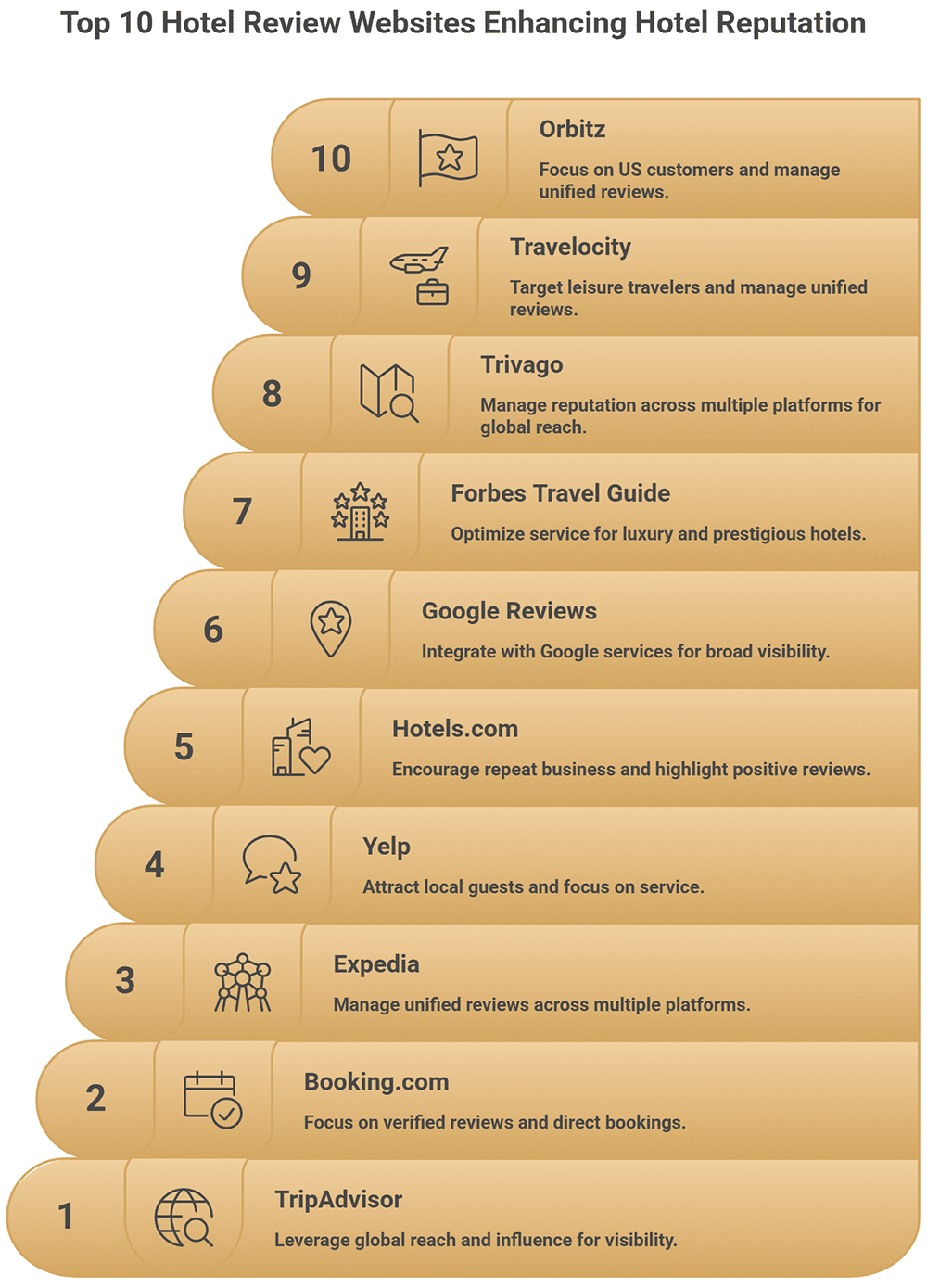
Top 10 Hotel Review Websites Every Hotelier Should Know
To manage your hotel’s reputation effectively, you need to understand the most important and influential hotel review websites. This will allow you to focus your efforts on the platforms that matter most:
1. TripAdvisor
TripAdvisor promotes itself as the world’s largest travel guidance platform. It is not only one of the most popular hotel review websites, but also a platform for reviewing restaurants and travel experiences.
For hoteliers, TripAdvisor matters because it is the go-to information source for so many travelers. In fact, it has a claim to being the most influential of all guest feedback sites, with over 1 billion reviews on the platform.
Good reviews have a direct impact on visibility, as TripAdvisor uses a ranking system for search results that rewards review quality, review quantity, and review recency. You can also use the platform to generate direct bookings.
2. Booking.com
Booking.com is an online travel agency that has also become one of the world’s most popular hotel review websites. It is a platform with highly credible reviews, as feedback comes only from verified guests.
Its role as an OTA makes Booking.com a valuable platform to focus efforts on. Guests use the platform not only to find hotels, but also to book the rooms, so managing your listing can generate more revenue.
The Booking.com Partner Hub provides useful insights into guest feedback trends. The platform is also available in a wide range of languages, making it ideal for hotels targeting an international audience.
3. Expedia
Expedia is an online travel agency and part of the Expedia Group, along with Hotels.com, Orbitz, and Travelocity. Reviews across these brands are unified, meaning hotel reviews left on one platform can influence the others.
As Expedia is also an OTA, managing feedback is important for generating third-party bookings. This can allow you to expand your reach beyond where your marketing efforts are currently targeted.
Expedia also uses positive feedback to enhance the visibility of your hotel on its platform. As a result, earning plenty of positive reviews can make it easier to generate bookings and revenue.
Video: Expedia vs Booking.com vs Direct: What’s the Best Way to Book Hotels?
4. Yelp
Yelp is one of the world’s biggest business review websites and business discovery platforms. It has a significant travel section, which essentially makes it one of the most important hotel review websites, too.
As a platform, Yelp has a strong focus on local business reviews, which makes it especially important for hotels to attract local guests. It can be one of the most valuable platforms for boutique and urban hotels.
The website includes options to respond to reviews publicly or send private messages to resolve issues away from the public glare. Reviewers also often place a focus on service standards more than amenities.
5. Hotels.com
Another part of the Expedia Group, Hotels.com is both an online booking platform and one of the most popular accommodation review websites. It appeals to frequent travelers thanks to a generous rewards program.
Managing reviews on Hotels.com has the potential to generate repeat business from some customers. It also has a ‘Loved By Guests‘ section, highlighting properties that generate the most positive verified guest reviews.
The Partner Central platform offers hoteliers access to valuable insights. This can make it easier to keep track of trends around sentiment and to understand your hotel’s positioning compared to rival properties.
6. Google Reviews
Google Reviews has emerged as one of the biggest review platforms for hotels. It is also fully integrated with Google Maps, Google Search, and Google Travel, making it easy for users to find more information about your hotel.
As Google is most people’s default search engine, your Google Reviews score will be one of the first things many users see about your hotel. These reviews may also be more widely seen than those on dedicated hotel review websites.
Managing feedback on Google Reviews is important, as potential guests may use it to determine whether to look into your hotel further. You should also manage your Google Business Profile to get the most from the integration features.
7. Forbes Travel Guide
The Forbes Travel Guide is different from other hotel review websites, using professional hotel critics to review hotels based on set criteria. This helps to deliver a level of consistency and reliability.
When compared to the major hotel booking review platforms, the Forbes Travel Guide positions itself as a high-authority resource. This makes it especially important for luxury hotels and prestigious hotel brands.
The main way to manage reviews from the Forbes Travel Guide is to optimize service standards. Forbes reviewers primarily focus on the quality of service rather than the physical features of the hotel.
8. Trivago
Trivago is primarily a metasearch engine, aggregating listings from other platforms and presenting them to users in a simple format. However, it also aggregates user ratings from these other platforms.
This is significant because it makes Trivago’s hotel scores a sort of summary of scores on a range of hotel review websites. However, it does also mean you cannot manage reviews directly on the Trivago platform.
Trivago aggregates these scores from dozens or even hundreds of other platforms, making it important to manage your hotel’s reputation everywhere. The Trivago platform has a global reach and can help you boost revenue.
9. Travelocity
As part of the Expedia Group, Travelocity operates as both a booking platform and one of the leading hotel review websites. It uses a centralized review system, including reviews from other Expedia platforms.
Travelocity remains an important platform because it targets leisure travelers more than business travelers. This makes it especially valuable for hotels that are also targeting the leisure segment of the market.
Despite being part of the Expedia Group family, many Travelocity users do not use Expedia or Hotels.com. Nevertheless, managing your reviews across all Expedia platforms is the way to generate bookings through this platform.
10. Orbitz
Finally, Orbitz is another part of the Expedia Group and functions as a core part of the Expedia ecosystem. It allows users to book hotels, flights, and other travel products and services, while also featuring reviews.
The Orbitz platform still has unique value, especially for hotels targeting US customers, as it has historically had a strong US focus. Many of its users remain loyal and may not explore other travel websites in the same depth.
Again, with Orbitz, the key is to manage your reviews across the entire Expedia Group. Scores are not aggregated from other hotel review websites outside of the Expedia umbrella, but do include Expedia, Hotels.com, etc.
Strategies for Managing Your Hotel’s Online Reputation
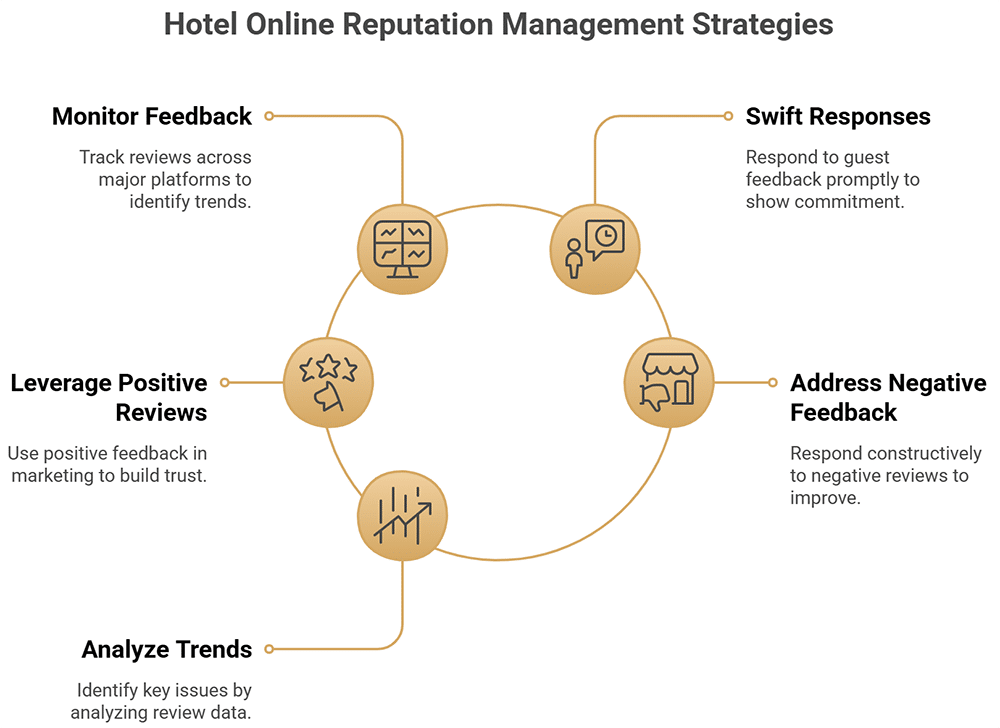
In addition to knowing the main hotel review websites to focus on, you also need to understand how to actually manage feedback. The strategies in this section can help you optimize your hotel’s online reputation:
1. Monitor Feedback Across the Main Platforms
You need to monitor feedback from guests across all major hospitality rating websites. In particular, you must closely monitor the likes of Google Reviews, TripAdvisor, Expedia, Booking.com, and Hotels.com.
This is important because each of these hotel review websites reaches a different user base, and all can influence future booking decisions. Monitoring feedback across platforms helps you to quickly spot emerging patterns in reviews.
Importantly, these trends can vary based on the platform, as some appeal to leisure travelers, while others appeal to corporate demographics. This means a trend in feedback from one demographic may not apply across the board.
2. Provide Swift Responses to Guest Feedback
Try to respond to guest feedback quickly; ideally, within 24 to 48 hours. Your guest has taken the time to leave a review, and your hotel taking the time to reply helps to show you are committed to living up to their expectations.
Responding to reviews quickly is important because it demonstrates that you pay attention to guest feedback and actively engage with your customers’ views. It also limits the amount of time criticism goes unaddressed.
Some hotels make the mistake of only responding to negative comments. Show appreciation to everyone for sharing their views, thank guests who leave positive feedback, and reply professionally to negative reviews.

Joanne Greene, Hospitality Expert“It is incredible how few hotels are following up with emails to their guests thanking them for their stay and inviting them to book directly next time. At the end of the day, it is THEIR guest and not an OTA guest once the guest has checked in. As long as the guest has opted in to receiving emails, there are no GDPR breaches, and this is the perfect way to convert an OTA booking to a direct booking. Incentivise them in your email by offering them a bottle of wine for dinner when booking directly, or an upgrade to a suite etc., so that they have a reason to want to book directly. Another way is to let people know when you respond to their reviews that they should book directly next time in order to receive preferred rates. This is possible on Tripadvisor and on Google, and just takes a small **Please book directly via our website – www.hotelx.com – for our best available rates and receive a welcome drink upon arrival/free car parking”, etc. With 95% of all travellers referring to review sites before they choose a hotel, it is the perfect place to get your message across. But most importantly, make sure that your team are able to take direct bookings over the telephone. At any time of day or night. And that your website is easy to use and clear with regard to rates, packages, room types. 3-4 clicks is enough or you lose them. One of the main reasons that people use OTAs to make a hotel reservation is because it is easy to navigate, unlike many hotel websites.” Click here to learn more from our Hotel Marketing Expert Panel. |
3. Leverage Positive Reviews in Hotel Marketing
Positive feedback on hotel review websites is one of your most valuable marketing resources. Leverage positive reviews and review scores within your marketing content to signal guest satisfaction.
Research shows the importance of leveraging feedback, as 86% of customers trust word-of-mouth recommendations and online reviews. By contrast, just 40% of customers trust advertising messages.
This means customer reviews do a better job of convincing guests to book your hotel than your own promotional messages. Include quotes, review scores, and other signals of customer trust in your marketing content.
4. Address Negative Feedback Constructively
While negative feedback can feel hurtful or disheartening, it also provides opportunities to learn and grow. Approach negative feedback with empathy, avoid going on the attack, and respond constructively.
Guests can often learn more about a hotel from how they respond to negative feedback than from their responses to positive feedback. Keep it professional and think about how your reply reflects on your hotel.
Your responses will be visible to all users, so use them as an opportunity to demonstrate professionalism and a commitment to improvement. When criticism is valid, apologize and explain what you will do to prevent a repeat.
Video: Online Reputation Management (ORM) Made Simple
5. Analyze Review Trends to Address Key Issues
Take the time to analyze the wider trends within guest feedback on hotel review websites. Look for patterns, such as specific issues that get mentioned a lot, or services that multiple guests have concerns about.
Understanding the most important issues to focus on can be difficult when reading reviews individually. By analyzing data and identifying trends, you can more easily pinpoint the most critical areas to improve in your hotel.
AI tools are helping to make this data analysis process easier, automating some of the more time-consuming elements. This can allow you to identify the most pressing issues quickly, so you can get to work on fixing them.
The Role of AI in Modern Hotel Review Management
Artificial intelligence is transforming hotel review websites in two key ways. First, it is altering the way users consume guest feedback, and secondly, it is changing the way hotels analyze and act on this feedback.
A growing number of hotel feedback portals are now providing AI summaries of guest reviews. This means users can easily gain the main information from hundreds of reviews in a matter of seconds.
For hotels, this makes it essential to carefully manage reviews, especially on platforms using AI summaries, including Google. Failure to manage reviews can lead to AI summaries that misrepresent your hotel to a wide audience.
Hotels are also increasingly using AI for everything from sentiment analysis, where the AI identifies common themes in guest feedback, to response drafting, where AI generates a basic template for professional responses to guest reviews. This can make it easier to understand and address guest feedback while maintaining the right tone.
For a complete explanation, including real-world use cases, practical examples, and the impact of AI on hotel operations, read our dedicated article “Discover Examples of Artificial Intelligence (AI) in the Hotel Industry.”
How to Respond Effectively to Online Hotel Reviews
These guidelines can help you to respond effectively to guest feedback on hotel review websites and platforms, so that users are left with a positive perception of your business:
- Positive Reviews: Thank the guest for choosing your hotel and for their feedback. Reference specific compliments they gave you, invite them back in the future, and make sure your reply feels personalized.
- Negative Reviews: Acknowledge their complaints and concerns, explain any necessary context, but avoid over-defensiveness. Apologize for their negative experiences and explain what actions you will take to resolve issues.
- Response Timing: Try to respond within 24 hours when possible and within 48 hours if this is impractical. Fast responses demonstrate attentiveness and a genuine interest in guest feedback.
- Personalized Responses: Address guests by name when possible and reference specific things they said in their review. Avoid generic responses and sign off with your name and position within the hotel.
- Follow-up Process: Document hotel review website interactions for sentiment tracking and learning. On relevant platforms, check back to see if reviews are updated or changed after your response.
Trust, Verification, and the Growing Risk of Fake Reviews
As hotel review websites become more powerful in shaping booking intentions, the issue of trust has become more important. Platforms are taking action to prevent fake reviews and to highlight verified guest reviews.
This issue has also extended away from online platforms to the government level. For example, in 2024, the US Federal Trade Commission (FTC) officially banned fake reviews, including their sale or purchase.
Customer research also shows buyers are savvy and are more likely to trust brands that have positive overall reviews, but with negative reviews present. They are much more skeptical of entirely positive scores, such as 5/5 or 10/10.
Video: TripAdvisor’s Fake Hotel Reviews – Which?
Hotel Review Websites: Global Outlook for the Next 10 Years
According to Global Market Statistics, the hotel booking market is valued at $22.4 billion in 2026. This value is expected to rise to $34.3 billion by 2035, achieving a compound annual growth rate of over 15% in that time.
Hotel review websites and booking platforms are a crucial part of this market and will continue to play a major role over the next 10 years. However, the way this feedback is discovered is already beginning to change.
Today, many platforms have built-in AI features, which can create summaries of guest feedback. This is going to move to the next level as AI agents become more widespread. Kantar research shows that AI acceptance is growing, with 40% of travelers having already used AI tools for travel planning and 62% saying they are open to doing so in the future.
The Mews Hospitality Industry Outlook projects that by 2035, most hotel discovery and booking will happen through a single AI-driven conversation, shifting visibility away from advertising budgets and toward structured content quality and review authenticity.
In the next few years, one of the big expected changes will be an increased reliance on AI agents to book travel experiences. These agents are likely to make extensive use of hotel review websites to select the best hotels.
Hotel Reviews: Strategies for Managing Negative Feedback
Negative reviews can feel hurtful, but they contain valuable information that can help you to improve service standards. One of the best ways to mitigate the damage caused by negative feedback on hotel review websites is to answer the reviews professionally and with an empathetic tone, while explaining how you will prevent a repeat.
In the “Hotel Reviews: Strategies for Managing Negative Hotel Reviews Online” article, you can dive deeper into the importance of managing negative reviews and learn how to answer these reviews effectively.
Hotel CRM System: A Guide to Customer Relationship Management
A high-quality hotel CRM system will transform the way your hotel collects, analyzes, and uses data from guests, including feedback from hotel review websites. This software allows you to create unified guest profiles, which can then be used to improve guest communications, target your marketing efforts, and streamline operations.
In the “Hotel CRM System: The Ultimate Guide to Customer Relationship Management” article, you can discover the main features of hotel CRM software, explore the key benefits, and learn how to choose the best software.
FAQs Related to Hotel Review Websites
Hotel review websites are one of the major touchpoints that have a direct bearing on customer booking decisions. By carefully managing online feedback, responding to guest reviews, and leveraging customer comments within your marketing content, you can protect and enhance your hotel’s reputation while generating more revenue.
Did You Like This Article About Hotel Review Websites?
Yu might also be interested in the following articles:
- Hotel Reputation Management Software Guide
- Review Management Tips for Companies Operating in The Travel Industry
- Best Hotel Loyalty Programs to Turn Visitors into Loyal Guests
More Tips to Grow Your Business
Revfine.com is the leading knowledge platform for the hospitality and travel industry. Professionals use our insights, strategies, and actionable tips to get inspired, optimize revenue, innovate processes, and improve customer experience.Explore expert advice on management, marketing, revenue management, operations, software, and technology in our dedicated Hotel, Hospitality, and Travel & Tourism categories.
This article is written by:

Hi, I am Martijn Barten, founder of Revfine.com. With 20 years of experience in the hospitality industry, I specialize in optimizing revenue by combining revenue management with marketing strategies. I have successfully developed, implemented, and managed revenue management and marketing strategies for individual properties and multi-property portfolios.






Leave A Comment