


Hotels build a corporate sales strategy by identifying companies with recurring room night demand, negotiating rates that maintain both volume and yield, and managing those accounts as a portfolio rather than a stack of one-off RFP responses. A hotel corporate sales strategy is the organized plan a property uses to win, price, and grow bookings from corporate travel programs.
Key Takeaways:
|
Table of Contents:
- What Is a Hotel Corporate Sales Strategy?
- Why Does Corporate Business Matter for Hotel Revenue Now?
- How Do You Build a Corporate Account Portfolio?
- The Corporate RFP Response Process
- How Does GDS Visibility Win Corporate Bookings?
- How Do You Win Group and Meetings Business From Corporate Accounts?
- The Corporate Sales Role at a Mid-Size or Independent Property
- FAQs About Hotel Corporate Sales Strategy
What Is a Hotel Corporate Sales Strategy?
A hotel corporate sales strategy is a clear plan for winning and growing bookings from companies whose employees travel on business. It covers account targeting, rate negotiation, distribution visibility, and ongoing relationship management. Corporate demand should be treated as a portfolio of accounts that you build and manage.
The practice that falls short is reactive selling. This means waiting for RFPs to arrive, bidding on everything, and judging success by how many rates you loaded. That approach fills your system with accounts that produce twelve room nights a year at a discount you would never have offered knowingly. The rate loading fees alone can exceed the profit on the business.
A working hotel corporate sales strategy answers four questions before RFP season starts.
- Which companies generate room nights in your market, and on which nights?
- What rate structure protects your yield while giving the buyer the certainty they need?
- Through which channels do their travelers actually book?
- And who at your property owns each of those answers?
The output would be a target account list, a rate card with volume tiers, loaded and audited rates in the right systems, and a review calendar. Start by auditing your current base. If you can’t name your top ten producing companies and their booking channels, that audit beats any new prospecting this quarter.
Corporate selling is one segment within a wider commercial plan, so read this alongside our hub guide to “hotel marketing strategies.”
Why Does Corporate Business Matter for Hotel Revenue Now?
Corporate business is important for hotel revenue because it delivers contracted, midweek, repeat demand that stabilizes occupancy and gives your revenue team a base to price around. Leisure demand fills your weekends. Corporate demand decides whether Tuesday runs at 55 percent or 80 percent.
The Global Business Travel Association forecasts global business travel spending to reach a record $1.71 trillion in 2026, up 7.2 percent year over year, while trip volume grows just 1.3 percent. Fewer trips carrying more spend means each corporate traveler you win is worth more, and each account decision is reviewed harder.
As Suzanne Neufang, CEO of GBTA, said at the release of the 2026 Business Travel Index,
“The big story this year is that companies haven’t stepped away from travel, but they are increasingly more selective and productivity-focused.”
Corporate buyers are becoming more selective. Some companies are reducing the number of hotels in their preferred programs and directing more bookings toward fewer suppliers.
Hotels without a clear corporate sales strategy may lose out. Hotels that can show reliable service, consistent rates, and proven account production are more likely to remain preferred suppliers.
There is still a trade-off. Corporate rates are usually lower than your Best Available Rate (BAR), but they can bring regular volume, repeat stays, and predictable booking patterns.
Compare the Average Daily Rate (ADR) of each negotiated account with your BAR for the same stay dates. If the difference is too large for the amount of business received, use that information when renegotiating the account.
How Do You Build a Corporate Account Portfolio?
You build a corporate account portfolio by finding the main business demand generators in your market, checking which companies fit your hotel’s needs, and focusing on accounts with real booking potential.
Do not chase every RFP that arrives. A stronger approach is to build a balanced mix of large, medium, and smaller corporate accounts.
Kate Ferrara, Deloitte’s vice chair and U.S. transportation, hospitality and services sector leader, explained the need for closer cooperation:
“This moment calls for agility and partnership between companies and their travel providers, as well as companies and their traveling employees.”
Where Do You Find Corporate Prospects?
Start with businesses close to your hotel. Make a list of office parks, hospitals, universities, factories, construction projects, consulting firms, and energy companies within about a 15-minute drive. The same mapping exercise feeds your local partnership strategy, so run it once and use it twice.
For example, consider a 110-room independent hotel near the Port of Rotterdam. Its best prospects may not be large international companies with global hotel programs. Marine engineering companies that regularly send project teams to the area could produce more useful and repeat business.
Focus on companies that already have a clear reason to stay near your property.
Video: Hotel Prospecting: Research, Qualify & Build Meaningful Relationships | Hotel Sales Masterclass
How Do You Qualify a Corporate Account?
Before spending sales time on an account, check three things:
- How many room nights could the company produce each year?
- Which days of the week are employees likely to stay?
- What rate can the company accept compared with your Best Available Rate (BAR)?
The timing of bookings is as important as the volume.
Build a balanced portfolio, not an account count. You might plan for three to five anchor accounts producing more than 300 room nights each, ten to fifteen growth accounts producing 100 to 300 room nights, and smaller accounts using a flexible corporate rate instead of a separate negotiated contract.

Max Starkov, Adjunct Professor, Hospitality Technology, New York University“The secret to building a loyal B2B customer base is building a successful B2B Content Marketing strategy. If you are a corporate group hotel or resort, B2B content marketing can position you as the ultimate destination for corporate groups, MICE, SERF groups, etc. If you are a vendor serving the hospitality industry, B2B content marketing can position you as the ultimate expert in your field Many hoteliers and hotel tech vendors alike are pushing services/products without identifying their core value proposition. B2B marketing is all about telling your story and explaining your value proposition and B2B media is the perfect avenue to do that. The best B2B marketing channels are LinkedIn, PR, blog articles and posts, white papers, webinars, case studies, influencer marketing, conference speakerships, panel discussion participation, award announcements, new client acquisition announcements, etc. The best scenario is the right balance between the various formats. B2B Content Marketing allow hotels to reach corporate travel managers, corporate group planners, conference and convention organizers, company decision-makers, etc. The question is, how many hoteliers and hotel tech vendors use B2B Content Marketing to engage and acquire customers? Just a few.” Click here to learn more from our Hotel Marketing Expert Panel. |
The Corporate RFP Response Process
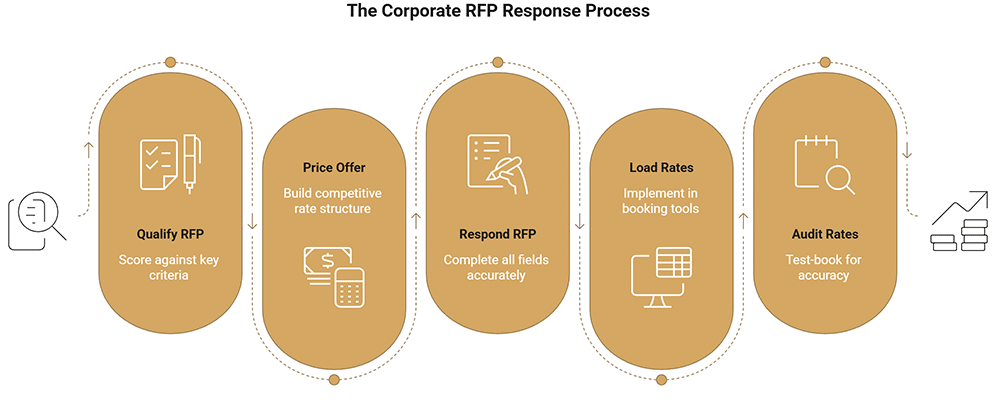
The corporate RFP response process starts with checking whether an opportunity is worth pursuing. It ends with loading the agreed rate, testing it, and reviewing how much business the account actually produces.
Hotels that perform well do not stop once the proposal is submitted. The measures after acceptance also matter.
RFP (Request for Proposal): A formal invitation from a company or its travel management company asking hotels to bid negotiated rates and terms for the coming contract year.
| Step | Action | Deadline discipline |
| 1. Qualify | Score the RFP against room night potential, need-period fit, and rate tolerance before bidding | Within 48 hours of receipt |
| 2. Price | Build the offer: rate structure, inclusions, blackout dates, cancellation terms | Before the platform deadline, not on it |
| 3. Respond | Complete every field; incomplete bids are filtered out before a human reads them | Platform deadline |
| 4. Load | Load accepted rates in the GDS and the client’s booking tool with correct inclusions | Before the contract year starts, usually January 1 |
| 5. Audit | Test-book the rate through the client’s channel to confirm it displays and prices correctly | First two weeks of the contract year |
| 6. Review | Compare production against estimates quarterly and flag gaps to the buyer | Every quarter |
You do not have to bid on every RFP.
If an account cannot produce enough profitable business, declining it can be the better decision. A weak account still creates work through rate loading, auditing, reporting, and account management.
Which Corporate Rate Structure Should You Offer?
LRA (Last Room Availability): A negotiated rate condition guaranteeing the corporate client can book their contracted rate as long as any standard room remains unsold.
NLRA (Non-Last Room Availability): A negotiated rate the hotel can close out during high-demand dates, protecting yield in exchange for weaker availability guarantees.
Use LRA carefully. It works best for important accounts that deliver enough regular room nights to justify giving them access during busy periods.
For smaller or less predictable accounts, consider NLRA or dynamic corporate pricing. A dynamic rate may offer a fixed percentage discount from the hotel’s Best Available Rate (BAR), sometimes with a minimum rate.
The main risk with a fixed LRA agreement appears on high-demand nights. Your hotel may have to sell a room at the negotiated rate even when other guests would pay much more.
The answer is not to avoid corporate contracts. Match the rate and availability guarantee to the value of the account.
How Do You Defend Rate Under Buyer Cost Pressure?
Corporate buyers are paying close attention to travel costs. Deloitte’s corporate travel research found that 54 percent of travel managers listed cost among the main factors limiting business travel. Do not reduce your room rate immediately.
A lower negotiated rate can affect every booking from that company and may become the starting point for the next contract negotiation. Protect the rate first, then use valuable inclusions to make the offer more attractive.
How Does GDS Visibility Win Corporate Bookings?
GDS (Global Distribution System): The booking networks (Amadeus, Sabre, Travelport), travel agencies, and corporate booking tools use to find and reserve hotel rates.
TMC (Travel Management Company): An agency that manages a corporation’s travel program, including hotel sourcing, booking enforcement, and traveler support.
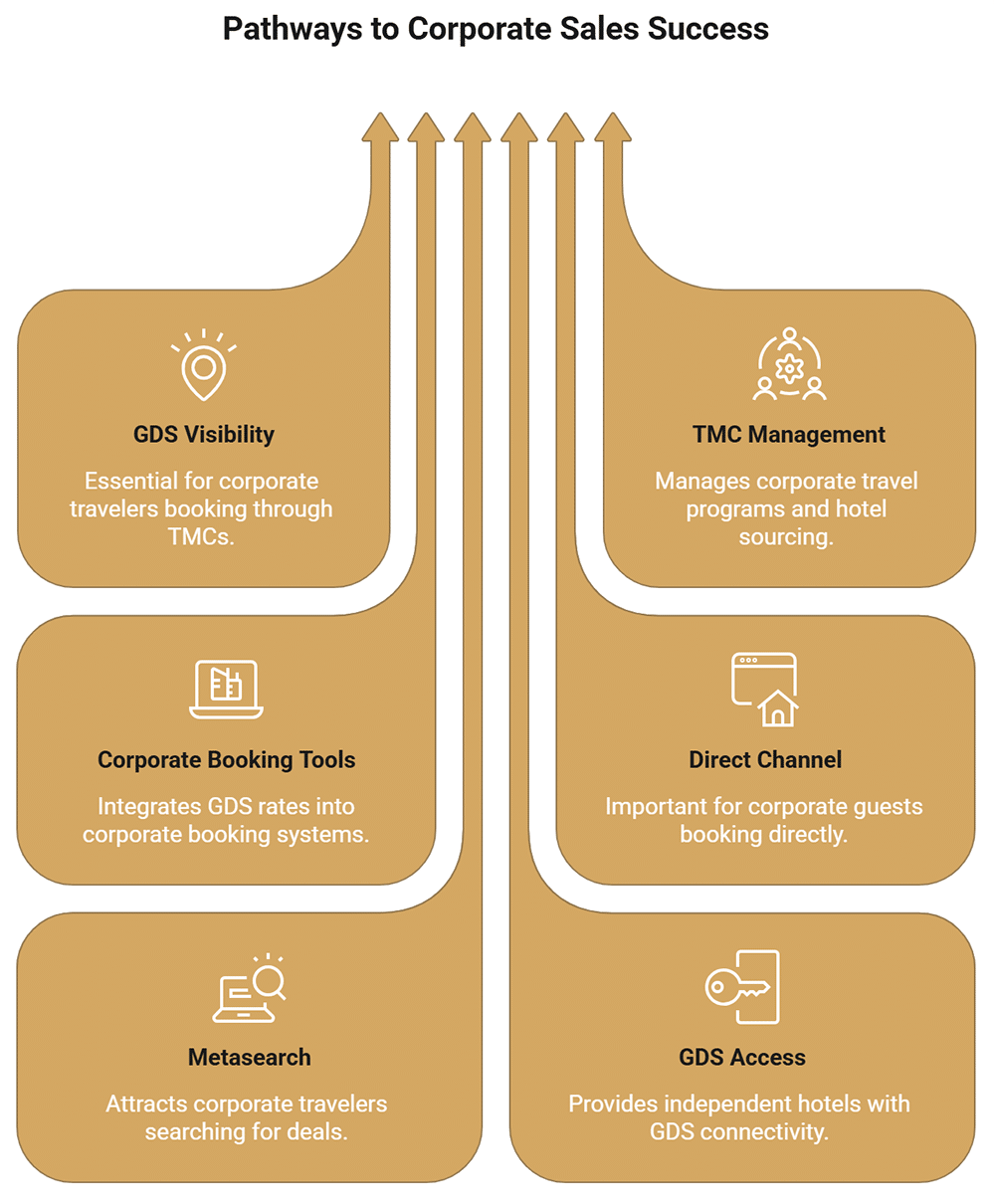
GDS visibility wins corporate bookings because managed travelers book through TMCs and corporate booking tools that pull rates and content from the GDS, so a hotel that isn’t loaded there correctly is invisible at the moment of purchase.
Read that number both ways. Half of corporate demand flows through channels where GDS presence decides your fate. The other half books like a leisure guest, which is why your direct channel and metasearch presence still matter for the corporate segment.
So, how do independent hotels get GDS access? For a branded hotel, GDS connectivity comes with the flag. For an independent hotel, you connect through a representation company or a GDS connectivity provider, paying a combination of subscription, transaction, and commission costs.
Before investing, compare the cost with the business you expect to win.
For example, if one corporate account could produce 200 profitable midweek room nights per year, GDS connectivity may be commercially worthwhile. If expected production is very low, the costs may be harder to justify.
How do you audit your GDS presence? Getting connected to the GDS is only the first step. The information shown to corporate travelers must be correct.
Suppose your negotiated rate includes breakfast, but the GDS listing does not show it. The traveler may think breakfast costs extra, choose another hotel, or complain after arrival.
Check your corporate rates regularly. Once a quarter, have someone test-book your property through a travel agency terminal or ask a friendly account contact to screenshot what their booking tool shows.
Track your GDS production monthly and your look-to-book ratio: high looks with low bookings signal a content or rate display problem, not a demand problem.
How Do You Win Group and Meetings Business From Corporate Accounts?
You can win more group and meeting business by treating every corporate account as a possible source of training events, project stays, and company meetings. The company already knows your hotel, so you have a strong starting point.
A common mistake is keeping corporate sales and MICE (Meetings, Incentives, Conferences, and Exhibitions) sales separate. One company may book regular business travelers, staff training, sales meetings, and project teams. If you only speak with the travel manager, you may miss these extra opportunities.
During every account review, ask: “Who books meetings, training sessions, and project stays in your company?”
For example, a 140-room hotel near a business park may increase account value by winning a monthly ten-person training group alongside regular corporate stays.
Small meetings often need quick decisions. Set a same-business-day response target for qualified leads and track both response time and group conversion rate.
Price each group carefully. Low-demand midweek groups can be valuable, but bookings on busy dates should cover the higher-value business they may replace.
The Corporate Sales Role at a Mid-Size or Independent Property
A mid-size or independent hotel does not need a large sales department. It needs one person who clearly owns corporate sales, has protected time for prospecting, and reviews results regularly.
Independent hotels do not have a global sales office, cluster sales team, or brand RFP desk sending them leads. The same sales work still needs to happen, but it can be handled through a simple weekly routine.
Set aside:
- Two half-days each week for prospecting and account meetings
- One hour each week to review pricing with the revenue manager or general manager
- One monthly review of account production and performance
- Extra time during RFP season to manage bids and renewals
For a hotel with fewer than about 80 rooms, corporate sales may fit into a combined Director of Sales and Marketing or general manager role. Outside providers can handle GDS connectivity and technical distribution.
Outsource the system work, not the client relationship.
Hire a dedicated corporate sales manager when corporate and group business becomes a large share of room nights or the account portfolio becomes too large to review properly.
Whoever owns the role, give them three numbers to run the function on: portfolio materialization rate, ADR spread versus BAR by account, and midweek occupancy against last year. If all three move the right way, the strategy is working.
FAQs About Hotel Corporate Sales Strategy
Winning corporate business comes down to running accounts like a portfolio: target the right companies, match rate guarantees to real volume, stay bookable in the channels buyers enforce, and prove your value with production data. For your own property, that means the work starts before RFP season, with an honest audit of what your current accounts actually deliver.
Did You Like This Article About Hotel Corporate Sales Strategy?
You might also be interested in the following articles:
- AI Agents for Hotel Marketing Are Picking Winners Already
- How Can a Hotel AIO Strategy Get Your Property in AI Answers
- Hotel Digital Marketing Strategies: A Comprehensive Guide for Modern Properties
More Tips to Grow Your Business
Revfine.com is the leading knowledge platform for the hospitality and travel industry. Professionals use our insights, strategies, and actionable tips to get inspired, optimize revenue, innovate processes, and improve customer experience.Explore expert advice on management, marketing, revenue management, operations, software, and technology in our dedicated Hotel, Hospitality, and Travel & Tourism categories.
This article is written by:

Hi, I am Martijn Barten, founder of Revfine.com. With 20 years of experience in the hospitality industry, I specialize in optimizing revenue by combining revenue management with marketing strategies. I have successfully developed, implemented, and managed revenue management and marketing strategies for individual properties and multi-property portfolios.





Leave A Comment