


Hotels drive more bookings from local partnerships by turning nearby businesses, employers, venues, and attractions into formal referral and distribution channels. A hotel local partnership is a commercial arrangement in which a local organization sends guests to your property in exchange for reciprocal value. Managed as a real channel, it produces direct demand no OTA can tax.
Key Takeaways:
|
–
Table of Contents
- What Are Hotel Local Partnerships?
- Which Local Partners Drive the Most Bookings?
- How Can Hotels Use Local Partnerships to Drive More Bookings?
- How Do You Formalize a Local Referral Agreement?
- How Do You Track Which Partnerships Drive Bookings?
- When Do Hotel Local Partnerships Fail?
- FAQs About Hotel Local Partnerships
What Are Hotel Local Partnerships?
Hotel local partnerships are commercial agreements between a hotel and nearby organizations, such as employers, event venues, tour operators, restaurants, and destination marketing organizations (DMOs), in which each party sends the other business on defined terms. The defining feature is reciprocity with structure: an agreed value exchange, a way to track it, and a reason for both sides to keep sending referrals.
The commercial case has strengthened. U.S. travelers increased their spending on every category of tours, activities, and attractions this year even as overall trip spend fell, according to Arival’s 2026 U.S. Experiences Traveler Outlook.
As Bruce Rosard, co-founder and chief commercial officer of Arival, put it when the research was released,
“Experiences are becoming the anchor of travel decision-making.” (Travel Daily News)
Read that as a hotelier, and the implication is direct. Guests increasingly choose destinations for what surrounds your property, so the businesses providing those experiences are demand generators you can either partner with or watch feed your comp set.
Local partnerships are one lever within a broader commercial plan. For the full picture of how this fits alongside direct booking, distribution, and demand generation, see our guide to “hotel marketing strategies”, the pillar this article supports.
Which Local Partners Drive the Most Bookings?
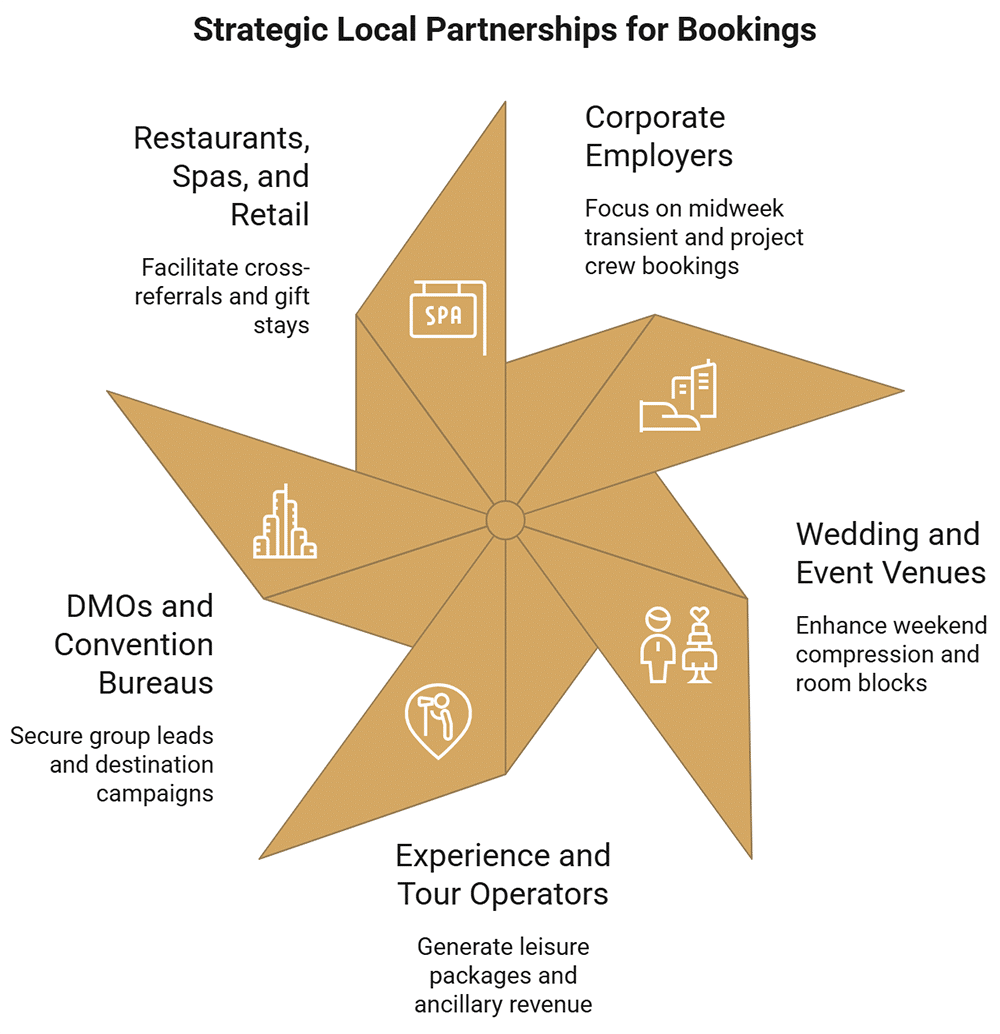
The honest answer depends on your demand gap. If midweek occupancy is your problem, corporate employers matter more than any other partner type. If weekends are soft, event venues and experience operators do the heavy lifting, and if you lack group base, your DMO or convention bureau is the priority.
Corporate demand deserves particular attention because it’s contracted, recurring, and midweek by nature. Business travel spending in Europe alone is projected to reach 389.9 billion euros in 2026, an 8.2 percent increase over last year, according to the GBTA (Global Business Travel Association) Business Travel Index Outlook. A meaningful slice of that spend lands within a few kilometers of properties like yours, and it books wherever a local negotiated rate (LNR) exists.
| Partner Type | Booking Type It Drives | Best Property Fit | First Move |
| Corporate employers and hospitals | Recurring midweek transient, project crews, relocations | Hotels near business parks, medical centers, industrial sites | Offer a local negotiated rate to your five nearest large employers |
| Wedding and event venues | Room blocks, weekend compression | Hotels within 15 minutes of venues without their own lodging | Propose a standing room-block agreement with courtesy terms |
| Experience and tour operators | Leisure packages, ancillary revenue, shoulder-season demand | Boutique, resort, and leisure-led urban properties | Negotiate a reciprocal referral commission with trackable codes |
| DMOs and convention bureaus | Group leads, citywide overflow, destination campaigns | Properties in event-driven or destination markets | Join, complete your listing, and get on the RFP distribution list |
| Restaurants, spas, and retail | Cross-referrals, gift stays, package components | Urban and neighborhood hotels with strong walk-in surroundings | Set up a two-way referral deal with unique promo codes |
Pick two or three partner types that map to your gap, not all five. A partnership program that tries to cover every category in year one produces five shallow relationships and no measurable channel.
How Can Hotels Use Local Partnerships to Drive More Bookings?
Hotels use local partnerships to drive bookings by connecting a defined source of demand with a specific offer and a low-friction reservation path. Posting each other’s logos or exchanging brochures rarely changes booking behavior.
Use this sequence:
- Start with a demand gap: Choose the dates, segments, or room types you need to sell before approaching partners.
- Match the partner to that gap: A corporate employer may support Monday-to-Thursday occupancy, while a wedding venue may strengthen weekends.
- Create one clear offer: Specify the rate, package element, room block, guest benefit, eligible dates, and booking deadline.
- Build a direct path: Use a dedicated landing page, tracked booking link, partner code, request form, or named hotel contact.
- Set a response standard: Decide who answers leads, how quickly they respond, and how availability changes are communicated.
That last step is where most event partnerships quietly fail.

Moriya Rockman, Chief of Marketing, Smiling House Luxury Global“To drive more group bookings, both direct and through third parties, hotels should focus on personalisation, partnerships, and compelling storytelling. Curated experiences, such as private chefs or live local entertainment (like we offer at Smiling House Luxury Group), create memorable stays that encourage groups to book. Collaborating with travel advisors and platforms like Villa Tracker can streamline the process for travel professionals, offering them tailored packages and seamless access to properties. Leveraging technology, such as dynamic pricing, CRM insights, and virtual tours, also helps convert inquiries into bookings. Showcasing past successful group events through testimonials and videos further builds trust and inspires new clients.” Click here to learn more from our Hotel Marketing Expert Panel. |
How Do You Formalize a Local Referral Agreement?
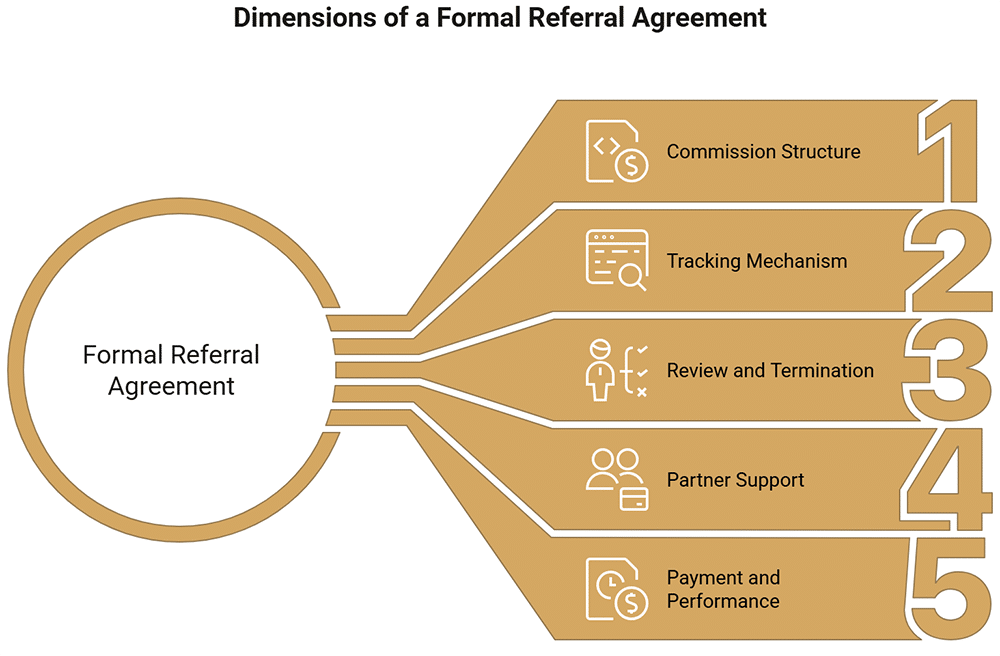
Formalize it in writing, with a commission, a tracking method, and a review date. Handshake deals are the standard failure mode: they depend on two individuals remembering an arrangement, and they decay the moment a duty manager or a tour operator’s booking agent moves on.
Your negotiating position is stronger than you might assume. OTAs captured 33 percent of tour and activity bookings in 2024, up from 24 percent in 2019, according to Arival’s operator research. An operator ceding that much of their channel mix to commission-heavy intermediaries has every reason to pay a hotel a smaller referral fee for direct, high-intent guests. Start negotiations at 10 to 15 percent, and you’re offering them a cheaper channel than the one they already accept.
One clause is more important than the rest: the exit. A 90-day termination right lets both sides sign quickly, because neither is betting the relationship on a guess.
Pay fast. A partner who receives their referral commission within two weeks becomes an advocate; one who chases invoices for two months quietly stops referring.
How Do You Track Which Partnerships Drive Bookings?
Give every partner their own trackable path into your PMS (Property Management System) and reconcile it monthly. Without attribution, a partnership survives on anecdotes and dies at the first budget review, usually right after someone asks what the venue relationship actually produced.
The mechanics are unglamorous and effective. Build a dedicated rate code per partner in your PMS, issue UTM-tagged links for any partner placing you on their website, and print unique promo codes for offline referrals. Wedding and event blocks get tracked through block pickup reports, and “how did you hear about us” at check-in is your fallback, never your system.
Timing is as important as tooling. In 2025, 60 percent of travelers booked their tour and attraction tickets at least three days before the experience, according to Arival’s research on booking behavior. A partnership that lives only at your front desk misses the majority who plan ahead, so partner offers belong on your website, in your booking engine, and in pre-arrival emails with tracked links.
Now the fair objection: individual partners send small numbers, so is this worth the effort? Run the portfolio math before deciding. Consider a 70-room independent in Porto with eight formalized partners each producing four room nights a month at a 140 euro ADR: that’s roughly 54,000 euros in annual partner-sourced revenue, acquired at a referral cost well below what the same bookings would carry in OTA commission.
Manage it on one metric: partner-sourced room nights and revenue, per partner, per quarter. Compare each partner’s cost per booking against your average OTA acquisition cost, keep the ones that beat it, fix or exit the ones that don’t.
When Do Hotel Local Partnerships Fail?
Hotel local partnerships fail when they consume management time, discount existing demand, complicate guest service, or claim credit for bookings the hotel would have received anyway.
Four weaknesses explain the problem:
- Incrementality: The partner does not generate new guests, spending, or demand on target dates.
- Execution: Slow responses, outdated availability, or unclear responsibilities lose leads.
- Economics: Discounts, commission, and fulfillment costs remove contribution.
- Attribution: Neither party can verify which bookings came from the relationship.
Responsiveness matters in wedding partnerships. The Knot Worldwide’s Real Weddings Study found that 52% of surveyed couples viewed responsiveness as a trust factor. A slow reply to a room-block request can damage both the hotel’s conversion and the venue partner’s relationship.
Use a renew, repair, or retire review after 90 days or one demand cycle. Renew profitable relationships supporting target dates. Repair partnerships where demand exists but the offer, handoff, or tracking process fails. Retire partners producing no qualified demand or repeatedly ignoring agreed rules.
Corporate accounts can be tested monthly. Wedding partnerships need longer reviews because bookings may be made months before the stay.
FAQs About Hotel Local Partnerships
Local partnerships are a distribution strategy, not a community relations exercise. The properties that profit from them pick partners against a specific demand gap, put every agreement in writing with its own tracking path, and manage the portfolio quarterly like any other channel. Treat your neighborhood that way, and it starts paying rent.
Did You Like This Article About Hotel Local Partnerships?
You might also be interested in the following articles:
- AI Agents for Hotel Marketing Are Picking Winners Already
- How to Improve Hotel Profit Margin With Smart Strategies
- What Is TikTok GO for Hotels and What It Means for Bookings
More Tips to Grow Your Business
Revfine.com is the leading knowledge platform for the hospitality and travel industry. Professionals use our insights, strategies, and actionable tips to get inspired, optimize revenue, innovate processes, and improve customer experience.Explore expert advice on management, marketing, revenue management, operations, software, and technology in our dedicated Hotel, Hospitality, and Travel & Tourism categories.
This article is written by:

Hi, I am Martijn Barten, founder of Revfine.com. With 20 years of experience in the hospitality industry, I specialize in optimizing revenue by combining revenue management with marketing strategies. I have successfully developed, implemented, and managed revenue management and marketing strategies for individual properties and multi-property portfolios.


Leave A Comment