

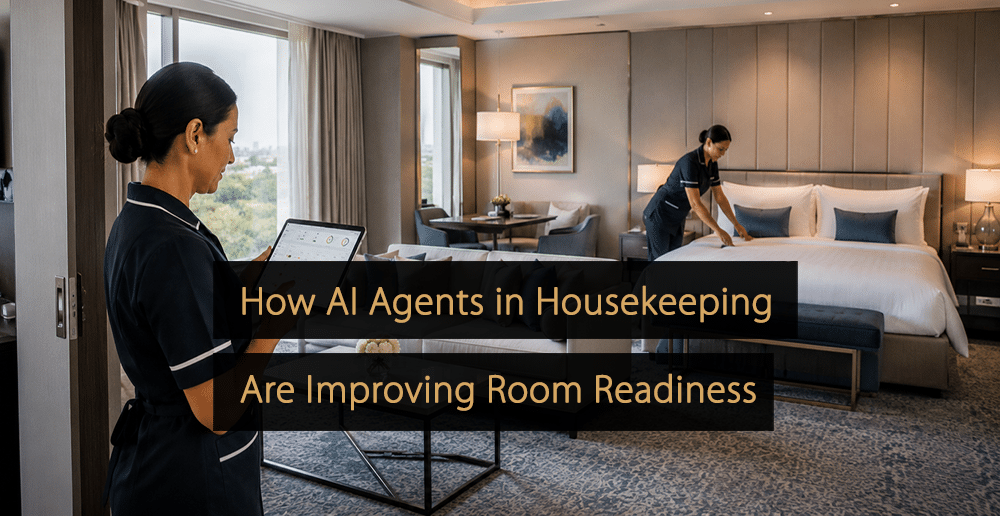
AI agents in hotel housekeeping are software systems that read live operational data, prioritize cleaning work, take approved actions, and escalate exceptions on their own. An AI agent is software that pursues a defined goal without waiting for instructions. In housekeeping, the goal is to have every room ready at the right moment with the fewest wasted labor minutes.
Key Takeaways:
|
–
Table of Contents
- What Are AI Agents in Hotel Housekeeping?
- Why Are AI Agents Becoming Important for Hotel Housekeeping?
- Which Housekeeping Tasks Should AI Agents Handle First?
- Can AI Agents and Robots Replace Room Attendants?
- How Should You Pilot a Housekeeping Agent?
- What Data and Systems Do Housekeeping Agents Need?
- What Controls Should Hotels Put Around Housekeeping Agents?
- What Do AI Agents Mean for Independent Hotels?
- FAQs About Housekeeping AI Agents
What Are AI Agents in Hotel Housekeeping?
An AI agent is different from ordinary housekeeping software because it doesn’t simply display information or follow one fixed rule. It evaluates a goal, such as releasing priority rooms before check-in, reviews changing conditions, selects an allowed action, and checks whether the action was completed.
A digital checklist records that room 412 has been cleaned. An AI agent can recognize that room 412 is assigned to an early-arriving guest, move it ahead of a stayover room, reassign an available inspector, and alert the front desk when the room is released.
The current hotel technology market shows agent-like capabilities entering existing operational systems rather than arriving as independent robot workforces. In June 2026, Oracle introduced AI capabilities inside OPERA Cloud for room assignment, staff guidance, language translation, and other hotel workflows.
Scott Strickland, Chief Commercial Officer at Wyndham Hotels & Resorts, said,
“AI is reshaping how hotels operate and deliver great guest experiences.”
For a wider view of how AI agents are changing hotel operations, guest service, and revenue decisions, read our guide “AI Agents for Hotels: Benefits, ROI, and Implementation Strategy.”
Why Are AI Agents Becoming Important for Hotel Housekeeping?
Housekeeping operates under continuous disruption. Departure times change, guests request late checkouts, early arrivals reach the hotel, attendants call in sick, maintenance defects appear, and the front desk needs immediate answers about room readiness.
Paper sheets and morning-only assignments cannot keep pace with that environment.
In the American Hotel & Lodging Association’s Front Desk Feedback survey, housekeeping was the hardest hotel role to fill, cited by 38% of properties reporting shortages, ahead of front desk, culinary, and maintenance roles. Higher wages help you compete for candidates, but they don’t change how the shift you already pay for gets spent.
AI agents won’t create new workers, but they can reduce the time scarce supervisors spend rebuilding assignments, calling departments, searching for attendants, and deciding which room moves next.
Consider a 120-room airport hotel expecting 45 departures and 28 early arrivals. At 9:30 a.m., two attendants report sick, and a flight cancellation produces 12 unexpected stayovers.
A static task sheet becomes outdated immediately. A bounded agent can recalculate available labor, protect rooms linked to confirmed early arrivals, move low-priority deep cleaning, and flag the projected shortfall to the executive housekeeper.
The goal isn’t to make attendants work faster. It is to stop wasting their time in the wrong rooms.
For a look at how it plays out one department over, read our article on “AI agents for hotel front desks and what to automate first.”
Video: AI Agents and AI Assistants: A Contrast in Function
Can AI Agents and Robots Replace Room Attendants?
AI agents can replace parts of housekeeping coordination. Current robots cannot reliably replace the full room attendant role across an ordinary hotel room.
Software agents and cleaning robots solve different problems. An agent manages information and decisions. A robot performs a physical action, such as vacuuming a mapped corridor or transporting supplies.
Research from the World Robot Challenge describes real-world tidying as difficult because robots must handle environmental variation, visual recognition, object manipulation, motion planning, and safe deployment around people. Hotel rooms include guest belongings, wet bathrooms, different bed configurations, fragile objects, and property-specific presentation standards.
| Approach | Where It Works Best | Where It Falls Short | Required Human Role |
| Rule-based automation | Repetitive triggers, such as marking a room dirty after checkout | Can’t adapt when arrivals, staffing, or priorities change unexpectedly | Configure rules and manage exceptions |
| AI agent | Prioritization, workload coordination, issue routing, and status updates | Makes poor decisions when data is late, incomplete, or outside its limits | Set authority boundaries and approve sensitive actions |
| Cleaning robot | Repetitive physical work in controlled spaces, such as mapped corridors | Struggles with bathrooms, bedmaking, guest belongings, and changing layouts | Prepare the area and inspect completed work |
Consider a hypothetical convention hotel with large, uniform corridors and extensive meeting space. A floor-cleaning robot may remove repetitive public-area work from overnight employees.
The same investment may deliver little value in a converted heritage hotel with narrow passages, stairs, uneven flooring, and irregular room layouts.
Measure robotic support using human rework minutes, incomplete-task incidents, downtime, and supervisor interventions. A robot that reports task completion while employees repeatedly finish missed edges has shifted labor rather than removed it.
Which Housekeeping Tasks Should AI Agents Handle First?
The right starting tasks occur frequently, depend on structured data, and can be reversed without harming a guest or employee. Begin with coordination work before giving the agent authority over quality, safety, privacy, or staffing decisions.
Cornell’s Center for Hospitality Research classifies housekeeping as “controllable work” in its workforce scheduling guidance: work whose timing can be shifted because it doesn’t require the guest to be present. That timing flexibility is exactly the asset an agent exploits and a static schedule squanders.
Which Tasks Create Immediate Operational Value?
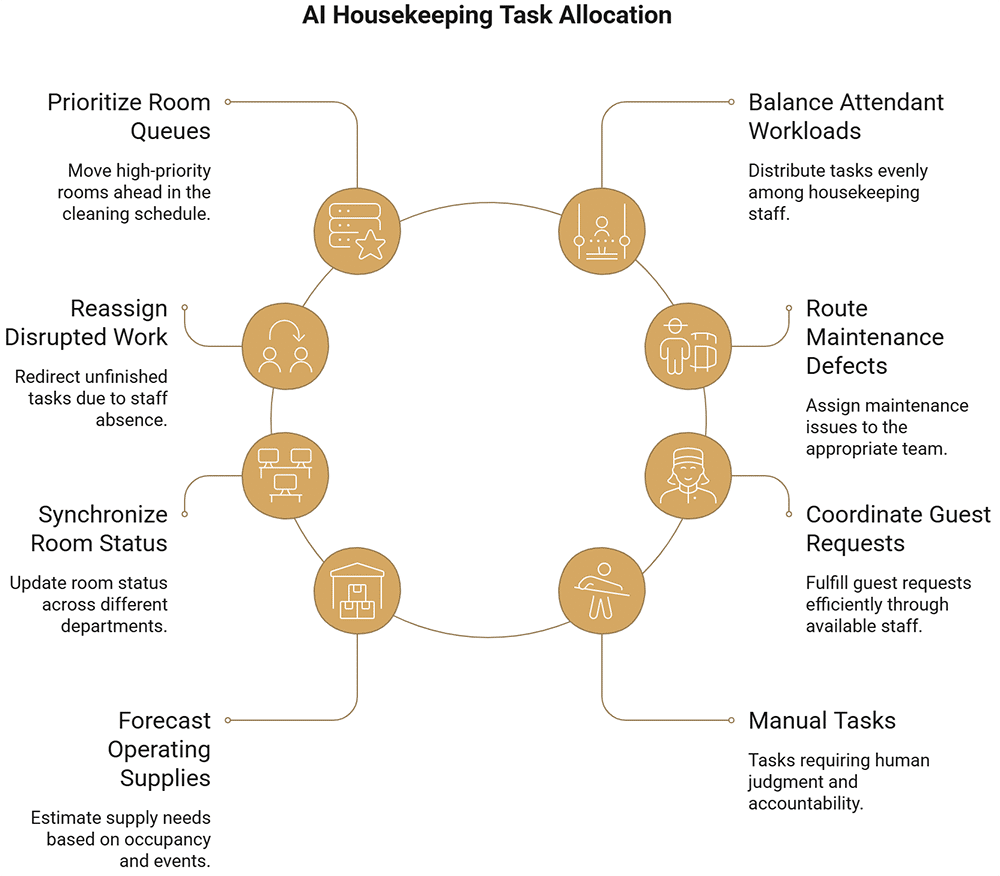
- Prioritize Room Queues: Move confirmed early arrivals, connecting rooms, accessible rooms, and service-recovery cases ahead of lower-priority work.
- Balance Attendant Workloads: Assign work using room type, service level, floor location, shift duration, mobility requirements, and cleaning difficulty.
- Reassign Disrupted Work: Redirect unfinished rooms when an attendant is absent, delayed, or transferred to another assignment.
- Route Maintenance Defects: Turn a reported leak, broken fixture, or air-conditioning problem into a maintenance task with room and urgency data attached.
- Synchronize Room Status: Update cleaning, inspection, maintenance, and front office records after approved events occur.
- Coordinate Guest Requests: Send extra linen, amenities, baby cots, or service requests to the appropriate available employee.
- Forecast Operating Supplies: Estimate linen, amenities, and cleaning materials using occupancy, stayovers, room mix, and scheduled deep cleaning.
Each use case needs a measurable result. For room prioritization, track late-arrival rooms. For workload balancing, compare weighted workloads between attendants, and for maintenance routing, measure the time between defect reporting and acknowledgment.

Massimiliano Terzulli, International Business Developer, Franco Grasso Revenue Team“I think a couple of areas have already shown remarkable results. That of reservations and communication with guests. Here, for example, AI agents can answer guest questions, modify reservations, propose upgrades, early check-in, late check-out, acquiring all the necessary information from the various systems (PMS, channel manager, booking engine) and performing transactions and updates to the various systems described above. Even in housekeeping, I think they can bring considerable benefits, for example, recording that a certain room has problems, due to guest complaints, blocking inventory, notifying the responsible departments, scheduling maintenance, moving incoming reservations to other rooms, notifying the reception, etc. Certainly, AI agents will allow for leaner and more efficient teams, where humans will be tasked with supervising and accepting any decisions proposed by AI agents in more sensitive areas or letting them act autonomously in less risky areas.” Click here to learn more from our Hotel Revenue Management Expert Panel. |
Which Tasks Should Remain Manual?
An agent should not determine whether a questionable room passes inspection, whether an employee receives disciplinary action, or whether staff may enter a room with uncertain occupancy status.
Those decisions require direct judgment, accountability, or awareness of conditions the software may not see. Automation should remove routine coordination work, not remove the person responsible for the outcome.
How Should You Pilot a Housekeeping Agent?
Don’t introduce an agent across every housekeeping process at once. A controlled 90-day pilot starts with one measurable problem, observes recommendations before activating them, and grants live authority only after the data proves reliable.
Focus the pilot on one operating window, such as departure-room coordination between 9 a.m. and your stated check-in time. Define shutdown conditions before launch: unavailable PMS data, incorrect occupied-room statuses, or an unexplained rise in re-cleaning all stop the pilot.
At day 90, decide to expand, revise, or stop. Sunk technology costs are not evidence that an ineffective workflow deserves a larger deployment.
What Data and Systems Do Housekeeping Agents Need?
A housekeeping agent is only as reliable as the data it can read and the actions it’s permitted to take. Connecting a language model to your standard operating procedures doesn’t create an operational agent.
What is the Minimum Viable Data Stack?
A useful housekeeping agent needs access to:
- Property management system data, including arrivals, departures, room moves, stayovers, and room status.
- Staff availability, shift times, zones, skills, restrictions, and breaks.
- Mobile task updates from attendants and supervisors.
- Guest requests, including early check-in, late checkout, extra amenities, and service refusals.
- Maintenance status, including open defects and out-of-order rooms.
- Standard operating procedures, inspection requirements, and room-type cleaning standards.
- Linen, amenities, minibar, and cleaning-supply inventory when forecasting is included.
Occupancy sensors and smart-room data can add context, but they aren’t required for the first deployment. Don’t delay a useful scheduling pilot because your property lacks a complete Internet of Things infrastructure.
Mike Rawson, Chief Information Officer at citizenM, described the operational value of connected agent technology clearly:
“The MCP is the great AI democratiser in hotel tech. It shifts us from coding to describing intent.”
For housekeeping teams, this means future agents could connect room status, assignments, maintenance, and guest requests without requiring a custom integration for every workflow.
How Do You Test Whether the Data is Usable?
You need to test usability before you buy anything. Run a seven-day comparison between system records and actual operations. Check whether departure status, room occupancy, staff attendance, room assignment, and inspection completion are updated when they occur.
Track data freshness failures. An agent receiving a room 20 minutes late will make poor recommendations even when their reasoning is sound.
Our guide to housekeeping technology and how hotels apply it covers the wider toolset this data layer supports.
What Controls Should Hotels Put Around Housekeeping Agents?
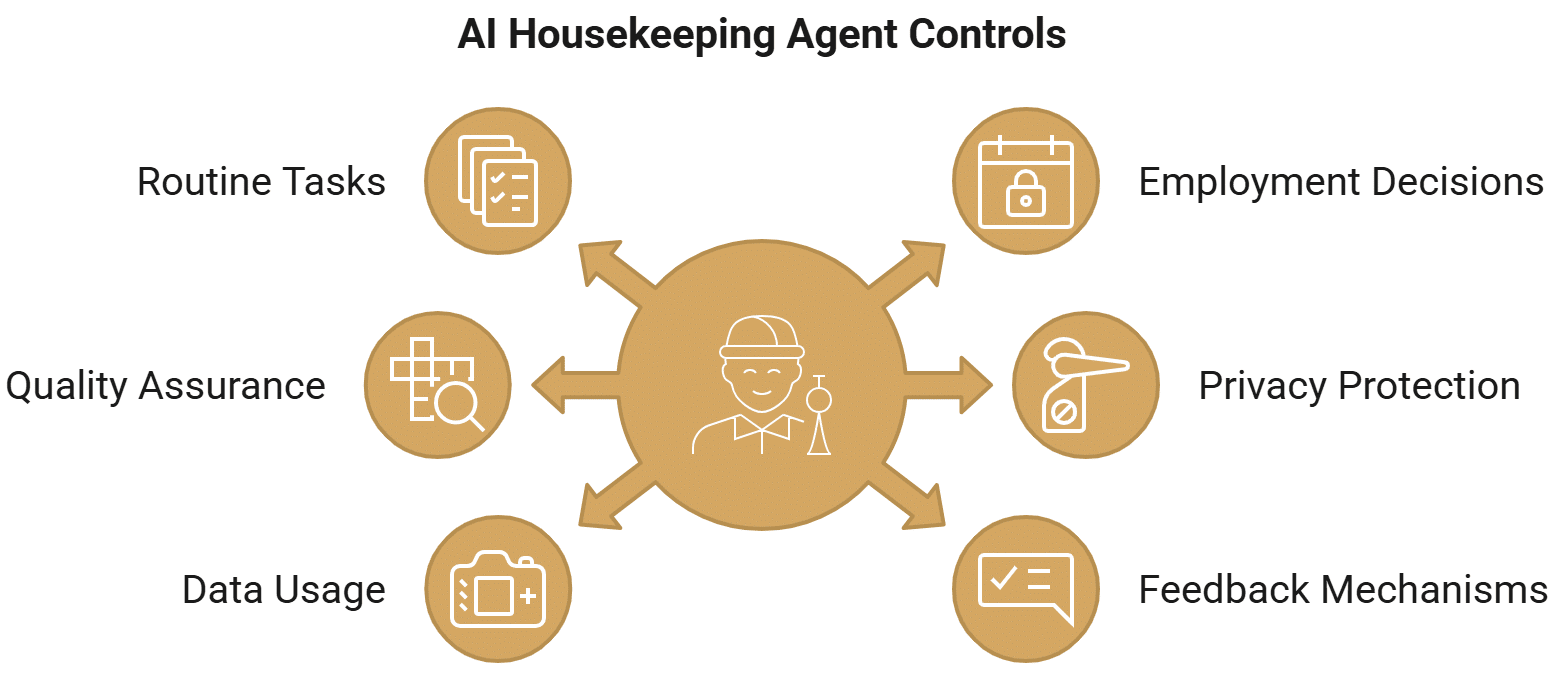
Housekeeping agents need bounded authority. An agent should receive enough permission to remove routine coordination work, but not enough to make sensitive employment, privacy, safety, or guest-access decisions without approval.
NIST states that trustworthy AI may require human intervention when a system cannot detect or correct its own errors. Its framework calls for realistic testing, ongoing monitoring, privacy review, transparency, accountability, and mechanisms to deactivate systems that perform outside their intended purpose. That principle fits housekeeping, where room conditions and risks change every shift.
Within written limits, an agent can reorder unstarted cleaning tasks, execute approved room reassignments, create maintenance and inspection tasks, alert the front office about projected delays, and generate shift summaries.
Human approval should remain mandatory before the agent:
- Changes in staffing levels, shift lengths, or scheduled breaks are employment decisions with legal and contractual weight.
- Skips a required inspection or marks a disputed room as guest-ready, because quality accountability must stay with a named person.
- Authorizes entry into a room with an uncertain occupancy status because guest privacy failures are unrecoverable.
- Uses employee performance data for discipline, or draws on cameras, biometrics, or precise location tracking.
Hoteliers should give attendants a clear way to reject, pause, or explain an assignment. Their feedback is evidence of room condition, physical workload, and inaccurate system data. Keep an audit record showing the information used, the action taken, and the person who approved or reversed it.
What Do AI Agents Mean for Independent Hotels?
Independent hotels should use AI agents to solve one clear housekeeping problem, not to copy the technology strategy of a large hotel group. Your executive housekeeper is often a working supervisor. Every hour spent changing room assignments, checking room status, or searching for available attendants is an hour lost from inspections, training, and quality control.
Start with the task causing the most delay. This may be late room releases, uneven workloads, missed maintenance issues, or attendants waiting for new instructions. A focused agent can update priorities, reassign unfinished rooms, and alert the front desk without adding another supervisor.
The labor impact is worth measuring. The U.S. Bureau of Labor Statistics reported a median hourly wage of $17.07 for maids and housekeeping cleaners. If six attendants each lose 30 minutes per day waiting or backtracking, the hotel pays for three unproductive hours daily.
Track room time-to-ready, minutes per room, housekeeping cost per occupied room, and supervisor overrides. Time-to-ready should improve first. If it doesn’t, check whether room-status and staffing data are accurate before deciding that the agent has failed.
FAQs About Housekeeping AI Agents
AI agents in hotel housekeeping work best as operational coordinators that keep priorities, people, room status, and support departments aligned. Hotels should begin with bounded, measurable decisions and expand only when room readiness improves without weakening cleaning quality, staff safety, or human accountability.
Did You Like This Article About Housekeeping AI Agents?
You might also be interested in the following articles:
- How Can AI Agents Improve Hotel Revenue Management
- AI Agents for Hotel Marketing Are Picking Winners Already
- AI Agents in the Travel Industry: Use Cases, ROI, and Strategy
More Tips to Grow Your Business
Revfine.com is the leading knowledge platform for the hospitality and travel industry. Professionals use our insights, strategies, and actionable tips to get inspired, optimize revenue, innovate processes, and improve customer experience.Explore expert advice on management, marketing, revenue management, operations, software, and technology in our dedicated Hotel, Hospitality, and Travel & Tourism categories.
This article is written by:

Hi, I am Martijn Barten, founder of Revfine.com. With 20 years of experience in the hospitality industry, I specialize in optimizing revenue by combining revenue management with marketing strategies. I have successfully developed, implemented, and managed revenue management and marketing strategies for individual properties and multi-property portfolios.



Leave A Comment