

ChatGPT hotel ads are sponsored placements that appear beneath ChatGPT’s answers when travelers research trips and accommodation. OpenAI began piloting them in early 2026, which means a channel you could previously influence only through organic visibility now has a paid layer. Whether you buy in early or prepare first is a decision worth making deliberately.
Key Takeaways:
|
–
Table of Contents:
- What Are ChatGPT Hotel Ads?
- How Do ChatGPT Hotel Ads Work?
- How Do You Buy ChatGPT Hotel Ads?
- The ChatGPT Demand Stack: Three Ways Your Hotel Can Appear
- Why Does Organic AI Visibility Come Before Paid Placement?
- Should You Buy ChatGPT Ads Now or Wait?
- What Should Hotels Advertise First?
- How Should You Measure ChatGPT Hotel Ads?
- Where ChatGPT Hotel Ads Work Best and Where They Fall Short
- FAQs About ChatGPT Hotel Ads
What Are ChatGPT Hotel Ads?
ChatGPT hotel ads are paid placements shown to users on ChatGPT’s Free and low-cost Go tiers, displayed as a labeled sponsored block beneath the organic answer rather than woven into it. OpenAI began the pilot in the United States in February 2026, expanded it to Canada, Australia, and New Zealand in April, and announced the United Kingdom, Mexico, Brazil, Japan, and South Korea in May. Subscribers on Plus, Pro, Business, and Enterprise tiers see no ads.
The ad unit itself is a compact creative card containing your brand name, logo, title, copy, image, and landing page link, all under a clear sponsored label. A traveler may receive an organic answer describing suitable neighborhoods or hotel types, followed by that separate paid placement.
OpenAI’s stated position is that the paid layer sits apart from the answer itself:
“Ads do not influence the answers ChatGPT gives you, and we keep your conversations with ChatGPT private from advertisers.”
How Do ChatGPT Hotel Ads Work?
Hotels can create campaigns through OpenAI Ads Manager where access is available. Each campaign contains an objective, budget, schedule, location targeting, ad groups, creative assets, and landing pages.
The platform currently supports two main buying objectives:
- Views: Campaigns optimized for visibility and purchased through cost-per-thousand-impressions bidding.
- Clicks: Campaigns optimized for website traffic and purchased through cost-per-click bidding.
Within each ad group, you provide context hints describing the conversations where your offer may be useful. A family package in Orlando might use themes around theme park accommodation, connecting rooms, breakfast, shuttle transport, and child-friendly stays.
OpenAI uses a relevance-weighted auction rather than selecting the highest bid alone. For click campaigns, its current advertiser guidance recommends testing a maximum CPC bid of approximately $3 to $5, although the competitive level will vary by market and intent.
CPC (Cost Per Click): The average amount paid whenever someone clicks your advertisement.
Formula: CPC = Total ad spend / Total clicks.
Don’t copy your Google Ads structure directly. ChatGPT campaigns need to reflect traveler situations, not just keyword variations.
Video: How to Run ChatGPT Ads: The Complete Tutorial
How Do You Buy ChatGPT Hotel Ads?
You buy through OpenAI’s self-service Ads Manager, which opened in beta to U.S. advertisers in May 2026 with no minimum spend, structured in the campaign, ad group, and ad hierarchy every paid search manager already knows. The platform supports two objectives: Reach, optimized for impressions and bought on a CPM basis, and Clicks, optimized for traffic and bought on a CPC basis, with OpenAI recommending a starting maximum bid of $3 to $5 per click.
The real difference from Google Hotel Ads sits in targeting. There are no exact-match keywords. Instead, you write context hints at the ad group level, short descriptions of the traveler conversations where your offer belongs, which guide matching but don’t guarantee delivery in any specific conversation.
That mechanism exists because conversations carry intent that keywords never captured.
As Rob Francis, Chief Technology Officer at Booking.com, put it in OpenAI’s case study on Booking.com’s use of its models:
“There’s no filter for heart-shaped beds or Elvis impersonators. Traditional search just wasn’t built to unlock that kind of intent.”
The practical consequence: don’t copy your Google Ads account structure across. Build ad groups around traveler situations, not keyword variations.
The ChatGPT Demand Stack: Three Ways Your Hotel Can Appear
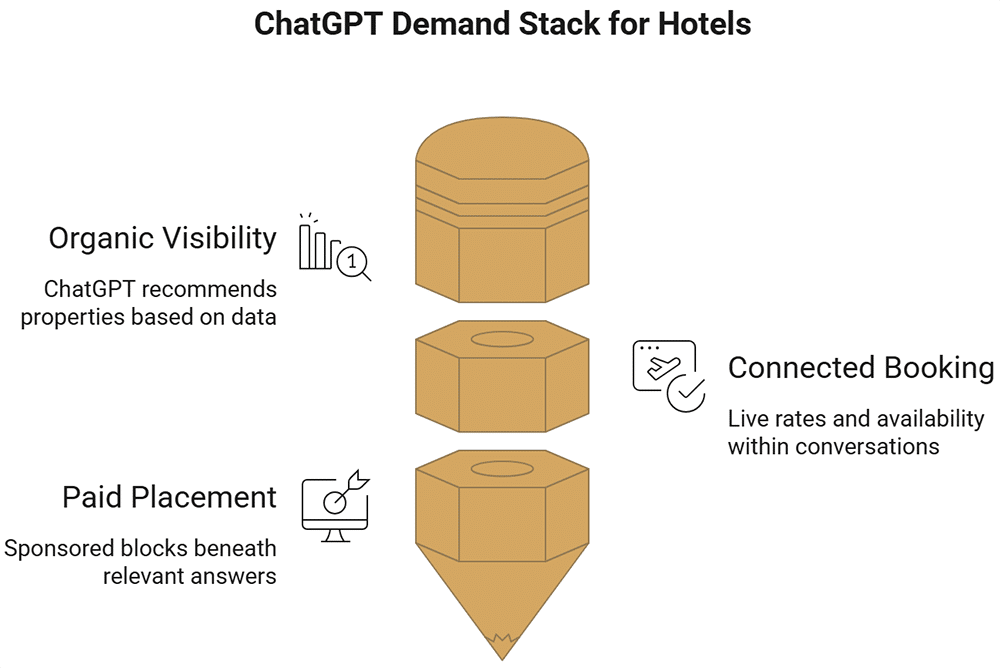
Ads are the newest layer of ChatGPT presence, not the only one. Think of your position in the platform as a stack of three layers, each building on the one below it.
| Layer | What It Is | What It Requires | What It Costs |
| 1. Organic visibility | ChatGPT recommends your property in its answers | Structured data, consistent listings, review depth and recency | Staff time, not media spend |
| 2. Connected booking | Live rates and availability surface inside the conversation | A booking engine or connectivity partner with a ChatGPT app or connection | Subscription or commission, depending on the route |
| 3. Paid placement | A sponsored block beneath relevant answers | An ad account, creative, and a test budget | Cost per click |
The layers compound. A paid click on a property ChatGPT cannot corroborate organically lands on a brand the model knows nothing about, which weakens both the ad and the conversation around it.
Layer 2 is already open to properties of every size. As Juanjo Rodriguez, head of direct booking at Lighthouse, put it at launch:
“AI is the biggest shift in how travelers plan their trips and discover hotels since Google.” (PhocusWire, 2026).
Why Does Organic AI Visibility Come Before Paid Placement?
Organic AI visibility comes before paid placement because the organic layer is where the real gap sits. HotelWorld AI’s World’s Best at AI Index, which analyzed 2.36 million data points across 130,884 properties in 30 countries, found that only one-sixth of the world’s roughly 810,000 hotel properties are visible when travelers search for accommodation through ChatGPT, Google AI, and Perplexity. Chain-affiliated brands dominate what does surface, leaving independents underrepresented in exactly the channel where recommendation lists are shortest.
AI models recommend what they can validate. That means structured data on your website, amenity information that matches across your booking engine, OTA listings, and review platforms, and a steady flow of recent reviews and third-party mentions. A property that is inconsistent across those sources is not penalized so much as skipped.
Here is a measurement you can run this week. Write ten realistic prompts for your market (“boutique hotel near the old town with parking,” “family hotel with a pool under 200 euros”) and track how often your property and each comp set member appears, month over month, as a simple appearance rate. Treat it like a market penetration exercise for AI search.
AAR (AI Appearance Rate): Measures how visible your property is in AI-generated hotel recommendations for your market.
Formula: AAR = Appearances / Prompts Tested x 100, tracked monthly against your comp set.
Should You Buy ChatGPT Ads Now or Wait?
The answer depends on your readiness rather than the calendar, so weigh the conditions below before spending and leave with a concrete first move either way.
When Does Paid Spend Make Sense?
Spend now if three conditions hold: the ad pilot is live in your feeder markets, your property already appears organically for relevant prompts, and you can tag and track AI-referred sessions in your analytics. If all three are true, a test allocation of 2 to 5 percent of your digital media budget is a reasonable ceiling while auctions are thin and CPCs are not yet bid up by OTA budgets.
The honest counterargument deserves stating: ad volumes are small, published rate benchmarks do not exist, and booking attribution is immature. Skift’s hands-on testing in July 2026 found that connected travel apps often go unused unless the chatbot chooses to surface them, and that Booking and Expedia ads appeared beneath rival results. Availability does not equal visibility, on the paid layer or the connected one. That argues for testing, not for reallocating your metasearch budget wholesale.

Piergiorgio Schirru, Executive Vice President & COO, Blastness“At the moment, the situation is very fluid. In Europe it’s still a small share and there isn’t payment advertisement – that can completely change the scenario. For sure this can be disruptive, because at the beginning, the hotels that will be able to gain visibility will have a strong boost, exactly the same as what happened at the beginning of traditional search engines and OTAs. A key change could be if AI tools will become more oriented on direct bookings or OTAs.” Click here to learn more from our Hotel Revenue Management Expert Panel. |
What Should Independent Hotels Do First?
If you run a property without a cluster revenue manager or an enterprise marketing stack, your highest-leverage move is data readiness, not media buying. Fix schema markup on your website, align amenity and location data across every listing, respond to reviews to keep signals fresh, and ask your booking engine vendor what their ChatGPT connection roadmap looks like.
Consider a 90-room boutique in Lisbon’s Chiado district with 60 percent OTA dependency. Its OTA partners are already buying its guests inside ChatGPT. Its counter is not outbidding Booking.com, which it cannot do. And its counter is being the property ChatGPT recommends organically and can book directly, so the paid click it eventually buys converts.
That exposure work sits alongside the automation happening inside your own marketing stack. In the article “AI Agents for Hotel Marketing Are Picking Winners Already” you can read how to staff both fronts, the agents working in your tools and the assistants deciding whether travelers ever see your property.
What Should Hotels Advertise First?
Start with the offer that has the clearest traveler situation, commercial value, and booking path. Don’t begin with a general hotel advertisement covering rooms, dining, meetings, weddings, and wellness in one message.
Consider a 70-room airport hotel. Instead of one campaign, it could create separate ad groups for:
- Travelers facing an overnight flight connection.
- Families needing parking and an early breakfast before departure.
- Business travelers requiring late check-in and a workspace.
- Guests needing a day room after a canceled flight.
Each ad group carries context hints and creative written for that single situation.
The copy test is simple: does the ad name the benefit, or ask the traveler to interpret vague language? “Stay rested before your early flight with parking and breakfast included” beats “Experience comfort and convenience” because it answers a recognizable need. Write genuinely different titles and descriptions for each occasion rather than repeating one claim with minor wording changes, since varied creative gives the matching system more contextual coverage.
Video: How to Advertise in ChatGPT: OpenAI Ads Tutorial (Step-by-Step)
How Should Hotels Measure ChatGPT Hotel Ads?
Click-through rate can indicate whether the advertisement matched the conversation, but it can’t tell you whether the campaign produced commercially valuable guests.
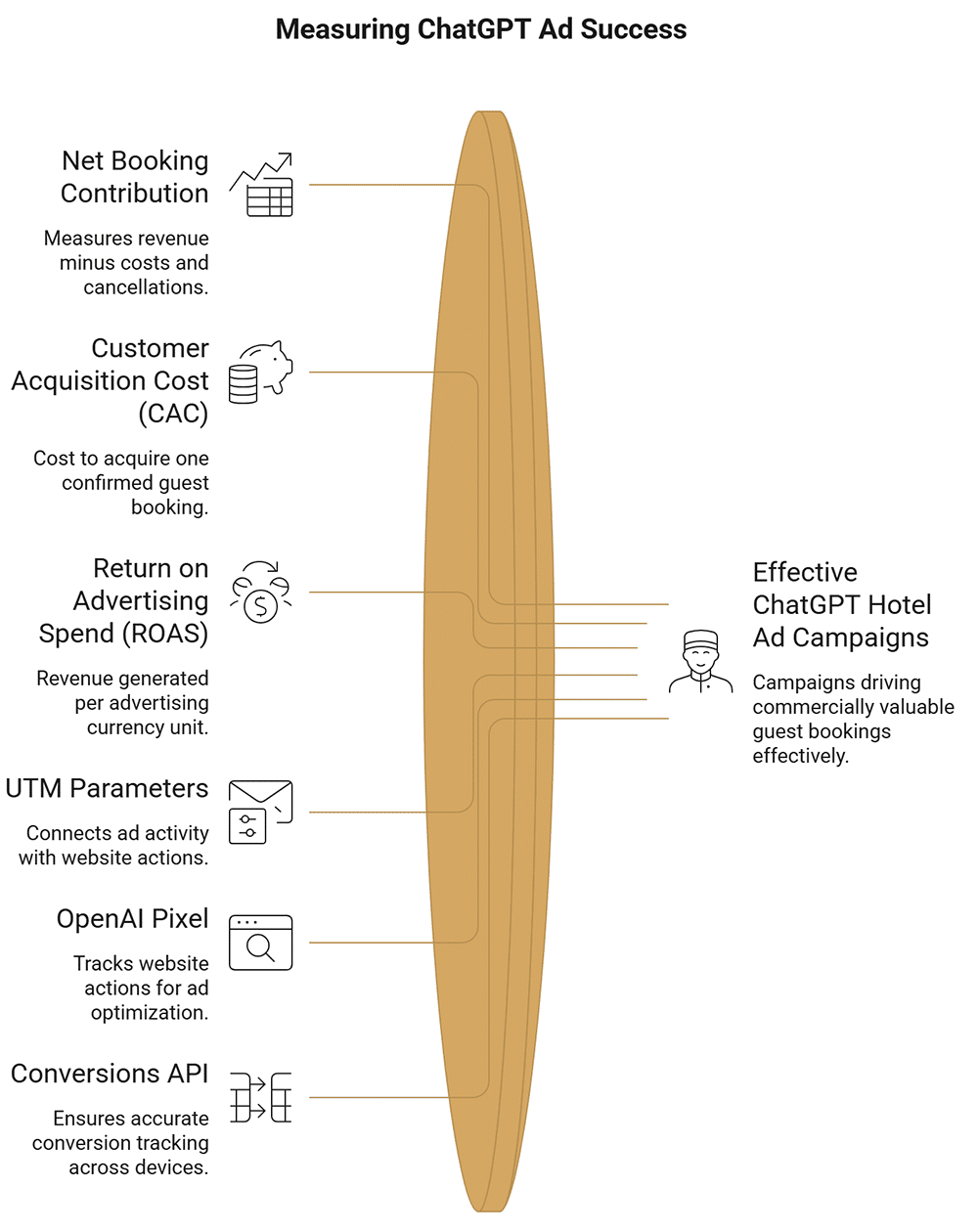
Your primary measure should be confirmed booking contribution:
Net booking contribution = Room revenue + ancillary revenue − variable costs − cancellations − advertising spend
Track CAC and ROAS at the campaign level, and read failures diagnostically. High impressions with few clicks point to weak context hints or creative, while strong clicks with poor booking conversion point to the landing page, the rate, or the booking engine.
CAC (Customer Acquisition Cost): The advertising cost required to generate one confirmed guest booking.
Formula: CAC = Total campaign spend / Confirmed bookings.
OpenAI Ads Manager currently reports impressions, clicks, spend, CTR, average CPC, average CPM, and attributed conversions. Hotels can use static UTM parameters, the OpenAI Pixel, the Conversions API, or a combination of these methods to connect advertisement activity with website actions.
ROAS (Return on Advertising Spend): The booking revenue attributed to each unit of currency spent.
Formula: ROAS = Attributed booking revenue / Advertising spend.
Reconcile those results with your booking engine and property management system. Platform conversions and confirmed hotel bookings can differ because of cancellations, attribution windows, cookie consent, payment failures, or cross-device behavior.
Where ChatGPT Hotel Ads Work Best and Where They Fall Short
ChatGPT hotel ads work best when conversational intent can be matched to a clearly differentiated, immediately bookable hotel offer. They fall short when the hotel relies on generic branding or sends traffic into a confusing booking path.
As of mid-2026, the capability picture looks like this. Expect it to change quickly.
OpenAI states that advertisements don’t influence ChatGPT’s answers and that advertisers receive aggregated campaign performance rather than access to users’ conversations or chat histories.
Treat ChatGPT Ads as an incremental channel. A controlled test can reveal useful demand, but shifting a large budget before you understand booking economics would be premature.
FAQs About ChatGPT Hotel Ads
ChatGPT hotel ads add a paid layer to a discovery channel where recommendation lists are short, and the invisible majority of properties never enter the conversation. Your commercial priority is sequencing: make your property visible and bookable inside AI search first, then use paid placement to defend and extend that position while the auction is still cheap.
Did You Like This Article About ChatGPT Hotel Ads?
You might also be interested in the following articles:
- ChatGPT Travel Guide: How the Travel Industry Can Benefit!
- ChatGPT Hotel Guide: Learn How Hotels Can Benefit from ChatGPT!
- Hotel ads: Advertising Strategies to Gain More Customers
More Tips to Grow Your Business
Revfine.com is the leading knowledge platform for the hospitality and travel industry. Professionals use our insights, strategies, and actionable tips to get inspired, optimize revenue, innovate processes, and improve customer experience.Explore expert advice on management, marketing, revenue management, operations, software, and technology in our dedicated Hotel, Hospitality, and Travel & Tourism categories.
This article is written by:

Hi, I am Martijn Barten, founder of Revfine.com. With 20 years of experience in the hospitality industry, I specialize in optimizing revenue by combining revenue management with marketing strategies. I have successfully developed, implemented, and managed revenue management and marketing strategies for individual properties and multi-property portfolios.

Leave A Comment