

A hotel marketing budget is the annual amount a property commits to acquiring and retaining guests, typically between 4 and 8 percent of total revenue. The percentage matters less than what it buys. Every point you underspend on direct demand generation, you repay to intermediaries in commission, usually at a higher rate.
Key Takeaways:
|
Table of Contents:
What Is a Hotel Marketing Budget?
A hotel marketing budget covers the campaigns, platforms, content, partnerships, and technology used to influence booking demand: paid search, metasearch, social advertising, your website and booking engine, SEO and AI-search content, email and CRM (Customer Relationship Management) programs, photography, and public relations. It is a demand investment, not an overhead line, and it should be planned against revenue targets the way a revenue manager plans rate.
The first mistake happens before a single euro is spent: definitions. The sales and marketing department line in your P&L, structured under USALI (the Uniform System of Accounts for the Lodging Industry), bundles payroll, franchise fees, and loyalty charges together with actual marketing activity. According to CBRE’s Trends in the Hotel Industry research, franchise-related fees alone averaged 48.8 percent of total sales and marketing department costs at U.S. hotels.
That means a branded hotel can show a healthy-looking department expense while spending almost nothing on discretionary demand generation. Before you benchmark anything, split your number into three buckets: people (payroll and benefits), obligations (franchise, brand, and loyalty fees), and true marketing (campaigns, channels, content, tools).
Only the third bucket is a budget you actively manage. That is the number this article is about.
How Much Should Hotels Spend on Marketing?
Hotels should plan for 4 to 8 percent of total revenue as true marketing spend, excluding payroll and franchise obligations. Established properties in stable markets sit at the lower end. Properties in competitive urban markets, repositioning after renovation, or fighting high OTA dependency belong at the upper end.
Context makes that range look conservative rather than generous. Gartner’s CMO Spend Survey found average marketing budgets across industries held at 7.7 percent of company revenue. Hotels selling a perishable product in one of the most contested digital categories routinely spend a fraction of what an average consumer business commits.
Hospitality strategist Max Starkov has argued the same point from the distribution side:
“Hotels that treat marketing as risky discretionary spend while paying 20 percent-plus commissions without hesitation are choosing the more expensive form of demand. His recommended floor is 4 to 6 percent of total revenue, excluding payroll, invested in marketing and the direct-channel technology behind it” (Hospitality Net World Panel).
If your true marketing spend is below 4 percent of revenue and your OTA share is above half of bookings, those two facts are connected. Underspending did not save you money. It moved the spend to your commission line and marked it up.
How Should You Allocate Your Hotel Marketing Budget?
Split the budget across paid, owned, and earned channels, and resist the pull to spend it all at the bottom of the funnel. Paid media dominates budgets across industries: Gartner’s survey put it at 30.6 percent of total marketing budgets. Hotels tend to run even heavier on paid because metasearch and brand-name search defense feel measurable and safe.
| Channel type | What it includes | What it does for you | Working starting allocation |
| Paid | Metasearch, paid search, social ads, display, retargeting | Captures existing demand and defends your brand name from OTA bidding | 50 to 60 percent |
| Owned | Website, booking engine optimization, SEO and AI-search content, email, CRM | Converts demand you already paid for and generates repeat bookings at near-zero CPA | 25 to 35 percent |
| Earned | PR, review management, partnerships, influencer and word-of-mouth programs | Builds demand that arrives without a per-booking cost attached | 10 to 15 percent |
Treat the starting allocation as a position to adjust, not a formula. The right split depends on your channel mix. If OTAs deliver more than half your bookings, weight paid toward metasearch and brand defense first, because that is where direct revenue is leaking fastest. If direct share is already above 40 percent, shift budget toward owned channels. Every improvement to website conversion and CRM reactivation compounds across all future demand.
One test keeps the allocation honest. If cutting a channel tomorrow would change nothing in 90 days, it was capturing demand, not creating it, and it deserves less than it currently gets.
Simone Puorto, Head of Emerging Trends and Strategic Innovation at Hospitality Net, anchors his hotel marketing budget advice to the same discipline:
“Whenever we talk about “how much”, the first question I ask is not about percentages, but about definitions. What exactly lives under the umbrella of “marketing”? Does OTA advertising count, or should it be relegated to the distribution column? Is metasearch advertising a marketing expense, or is it revenue management wearing a different suit? The answer to those questions changes the budget conversation entirely.
My approach is less about chasing an industry average and more about anchoring spend to a healthy cost of acquisition for direct business. As a general rule, I never let the cost per acquisition for direct bookings exceed 10-12%, although the context may justify a lower or higher rate.
If you stay focused on the lower funnel, then 10% of total revenue is a comfortable and sustainable figure.
If you want to expand into mid-funnel activity, 15% is a better benchmark.
And your ambition is to own the top of the funnel (building awareness in new markets, launching a property, or relaunching after a renovation), then a 20% is more realistic.
The real danger lies in the delusion we can achieve OTA-level reach with budgets that would not keep a metasearch campaign alive for a month…”(Hospitality Net World Panel).
Video: Build a Hotel Marketing Plan | Hotel Marketing Strategies Guide Step-By-Step
When Should Hotels Increase Their Marketing Budget?
Increase the budget when you can identify a commercially addressable revenue gap and show how additional investment could influence it. Spending more because occupancy is behind budget is not enough. The shortfall may come from pricing, product quality, poor reviews, unavailable inventory, or an unrealistic forecast.
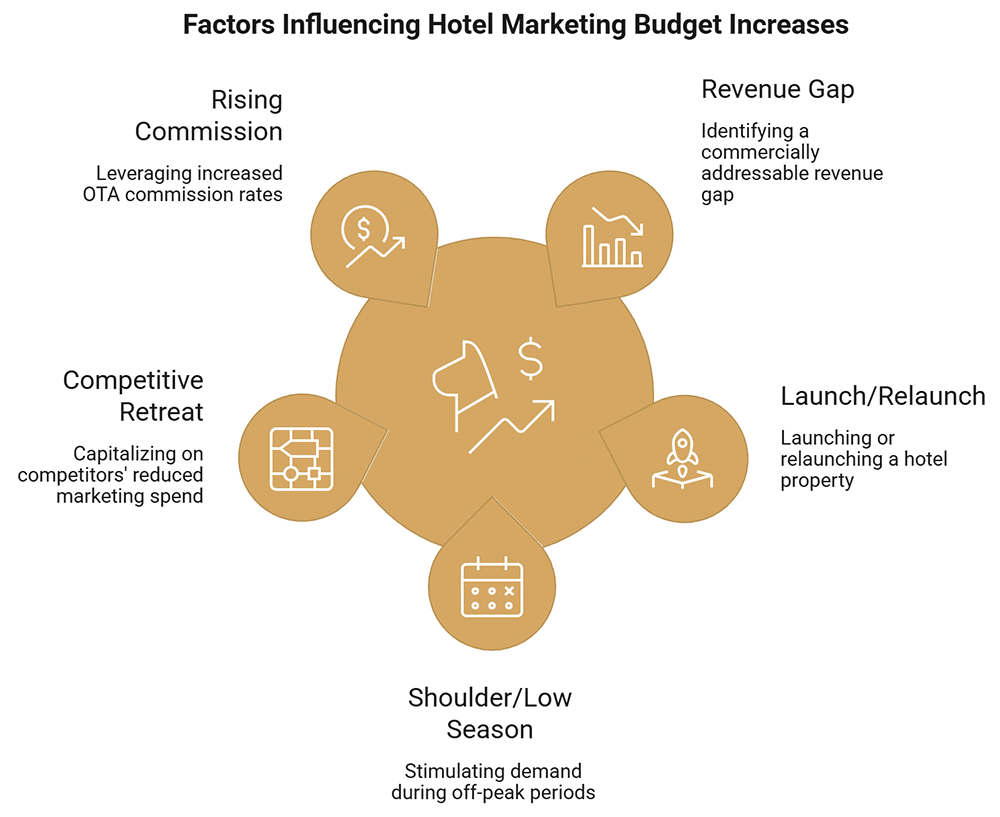
Four triggers justify a deliberate increase:
- Launch or relaunch. Launch-stage properties should spend far above the mature-property range, in the region of 15 to 25 percent of expected revenue, tapering as the property establishes itself.
- Shoulder and low season, selectively. Shift budget from capturing peak demand (which books itself) toward stimulating need periods and advance bookings. Cutting to zero in low season trains the market to find you only on OTAs.
- Competitive retreat. When comp set properties visibly cut spend in a downturn, share of voice gets cheaper. Buying it then is the cheapest market share you will ever acquire.
- Rising effective commission. If OTA visibility programs are pushing your effective commission from 17 toward 22 percent, your ceiling just rose, and so did the budget you can justify.
“How much is enough” has a contribution-based answer. A hotel needing 300 incremental m nights in a shoulder month, each contributing $120 after variable servicing costs, is chasing $36,000 of contribution. At a 15 percent acquisition ceiling, the defensible marketing allowance is $5,400. That is a budget case. “We need more visibility” is not.
How Should Hotels Measure Marketing Budget Performance?
Measure at three levels: campaign efficiency, booking contribution, and total commercial impact. A campaign can report an attractive return on ad spend while producing heavily discounted, cancellation-prone, or expensive-to-service bookings, which is why no single platform metric should define success.
ROAS (Return on Ad Spend): Attributed booking revenue generated per unit of currency spent on a campaign or channel. It measures attributed revenue, not profit.
Formula: ROAS = Attributed Booking Revenue / Campaign Spend.
Keep the monthly scorecard short enough to act on: spend against plan, confirmed and stayed bookings, CPA by channel, net booking contribution, booking engine conversion rate, cancellation rate by campaign, direct revenue share, and the GOPPAR trend. Reconcile platform data against your PMS (Property Management System) and finance numbers, because ad platforms attribute generously to themselves.
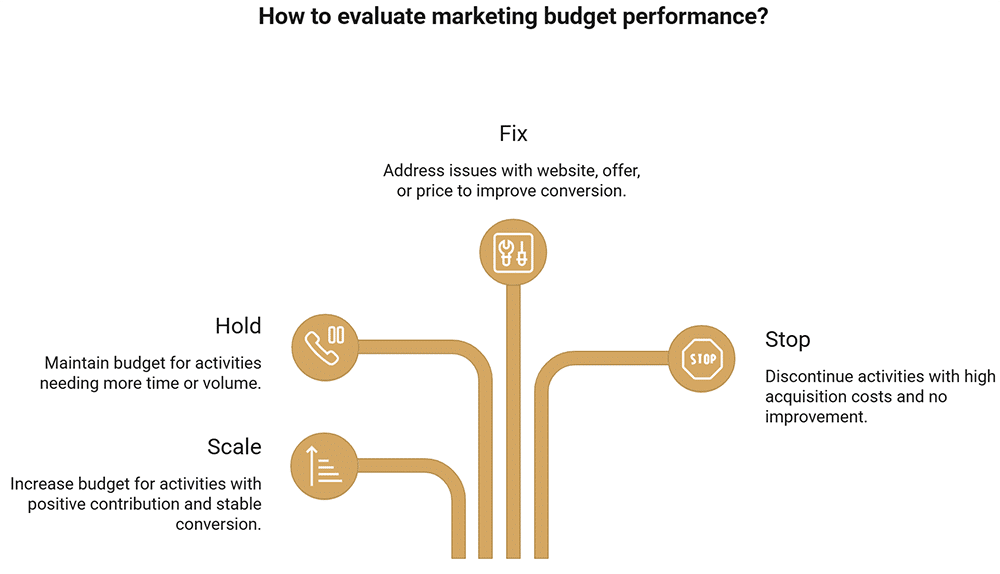
Then apply four decision rules to every funded activity:
- Scale: Contribution is positive, conversion is stable, and an addressable demand gap remains.
- Hold: Performance is within range but needs more time or booking volume to judge.
- Fix: Traffic arrives, but the website, offer, or price isn’t converting. More budget won’t help.
- Stop: Acquisition cost exceeds the approved ceiling with no evidence that changes will restore contribution.
The rules matter more than the dashboard. A scorecard nobody acts on is a reporting cost, not a measurement system.
How Do You Justify a Marketing Budget to Ownership?
Frame the budget as margin recovery, not as a marketing plan. Owners do not approve creativity. They approve arithmetic that improves net operating income.
Start with what the property already spends on demand without calling it marketing. Your proposed budget isn’t new spend. It is a cheaper substitute for spend that already exists on the commission line.
A strong request fits on one page:
- Revenue gap: Which dates, segments, room types, or source markets are underperforming?
- Diagnosis: Whether the problem is awareness, conversion, price, distribution, or product?
- Proposed investment and expected economics: What gets funded, and the incremental bookings or contribution required, stated as a currency figure?
- Leading indicators: Which search, traffic, pickup, or conversion measures will move first?
- Stop rule: The acquisition cost, date, or threshold at which spending pauses.
The stop rule is the trust builder. Nothing earns ownership confidence faster than a commercial leader volunteering the conditions under which they lose budget. Lead with the CPA-versus-commission gap, not with ROAS, because sophisticated owners know channel-level ROAS flatters campaigns that harvest demand the property would have received anyway.

Moriya Rockman, Chief of Marketing, Smiling House Luxury Global“When allocating a marketing budget, it’s crucial to prioritise channels that align with your brand values and foster long-term relationships. Each channel plays a unique role in driving engagement and ROI. 1. Trade Shows: Building Relationships & Industry Influence Trade shows can be a key element in a marketing strategy. They offer excellent opportunities to connect with industry professionals, stay ahead of trends, and inspire innovation. Allocating a portion of the budget to attend global conferences can help establish connections across international markets. For businesses like Villa Tracker, this approach has proven valuable in bridging two industries—travel professionals and property managers/homeowners—while fostering lasting partnerships and gathering crucial industry insights. 2. Luxury-Focused Marketing: Highlighting Values & Storytelling For brands in the luxury travel segment, campaigns that focus on meaningful topics—such as sustainability and curated travel experiences—tend to resonate more deeply with both travellers and property managers. By emphasising core values, companies can position themselves as trusted voices in the industry. Leading conversations about luxury rentals can establish thought leadership and educate property managers on best practices. 3. Organic Growth & Community Engagement An organic marketing strategy focused on genuine conversations and long-term relationships can be highly effective. Instead of relying on aggressive selling, creating valuable content that naturally engages the audience fosters trust and strengthens relationships. This approach helps future clients recognise the true value of your offerings. Cultivating a global network of like-minded individuals or partners can also lead to deeper industry connections and long-term success. In conclusion, strategically allocating your budget across these channels can nurture relationships, foster organic growth, and build a reputation grounded in authenticity, value, and expertise.” Click here to learn more from our Hotel Marketing Expert Panel. |
What Does This Mean for Independent Hotels?
The benchmarks in this article come mostly from branded, professionally staffed portfolios. If you run a 60-room independent without a commercial team, three things change, and none of them is the logic.
First, your percentages look different because you carry no franchise or brand fees. A branded competitor’s 9 percent department line includes obligations you do not pay. Your equivalent true marketing spend at 4 to 6 percent of revenue can buy more actual demand generation than their entire department budget, if it goes to channels rather than headcount.
Second, the OTA matters more for you, not less. Independents pay higher effective commissions than chain-negotiated rates, frequently 20 to 25 percent once visibility boosters are included. A higher ceiling means more headroom: an independent with a 12 percent direct CPA against a 23 percent effective commission has a wider margin-recovery gap than almost any branded property in its market.
Third, concentrate rather than imitate. You cannot fund eight channels credibly, so fund three: metasearch and brand-defense search, a fast booking-engine-optimized website with genuinely better direct rates or perks, and a CRM email program that reactivates past guests. A property running 70 percent OTA share does not have an awareness problem. It has a capture problem, and those three channels are the capture stack.
The trap to avoid is the “no budget, no data, no case” loop. Spending too little to measure anything, then citing the lack of proof as the reason not to spend. Set a 90-day test budget, track CPA against commission, and let the gap make the argument.
FAQs Related to Hotel Marketing Budget
Your marketing budget is the price of owning your own demand, and its correct size is set by arithmetic, not habit. Keep direct acquisition cost below your effective OTA commission, scale spend while the gap stays wide, and present the whole exercise to ownership as margin recovery. Hotels that budget this way stop debating marketing and start pricing it.
Did You Like This Article About Hotel Marketing Budget?
You might also be interested in the following articles:
- AI Agents for Hotel Marketing Are Picking Winners Already
- Hotel Budget: Effective Budgeting Tips for Hoteliers
- Hotel Budget Plan: Practical Budgeting Tips for Hoteliers
More Tips to Grow Your Business
Revfine.com is the leading knowledge platform for the hospitality and travel industry. Professionals use our insights, strategies, and actionable tips to get inspired, optimize revenue, innovate processes, and improve customer experience.Explore expert advice on management, marketing, revenue management, operations, software, and technology in our dedicated Hotel, Hospitality, and Travel & Tourism categories.
This article is written by:

Hi, I am Martijn Barten, founder of Revfine.com. With 20 years of experience in the hospitality industry, I specialize in optimizing revenue by combining revenue management with marketing strategies. I have successfully developed, implemented, and managed revenue management and marketing strategies for individual properties and multi-property portfolios.



Leave A Comment