


AI revenue management system evaluation tests whether a system’s forecasts and price recommendations beat your current method on your data, without costing you control or accountability. With the AI label now stretched from rules engines to machine learning, favor the system you can test, explain, control, and measure against your property’s baseline, not the one with the most automation.
Key Takeaways:
|
Table of Contents:
- What Is AI Revenue Management System Evaluation in Hotels?
- The Revfine Glass-Box Test for AI RMS Selection
- How Do You Test an AI RMS Forecast Before You Sign?
- What Does RMS Auditability Mean in Practice?
- How Should an Independent Hotel Choose an AI RMS?
- AI RMS Capability Contrast: Where It Works Best and Where It Falls Short
- Jargon Translator
- FAQs About AI Revenue Management System Evaluation
What Is AI Revenue Management System Evaluation in Hotels?
AI revenue management system evaluation means proving that a revenue management system (RMS) improves forecasting and pricing decisions for your property before you commit to automation. It replaces a feature-first request for proposal with a performance-first test.
A checklist can confirm that a platform connects to your property management system (PMS), shows competitor rates, or auto-publishes. It can’t tell you whether the model reads your booking curve correctly or underprices a compression Saturday.
The AI label makes checklists even less reliable. Gartner estimates that only about 130 of the thousands of vendors selling agentic AI offer genuine agentic capabilities, and it calls the rebranding of older tools “agent washing.” Hotel technology isn’t exempt.
If you’re working out how to choose an AI RMS, set one bar before any demo: beat your current forecast and pricing results on your history. If you can’t check a pricing decision, you can’t defend it to your owner.
The Revfine Glass-Box Test for AI RMS Selection
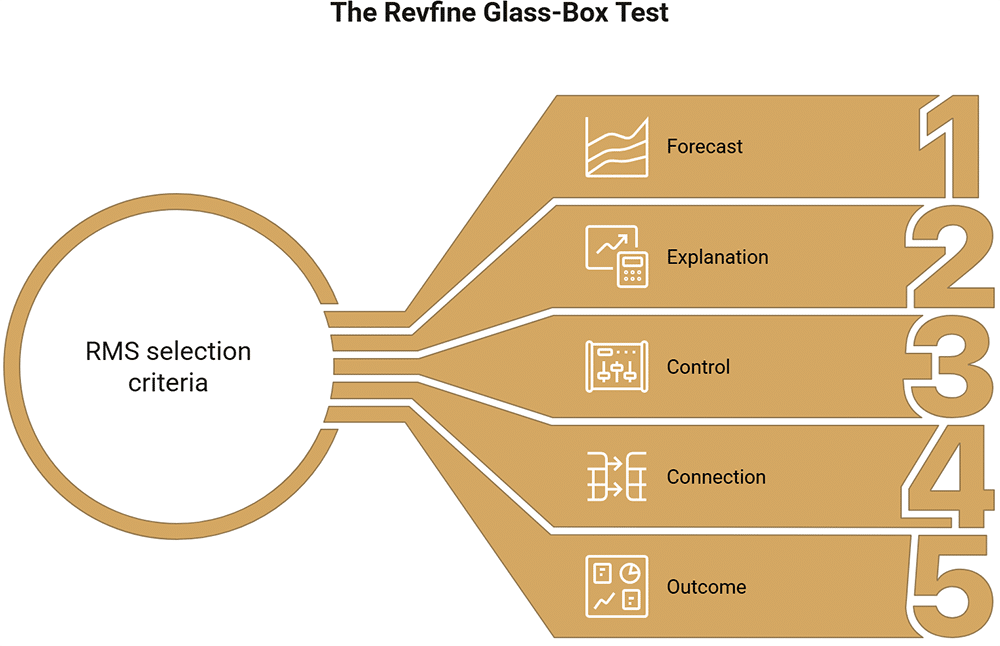
The Revfine Glass-Box Test turns RMS selection criteria into five proofs an AI system must pass on your data before you sign. None requires proprietary source code, only evidence you can check.
| Proof | What the Vendor Must Show | How You Test It |
| 1. Forecast | Demand forecasts on unseen property data | Compare forecast error at the same booking horizons against your current method. |
| 2. Explanation | The main demand drivers behind a recommendation | Check whether your team can explain 10 sampled price moves |
| 3. Control | Guardrails, overrides, logs, and clear data-use rules | Test one override and one rate-floor breach, then check the log |
| 4. Connection | Two-way flow with your property management system (PMS) and channel manager | Delay one PMS update and watch for a stale-data alert. |
| 5. Outcome | Measurable operational and commercial change | Compare decision time, override patterns, forecast quality, and RGI (Revenue Generation Index) |
Explanation is what revenue teams ask for. An open-access Tourism Economics study, based on 27 interviews with hotel revenue professionals and technology experts, found users want an RMS to answer what, why, why not, and what if questions. Use the five proofs as the scoring sheet for any AI RMS comparison.
How Do You Test an AI RMS Forecast Before You Sign?
Skip the vendor’s showcase backtest, which runs on data the model already knows. Give every shortlisted vendor the same 24 months of daily booking data, hold back the final 90 days as a holdout, and request blind forecasts at identical horizons, such as 30, 14, and 7 days before arrival. Then score each against your current pickup method’s forecast for the same dates.
Simple methods set a high bar. In a comparison of forecasting methods using Marriott hotel data, researchers at Cornell and the University of Wyoming found exponential smoothing, pickup, and moving average models the most robust, so a vendor’s accuracy claim means little until it beats that baseline on your property.
Break results out by weekday, room type, booking horizon, and demand condition. A system that wins overall but repeatedly misses Saturday compression or a high-value suite category can still lose money on your most valuable dates.
Then start a live pilot in recommend-only or shadow mode and record where the system differs from your team. Widen auto-publishing only after it performs reliably.
Jeff Wermager, vice president of sales and revenue management at My Place Hotels of America, told Hotel Management,
“AI owns the high-volume, repeatable pricing decisions; our RM team owns the strategic exceptions.”
What Does RMS Auditability Mean in Practice?
RMS auditability is your ability to reconstruct why any rate was set, who approved it, and which data informed it. It rests on three records: recommendation drivers, logged override reasons, and a written account of whose data trains the model.
That last record now carries antitrust risk. In July 2026, the US Court of Appeals for the Third Circuit revived the Cornish-Adebiyi antitrust case, alleging that Atlantic City casino-hotels fed non-public data into Cendyn’s shared Rainmaker software and accepted its recommendations about 90 percent of the time. It’s a pleading-stage ruling, not a finding of wrongdoing, and the law remains unsettled.
According to Sherri Kimes, emeritus professor at Cornell’s Nolan School of Hotel Administration,
“When the system is right, we look brilliant. When it is wrong, we may not notice quickly enough.” Source
Before you sign, ask in writing whether the vendor pools your data to set other clients’ prices and whether override logs are exportable, then have counsel review the data clauses.
Override Rate: The share of system recommendations your team changes before publishing.
Formula: Override Rate = Overridden Recommendations / Total Recommendations x 100.
A low override rate can indicate strong system performance or limited human review. A rising rate may reveal disagreement between the RMS and your pricing strategy. Track override reasons alongside the percentage to understand what is happening.

Tawana Muratu, Group Revenue Manager, Cresta Hotels“Revenue managers have to evolve beyond traditional pricing skills into a blend of analytics, technology fluency, and strategy. Data interpretation remains critical, but teams will increasingly need skills in AI-assisted analysis and commercial decision-making across revenue and distribution. One important skill will be knowing how to challenge and validate AI outputs rather than accepting them blindly. AI can accelerate decisions, but human judgment is still essential where market nuance matters, especially around events, displacement, and sudden demand shifts. I also believe data storytelling will become more important, as revenue leaders will need to translate AI-generated insights into actions stakeholders can support. Click here to read more about AI RMS from our Revenue Management Expert Panel. |
How Should an Independent Hotel Choose an AI RMS?
An independent hotel without a dedicated revenue manager shouldn’t copy an enterprise scorecard. You need a system that reduces routine decisions while keeping unusual dates visible.
Prioritize reliable PMS and channel connectivity, rate floors and ceilings, alerts for large recommended changes, recommend-only mode during onboarding, simple overrides, and usable data exports. Portfolio dashboards matter less when one general manager is reviewing pricing twice a week.
Consider a 60-room independent generating €2.4 million in annual room revenue. If 75 percent of extra room revenue survives distribution and operating costs, an RMS costing €9,000 a year needs a 0.5 percent lift just to cover the software fee, before implementation, interface, or staff costs.
Don’t treat RevPAR growth during a short pilot as proof that the RMS caused it. Track forecast improvement, time saved, override rate, failed publishes, and RGI (Revenue Generation Index) alongside revenue.
AI RMS Capability Contrast: Where It Works Best and Where It Falls Short
Current AI RMS platforms are strongest when they have repeatable demand patterns, usable history, and reliable integrations. Their limits become more visible when the market changes faster than the data can represent it. Retest these limits at each renewal.
| Where It Works Best | Where It Falls Short |
| Repetitive transient demand with clean booking and pickup history | Openings, rebrands, and renovations where history is no longer comparable |
| Dynamic pricing across hundreds of future stay dates | First-time events or sudden demand shocks with little precedent |
| Routine length-of-stay and inventory controls | Group displacement when meeting space or food and beverage value is not modeled |
| Detecting pace changes across room types and segments | Strategic repositioning where management accepts short-term share loss |
| Automated publishing inside defined rate guardrails | Poor integrations that leave stale rates selling |
The strongest objection to a glass-box standard is that the best-performing model may be harder to explain. Cynthia Rudin, a computer scientist at Duke University, argues that complex models aren’t necessarily more accurate than interpretable ones when data is structured, and booking data is.
If a black-box model wins the blind test, stays inside your guardrails, preserves override authority, and lets you investigate failures, choosing it is defensible. Explanation is the proof you can most afford to trade. Control isn’t.
Video: The Evolution of Hotel Revenue Management and Pricing Strategies | with Chris Anderson
Jargon Translator
These five terms explain the key concepts behind AI RMS forecasting, pricing decisions, and data control. They can help you evaluate systems with greater confidence.
Holdout backtest: A test in which a system forecasts past dates whose real results you know but have hidden from it. It shows how the system would have performed before you trust it with live prices.
Pickup method: A forecasting approach that adds expected future bookings, based on how similar past dates filled up, to what’s already on the books for a given stay date.
Black-box model: A forecasting or pricing model whose inner logic is too complex or too proprietary for its users to inspect, so you can judge it only by the results it produces.
Rate guardrails: Minimum and maximum rates you set by room type or season that an automated pricing system can’t cross without a person approving the change first.
Data pooling: When a vendor combines confidential data from two or more client hotels in one model, so one property’s bookings can shape the prices recommended to its direct competitors.
FAQs About AI Revenue Management System Evaluation
An AI RMS is worth adopting when it produces better revenue decisions that your team can understand, control, and execute reliably. The strongest evaluation process treats AI as commercial infrastructure, then proves its value with your own demand data, operating constraints, and measurable results.
Did You Like This Article About AI RMS Evaluation?
You might also be interested in the following articles:
- Calculate RevPAR and Maximize Your Hotel’s Revenue
- What Is the EU AI Act for Hotels? Know Which Duties You Own
- What Makes a Hotel PMS Ready for AI Agents?
More Tips to Grow Your Business
Revfine.com is the leading knowledge platform for the hospitality and travel industry. Professionals use our insights, strategies, and actionable tips to get inspired, optimize revenue, innovate processes, and improve customer experience.Explore expert advice on management, marketing, revenue management, operations, software, and technology in our dedicated Hotel, Hospitality, and Travel & Tourism categories.
This article is written by:

Hi, I am Martijn Barten, founder of Revfine.com. With 20 years of experience in the hospitality industry, I specialize in optimizing revenue by combining revenue management with marketing strategies. I have successfully developed, implemented, and managed revenue management and marketing strategies for individual properties and multi-property portfolios.





Leave A Comment