

The EU AI Act for hotels applies specific transparency rules to hotel AI systems, including chatbots, synthetic content, and biometric tools. Article 50 does not require you to label every use of AI. The duty depends on what the system does, who is exposed to it, and whether your hotel is the provider or deployer.
Key Takeaways:
|
Table of Contents:
- What Does the EU AI Act for Hotels Require?
- Which Guest-Facing AI Tools Need a Disclosure?
- Does AI-Generated Hotel Content Need a Label?
- The Revfine Role-Then-Trigger Test
- Can Hotels Use AI Emotion Recognition on Guests or Staff?
- Will AI Disclosure Hurt Your Hotel’s Conversion?
- Article 50 Penalties and Enforcement
- How Should Independent Hotels Prepare for Article 50?
- Jargon Translator
- FAQs About the EU AI Act for Hotels
What Does the EU AI Act for Hotels Require?
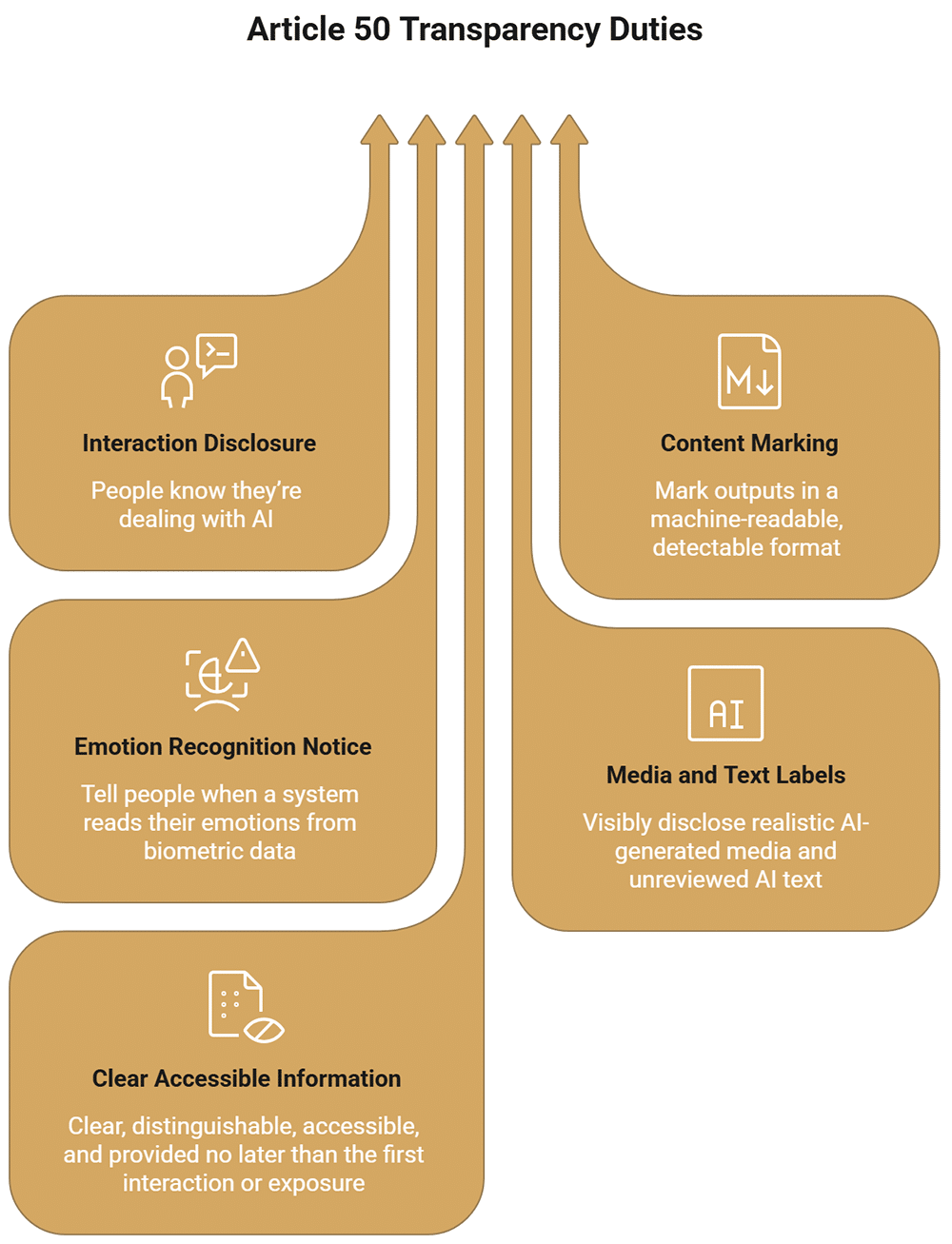
Article 50 sets four transparency duties that apply whether or not an AI system counts as high-risk. Under the AI Act’s text, they have applied since 2 August 2026, and each falls on the provider (the company building the system) or the deployer (the business using it).
- Interaction Disclosure (50(1)): Providers must design chatbots and voice agents so people know they’re dealing with AI, unless that’s obvious.
- Content Marking (50(2)): Providers of generative tools must mark outputs in a machine-readable, detectable format.
- Emotion Recognition Notice (50(3)): Deployers must tell people when a system reads their emotions from biometric data.
- Deep Fake and Public-Interest Text Labels (50(4)): Deployers must visibly disclose realistic AI-generated media and unreviewed AI text on public-interest matters.
Article 50(5) requires the information to be clear, distinguishable, accessible, and provided no later than the first interaction or exposure. A chatbot notice hidden in your terms and conditions misses the operational point.
For hotels, compliance starts with classification, not labeling everything that touched AI.
Which Guest-Facing AI Tools Need a Disclosure?
If an AI system directly interacts with a guest, Article 50(1) requires the provider to ensure people know they are dealing with AI, unless this is already obvious.
For hotels, this includes website chatbots, WhatsApp assistants, booking tools, AI concierges, and voice agents. Consider a 60-room Amsterdam hotel using an AI voice agent after 10 p.m. A clear opening could be: “Hi, I’m the hotel’s AI assistant. I can check availability or connect you with the night manager.”
The hotel may not carry the provider’s design obligation when using a third-party product, but it still has a commercial reason to test the implementation. Check whether disclosure appears on every entry point, language version, and channel after system updates.
Transparency by itself is not enough. A 2026 Texas A&M study of 340 UK users of hotel-booking chatbots found that inaccurate chatbot responses produced the strongest negative reaction and that discomfort reduced willingness to continue interacting by nearly 38%. Lead researcher Babak Taheri put the operational lesson simply:
“Competence without transparency doesn’t solve the problem.”
Hotels need to track disclosure coverage, chatbot escalation rate, failed-answer rate, and chat-assisted booking conversion together.
Does AI-Generated Hotel Content Need a Label?
No. Article 50 does not require you to put an AI label on every room description, email, blog post, or marketing image created with AI assistance.
The distinction between machine-readable marking and visible disclosure matters. Providers of generative AI systems generally handle technical marking under Article 50(2), while hotels acting as deployers may need visible disclosure for deepfakes and certain public-interest text.
This matters because AI is already widely used in hotel marketing. Eurostat data show that 58.82% of EU accommodation businesses using AI in 2025 applied it to marketing or sales.
Consider a beachfront hotel that uses AI to add a rooftop pool that does not exist and publishes the image as a genuine property photo. That image may fall under Article 50’s deepfake disclosure rules. Minor edits, such as lighting or color adjustments, are different from fabricating property features.
Sébastien Felix, founder of Influence Society, argues:
“Marking an image as AI-generated does not remove the need to represent the property’s actual facilities accurately.”
AI-generated text has a narrower rule. Article 50(4) focuses on public-interest content. Ordinary hotel marketing copy generally does not require labeling, while qualifying public-interest text may avoid disclosure when it receives substantive human review and clear editorial responsibility.
The Revfine Role-Then-Trigger Test
The easiest mistake is asking, “Did we use AI?” Article 50 requires a better sequence: What role are we playing, and which transparency trigger applies?
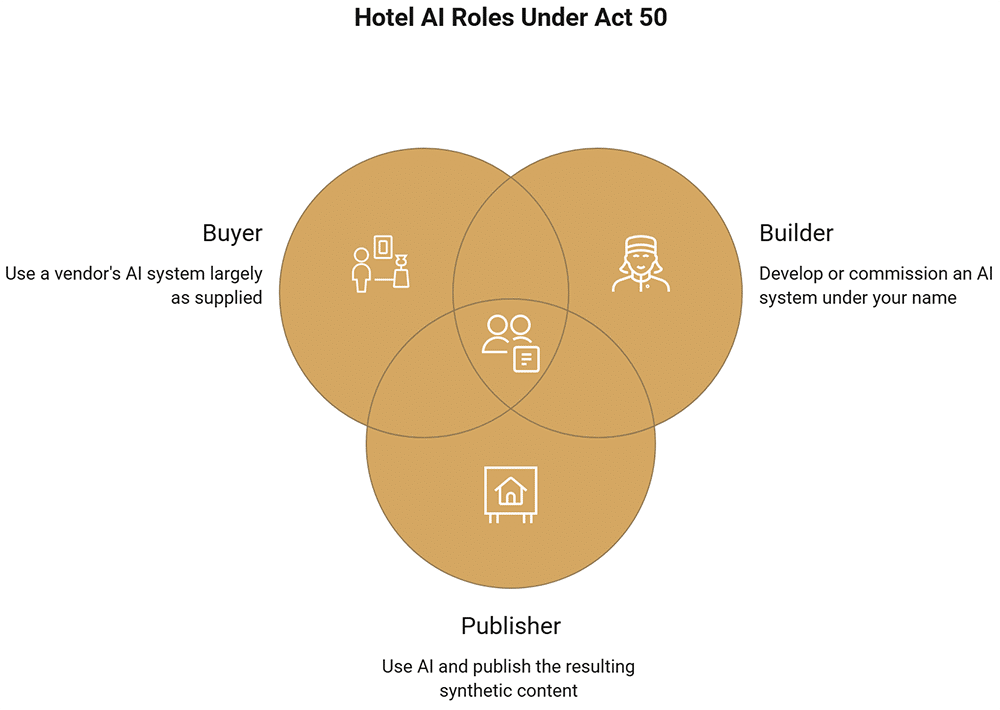
The Revfine Role-Then-Trigger Test uses three practical hotel roles. These are operational labels rather than legal categories. The legal categories remain provider and deployer.
| Hotel role | What It Means | Likely Legal Position | Example |
| Buyer | You use a vendor’s AI system largely as supplied | Usually deployer | Vendor chatbot on your website |
| Builder | You develop or commission an AI system and put it into service under your name. | May be provider | Hotel-branded booking assistant built for your group |
| Publisher | You use AI and publish the resulting synthetic content | Deployer for relevant Article 50 duties | AI-manipulated property image on Instagram |
The Article 50 guidelines reinforce the distinction between provider and deployer responsibilities. One hotel can occupy different roles across different systems.
A 70-room property might be a Buyer when operating a vendor chatbot, a Publisher when its marketing team creates synthetic visuals, and potentially a Provider if it commissions an AI system that is put into service under the hotel’s own name.
Once the role is clear, check the trigger, such as guest interaction, content marking, biometric or emotion analysis, or deepfake and public-interest disclosure.
That two-stage check prevents vendor contracts from becoming a false sense of security. Outsourcing the technology does not automatically outsource every transparency duty.
Can Hotels Use AI Emotion Recognition on Guests or Staff?
Emotion recognition is not the same as ordinary sentiment analysis. Under the AI Act, an emotion recognition system identifies or infers emotions or intentions using biometric data. Text analysis that classifies the sentiment of guest reviews based only on written words falls outside that definition.
Voice analytics needs closer attention. If software uses biometric characteristics of a caller’s voice to infer mood or emotion, Article 50(3) requires the deployer to inform the person exposed to the system. Where personal data is processed, data protection requirements can apply alongside the AI Act.
Employee use is different. The Commission’s AI Act overview identifies emotion recognition in workplaces as a prohibited AI practice except where used for medical or safety reasons. This prohibition has applied since 2 February 2025.
Before renewing contact-center, call-scoring, or quality-assurance software, ask the vendor in writing whether it infers employee emotions from voice, facial expressions, or other biometric data. Do not assume a feature called “engagement,” “mood,” or “quality scoring” is only sentiment analysis.
Will AI Disclosure Hurt Your Hotel’s Conversion?
The strongest business objection to Article 50 is clear: if you tell a guest they are speaking to AI, will fewer people book?
Hospitality research suggests the answer depends partly on how the AI performs. The 2026 Texas A&M hotel-chatbot research found a mixed disclosure effect. Identifying the chatbot as AI increased sensitivity to some forms of perceived deception, but reduced discomfort connected with inaccurate responses because users were more likely to attribute mistakes to AI limitations.
That means hiding AI identity is the wrong conversion strategy under Article 50 anyway, but bad disclosure copy is not the answer either.
Compare:
“YOU ARE TALKING TO ARTIFICIAL INTELLIGENCE.”
with:
“I’m the hotel’s AI assistant. I can check live availability, answer stay questions, or connect you with our team.”
Both reveal AI. The second tells the guest what the system can do and gives them an exit route.
Measure the result rather than guessing. Track chat-assisted booking conversion, human handoff rate, abandonment, and repeated questions for 30 days after introducing or changing disclosure wording. rates rise, the bigger problem is likely chatbot performance, not transparency.
Article 50 Penalties and Enforcement
Article 50 is enforceable, not voluntary guidance. National competent market surveillance authorities are primarily responsible for supervision, while the AI Office has a narrower enforcement role for specified systems.
Under Article 99, infringements of Article 50 can carry administrative fines of up to €15 million or 3% of total worldwide annual turnover for the preceding financial year.
The treatment of smaller businesses matters. For small and medium-sized enterprises, the applicable maximum is the lower of the fixed amount and percentage ceiling. Authorities must also consider proportionality and economic viability when deciding penalties.
A different penalty tier applies to prohibited AI practices under Article 5. That distinction matters if a hotel moves from a transparency issue, such as guest emotion recognition, into prohibited workplace emotion recognition.
Compliance therefore needs to distinguish something that must be disclosed from something the hotel should not be using in that context at all.
If conversion falls while handoffs and failed answers rise, the problem is probably bigger than the disclosure line.
How Should Independent Hotels Prepare for Article 50?
Large hotel groups can distribute AI compliance across legal, technology, marketing, and operations teams. A 50-room independent property cannot, so the process needs to fit into normal vendor management and quality assurance.
Hotels can use a four-week Article 50 check:
- Week 1: List every guest-facing AI touchpoint and tag it Buyer, Builder, or Publisher.
- Week 2: Get each vendor’s written confirmation of how it meets Article 50 and which settings could disable disclosure.
- Week 3: Script first-line disclosures per channel and label realistic AI imagery.
- Week 4: Brief front office and marketing staff, as Article 4 still requires measures supporting AI literacy.
The Digital Omnibus kept Article 50 on its 2 August 2026 timetable. Its limited transition gives providers of qualifying generative AI systems already on the market before that date until 2 December 2026 to meet Article 50(2) marking requirements. Do not treat that as a general Article 50 grace period.
You’re done when every register entry has a role, a vendor confirmation, and a dated disclosure test.
Jargon Translator
Article 50 introduces several legal and technical terms that can change how a hotel should assess an AI use case. Understanding these distinctions helps you separate routine AI use from situations that trigger disclosure, marking, or wider compliance requirements.
Machine-readable Marking: A technical signal embedded in or attached to AI-generated content so software can identify it as artificially generated or manipulated. This is different from a visible label shown to a guest.
Obviousness Exception: The Article 50(1) exception where separate AI-interaction disclosure is unnecessary because a reasonably well-informed person would already recognize that they are dealing with AI.
Market Surveillance Authority: The national regulator in each EU member state responsible for checking AI Act compliance, including Article 50 disclosures, and for fining providers and deployers that fall short.
Digital Omnibus: The July 2026 package of amendments to the AI Act, formally Regulation (EU) 2026/1744, that postponed high-risk obligations while keeping Article 50’s disclosure duties on their original timetable.
AI Literacy: The Article 4 duty on providers and deployers to take measures that support their staff’s understanding of the AI tools they use. For a hotel, that means practical training for anyone running guest-facing AI.
FAQs About the EU AI Act for Hotels
Article 50 is a targeted transparency rule, not a blanket AI-labeling mandate for hospitality. Hotels that map each use case by role, interaction, content type, and biometric exposure can focus compliance on the moments that matter while keeping vendor checks and content approval practical enough to run consistently.
Disclaimer: This article provides general business information, not legal advice. Involve qualified legal counsel when assessing specific AI systems, vendor contracts, or guest-facing disclosures under the EU AI Act.
Did You Like This Article About EU AI Act For Hotels?
You might also be interested in the following articles:
- Hotel Algorithmic Pricing Antitrust Risk Starts With Data, Not AI
- What Is Agentic Hotel Booking and How Should Hotels Prepare
- What Makes a Hotel PMS Ready for AI Agents?
More Tips to Grow Your Business
Revfine.com is the leading knowledge platform for the hospitality and travel industry. Professionals use our insights, strategies, and actionable tips to get inspired, optimize revenue, innovate processes, and improve customer experience.Explore expert advice on management, marketing, revenue management, operations, software, and technology in our dedicated Hotel, Hospitality, and Travel & Tourism categories.
This article is written by:

Hi, I am Martijn Barten, founder of Revfine.com. With 20 years of experience in the hospitality industry, I specialize in optimizing revenue by combining revenue management with marketing strategies. I have successfully developed, implemented, and managed revenue management and marketing strategies for individual properties and multi-property portfolios.




Leave A Comment