

AI agents in the hospitality industry are used by hotels, restaurants, cafés, and similar businesses to handle complex tasks autonomously. They are capable of advanced reasoning and can make decisions without human oversight. This technology is important for hospitality businesses because guests want personalization and fast service, which AI agents can deliver. At the same time, autonomous agents can help businesses cope with staff shortages.
In this article, you can explore the role of AI agents in the hospitality industry, the benefits for businesses that invest in the technology, and the impact agentic AI can have on business performance.
Quick Definition:
Key Takeaways:
|
–
Table of Contents:
- What Are AI Agents in the Hospitality Industry?
- Why AI Agents Are Becoming Important for Hospitality Businesses
- How Are AI Agents Reshaping Segments of the Hospitality Industry?
- Practical Ways AI Agents Improve Hospitality Business Performance
- Core Types of AI Agents Powering Hospitality Operations
- Which AI Agent Should You Deploy First?
- Implementation Strategies for AI Agents in the Hospitality Industry
- Global Outlook of AI Agents in the Hospitality Industry (2026-2036)
- How to Use AI Technology in the Hospitality Industry
- How AI Technology is Changing the Travel Industry
- AI Agents in the Hospitality Industry FAQs
What Are AI Agents in the Hospitality Industry?
In simple terms, AI agents in the hospitality industry are autonomous systems that can reason and carry out complex actions with minimal involvement from humans. They are goal-oriented and go beyond responding to prompts.
While an AI chatbot is driven by individual requests or commands, AI agents act to achieve higher-level goals. They can act independently to achieve their objective, often by accessing multiple systems and vast amounts of data.
The technology has the capacity to make a sequence of logical decisions, working through tasks from beginning to end. These artificial intelligence agents for hospitality can also learn from outcomes, improving performance over time.
Video: AI Agents, Clearly Explained
Why AI Agents Are Becoming Important for Hospitality Businesses
The growing role of AI agents in the hospitality industry can be partially explained by changing guest expectations. Modern guests want personalized service, delivered quickly, at a time when many businesses face staffing pressures.
Autonomous AI agents for hospitality have the capacity to autonomously perform complex tasks and work towards defined goals. This can reduce pressure on staff, and AI can use data to intelligently tailor hospitality services.
AI agents are able to work on a 24/7 basis, independently, without constant prompting from humans. They are also able to draw data from a wide range of API-enabled systems, including property management systems, customer relationship management systems, point-of-sale systems, and smart devices in hotels, restaurants, and similar businesses.
As Sam Altman, CEO of OpenAI, states:
“2025 could be the year that AI agents are integrated into the workforce, and they would materially change the output of companies.”
Video: AI Agents for Hospitality
How Are AI Agents Reshaping Segments of the Hospitality Industry?
AI agents in the hospitality industry are reshaping the way businesses operate. In the following sections, you can explore the impact the technology is having on specific hospitality sectors:
1. Accommodation (Hotels, Resorts, Hostels)
AI agents in the hospitality industry are helping hotels, resorts, and similar properties to personalize interactions with guests. AI agents can also manage room rate adjustments and respond to customer questions.
Many hotels currently face staff shortages, and AI agents can reduce workloads by handling time-consuming tasks. AI is also available 24/7, delivering rapid responses and performing time-sensitive actions at the ideal moment.
AI agents can connect with PMS and CRM systems and analyze data to forecast demand levels and adjust strategies accordingly. They can also provide a conversational interface for booking rooms, hotel restaurant tables, and other services.
To get more information about the AI agents in the hotel industry, read the “AI Agents for Hotels Are Shaping the Next Generation of Hospitality” article.
Naveen Manga, Global Chief Information Officer, Marriott International, puts it:
“We’re in deep discovery with agents. We have an agentic mesh capability that we’re building in our horizontal AI architecture, and we’re looking at use cases.”
Video: Using AI Agents at Classik Hotels: Practical Ideas for How Hotels Can Adopt AI Powered by Triptease
2. Food and Beverages (Restaurants, Bars, Cafés)
F&B businesses have some of the most exciting uses for AI agents in the hospitality industry. This includes the potential to optimize supply reordering, personalize restaurant menus, and improve service speed.
Hospitality AI agents can assist restaurants with order taking and accuracy, which can be vital in high-stress environments. Personalization elements can present relevant menus, factoring in guests’ dietary requirements.
AI-powered order taking speeds up the bar and restaurant service experience, while adding data-driven upselling and cross-selling. Optimized supply reordering also reduces waste and prevents items from being temporarily taken off the menu.
If you want to learn more about the food and beverage sector, read “How Food and Beverage Management Drives Hotel Profitability.”
3. Nightclubs, Lounges, and Entertainment Venues
Possible uses for AI agents in the hospitality industry extend to managing guest lists and enforcing rules at nightclubs, lounges, and entertainment venues. This can include ID checks, managing bookings, and more.
Entertainment venues, nightclubs, and similar hospitality businesses rely on clear communication and enforcement of rules. AI agents can assist with rule enforcement and quicken response times to guest questions.
When implemented properly, with access to business systems and data, AI agents can improve the flow of guests into these venues, reduce communication delays, and alleviate pressure on employees.
4. Lifestyle and Mixed-Use Hospitality Properties
Mixed-use hospitality includes resorts, retreats, and other properties that combine elements like accommodation, spas, dining, and lifestyle services. AI agents in the hospitality industry help with coordination here.
This is important because guests engage with these brands as a single entity, rather than as multiple distinct departments. AI agents can ensure tasks are routed to the right team at the right time to optimize the guest journey.
The result is cross-departmental schedule alignment and real reputational benefits. AI agents can also assist guests with booking the right services for their individual needs and help businesses manage customer loyalty programs.
Video: 10 Use Cases for AI Agents: IoT, RAG, & Disaster Response Explained
Practical Ways AI Agents Improve Hospitality Business Performance
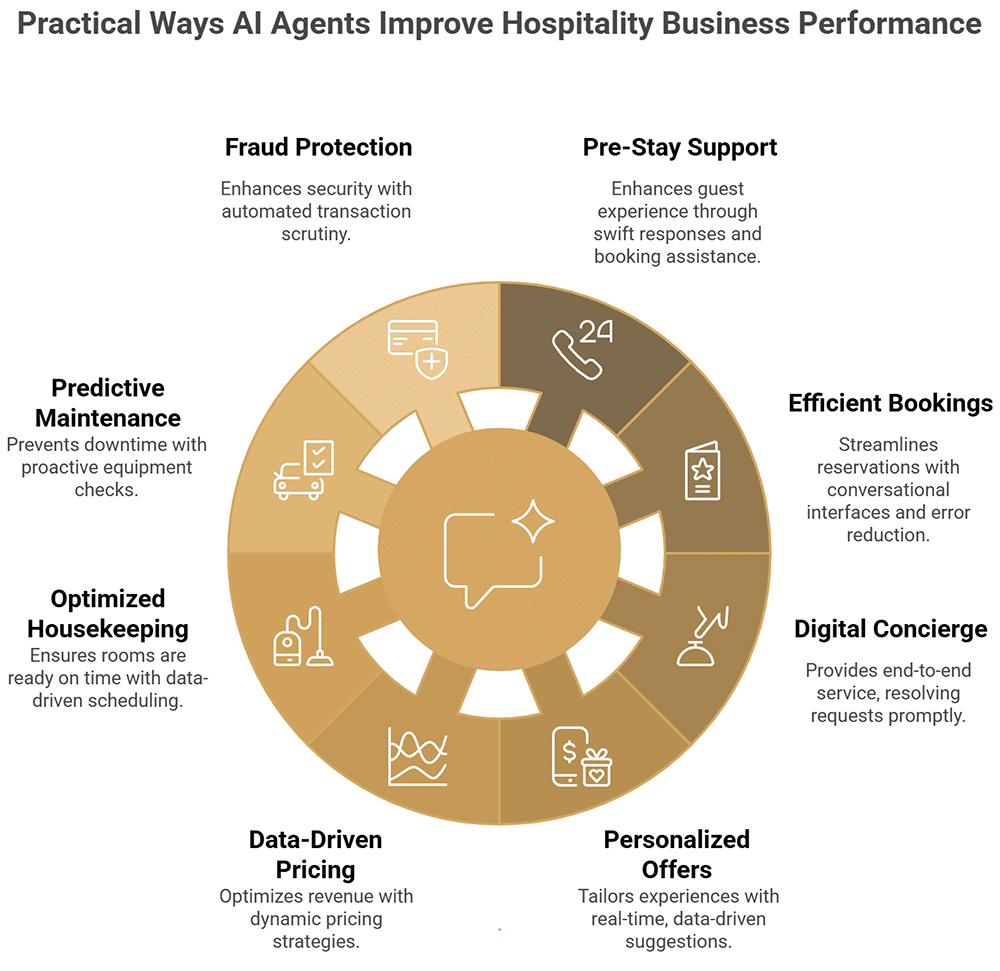
AI agents in the hospitality industry can improve efficiency and accuracy while reducing friction and workloads. Below, you can explore some of the specific, practical ways AI agents are improving hospitality:
1. Pre-Stay Questions and Booking Support
One of the biggest uses for AI agents in the hospitality industry is for handling pre-stay communications. This includes understanding customer intent, autonomously responding to questions, and providing booking support.
These early interactions can often make or break the relationship between a hospitality brand and a potential guest. By offering swift replies and guidance, brands can avoid booking abandonment issues.
AI agents are able to connect with customer relationship management and property management systems. This enables the agents to refer to previous communications, current prices, and established customer preferences.
As Chema Basterrechea, Chief Operations Officer, Radisson Hotel Group, states:
“Generative AI is shifting travel planning from traditional search into more conversational and agent-led environments. So that makes building relationships [with customers] a bit more strategic and important. Increasing direct bookings could help us collect more guest data and provide a much more personalized experience that drives repeat business.”
2. Efficient Bookings and Reservations
Artificial intelligence agents for hospitality can also provide a more convenient interface for bookings and reservations. In particular, it can offer a conversational interface, which may be easier for some users.
As AI agents can understand contextual information, including intent, they can automatically make bookings for guests. Along the way, they can ask guests to confirm plans before the booking is confirmed.
For an added benefit, AI agents in the hospitality industry can reduce human error, such as double bookings.
3. Digital End-to-End Concierge that Closes Requests
Hospitality businesses can use AI agents as an end-to-end concierge. Not only will the agent understand each customer request, but it can also take the necessary steps from beginning to end, so the task is completed.
Concierge services are important for hospitality businesses, connecting guests with the experiences they desire. AI agents in the hospitality industry can act swiftly, preventing delays that lead to time-consuming follow-ups.
AI concierge services can connect with other business systems, alerting staff to work that needs to be carried out. The agent can also ensure tasks happen at the ideal time to ensure smooth progress through the workflow.
4. Personalized Offers, Upgrades, and Add-Ons
Advanced artificial intelligence can personalize offers, upgrades, and add-ons, so guests get the ideal experience. Better still, AI agents are able to personalize offers in real-time, based on what customers say in the moment.
Personalization is vital, as guests want to be treated as unique individuals. It is also the basis on which many hospitality brands compete with rivals, so AI agents in the hospitality industry can give a competitive edge.
By matching specific guests to specific needs, rather than offering generic bundles, a hospitality brand can improve customer satisfaction. The knock-on effect is a boost to reputation through more positive reviews.

Michael J. Goldrich, Founder & Chief Advisor, Vivander“AI agents learn to understand and anticipate unique customer needs by acting as digital receptionists across voice, chat, web, and messaging apps. They remember guests, maintaining context and continuity. Eventually, they will remember you across devices. If a guest asks about pet policies on WhatsApp, the AI suggests pet-friendly rooms when they visit the website later. With real-time access to inventory, pricing, and PMS data, these AI agents will move beyond simple Q&A to perform transactions. They instantly check room availability, verify prices, and confirm services like late check-outs on any channel. This frictionless interaction means that guests don’t have to repeat themselves; each engagement builds on the last. This personalisation enhances sales interactions and boosts conversion rates. Guests receive customised experiences, making them more likely to engage with offers and complete bookings. Achieving this requires strong API integrations plus strict data privacy and security measures to protect guest information and build trust.” Click here to learn more from our Hotel Marketing Expert Panel. |
5. Improved, Data-Driven Pricing Decisions
One of the biggest emerging uses of AI agents in the hospitality industry is to assist with pricing. The AI can analyze and interpret past data, current data, local signals, and more to anticipate demand.
Data-driven pricing decisions are especially important in hotels and similar properties, where dynamic pricing is common. By using AI agents, brands can charge the ideal price at any time, maximizing revenue and avoiding vacancies.
In other hospitality businesses, pricing recommendations can also be made by analyzing competitor pricing and demand patterns. This might include determining the popularity of a restaurant dish or a particular DJ at a nightclub.
6. Optimized Housekeeping and Room Readiness
The use of AI agents in the hospitality industry for housekeeping is growing. Here, AI can help to identify rooms that need to be cleaned, based on expected arrivals, and optimize work schedules to avoid guest delays.
Housekeeping is one of the key services that can shape a guest’s opinion of a hospitality business. By using AI agents, businesses can direct attention to where it is most needed, creating data-driven prioritization.
Using AI can help to flag VIP arrivals ahead of time, reduce last-minute housekeeping tasks, and highlight special guest requirements. When guests arrive, their room is ready on time, and the staff has a more manageable workload.
7. Predictive Maintenance and Engineer Dispatch
Predictive maintenance AI agents in the hospitality industry are able to combine real-time data from smart devices, guest reports, and usage data to anticipate problems in advance. They can then dispatch engineers.
For hospitality businesses, predictive maintenance can greatly reduce or avoid downtime for equipment and technology. In most cases, preventative maintenance is also quicker and cheaper than fixing an issue after the fact.
AI-assisted predictive maintenance can also prevent situations where services or amenities are unavailable.
8. Strengthened Fraud Protection and Verification
AI agents in the hospitality industry are ideal for scrutinizing financial transactions and flagging suspicious patterns. They can also be used to verify identities, confirm booking details, and alert staff to potential problems.
Protecting a hospitality business against fraud is essential for optimizing financial outcomes. Yet, the automated nature of AI agents can ensure check-in experiences remain swift and genuine customers are not held up unnecessarily.
Agents can be connected to ticketing systems, booking engines, POS systems, and ID verification workflows.
Core Types of AI Agents Powering Hospitality Operations
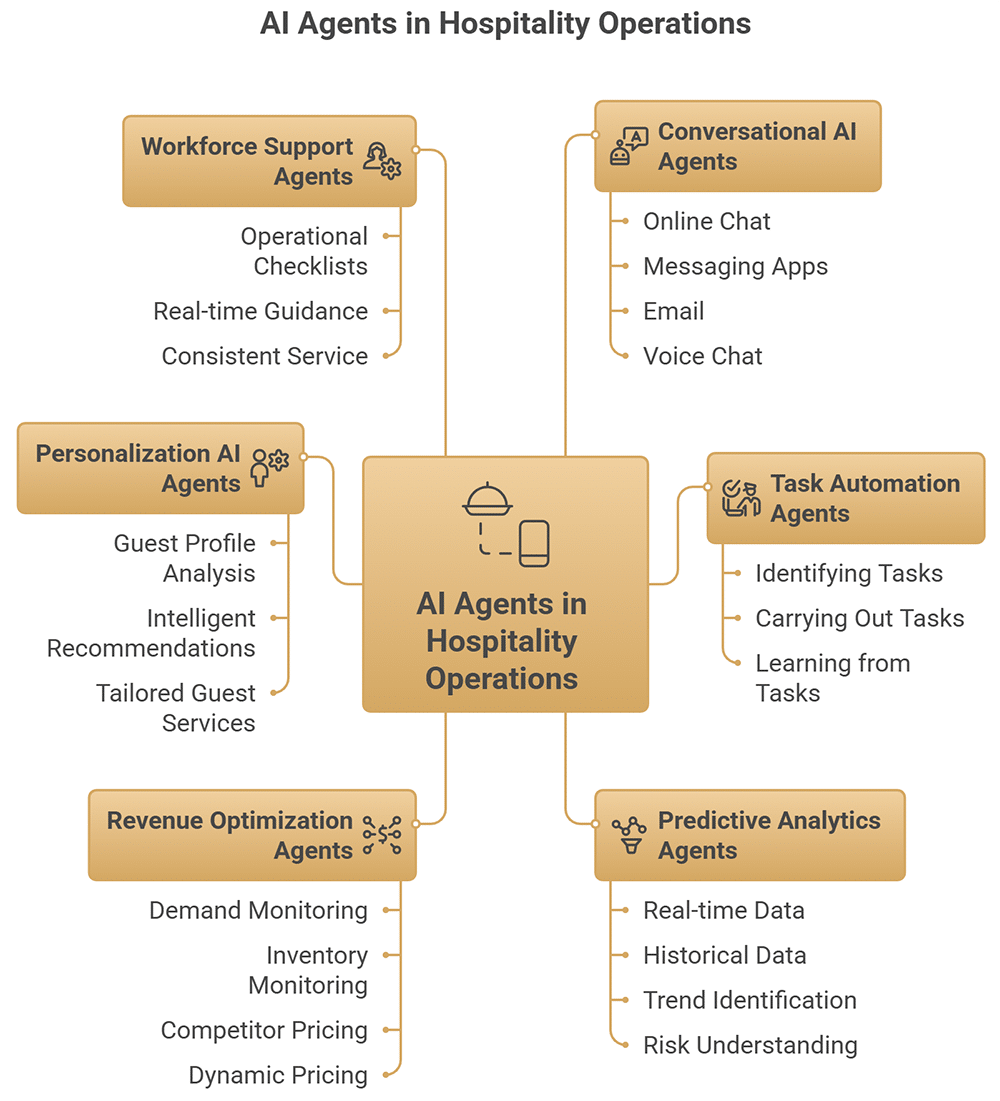
The various AI agents in the hospitality industry can be separated into different types, which all offer valuable functions. In these sections, you can learn about the main types and what they actually do:
1. Conversational AI Agents
Conversational AI agents in the hospitality industry are able to handle natural language interactions. These discussions may occur across various channels, including online chat, messaging apps, email, and voice chat.
In this context, AI agents can serve as a communication layer that links guests to hospitality systems. The agents capture guest intent and connect that intent to systems that facilitate what guests want.
2. Task Automation Agents
AI agents focused on task automation are designed to carry out hospitality jobs by themselves. Modern AI agents in the hospitality industry can identify tasks, carry them out, and learn from them, without human involvement.
Automation-focused AI agents are capable of more advanced reasoning than other forms of AI. This can allow the AI agents to make evidence-based decisions on their own, rather than simply following instructions.
3. Predictive Analytics Agents
Some AI agents in the hospitality industry are focused on predictive analytics. This means they use a combination of real-time and historical data to forecast future demand, workloads, or operational pressures.
Agentic AI can take predictive analytics to the next level, identifying trends, understanding risks, and offering actionable insights. Hospitality businesses can use these abilities to manage resource allocation.
4. Revenue Optimization Agents
Revenue optimization-centered AI agents in the hospitality industry monitor issues around demand, inventory, and competitor pricing. They are able to use this data to determine the ideal pricing strategy at any given moment.
AI agents of this kind can make recommendations on pricing or, if authorized, autonomously enact rate changes. This opens up the potential to manage dynamic pricing on a much more in-depth level, 24/7.
5. Personalization AI Agents
Some AI agents focused on personalization are able to analyze guest profiles and understand questions and requests. From there, they can make intelligent recommendations and tailor guest services.
AI agents in the hospitality industry are increasingly being used to not only determine what to recommend, but when. They are able to determine the best time to push a recommendation or message in order to maximize income.
6. Workforce Support Agents
Workforce support for AI agents in the hospitality industry helps to focus employee efforts and coordinate staff effectively. They primarily achieve this by integrating guidance into day-to-day workflows.
For example, a workforce support AI agent may provide employees with operational checklists or paths forward in real-time. This can help hospitality brands to deliver a more consistent standard of service.
Which AI Agent Should You Deploy First?
The right starting point depends on your main business constraint:
- If revenue growth is slow, → Start with a Revenue Optimization AI Agent.
- If response times are long, → Deploy a Conversational AI Agent.
- If labor costs are rising, → Introduce Task Automation or Workforce Support Agents.
- If maintenance issues disrupt operations, → Use Predictive Maintenance Agents.
- If guest personalization is weak, → Implement Personalization AI Agents.
Start with one high-impact area, measure performance, then expand gradually.
Implementation Strategies for AI Agents in the Hospitality Industry
The implementation of AI agents in the hospitality industry relies on the right approach. Here, you can explore some of the most beneficial strategies for putting AI agents into action:
- Assessment and Planning: Identify operational bottlenecks, time-consuming predictable tasks, and key customer touchpoints. Assess where AI agents in the hospitality industry can have the biggest impact.
- Technology Integration: Use API-enabled software solutions to share data. Choose AI agents that are specifically designed for hospitality and that have a proven track record of success.
- Training and Change Management: Provide comprehensive training for employees, so they know how to use AI agents and work with them. Manage staff resistance by emphasizing AI’s ability to assist, not replace.
- Testing and Iteration: Implement AI agents in the hospitality industry gradually, testing and refining along the way. Increase the role of AI agents over time, slowly adding new capabilities.
- Continuous Monitoring and Optimization: Establish key performance indicators and monitor the performance of AI agents. Make changes, where necessary, to optimize your return on investment.
Video: Risks of Agentic AI: What You Need to Know About Autonomous AI
Global Outlook of AI Agents in the Hospitality Industry (2026-2036)
Over the next decade, the use of AI agents in the hospitality industry is expected to increase dramatically. This will not only alter business operations but will also fundamentally shift the way guests find and book hospitality services.
The scale of this change is highlighted in a PWC survey on AI agents, which found that 75% of executives agree that agentic AI will transform workplaces more than the internet did. Almost as many (71%) believe AI is advancing at a pace that will allow AI agents to think, learn, and solve problems as flexibly as humans within a couple of years.
One of the biggest reasons why hospitality businesses are keen to adopt AI agents is that many are now facing staffing pressures. In fact, the World Travel & Tourism Council estimates that labor availability in the hospitality sector will be 18% below required levels by 2035. Agentic AI will be invaluable for dealing with this shortfall.
Many hospitality businesses are already experimenting with AI agents, but few have achieved full adoption. Over the decade ahead, AI agents in the hospitality industry will move beyond experimental technology, towards becoming an integral part of day-to-day workflows and a critical interface between brands and their guests.
Bill Gates, Microsoft Co-founder, says on the future role of AI agents:
“In the next few years, [AI agents] will utterly change how we live our lives, online and off. They’re proactive – capable of making suggestions before you ask for them. They accomplish tasks across applications. They improve over time because they remember your activities and recognize intent and patterns in your behavior. They’re also going to upend the software industry, bringing about the biggest revolution in computing since we went from typing commands to tapping on icons. Agents won’t simply make recommendations; they’ll help you act on them.”
How to Use AI Technology in the Hospitality Industry
The rising use of AI agents in the hospitality industry is one example of how artificial intelligence can be deployed in these settings. However, AI can be used in a number of other ways too, including for data analysis, contactless check-ins, translation services, and to power smart room systems in hotels.
In the “How to Use Artificial Intelligence in the Hospitality Industry” article, you can fully explore AI usage in hotels, restaurants, and similar businesses, and also discover some of the specific benefits.
How AI Technology is Changing the Travel Industry
In addition to AI agents in the hospitality industry improving guest services, artificial intelligence is transforming travel. Examples include more accurate and automated flight forecasting, AI face recognition for greater security, AI business travel planning, and AI-powered airport operations management.
In the “How Artificial Intelligence is Changing the Travel Industry” article, you can take a deep dive into the ways AI technology is being deployed by the travel industry today and examine the global outlook for the future.
AI Agents in the Hospitality Industry FAQs
AI agents in the hospitality industry have the potential to transform business operations and guest experiences. The technology is capable of contextualizing information and making decisions autonomously, which could greatly reduce pressure on staff while improving personalization, response times, and financial outcomes.
Did You Like This Article About AI Agents in the Hospitality Industry?
You might also be interested in the following articles:
- AI Agents in the Travel Industry: Use Cases, ROI, and Strategy
- Examples of Robots Being Used in the Hospitality Industry
- The Housekeeping Robots Driving Hospitality Industry Innovation
More Tips to Grow Your Business
Revfine.com is the leading knowledge platform for the hospitality and travel industry. Professionals use our insights, strategies, and actionable tips to get inspired, optimize revenue, innovate processes, and improve customer experience.Explore expert advice on management, marketing, revenue management, operations, software, and technology in our dedicated Hotel, Hospitality, and Travel & Tourism categories.
This article is written by:

Hi, I am Martijn Barten, founder of Revfine.com. With 20 years of experience in the hospitality industry, I specialize in optimizing revenue by combining revenue management with marketing strategies. I have successfully developed, implemented, and managed revenue management and marketing strategies for individual properties and multi-property portfolios.

Leave A Comment