

MICE hotel marketing is the strategy hotels use to attract, convert, and retain meetings, incentives, conferences, and exhibitions business. It is important because group buyers make most of their decisions before they ever speak to your sales team, using published specifications, photographs, and response speed to build a shortlist you either make or miss.
Key Takeaways:
|
Table of Contents:
What Is MICE Hotel Marketing?
MICE hotel marketing covers the strategies you use to generate demand from organizers of corporate meetings, incentive trips, conferences, conventions, exhibitions, training programs, retreats, and other business events.
It sits between hotel marketing and hotel sales. Marketing creates visibility and gives planners enough information to consider your property. Sales then turns that interest into a qualified Request for Proposal (RFP), negotiation, contract, and eventually repeat business.
The practice that falls short is simply advertising your hotel as an “ideal meeting venue.” A planner isn’t buying a ballroom. They are solving an event problem.
A pharmaceutical company organizing a 60-person training program may value airport access, reliable audiovisual equipment, three nearby breakout rooms, private dining, and predictable delegate pricing. A 300-person association conference has completely different requirements.
Your MICE hotel marketing should therefore answer four commercial questions:
- Which event types fit your property?
- Which buyers should you target?
- Which dates need group demand?
- Why should a planner shortlist your hotel?
The more specific those answers become, the easier it is to choose your marketing channels, content, packages, and sales targets.
Trying to sell every possible type of event usually produces weaker positioning and more unsuitable inquiries.
What Does MICE Stand For in Hotel Marketing?
MICE stands for Meetings, Incentives, Conferences, and Exhibitions. In some markets, the C means Conventions and the E means Events. For hotels, the important point is that each MICE segment has different buyers, budgets, planning timelines, and expectations.
Meetings include training sessions, board meetings, team gatherings, and client workshops. They are usually smaller events with fewer than 100 attendees. Incentive travel is designed to reward employees, sales teams, or business partners, so buyers usually focus more on the quality of the experience.
Conferences and conventions are larger, multi-day events run by associations or larger corporates. They can generate significant room blocks, meeting space demand, catering revenue, and other spending. Exhibitions work differently. Hotels near convention centers may receive large numbers of attendees who only need accommodation. These guests may never book meeting space at the hotel, which means this demand can easily be overlooked.
The Events Industry Council and Oxford Economics reported that business events attracted 1.65 billion participants worldwide, with direct spending averaging US$785 per participant.
As Amy Calvert, President and CEO of the Events Industry Council, put it:
“Business events are essential infrastructure for a connected, innovative and resilient global economy.”
MICE is one segment inside a wider commercial plan, so read this alongside our hub guide to “hotel marketing strategies.”
Why Is MICE Business Worth More Than Transient Room Revenue?
MICE business can be worth more than ordinary transient room bookings because a group often spends money across several hotel departments. Revenue may come from guest rooms, meeting space, food and beverage, audiovisual services, parking, and other event-related services.
Group business usually books further in advance as well. That gives your revenue team a stronger base of confirmed demand when deciding how to price the remaining transient inventory.
According to CoStar, U.S. Hotel Forecast Assumptions Q2 2026. U.S. group demand, defined as bookings of ten or more room nights, increased by 2.7%, with particularly strong growth in secondary markets hosting small and medium-sized events.
The mistake is assuming every group booking is automatically valuable.
Before accepting a group, calculate its Total Event Value.
Total Event Value: The full commercial value of a piece of group business rather than its room revenue alone.
Formula: Total Event Value = Rooms revenue + Room rental + Food and beverage + Audiovisual and ancillary, minus displaced transient revenue.
Consider a 90-room hotel receiving a 40-room group for three midweek nights. If that group brings another EUR 22,000 from meeting room rental and catering, it may be more profitable than the transient demand it replaces.
The same offer on a peak-season Saturday could produce the opposite result. Your decision should therefore depend on total contribution and displacement, not the negotiated room rate alone.
How Do You Build a MICE Hotel Marketing Strategy?
A MICE hotel marketing strategy is a plan for reaching event planners at every stage of their hotel selection process. Build it around how planners search, compare, shortlist, and contact hotels, rather than around the marketing channels you already use.
A common mistake is relying on one meetings page, an outdated sourcing-platform listing, occasional trade shows, and a sales team waiting for incoming RFPs. This creates visibility but does little to help your hotel survive the comparison stage.
Cvent’s Global Planner Sourcing Report, based on more than 1,650 planners, found that 22% follow a formal sourcing process for every meeting, while another 38% use one for most events.
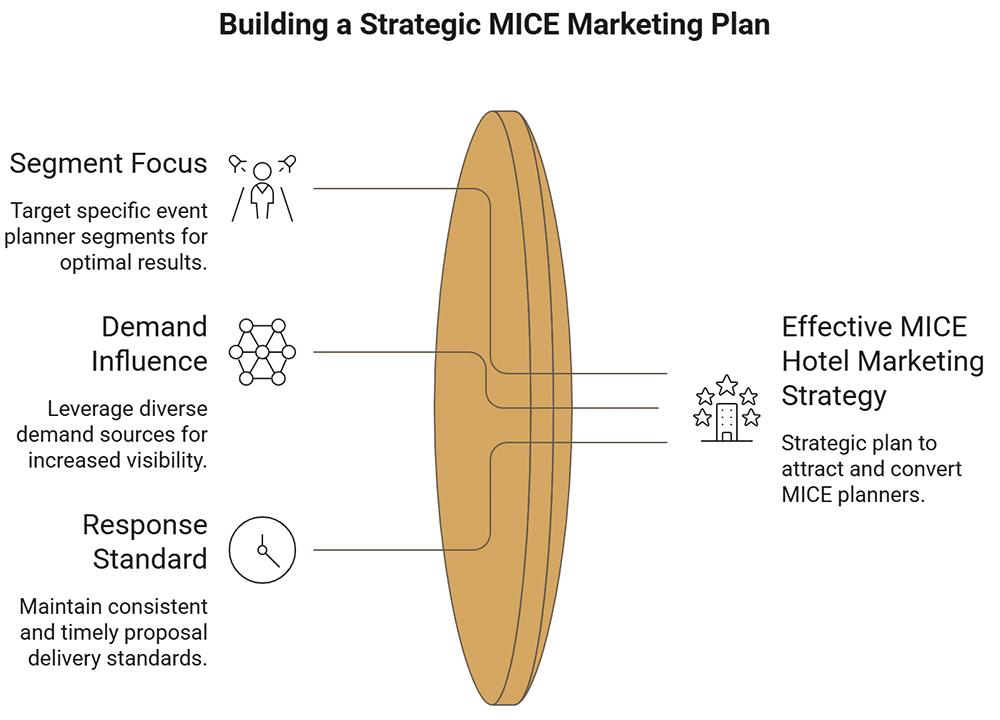
Three decisions set the shape of your strategy:
- Which segments you actually want. A 110-room city hotel with one 200 square meter ballroom should not be marketing to association conference organizers. It should own the 20 to 60 person corporate meeting.
- Which demand sources you can influence. Sourcing platforms, direct search, your destination marketing organization, and AI assistants each need different assets.
- Which response standard you can hold. Promising same-day proposals and delivering in six days damages you more than publishing a two-day standard and hitting it.
Write those three answers down before you spend anything. A focused strategy produces better leads than trying to market your hotel to every type of event planner.
How Do Event Planners Find and Shortlist Hotels?
Event planners usually discover hotels through sourcing platforms, Google search, destination marketing organizations, previous experience, referrals, and increasingly AI assistants. They then cut it to a shortlist of three to six properties using published details alone, before any conversation happens.
What Information Do Planners Check Before Sending an RFP?
Detailed venue information matters more than broad marketing language. Cvent’s Global Planner Sourcing report found that meeting room specifications influence 50 percent of planners when they decide whether to send you an RFP at all. Floor plans, diagrams, and current photography sit close behind.
So publish the things a planner needs to rule you out or in:
- Capacity charts for every room in every setup: theater, classroom, cabaret, boardroom, U-shape, banquet.
- Ceiling heights, floor loading, natural light, blackout capability, and column positions.
- Load-in access dimensions, power supply, and rigging points.
- Wi-Fi bandwidth per concurrent user, not a marketing adjective.
- Catering minimums, service charge structure, and audiovisual pricing bands.
How Does AI Search Change Hotel Visibility for Planners?
AI assistants now sit inside this stage, which changes what “findable” means. When a planner asks an assistant for hotels in your city with a room seating 120 theater-style and 40 bedrooms on site, the answer is assembled from structured, crawlable text. A capacity chart trapped in a PDF or a JPEG cannot be read, quoted, or cited.
The same principles apply behind a hotel AIO strategy. Publish capacity data as HTML tables with clear labels. That one change does more for your visibility in AI search than a year of social posting.
Technical specifications help your hotel reach the shortlist, but experience still matters.
Julien Houdebine, Global Chief Sales and Revenue Officer at Accor, set the bar in the Amex GBT Global Meetings and Events Forecast when he said:
“A great venue has to be capable of storytelling through design.”
What Makes a Hotel RFP Response Win?
A strong Request for Proposal (RFP) response is fast, specific, and easy for the planner to compare. Responding quickly gets your hotel considered, but the proposal still needs to show clearly why your property fits the event.
Cvent’s Global Planner Sourcing Report found that planners expect hotels to respond within four business days, whether the event has 50 or 100 attendees. A slow response can mean your hotel misses the shortlist completely.
A stronger response should:
- Name the room you are proposing and show it in the setup the planner asked for, not in a wedding configuration.
- Price the whole thing: rooms, rental, catering per person, audiovisual, and service charges in one visible number.
- Answer the question they asked about, whether that is breakout adjacency, dietary handling, or load-in timing.
- Give one flexible term up front, such as a reduced attrition band or a decision-date extension.
- Attach a floor plan with the proposed layout drawn on it.
One more thing decides the close: who signs off. A proposal that needs three internal approvals before it reaches the planner will always lose to a sales manager empowered to quote rental and catering in a single reply.
Set an internal standard of two business days for proposals under 50 rooms and three for anything larger. Track your median RFP response time rather than only the average. This gives you a clearer picture of whether slow responses are becoming a regular sales problem.
The Four MICE Buyer Profiles
MICE buyers don’t all want the same thing. Corporate meeting planners, incentive buyers, conference organizers, and exhibition organizers have different priorities, budgets, and booking timelines.
Your marketing and proposals should reflect those differences.
| Buyer | What they optimize for | Typical booking horizon | What wins the business |
| Corporate meeting planner | Cost control, logistics, speed of answer | 1 to 6 months | Fast, specific proposals and predictable all-in pricing |
| Incentive buyer | Emotional impact, exclusivity, participant memory | 9 to 18 months | Distinctive private space, local experiences, a named on-site host |
| Association or conference organizer | Delegate volume and budget certainty | 18 months to 5 years | Destination case, room block support, multi-year rate certainty |
| Exhibition organizer | Floor space logistics and room block coverage | 12 to 36 months | Venue proximity, freight access, disciplined block management |
The incentive buyer deserves separate attention because the economics are unusual. The Incentive Research Foundation reported that average spend per person on incentive travel rose 4 percent over the past year to US$5,100.
That doesn’t mean the full amount reaches the hotel. It does show why incentive buyers may pay more for experiences that feel distinctive.
A private rooftop dinner, exclusive-use hotel area, or chef-led local dining experience can make your offer stronger.
Corporate meeting planners usually have different priorities. They want a quick answer, clear total costs, simple logistics, and no unexpected charges when the final invoice arrives. 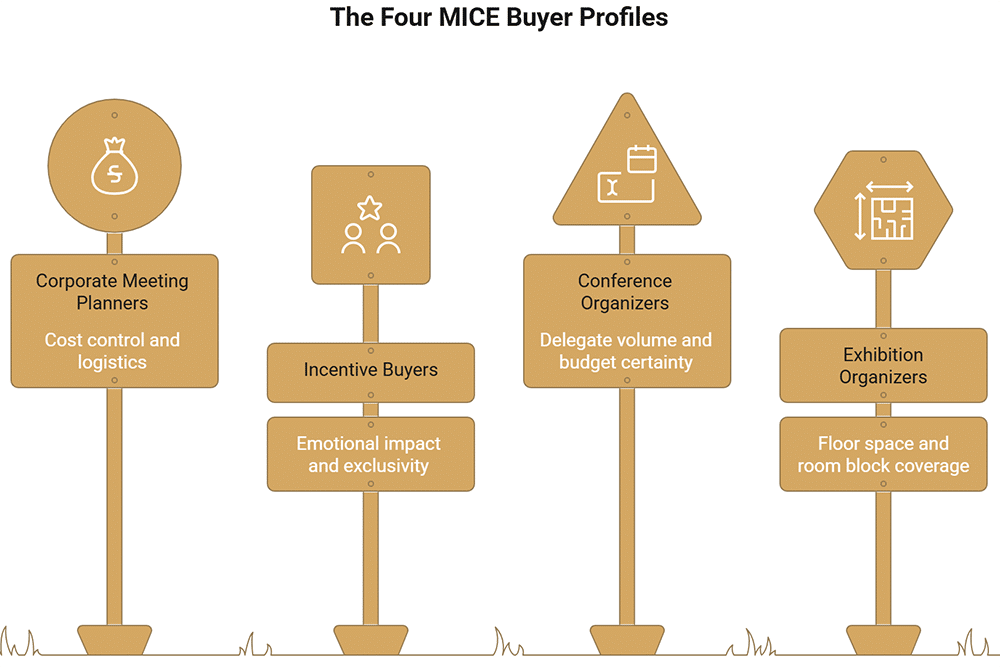
How Should Revenue Management Protect MICE Profitability?
The most dangerous target a commercial team can be handed is “more group business.” More is not better. A group that rescues a dead Tuesday can destroy value on a compression weekend, and your marketing calendar has to know the difference.
GBTA and ALTOUR’s Global Business Travel Forecast projects global hotel Average Daily Rate (ADR) growth of 3.7% in 2026 and 1.8% in 2027. With limited rate growth, hotels need to evaluate group pricing carefully.
Run the Total Event Value calculation rather than the group room rate alone. Judge the result at the property level with TRevPAR, because a group with a lower room rate can still produce more total revenue per available room than the transient business it replaced.
TRevPAR (Total Revenue Per Available Room) = Total hotel revenue / Available room nights
Build two thresholds rather than one:
- A need-date threshold for Sunday nights, shoulder weeks, and soft months, where you market hard and accept a lower room rate against strong catering.
- A compression threshold for citywide weekends and peak season, where a group clears a higher total contribution bar, or you protect the inventory.
Give your revenue manager sign-off above a set room count and give sales a published rate floor below it, so proposals still leave inside two business days. Approval friction is a response-time problem wearing a pricing costume.
Then tell marketing which dates to sell. Campaigns aimed at months you were going to fill anyway are not marketing. They are subsidy.

Cory Falter, Partner, Lure Agency“Sell experience. Not space. Use your sales team to educate prospects on how to host the best event possible. That’s your golden ticket to stand out from the sea of beautiful properties out there. Independent hotels, this is your chance to shine. Unlike branded chains, you have the flexibility to highlight what truly sets you apart: your team’s expertise on your website. Too many hotels are missing out on revenue by not showcasing their team’s knowledge. Many of our partners find that over half of their small meeting opportunities come from planners with little to no experience. These newbies have a ton of questions and need a guiding hand, but most hotel websites are geared towards seasoned planners who are ready to submit an RFP. Here’s a challenge:
Prospects want to work with people they trust. Encourage your sales team to share their expertise and personality on social media, especially on LinkedIn, which is rolling out a video feed tab similar to TikTok. It’s an incredible tool for subject matter experts to educate prospects. Sales get a whole lot easier when prospects already know who you are. So, be bold, be educational, and let your team’s expertise be the differentiator.” Click here to learn more from our Hotel Marketing Expert Panel. |
The Independent Hotel MICE Playbook
Independent hotels lose MICE business to brands on distribution reach and global sales teams. They win it on speed, specificity, and the small end of the market, where a national sales office has no advantage and often no interest.
Small meetings are a particularly good opportunity. The Amex GBT Global Meetings and Events Forecast found that 38% of meeting professionals expected to organize more small or simple meetings in 2026, while another 50% expected volumes to stay stable. These bookings are too small for a corporate sales team to chase properly and large enough to fill your midweek trough.
Here are the six moves that can work without a dedicated commercial team:
- Publish complete capacity and pricing data so the shortlist decision can happen without a phone call.
- Commit to a 24-hour response standard for inquiries under 30 rooms and put it on the page.
- Build a standing relationship with two or three local destination management companies rather than chasing twenty.
- Register with your convention and visitors bureau or destination marketing organization and keep the listing current.
- Package your midweek gap: a fixed day delegate rate, three room setups, and one menu, bookable in one email.
- Ask every departing organizer for their next date before they leave the property.
Consider a 65-room independent in Porto with a 90 square meter meeting room. It cannot compete for a 300-delegate conference. It can own the 25-person leadership offsite that wants a private dining room, a walkable location, and an answer by Friday.
Pick the fight you can win.
Is MICE Business Won by Marketing or by Relationships?
The strongest objection to everything above is that group business is a relationship sale. Experienced directors of sales will tell you that accounts follow people, that a site visit closes what a website never could, and that they would rather have one good contact at a pharmaceutical company than a rebuilt meetings page.
The limit of the objection is where relationships operate. They work at stages four and five of the shortlist path, on business you already have access to. They do nothing at stages one and two, where a planner you have never met is cutting a longlist of eleven properties down to four using published data alone.
Both things are true at once. Marketing gets you into the comparison; relationships and rate decide it once you are there. A hotel with excellent relationships and thin published data has a ceiling set by its existing account base, which shrinks every time a planner changes jobs.
Where the objection holds most firmly is repeat association and citywide business, where the destination and the convention bureau drive the decision more than any single property’s content. If that is most of your group base, weight your effort toward the bureau relationship and the multi-year rate case.
FAQs Related to MICE Hotel Marketing
MICE hotel marketing is the discipline of being findable, credible, and fast at every stage of a professional buyer’s sourcing process. Treat it as a content and response operation rather than a sales activity, and the results show up first in shortlist appearances, then in conversion. The hotels that publish the most usable detail get compared the most often.
Did You Like This Article About MICE Hotel Marketing?
You might also be interested in the following articles:
- How Can Hotel Local Partnerships Drive More Bookings
- How Much Should Your Hotel Marketing Budget Really Be?
- AI Agents for Hotel Marketing Are Picking Winners Already
More Tips to Grow Your Business
Revfine.com is the leading knowledge platform for the hospitality and travel industry. Professionals use our insights, strategies, and actionable tips to get inspired, optimize revenue, innovate processes, and improve customer experience.Explore expert advice on management, marketing, revenue management, operations, software, and technology in our dedicated Hotel, Hospitality, and Travel & Tourism categories.
This article is written by:

Hi, I am Martijn Barten, founder of Revfine.com. With 20 years of experience in the hospitality industry, I specialize in optimizing revenue by combining revenue management with marketing strategies. I have successfully developed, implemented, and managed revenue management and marketing strategies for individual properties and multi-property portfolios.
Leave A Comment