

Hotel staff retention is the discipline of keeping trained employees in active roles long enough to recover the full cost of hiring and developing them. It has become important for hoteliers because every avoidable resignation creates service gaps, recruitment costs, training pressure, and guest experience risk.
Key Takeaways:
|
–
Table of Contents
- What Is Hotel Staff Retention?
- Why Is Hotel Staff Retention a Bigger Priority in 2026?
- What Does Hotel Employee Turnover Actually Cost?
- What Causes Hotel Employees to Leave?
- The Hotel Retention Stack
- Which Hotel Staff Retention Metrics Should You Track?
- How Does Onboarding Affect Hotel Staff Retention?
- How Can Independent Hotels Improve Staff Retention?
- How Should Hotels Use Technology to Support Staff Retention?
- FAQs About Hotel Staff Retention
What Is Hotel Staff Retention?
Hotel staff retention measures how successfully a hotel keeps trained employees in active roles over time. It is the direct opposite of staff turnover and applies across front desk, housekeeping, food and beverage, maintenance, revenue, sales, reservations, and management roles.
Annual Turnover Rate = Departures ÷ Average Headcount x 100
Retention Rate = 100 − Annual Turnover Rate
The operational value goes beyond the formula. A front desk team with two years of shared experience handles complaints, upgrade requests, and peak check-in pressure differently from a team where half the agents started within the last 90 days. Housekeeping supervisors with tenure know which rooms need extra attention and how to pace heavy changeover days without quality slipping.
That institutional knowledge cannot be hired instantly. It has to be retained.
A practical retention strategy answers four questions:
- Who is leaving?
- Why are they leaving?
- Which departures damage service or profitability most?
- What can managers change before employees start applying elsewhere?
For a 90-room independent hotel, keeping one strong front desk agent can protect check-in speed, upsell quality, guest recognition, and manager time. Losing that employee creates a service gap before the replacement is fully productive.
For teams still building the hiring process alongside the retention strategy, our guide to “hospitality staffing” covers how to recruit, set role expectations, and onboard new hires
Why Is Hotel Staff Retention a Bigger Priority in 2026?
Hotel employment has recovered, but the operating environment remains structurally short-staffed. BLS data showed 962,000 open hospitality jobs in April 2026 against a workforce of 17.079 million, a gap that has persisted well past the period of pandemic-era disruption. Hotels may find candidates, but experienced employees remain expensive to lose.
The commercial impact is specific. When a housekeeping supervisor leaves before a peak weekend, room inspections slow, early arrivals wait longer, and front desk complaints increase. When a night auditor exits, managers cover gaps rather than focusing on revenue, service recovery, or owner reporting. Each departure creates a cost that the replacement start date doesn’t undo.
As Rosanna Maietta, President and CEO of the American Hotel and Lodging Association, noted in the AHLA’s workforce report:
“The hospitality sector has made significant strides in rebuilding its workforce and creating opportunities for career advancement, but staffing shortages continue to present significant challenges.”
Retention now needs to be treated as labor risk management. If you only react after resignations, you are already paying for the problem.
What Does Employee Turnover Actually Cost a Hotel?
Most hotels underestimate turnover because they count recruitment costs and ignore operational disruption. The direct cost is the visible part. The hidden cost is slower service, extra supervision, lower productivity, and weaker guest recovery while new employees learn the property.
SHRM’s benchmarking places the average nonexecutive cost per hire at $5,475. For hotels, that number should be treated as the starting point, not the full cost, because frontline roles affect service flow immediately.
Consider a 90-room independent hotel with a five-person front desk team. If three agents leave in one year, the property pays for sourcing, interviewing, onboarding, and training. It also loses upsell confidence, repeat guest recognition, and complaint-handling speed.
Turnover cost has three components: direct replacement, service inconsistency during vacancy and training, and the downstream revenue impact on review scores and repeat bookings. Most operators calculate only the first.
What Causes Hotel Employees to Leave?
Hotel employees usually leave when the job they are doing is worse than the job they accepted. The gap often appears in workload, scheduling, supervision, training, or career growth.
Gallup’s 2026 State of the Global Workplace report found global employee engagement fell to 20 percent in 2025, while manager engagement dropped from 27 to 22 percent over the same period. For hotels, direct manager quality is the most controllable retention lever.
The most common practical causes are:
- Unpredictable Schedules: Employees cannot plan childcare, transport, study, or second jobs.
- Uneven Workload: Strong employees carry weak systems until they burn out.
- Weak Supervisors: Managers correct mistakes but rarely coach, recognize, or explain.
- No Visible Career Path: Employees see jobs, not futures.
- Poor Onboarding: New hires are expected to perform before they understand the property.
- Low Voice: Staff raises problems, but nothing changes.
The strongest retention work happens before an employee becomes unhappy enough to leave. That is why stay interviews matter more than exit interviews.
A stay interview asks current employees why they remain, what might make them leave, and what one change would improve their work. Keep it short, record patterns, and report back on what changed. If employees tell you weekend allocations feel unfair, don’t promise culture change. Show the new weekend rotation rules.
That is how trust is rebuilt.
If you want to connect staff retention with payroll control, our guide to “hotel labor cost management” explains how to reduce labor pressure without cutting service quality.

Krunal Shah, Director of Revenue Management, The Biltmore Mayfair, LXR Hotels & Resorts“As much as recruitment remains a challenge, it is becoming more and more difficult to find the right people for the job. Even if you find the right candidate, it’s hard to retain staff. Work environment, right approach, training and development etc., are just some of many things that the candidate looks at whilst applying for the job. Although LinkedIn, Recruitment agencies and other platforms help to find the right person for the job, still I believe that training someone internally would be ideal for the company. This will help in slowing down the revolving door, although wouldn’t stop it completely. More support, appreciation and flexibility whilst hiring is the key. There are graduates interested in revenue management which also can be one of the successful recruitment drives in this area of hospitality.” Click here to learn more from our Hotel Revenue Management Expert Panel. |
The Hotel Retention Stack
Most hotel retention programs are built in the wrong order. They start with recognition programs, team events, or development promises while the basic working conditions remain unstable.
The Hotel Retention Stack organizes retention into five layers. A higher layer only works when the layers below it are stable.
When an employee leaves, trace the departure to the layer. A room attendant leaving in week two is usually an operational deficiency or onboarding failure. A front desk supervisor leaving after 18 months may be a growth architecture failure.
The Retention Stack turns turnover from a pattern into a diagnosis.
Which Hotel Staff Retention Metrics Should You Track?
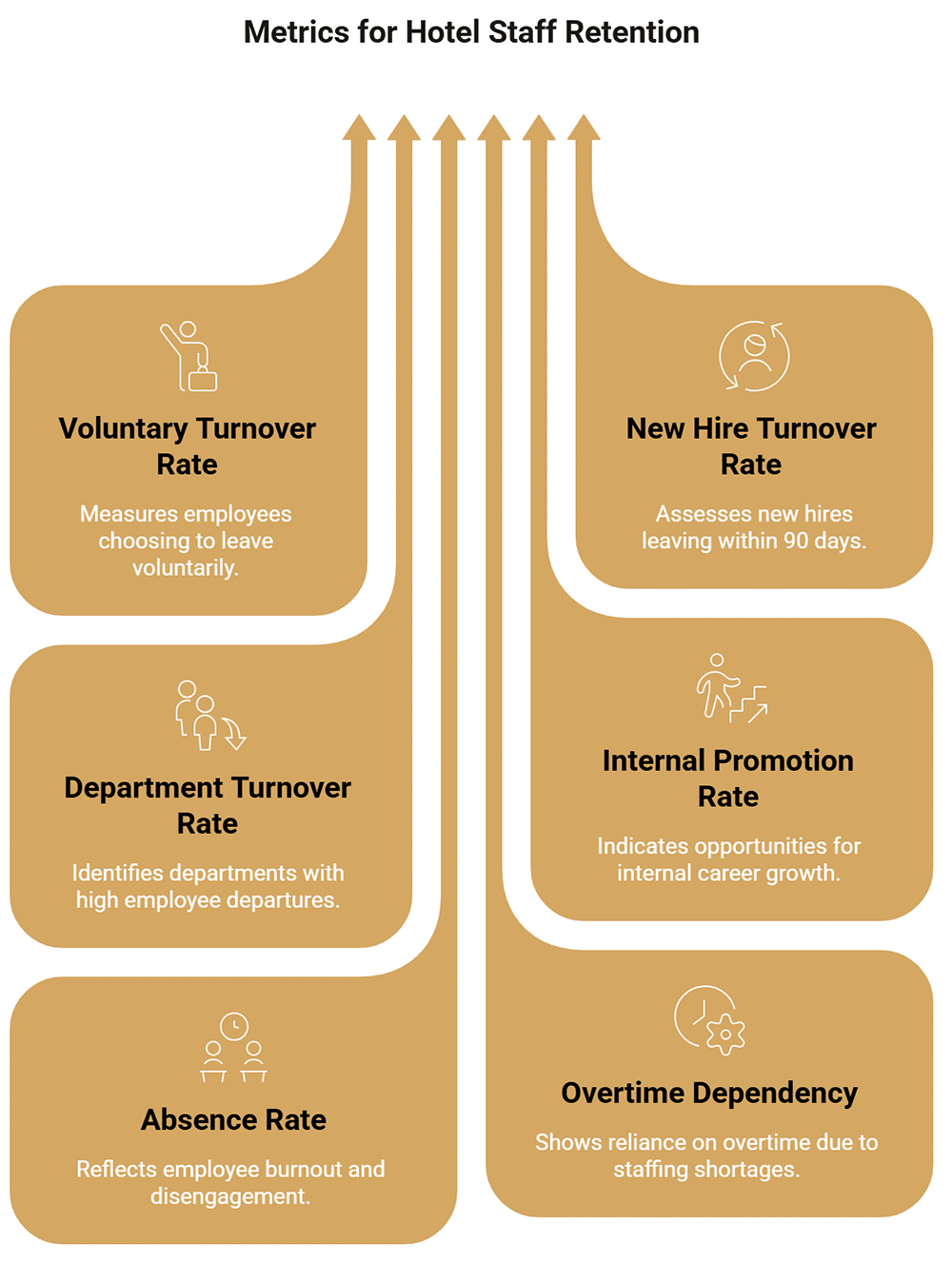
Hotels should track retention by department, role, tenure, and reason for leaving. Here is the best retention dashboard that is simple enough to update monthly and specific enough to inform decisions.
| Metric | Formula | What It Shows |
| Voluntary Turnover Rate | Voluntary departures / average headcount x 100 | How many employees choose to leave |
| New Hire Turnover Rate | New hires leaving within 90 days / total new hires x 100 | Whether hiring or onboarding is failing |
| Department Turnover Rate | Department departures/department average headcount x 100 | Where the problem is concentrated |
| Internal Promotion Rate | Internal promotions/total filled roles x 100 | Whether employees see a future |
| Absence Rate | Unscheduled absence days / scheduled workdays x 100 | Burnout, disengagement, or schedule strain |
| Overtime Dependency | Overtime hours / total hours worked x 100 | Whether vacancies are creating labor pressure |
You do not need to track everything with the same urgency. You can start with voluntary turnover, new hire turnover, and department turnover. Those three metrics tell you where employees are leaving, when they are leaving, and whether the problem is concentrated under a specific role or manager.
For example, if housekeeping has a high 90-day turnover, you can fix onboarding and room assignment rules first. If front office turnover rises after schedule changes, you can review rota fairness before increasing recruitment spend.
How Does Onboarding Affect Hotel Staff Retention?
The first 90 days determine whether a new hire becomes a long-term employee or another replacement cost. Most hotels under-invest in this window because the connection between a chaotic first month and a month-five resignation is rarely visible to the manager who ran both.
SHRM’s benchmarking data places the average time to fill an open position at approximately six to seven weeks. For a 100-room hotel with a lean front desk team, a new agent who leaves after 60 days creates two costs at once. The hotel loses the training time already invested and restarts the hiring cycle while existing employees cover the gap.
Structured onboarding means new employees know what good performance looks like before they are judged against it. Give every new hire written role expectations, a first-week checklist, a peer mentor, and manager check-ins at 30, 60, and 90 days.
Without that structure, new hires infer norms from whoever they shadow first, and onboarding becomes a gamble. The investment in structure is modest. The return in first-year retention is direct.
Video: How Great Hotel Onboarding Boosts Staff Retention | Past Lessons from Hospitality
How Can Independent Hotels Improve Staff Retention?
Independent hotels can improve staff retention without a large HR department by focusing on speed, clarity, and fairness.
A 70-room independent hotel may not offer the same benefits package as a global brand, but it can make decisions faster. It can publish schedules earlier, recognize strong employees personally, and promote cross-training without corporate approval.
The following three practical moves work for independent properties regardless of size:
- Schedule transparently and give staff input on shift preferences
- Hold monthly 10-minute stay interviews with your highest-value employees
- Build one visible advancement path per department and communicate it during onboarding
For example, a front desk agent could progress into reservations support, guest relations, revenue coordination, or shift supervision. A room attendant could progress into an inspector, linen control, supervisor, or housekeeping trainer.
This is where independent hotels can compete. You may not win every wage comparison, but you can create a workplace where employees feel seen, heard, and developed faster.
Video: 7 Proven Employee Retention Strategies to Implement
How Should Hotels Use Technology to Support Staff Retention?
Hotels should use technology to remove repetitive work, reduce frustration, and free employees for higher-value guest service. The wrong use of technology makes work feel colder and more stressful. The right use makes employees more effective.
The best retention-focused technology includes:
- Mobile housekeeping task lists with real-time room assignments
- Digital maintenance request and completion tracking
- Guest messaging tools that handle simple routine inquiries automatically
- Self-check-in for simple arrivals so the front desk focuses on meaningful interactions
- AI chatbots for repetitive questions
- Digital onboarding tools for consistent first-week training
- Staff scheduling apps with early publication and shift visibility
Technology can also hurt retention when it is poorly introduced. If a system adds extra logins, unclear workflows, or duplicate work, employees see it as another burden rather than support.
Before adopting any tool, ask one practical question: Does this reduce workload for the team using it? If the answer is unclear, test it with one department first and measure time saved, error reduction, and staff feedback before expanding it across the property.
For hotels exploring automation carefully, our article about “Artificial Intelligence (AI) in the Hotel Industry” shows how artificial intelligence can reduce repetitive tasks while helping staff focus on higher-value service
FAQs Related to Hotel Staff Retention
Hotel staff retention is a revenue and operations question before it’s an HR one. The properties that stabilize schedules, strengthen managers, structure onboarding, and create visible growth paths protect both employee commitment and guest service consistency. That investment is modest relative to what chronic turnover costs in labor expenses, review scores, and repeat bookings.
Did You Like This Article About Hotel Staff Retention?
You might also be interested in the following articles:
- Hotel Industry Challenges: A Guide for Hoteliers
- Hotel Automation: Benefits, Tools, and Trends
- How to Improve Hotel Profit Margin With Smart Strategies
More Tips to Grow Your Business
Revfine.com is the leading knowledge platform for the hospitality and travel industry. Professionals use our insights, strategies, and actionable tips to get inspired, optimize revenue, innovate processes, and improve customer experience.Explore expert advice on management, marketing, revenue management, operations, software, and technology in our dedicated Hotel, Hospitality, and Travel & Tourism categories.
This article is written by:

Hi, I am Martijn Barten, founder of Revfine.com. With 20 years of experience in the hospitality industry, I specialize in optimizing revenue by combining revenue management with marketing strategies. I have successfully developed, implemented, and managed revenue management and marketing strategies for individual properties and multi-property portfolios.





Leave A Comment