


Hotel generative engine optimization, or hotel GEO, is the practice of making a property’s information easy for AI search systems to retrieve, understand, verify, cite, and recommend. It has gained importance because hotel discovery is shifting from keyword results toward synthesized answers that compare properties, summarize evidence, and guide the next booking step.
Key Takeaways:
|
–
Table of Contents
- What Is Hotel Generative Engine Optimization?
- How Is Hotel GEO Different From Hotel SEO?
- Why Is Hotel GEO Becoming Important Now?
- The Hotel GEO Stack
- How Do AI Engines Decide Which Hotels to Cite?
- What Role Do Reviews and OTA Listings Play?
- Hotel GEO Platform Access Checklist
- What Should Independent Hotels Prioritize First?
- The Hotel GEO Measurement Scorecard
- What Are the Limits of Hotel GEO?
- FAQs About Hotel GEO
What Is Hotel Generative Engine Optimization?
Hotel generative engine optimization is the discipline of making your property retrievable, quotable, and trustworthy to the AI systems like ChatGPT, Perplexity, and Google AI Overviews that travelers now use to plan trips. Where SEO earns you a position on a results page, GEO earns you a mention inside a generated answer.
The acronym GEO collides with older industry shorthand. In hotel marketing, “geo” has long meant geographic targeting of source markets. GEO in this article means generative engine optimization, and that is how the term is now used across digital marketing.
The term was formalized by researchers from IIT Delhi, Princeton, Georgia Tech, and the Allen Institute for AI, whose paper on generative engines was presented at the KDD 2024 conference. Generative engines answer questions by retrieving sources, then converting them into a response with citations. Visibility means being one of the retrieved and cited sources.
Hotel GEO widens the playing field beyond your website. Your Google Business Profile, OTA listings, review corpus, and press mentions are all raw material an AI assistant can draw on when a traveler asks where to stay in your city. GEO is the work of making that entire footprint accurate, specific, and consistent enough to be used.
How Is Hotel GEO Different From Hotel SEO?
SEO and GEO share infrastructure but compete for different outcomes. SEO wins a ranked position and hopes for a click. GEO wins inclusion in an answer, where there may be no click at all.
The practical differences break down like this:
- Unit of competition: SEO ranks whole pages. Generative engines extract and cite individual passages, so a buried paragraph can outperform a strong page title.
- Query shape: SEO targets short keyword phrases. AI prompts are conversational and multi-constraint, such as “pet-friendly hotel in Ghent under 180 euros with parking”.
- Authority signal: SEO depends on links and domain strength. While generative engines lean on facts they can verify across several independent sources.
- Scope: SEO optimizes your site. Meanwhile, GEO optimizes your entire entity footprint, including pages you don’t own.
The economics behind this split are measurable. In a Pew Research Center analysis of real browsing data, users clicked a traditional result link on 8 percent of searches where an AI summary appeared, against 15 percent when no summary was shown. When the answer absorbs the click, being the cited source is the visibility that remains.
None of this makes SEO optional. Generative engines retrieve heavily from search indexes, so a page that can’t be crawled or ranked can’t be cited either. You should treat GEO as a layer on top of sound technical SEO.
Video: What Is GEO and Why It Is Important in 2026
Why Is Hotel GEO Becoming Important Now?
Because the surfaces generating these answers have reached mainstream scale, and hotel discovery is exactly the kind of task they handle well. A traveler describing dates, budget, neighborhood, and preferences in one sentence gets a shortlist of properties in return. That shortlist is the new first page.
The scale is no longer speculative. At Google I/O, CEO Sundar Pichai said:
AI Overviews now has over 2.5 billion monthly active users .
You should consider adding ChatGPT, Perplexity, and Google’s conversational AI Mode. Because a meaningful slice of your future guests are meeting hotel recommendations inside generated answers before they ever reach a booking site.
A hotel previously asked, “Do we rank for boutique hotel in Barcelona?” It must now ask, “Would an AI system include us when someone requests a quiet Barcelona hotel with balconies, allergy-friendly breakfast, and easy airport access?”
Those queries contain several requirements. Generative search can break them into related searches, gather property facts from different sources, and create a synthesized recommendation.
Hotel GEO brings those surfaces into one visibility discipline. It does not replace channel management, but it exposes the commercial cost of letting every channel describe the property differently.
The Hotel GEO Stack
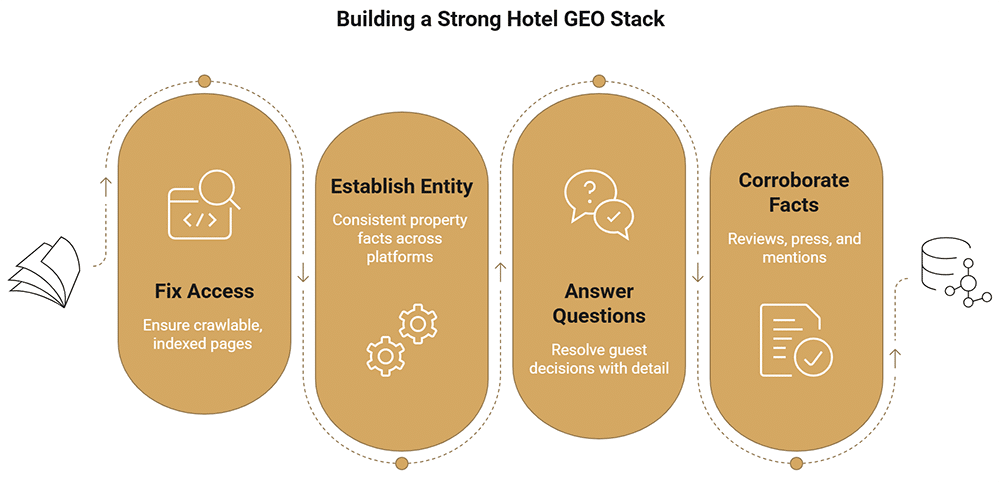
Hotel GEO turns into a scattered tactics list unless you sequence it. The Hotel GEO Stack organizes the work into five layers, ordered so each builds on the one below. Fix the access layer first: answer-shaped content built on inconsistent facts teaches AI systems the wrong things about your property.
Work the layers in order, and revisit layer two every quarter. Property facts drift: renovations, policy changes, and seasonal closures all create new mismatches. A hotel becomes more citable when all five support the same property identity.
How Do AI Engines Decide Which Hotels to Cite?
AI engines do not publish complete citation formulas, but current research offers enough evidence to guide hotel content decisions. Generative assistants combine knowledge learned during training with information retrieved from the live web. For platforms such as Perplexity, Google AI Overviews, and ChatGPT Search, retrieval determines which sources the system can evaluate.
Within that retrieved set, content must be relevant, clear, and easy to extract. Specific statements about room types, amenities, policies, prices, and location are more useful than broad marketing claims. Consistency across your website, Google Business Profile, and online travel agency listings can reduce uncertainty when systems encounter conflicting property information.
The KDD GEO study found that citations, credible quotations, and statistics increased source visibility by up to 40% in controlled generative-engine tests, while keyword repetition delivered limited value.
The practical lesson is clear. Relevance matters more than cosmetic formatting. Answer real guest questions precisely. When an OTA page explains your property better than your own website, the intermediary may earn the citation instead.
The same readability problem shows up on the agent side of hotel marketing. “AI agents for hotel marketing” covers how guest-facing assistants build shortlists, and why they can’t recommend what they can’t confidently read.

Tamie Matthews, Revenue, Sales & Marketing Consultant, RevenYou“The big question today is not whether AI will influence the traveller’s purchase decision — it already is. The question is how we are going to control what that AI says about our product, and how a transaction will be closed within that environment. And being honest, we don’t know that yet. There is a lot of talk about MCP, GEO, new distribution frameworks — but today there is no clear mechanism for a hotel to manage its product inside an AI conversation the same way it manages its listing on an OTA. We are in a transition moment where the rules are still being written. What is happening right now is that the inspirational part of the journey already lives inside AI. The traveler asks, gets an answer, and increasingly takes it as valid without questioning it. That is the real behavior we are seeing. And this is where the positive side comes in for those of us in revenue management: this is going to push us to work better. If the guest can easily find out when the best moment to buy is — and AI is going to tell them — an inconsistent pricing strategy becomes completely exposed. The hotels that win will be the ones with a coherent, well-built and defensible strategy.” Click here to learn more from our Hotel Revenue Management Expert Panel. |
What Role Do Reviews and OTA Listings Play in Hotel GEO?
Reviews are third-party prose about your property written at scale, and OTA listings are structured, high-authority pages that retrieval systems already trust. When an assistant checks whether your “quiet rooms” claim holds, the review corpus is where it looks.
OpenAI has introduced ChatGPT apps from companies including Booking.com and Expedia, showing that hotel inventory can be accessed through specific connected experiences. This does not mean every general ChatGPT answer automatically retrieves those listings.
Two practical consequences follow. First, maintain OTA listings with the same factual rigor as your website, because thin or outdated OTA content now misinforms AI answers about you. Second, treat review responses as publishable, indexed text you control. A reply that corrects “no parking” with “we added 12 covered spaces in March 2026” places a dated, citable fact into the public record.
There’s a tension here worth naming. Leaning on OTA visibility inside AI answers deepens the dependence your direct booking strategy exists to reduce. The countermove isn’t abandoning OTA optimization. It involves making your own site the most complete and specific source about your property, so assistants have a reason to cite you alongside the intermediary.
Hotel GEO Platform Access Checklist
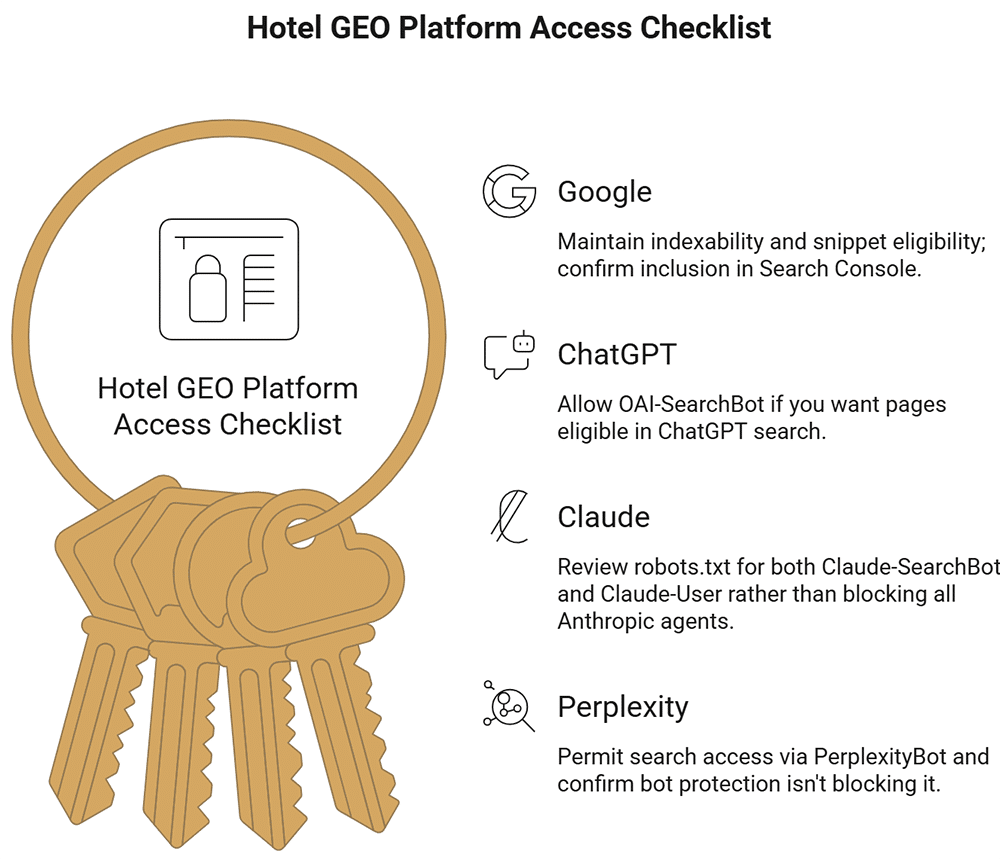
Platforms use separate crawlers for search retrieval and for model training, so blocking training access does not require blocking search visibility. Hotels that blanket-block AI user agents often remove themselves from AI answers without intending to.
Your web application firewall can quietly undo all of this. A crawler allowed in robots.txt can still be stopped by bot protection, geographic rules, cookie walls, or JavaScript challenges.
Test your key URLs as an unauthenticated visitor. Confirm the property name, core facts, headings, and internal links load without accepting cookies, submitting a form, or running a booking search.
What Should Independent Hotels Prioritize First?
An independent hotel does not need an enterprise content team or a separate GEO platform. It needs accurate property data, several strong decision pages, technical access, and a repeatable measurement routine.
Consider a 45-room independent hotel near Utrecht Centraal. Its first GEO project should not be 30 AI-written destination articles. It should correct every conflict across its website, Business Profile, booking engine, and leading OTA listings, then improve pages covering family rooms, parking, rail access, bicycles, and late arrivals.
Expedia Group’s AI Trust Gap report, based on a YouGov survey of more than 5,700 adults across the U.S., U.K., and India in March 2026, found 68 percent prefer booking with a trusted travel brand over AI chatbots and agents even when AI booking is available. GEO should therefore improve discovery while leading travelers toward a trustworthy website and booking experience, not attempt to keep the entire transaction inside an AI answer.
As Xavi Amatriain, Chief AI and Data Officer at Expedia Group, said in the company’s AI Trust Gap report,
“Travelers don’t have a technology problem with AI. They have a trust problem.”
For a property without a dedicated commercial team, assign the process to one accountable owner. Marketing can coordinate it, but operations must verify the facts and revenue management must confirm price-related statements.
Video: AI Terms for Independent Hoteliers: GEO (Generative Engine Optimization)
The Hotel GEO Measurement Scorecard
Two of the four major surfaces now report citations directly, which is a recent change and the first thing to check. Bing Webmaster Tools launched AI Performance in public preview in February 2026. They reported total citations, average cited pages, the grounding queries behind them, page-level citation counts, and visibility trends across Copilot and AI-generated summaries in Bing. Use those before paying for a third-party visibility tool.
Organic visibility also needs to come before paid placement in the same channel. Our guide to “ChatGPT hotel ads explained” covers the emerging auction and why a paid click on a property the model can’t corroborate works against you organically.
Where Do You Still Need to Sample?
ChatGPT, Perplexity, and Gemini provide no equivalent reporting, so measure them by sampling. AI Appearance Rate (AAR) is the metric that makes the sampling disciplined.
AAR (AI Appearance Rate): The share of test prompts in which your property appears in an AI assistant’s answer.
Formula: AAR = prompts where your property appears / total prompts run x 100.
How Do You Build a Prompt Panel?
Write 20 prompts that mirror real demand for your market and keep them fixed month to month. A workable split: five generic discovery prompts (“best boutique hotel in Ghent”), ten constraint-based prompts matching your segments (“family hotel in Ghent with parking under 180 euros”), and five branded prompts (“is [property name] good for business travelers”).
Run the panel across at least three assistants, and record accuracy and sentiment alongside presence, because a wrong description is its own problem.
Generated answers vary between runs, so treat AAR as a sampled trend and judge movement over a quarter rather than reacting to a single month.
Which Secondary Signals Confirm Progress?
Pair AAR with signals from your own analytics such as referral sessions from domains like chatgpt.com and perplexity.ai, branded search lift, and direct traffic growth. The referral line is worth watching closely because it is compounding fast. Do not treat citations as revenue. A citation builds awareness that may never produce a session, and a referral often signals research rather than intent to book.
What Are the Limits of Hotel GEO?
Hotel GEO cannot guarantee recommendations, control how an AI system summarizes a source, or prove that every citation will generate revenue. The strongest objection is valid. AI results remain variable, platform reporting is incomplete, and the evidence base is still developing.
A survey covering 45 GEO studies argued that current evidence does not establish a stable, longitudinal, cross-platform causal effect on organic discoverability or downstream behavior. The authors concluded that evidence is stronger for changing how already-retrieved content is used than for guaranteeing that the content will be retrieved in the first place.
That distinction should shape your expectations.
Hotel GEO cannot:
- Replace technical SEO and website indexability
- Correct weak reputation or poor guest experiences
- Overcome uncompetitive pricing for price-sensitive queries
- Guarantee inclusion across repeated prompts
- Force AI systems to use your preferred wording
- Repair inconsistent third-party information automatically
- Turn generic AI-generated articles into defensible expertise
Google explicitly warns against treating GEO as a collection of special hacks. Its guidance says websites do not need special AI markup or an llms.txt file for Google Search, and there is no requirement to divide content into artificially small chunks for AI systems.
The right position is disciplined rather than dismissive. GEO still matters, but its strongest current use is improving access, clarity, evidence, consistency, and measurement around hotel information.
FAQs About Hotel GEO
Hotel Generative engine optimization determines whether AI assistants describe your hotel accurately, recommend it confidently, or skip it entirely. Treat it as an extension of commercial fundamentals you already manage: verifiable facts, distinctive content, and a reputation footprint that says the same thing everywhere. Then hold it to the same standard as any channel and measure it monthly.
Did You Like This Article About Hotel Generative Engine Optimization?
You might also be interested in the following articles:
- PMS Integration Strategies to Streamline Hotel Management
- How Hotel Competitor Analysis Can Improve Your Market Position
- How to Improve Hotel Profit Margin With Smart Strategies
More Tips to Grow Your Business
Revfine.com is the leading knowledge platform for the hospitality and travel industry. Professionals use our insights, strategies, and actionable tips to get inspired, optimize revenue, innovate processes, and improve customer experience.Explore expert advice on management, marketing, revenue management, operations, software, and technology in our dedicated Hotel, Hospitality, and Travel & Tourism categories.
This article is written by:

Hi, I am Martijn Barten, founder of Revfine.com. With 20 years of experience in the hospitality industry, I specialize in optimizing revenue by combining revenue management with marketing strategies. I have successfully developed, implemented, and managed revenue management and marketing strategies for individual properties and multi-property portfolios.


Leave A Comment