

Employee Net Promoter Score (eNPS) is a workforce metric that measures how willing employees are to recommend your hotel as a place to work. It gives hotel managers a fast signal of employee sentiment, but the score becomes useful only when you connect it to departmental feedback, retention, and management action.
Key Takeaways:
|
Table of Contents:
What Does Employee Net Promoter Score (eNPS) Actually Measure?
Employee Net Promoter Score is a simple measure of employee advocacy. You ask employees one question, “How likely are you to recommend this hotel as a place to work?”, scored zero to ten, and the answer tells you whether an employee would attach their own name to your property.
For hotels, eNPS can act as an early warning sign. The U.S. Bureau of Labor Statistics reported a 4.5 percent quits rate for accommodation and food services in June 2026, compared with 2.0 percent across the overall workforce. This makes employee retention especially relevant for hospitality businesses.
Bain & Company, which developed the Net Promoter System, says the recommendation question can be useful for understanding employee retention, although it describes employee scoring as an emerging science.
NPS (Net Promoter Score, sometimes called the recommendation score): The guest-facing original that eNPS borrows from, measuring willingness to recommend your hotel to a friend or colleague.
Formula: NPS = % Promoters (9 to 10) – % Detractors (0 to 6).
The score should not be treated as a complete measure of engagement. Instead, use it to identify teams where employees may be unhappy, then investigate the reasons through comments, conversations, turnover data, and other workforce metrics.

Heiko Rieder, Senior Vice President Commercial & Distribution, Step Partners Europe GmbH“Generally, metrics from other industries should be evaluated in terms of their convenience. Useful examples of satisfaction metrics are Net Promoter Score (NPS) or customer satisfaction index (CSI), as they could help hotels gauge guest experiences and tailor services accordingly, ultimately impacting revenue. Perhaps a bit traditional, but still meaningful, is the conversion rate, which in many aspects is often undervalued. Take the value of the room upgrade sold by a front desk clerk at check-in. To understand the full profit of the upsell, the cost of software, guest amenities, staff incentives, and manpower efforts have been taken into account. Sometimes the net value vanishes after all such considerations. Overall, while directly transplanting metrics from other industries may not always be feasible or appropriate, adapting relevant concepts can certainly enhance hotel revenue management strategies.” Click here to learn more from our Hotel Revenue Management Expert Panel. |
How Do You Calculate eNPS?
Calculate eNPS by subtracting the percentage of detractors from the percentage of promoters. Sort every response into three groups, then subtract. Promoters score 9 or 10, passives score 7 or 8, and detractors score anything from 0 to 6.
The formula is:
eNPS = % Promoters – % Detractors
Passives are left out of the subtraction but stay in the denominator, which is why a property full of lukewarm 7s lands near zero rather than looking positive.
Consider a 90-room independent hotel in Porto with 40 employees. Thirty-two respond: 12 promoters (37.5 percent), 12 passives, and 8 detractors (25 percent). The eNPS is 37.5 minus 25, or roughly +13.
Record two things besides that number every time: the participation rate (32 of 40, so 80 percent) and the date. A score without a participation rate isn’t a measurement.
Participation Rate: The share of invited employees who completed the survey.
Formula: Responses received / employees invited x 100.
In the example above, 32 / 40 x 100 = 80 percent.
Video: What is eNPS? Boost Employee Engagement with eNPS
What Is a Good eNPS Score for a Hotel?
A good eNPS score is not simply a high number. What matters more is whether the score improves over time and matches other workforce signals such as employee turnover, absence, overtime, and staff feedback.
There is no single eNPS benchmark that proves a hotel has a healthy workplace. Results can vary depending on property type, location, labor market, survey method, and employee mix.
For example, a resort with an eNPS of +25 may appear stronger than an airport hotel scoring +10. But if the resort dropped from +45 while the airport hotel improved from -20, the airport property is showing the healthier trend.
eNPS should not be confused with employee engagement. Gallup defines engagement more broadly as employees’ involvement and enthusiasm in their work and workplace.
When reviewing eNPS, compare:
- Your previous survey rounds.
- Individual departments and locations.
- Voluntary turnover.
- Absence and overtime patterns.
- Recurring themes in anonymous employee comments.
- Results after a specific management intervention.
Your own eNPS trend is usually more useful than comparing your hotel with a general industry benchmark.
Where eNPS Works Best and Where It Falls Short
The strongest objection to eNPS is that compressing a complex working life into one number produces something too crude to act on, and that criticism is fair. Survey methodologists remain divided on whether the promoter and detractor split adds anything beyond a simple average.
Gallup’s 2026 State of the Global Workplace report, which uses a twelve-item instrument rather than a single question, put global employee engagement at 20 percent in 2025, its lowest level since 2020. A one-question score can’t reproduce that diagnostic depth and shouldn’t pretend to.
| Where It Works Best | Where It Falls Short |
| Tracking direction month over month in the same team | Explaining why a score moved |
| Comparing housekeeping against front office against F&B | Producing a defensible external benchmark |
| Testing whether a specific change (new rota, new supervisor) landed | Teams under five people, where anonymity collapses |
| Giving owners a people metric that fits on one line of a P&L pack | Replacing stay interviews or a full engagement survey |
For example, if housekeeping eNPS falls while overtime and voluntary turnover increase, management has a clear reason to investigate scheduling, workload, supervision, or working conditions.
Your hotel labor cost management process can help connect these employee signals with recruitment, training, vacancy, and overtime costs. Within the broader hotel management process, eNPS should therefore sit beside operational and financial measures rather than replace them.
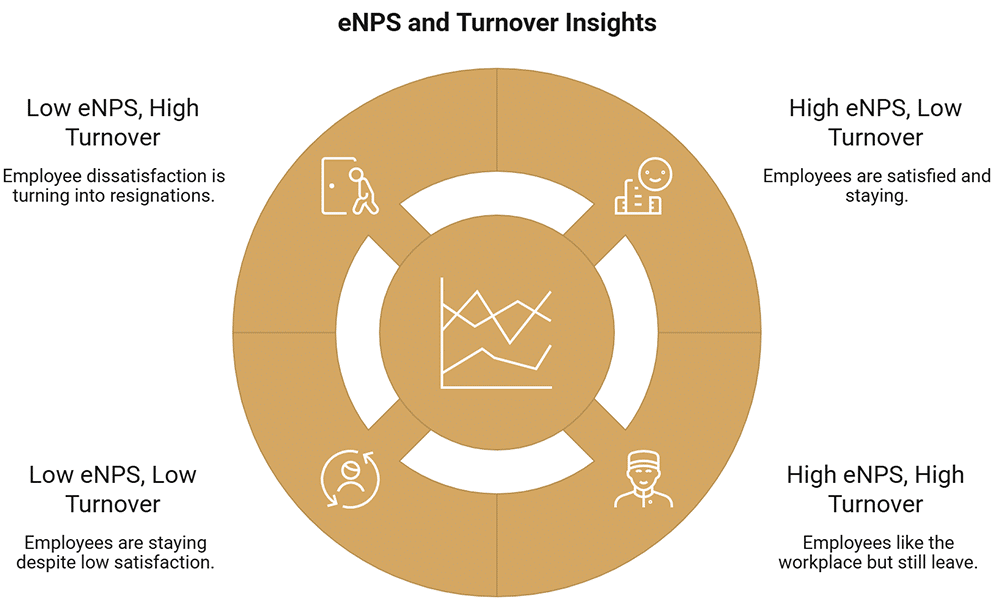
The eNPS Signal Grid
An eNPS score by itself tells you very little. It becomes much more useful when you compare it with voluntary employee turnover in the same department and during the same period.
Voluntary Turnover Rate: The share of employees who chose to leave over a period, as opposed to those you let go.
Formula: Voluntary departures / average headcount x 100.
This matters because staffing remains a challenge for hotels. AHLA’s February 2026 Front Desk Feedback survey of 246 hoteliers found that more than half of properties were somewhat or severely understaffed. When teams are already short-staffed, identifying which departments are at risk becomes even more important.
| Signal | What It May Mean | What to Review First |
| High eNPS, low turnover | Employees are satisfied and staying | Protect what works and identify successful management practices |
| High eNPS, high turnover | Employees like the workplace but still leave | Review pay, career development, and promotion opportunities |
| Low eNPS, low turnover | Employees are staying despite low satisfaction | Review working conditions, scheduling, workload, and management |
| Low eNPS, high turnover | Employee dissatisfaction is turning into resignations | Prioritize onboarding, workload, scheduling, and supervisor relationships |
The third situation is easy to overlook. Low turnover does not always mean employees are happy. They may simply have limited alternatives in the local labor market.
If a new hotel opens nearby with better pay or schedules, those employees may leave quickly. That is why eNPS should be reviewed alongside turnover rather than separately.
Your hotel labor cost management process can then help connect these workforce signals to recruitment, payroll, overtime, and training costs.
How Should Independent Hotels Run eNPS Without an HR Team?
Independent hotels do not need expensive HR software to run eNPS. A 60-room hotel with 25 employees can manage the process with a simple anonymous survey, one standard eNPS question, and a regular survey schedule.
Three rules make the process more reliable:
- Do not let supervisors collect responses from their own teams.
- Only report department results when at least five employees respond, helping protect anonymity.
- Before launching the next survey, tell employees what changed because of the previous feedback.
The last point matters most. If employees repeatedly give feedback but never see any action, they may stop taking the survey seriously.
For example, if staff repeatedly mention unfair weekend scheduling, management should explain what was changed before asking for another round of feedback.
Independent hotels can often act faster because there are fewer approval layers. eNPS can therefore become a practical management tool rather than just another HR report.
Pair the results with your hospitality staffing process so you can track employee experience from recruitment through retention.
FAQs About Employee Net Promoter Score (eNPS)
Employee Net Promoter Score gives hotels a fast, repeatable read on whether their teams would vouch for the workplace, expressed as one number you can trend. Its value comes from segmentation and follow-through rather than the score itself. Run it by department, read it beside turnover, and act visibly on what it surfaces.
Did You Like This Article About Employee Net Promoter Score (eNPS)?
You might also be interested in the following articles:
- The Most Used Revenue Management KPIs for Hotels
- What Is RevPAM in Hotels and How Do You Calculate It
- What Is Average Length of Stay (ALOS) in Hotels?
More Tips to Grow Your Business
Revfine.com is the leading knowledge platform for the hospitality and travel industry. Professionals use our insights, strategies, and actionable tips to get inspired, optimize revenue, innovate processes, and improve customer experience.Explore expert advice on management, marketing, revenue management, operations, software, and technology in our dedicated Hotel, Hospitality, and Travel & Tourism categories.
This article is written by:

Hi, I am Martijn Barten, founder of Revfine.com. With 20 years of experience in the hospitality industry, I specialize in optimizing revenue by combining revenue management with marketing strategies. I have successfully developed, implemented, and managed revenue management and marketing strategies for individual properties and multi-property portfolios.




Leave A Comment