

Hotel labor cost management is the discipline of controlling payroll, the largest expense on a hotel P&L, by matching staffing hours to demand, raising productivity, and reducing turnover. It has become important now because wages keep climbing while rate growth has flattened, so every unmanaged labor hour comes directly out of gross operating profit.
Key Takeaways:
|
–
Table of Contents
- What Is Hotel Labor Cost Management?
- Why Is Hotel Labor Cost Management a Profit Issue?
- Which Hotel Labor Cost Metrics Should You Track Weekly?
- Labor Cost Formulas Every Hotel Manager Should Know
- The Four Levers of Hotel Labor Cost Control
- How Do You Set Hotel Labor Productivity Standards?
- How Does Forecast-Driven Scheduling Reduce Hotel Labor Cost?
- How Does Cross-Training Reduce Labor Cost Without Damaging Service?
- How Does Turnover Increase Hotel Labor Cost?
- What Does Labor Cost Management Mean for Independent Hotels?
- FAQs About Hotel Labor Cost Management
What Is Hotel Labor Cost Management?
Hotel labor cost management is the practice of controlling total payroll spend, wages, benefits, payroll taxes, contract labor, and overtime, so that staffing costs track business volume instead of running as a fixed expense.
Fixed labor includes the minimum leadership, front desk, maintenance, and management coverage that is needed to operate safely. Flexible labor includes housekeeping, food and beverage, banquets, valet, and other hours that should move with arrivals, departures, covers, group activity, and service levels.
According to HVS, labor accounts for 30 to 45 percent of a hotel’s total operating costs, which makes it the single largest line you can influence week to week.
The better definition has three parts. You match scheduled hours to forecasted demand, you raise output per hour through standards and cross-training, and you reduce the hidden payroll cost of replacing people.
Consider a 120-room independent hotel that holds headcount flat but moves housekeeping from fixed eight-hour shifts to checkout-driven scheduling. The hotel will usually find more margin than one that eliminates two positions and keeps the same shift grid.
Because labor is the largest line feeding your bottom line, it pays to see how the rest stack up. Our guide on “How to Improve Your Hotel Profit Margin” breaks down exactly which operating costs erode profit and which levers recover it.
Why Is Hotel Labor Cost Management a Profit Issue?
Hotel labor cost management is a profit issue because labor costs can rise even when demand looks healthy. HVS reports that total compensation in the Accommodation and Food Service industry increased 26.5 percent between 2020 and 2024, based on Bureau of Labor Statistics data.
That changes the role of the general manager. You cannot rely on Average Daily Rate growth to hide labor inefficiency when rate growth moderates. The schedule becomes a commercial document, not an administrative file.
As Sarah McCay Tams, Head of Research and Editorial at Actabl, said in Hotel Management,
“labor planning is no longer just about controlling costs; it’s about precision.”
Precision means the labor model answers three questions every week:
- How much demand is on the books?
- How many hours should that demand require?
- Where did actual hours exceed the standard?
An 110-room select-service hotel running 82 percent occupancy on a sports weekend needs different staffing from the same hotel running 82 percent occupancy with a quiet corporate stayover pattern. Occupancy alone is not enough. Departures, arrivals, breakfast covers, late check-ins, event compression, and room type mix all change the labor needs.
Which Hotel Labor Cost Metrics Should You Track Weekly?
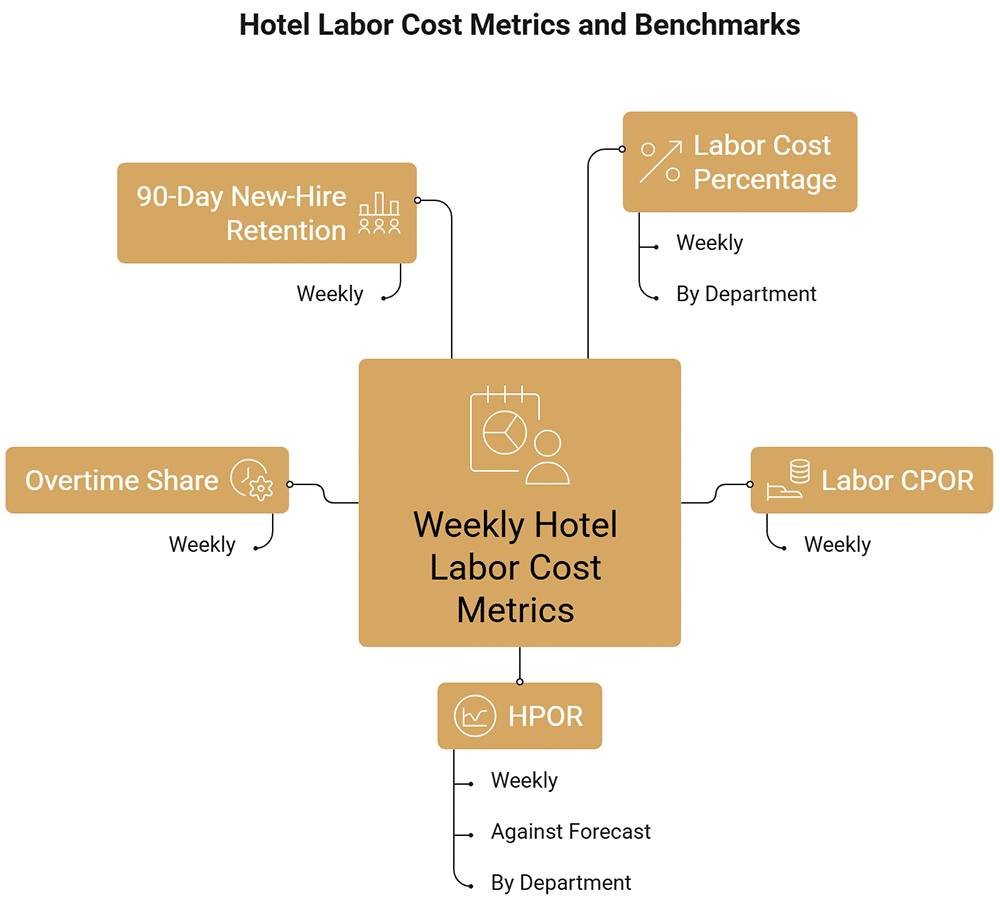
You should track labor cost percentage, labor CPOR, HPOR, overtime share, and 90-day new-hire retention every week. The monthly P&L is too late for labor management because the hours have already been worked.
HotelData.com’s Q1 Labor Costs Report found that labor CPOR increased from $45.96 in Q1 2025 to $46.79 in Q1 2026, while HPOR declined from 2.154 to 2.105 hours across all hotels in its data set.
Hoteliers can learn a lesson from this combination. Labor cost per room can rise while labor productivity improves. If you look only at CPOR, you may blame the schedule when wage pressure is the real driver. If you look only at HPOR, you may miss the cost impact of overtime, benefits, and agency labor.
| Metric | What does it tell you | Review cadence |
| Labor cost percentage | Whether payroll is growing faster than revenue | Weekly, by department |
| Labor CPOR | What each sold room costs you in labor | Weekly |
| HPOR | Whether effort tracks volume, independent of wage rates | Weekly, against forecast |
| Overtime hours as a share of total hours | Whether schedules and staffing levels are realistic | Weekly |
| GOPPAR | Whether labor decisions are protecting profit | Monthly |
So, the best first metric is HPOR because it strips out wage inflation and shows whether labor effort is tracking volume. Review it by department. A total hotel HPOR number can hide a housekeeping issue behind a front desk improvement.
These labor metrics sit inside a wider performance picture. Our rundown of the most used revenue management KPIs for hotels shows how RevPAR, GOPPAR, and the rest fit together so you can read your labor numbers against the metrics owners actually judge you on.
Labor Cost Formulas Every Hotel Manager Should Know
Use these formulas before judging whether labor cost is a wage problem, a scheduling problem, or a productivity problem. Together, they show how payroll connects to occupied rooms, worked hours, and gross operating profit.
Labor Cost Percentage
Measures payroll burden against revenue.
Formula: Labor Cost % = Total payroll and labor-related expenses / Total revenue x 100.Labor CPOR, or Labor Cost Per Occupied Room
Measures what each sold room costs in labor.
Formula: Labor CPOR = Total labor cost / Occupied room nights.HPOR, or Hours Per Occupied Room
Measures staffing effort against occupied room volume, independent of wage rates.
Formula: HPOR = Total labor hours worked / Occupied room nights.GOPPAR, or Gross Operating Profit Per Available Room
Measures operating profit after expenses across available room supply.
Formula: GOPPAR = Gross operating profit / Available room nights.
The Four Levers of Hotel Labor Cost Control
There are only four ways to move labor costs without degrading the product, and every credible tactic maps to one of them. Revfine calls this the Four Levers of Hotel Labor Cost Control.
| Lever | What it fixes | Metric to track |
| 1. Forecast-driven scheduling | Hours that don’t move with demand | HPOR vs. occupancy, scheduled vs. actual hours |
| 2. Cross-trained flexibility | Fixed roles trapped in departmental silos | Share of staff certified in two or more roles |
| 3. Productivity standards | Effort disconnected from output | Minutes per room, covers per server hour |
| 4. Retention economics | Turnover-driven recruiting, training, and overtime costs | 90-day new-hire retention rate |
The levers compound. Forecast-driven scheduling only works if cross-trained staff can absorb the variability, and productivity standards only hold if you keep the people you trained to meet them.
Here’s the strongest objection to this model, and it deserves a straight answer. Flexing hours to demand pushes income volatility onto employees, and in a tight labor market, that raises turnover, which destroys the savings through lever four.
The objection is valid where flexing means cutting posted schedules at short notice. It is why levers two and four exist. Cross-training lets you redeploy hours and schedule stability commitments (such as locking schedules seven days out) to keep flexibility from becoming churn.
If you pull lever one without levers two and four, expect the model to fail. Pull all four, and the trade-off largely disappears.
How Do You Set Hotel Labor Productivity Standards?
Productivity standards turn “work hard” into a number: how many minutes a task should take and how many units one paid hour should produce. Without them, scheduling is guesswork because HPOR and labor CPOR have nothing reliable to measure against.
Housekeeping is usually the first department to standardize because it carries heavy variable labor. The Canadian Center for Occupational Health and Safety says a housekeeper typically needs 15 to 30 minutes to clean one room and uses 25 minutes as an average cleaning-time assumption in its ergonomic exposure example.
Do not import that number blindly. Set your own standard by timing a representative week, separating checkout cleans from stayover refreshes and standard rooms from suites. Then calculate the labor budget: forecasted rooms multiplied by minutes per room, divided by 60.
Extend the same logic beyond rooms. Track covers per server hour in F&B, check-ins per front desk agent hour during arrival peaks, and tickets closed per maintenance hour.
A standard that is too loose wastes payroll. A standard that is too tight shows up as inspection failures, complaints, and turnover.
How Does Forecast-Driven Scheduling Reduce Hotel Labor Costs?
Forecast-driven scheduling cuts labor costs by building each week’s schedule from a demand forecast and department standards rather than from last week’s shift grid. The gap between those two methods is where overstaffed Tuesdays and overtime-heavy Saturdays live.
HVS notes that scheduling software now predicts staffing needs from historical and real-time data, with AI tools modeling labor demand against factors like weather, local events, and traffic patterns. You don’t need that level of sophistication to start. You need a repeatable weekly process.
You can start with the 14-day PMS forecast. Add arrivals, departures, stayovers, groups, events, breakfast covers, banquet activity, and maintenance work. Then convert the demand into an hours budget by department.
Consider a 95-room airport hotel in Atlanta where Monday has 78 percent occupancy but only 18 departures because crew accounts are staying through. Friday has 78 percent occupancy and 61 departures because weekend guests are turning over. The same occupancy needs a different housekeeping schedule.
You can measure scheduled hours against actual hours. If the gap narrows, the forecast is working. If it stays wide, fix your standards, demand inputs, or overtime approvals.

Mariska van Heemskerk, Owner, Revenue Management Works“100% yes! In the end, it’s the bottom line result that counts, and by knowing the cost structures of your locations you can determine the best way to sell. For example, is there a tipping point with regard to occupancy? At what number of rooms sold do you need more housekeeping staff, more reception staff, etc.? How much capacity can your restaurant handle for breakfast to maintain service/quality but also how many guests are needed to at least break even on the breakfast buffet costs? It is important to know such things so you make decisions regarding price vs. volume. By having commercial meetings with your teams, involving them in the forecast, and delivering operational forecasts, you can decide together on the best strategy and they can ensure proper scheduling and no under / overstaffing at certain points.” Click here to learn more from our Hotel Revenue Management Expert Panel. |
How Does Cross-Training Reduce Labor Costs Without Hurting Service?
Cross-training reduces labor costs by allowing one paid hour to support more than one demand pattern. HVS describes cross-training as a way to give managers a wider in-house talent pool while giving staff transferable skills across departments.
Hotels can fix it by creating role pairings. The weak practice is vague multi-skilling. Telling staff to “help where needed” creates confusion, resentment, and uneven service. The replacement is a certified second-role capability.
A breakfast attendant can support laundry after breakfast closes. A front desk agent can cover lobby pantry service during quiet evening periods. A night auditor can handle daily revenue reconciliation when guest volume is low. A houseperson can support the banquet reset after an event.
Moreover, pay recognition matters. Cross-training fails when management asks employees to carry more responsibility for the same reward. It works when second-role certification comes with a visible wage premium, more stable hours, or a path to supervisor responsibility.
Track the share of shifts covered without overtime or agency labor. If a housekeeping call-out no longer triggers a premium-rate agency request, cross-training creates real flexibility.
How Does Employee Turnover Inflate Hotel Labor Costs?
There can be many possible reasons. Every departure triggers recruiting spend, weeks of below-standard productivity during training, and overtime or agency premiums while the position sits vacant. None of that appears as a line called “turnover” on your P&L, which is why it gets ignored. An AHLA survey conducted with Hireology found that 65 percent of surveyed hotels reported staffing shortages, with housekeeping the hardest role to fill.
As AHLA President and CEO Rosanna Maietta put it in the same release,
“hotel employment is still nearly 10% below pre-pandemic staffing levels.”
In such a tight market, every avoidable departure costs you twice, once in replacement cost and again in the wage premium needed to attract the replacement.
You can put a number in the following formula for your own property.
Replacement cost per departure = recruiting spend + interview time + training hours + trainer wages + trainee wages + vacancy overtime + agency premium
For one room attendant, a realistic internal estimate can reach $1,900 when job advertising, manager time, training, overtime, and agency coverage are counted.
The number to manage is 90-day new-hire retention. Departures inside 90 days usually point to a fixable property-level issue, such as poor onboarding, unstable schedules, unclear room standards, weak supervisor support, or unrealistic job previews.
A retention bonus may look like an added labor cost. If it prevents repeated replacement costs in a hard-to-fill role, it can be the cheaper decision.
What Does Labor Cost Management Mean for Independent Hotels?
For an independent hotel, labor cost management can’t depend on a corporate labor management system, a cluster analyst, or a brand productivity dashboard, because none of those exist at your property. The discipline has to be owned by the general manager and run on tools you already have.
The following example is hypothetical, but it shows the math.
Consider a 90-room independent hotel in Porto running at 72 percent occupancy. Before changing the schedule, the hotel records 454 occupied room nights, 410 housekeeping labor hours, 0.90 housekeeping HPOR, 22 overtime hours, and $7,790 in weekly housekeeping labor cost. Its cleanliness score is 8.4 out of 10.
The GM finds the problem in the 13-week review. Low-departure days are overstaffed, while checkout-heavy days create overtime. The hotel is not understaffed overall. It is staffed at the wrong times.
After shifting labor to departure-heavy days, using two breakfast attendants for laundry support, and approving overtime before it is worked, housekeeping hours fall to 368. HPOR improves to 0.81, overtime drops to 4 hours, weekly labor cost falls to $6,624, and cleanliness rises slightly to 8.5.
That is labor management. You changed when work happened, not the service promise.
The same weekly discipline that protects your labor line protects your top line too. Our “hotel revenue management guide“ shows how independent properties can run pricing and forecasting with the same hands-on rhythm, no enterprise stack required.
FAQs About Hotel Labor Cost Management
Managing hotel labor costs means running payroll with the same discipline you apply to pricing. It includes forecasting demand, setting standards, measuring weekly, and keeping the people you’ve trained. Treat the schedule as a commercial document rather than an administrative one, and labor stops being the line that quietly absorbs your rate growth.
Did You Like This Article About Hotel Labor Cost Management?
You might also be interested in the following articles:
- Hotel Automation: Benefits, Tools, and Trends
- Hotel Room Cleaning Strategies for Better Hotel Performance
- What Does GOPPAR Stand for?
More Tips to Grow Your Business
Revfine.com is the leading knowledge platform for the hospitality and travel industry. Professionals use our insights, strategies, and actionable tips to get inspired, optimize revenue, innovate processes, and improve customer experience.Explore expert advice on management, marketing, revenue management, operations, software, and technology in our dedicated Hotel, Hospitality, and Travel & Tourism categories.
This article is written by:

Hi, I am Martijn Barten, founder of Revfine.com. With 20 years of experience in the hospitality industry, I specialize in optimizing revenue by combining revenue management with marketing strategies. I have successfully developed, implemented, and managed revenue management and marketing strategies for individual properties and multi-property portfolios.





Leave A Comment