


Hotel sustainability is the practice of reducing a property’s environmental impact across energy, water, waste, sourcing, and verified operating standards. It is becoming a profit strategy because its most reliable returns now appear in operating costs first, while revenue premiums apply mainly to upper-midscale, upscale, and luxury hotels.
Key Takeaways:
|
–
Table of Contents
- Why Is Hotel Sustainability Becoming a Profit Strategy, Not a PR Exercise?
- Where Does Sustainability Actually Save Hotels Money?
- Does Sustainability Earn Hotels a Rate Premium?
- The Revfine Three-Line Sustainability Profit Test
- How Should Hotels Measure Sustainability as a Profit Center?
- How Do Greenwashing Rules Change the Commercial Case?
- What Does the Guest Say-Do Gap Mean for Your Investments?
- What Is the Right Sustainability Sequence for Independent Hotels?
- FAQs
Why Is Hotel Sustainability Becoming a Profit Strategy, Not a PR Exercise?
Sustainability becomes a profit strategy when it moves from messaging to operating discipline. A hotel that reduces avoidable energy use, water leakage, food waste, and unnecessary single-use purchasing protects Gross Operating Profit before it tries to win extra demand.
The old mistake was treating sustainability as a page on the website. The stronger approach is to treat it like revenue management for resources: measure the baseline, remove leakage, track performance, and only then communicate what changed.
Energy is the clearest starting point. ENERGY STAR states that 47,000 U.S. hotels and motels spend about 6 percent of operating costs on energy each year, which means even small percentage improvements can protect margin in a business with tight expense control.
Consider a 110-room independent hotel with rising electricity bills and no dedicated commercial team. Replacing guest-room lighting, tightening heating and cooling controls, and training housekeeping to switch off unused equipment may not create a marketing story on day one. It creates a cleaner profit and loss statement.
That is the point.
Where Does Sustainability Actually Save Hotels Money?
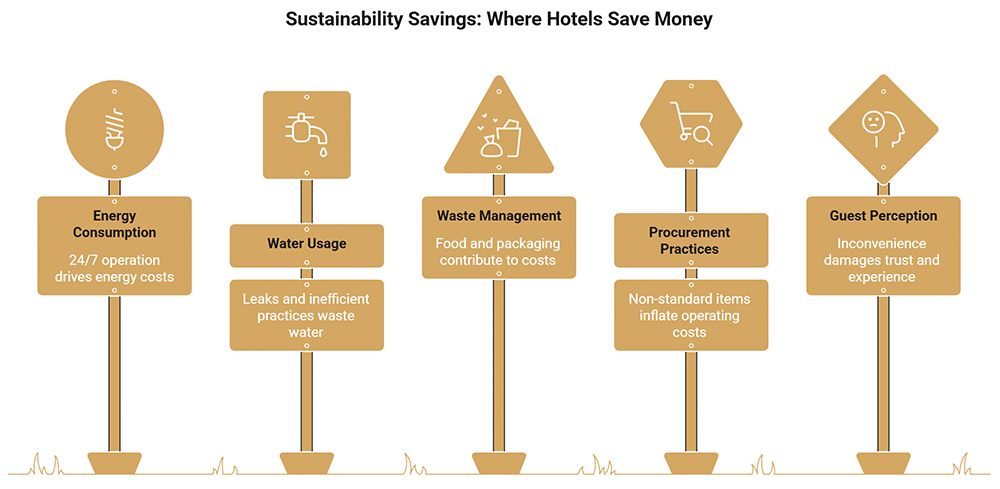
The fastest savings usually come from systems guests don’t notice when the work is done well. Heating, cooling, lighting, water fixtures, laundry, kitchen waste, and purchasing standards have direct cost lines and can be managed without asking guests to accept a weaker experience.
Energy should usually come first because hotels operate 24 hours a day. ENERGY STAR states that an energy management system can reduce hotel energy costs by 35 to 45 percent when linked to reservation and checkout systems, because rooms no longer need to be heated or cooled the same way when they are unsold or vacant.
Do not sell guests an inconvenience and call it sustainability. A linen reuse program that feels like cost-cutting damages trust. On the other hand, a program that explains the reason clearly, gives guests control, and keeps room standards high protects both margin and experience.
For a deeper look at practical energy-saving options, read our guide to “hotel energy solutions“, which explains how hotels can reduce energy bills while improving sustainability performance.
Does Sustainability Earn Hotels a Rate Premium?
Sometimes, the honest answer depends on your segment. Researchers studying 251 certified hotels in Florida found that properties with sustainability certification improved RevPAR, ADR, and occupancy against their competitive sets, with the advantage strongest for first movers. Cornell’s Center for Hospitality Research reached a similar conclusion in its earlier work on LEED-certified hotels, and most properties in that sample were upscale or luxury.
That sample composition is the point. Guests booking upper-midscale, upscale, and luxury properties have discretionary budget and increasingly treat verified sustainability as part of the quality signal they’re paying for. Guests booking economy and midscale rooms buy primarily on price and location.
So the premium is real but conditional. If you run a resort in Costa Rica, a boutique hotel in Copenhagen, or an upscale meeting hotel in Amsterdam, verified sustainability can strengthen positioning and RFP conversion. If you run a budget roadside property, the business case should begin with cost savings and treat any rate lift as upside.
A certification badge rarely fixes weak location, poor service, or uncompetitive pricing.
The Three-Line Sustainability Profit Test
Before approving any sustainability investment, run it through three questions. The mistake is approving a sustainability project because it “sounds good.” The better test is to ask where the return appears and how you will measure it after implementation.
| Line | Question It Answers | Who Captures It | Metric to Track |
| Cost Line | Does this reduce my cost per occupied room? | Every property, every segment | Energy, water, waste, or supply cost per occupied room |
| Compliance Line | Does this protect my claims, distribution, and corporate demand? | Properties marketing green credentials or bidding on corporate RFPs | Verified claims, certification status, RFP sustainability completion rate |
| Rate Line | Can my segment monetize this in ADR? | Primarily upper-midscale through luxury. | ADR index, RevPAR index, direct conversion, group win rate |
The Cost Line is where most projects should qualify first. A long-standing EPA ENERGY STAR benchmark holds that a 10 percent cut in energy consumption has the same financial effect as raising ADR by $1.35 in full-service hotels and $0.62 in limited-service hotels. The dollar figures have aged, but the equivalence logic is the point.
If a project cannot lower resource cost, protect a commercial channel, or support rate in a segment that values sustainability, it is probably a PR exercise wearing a business case.
Use this test before certification, not after. Certification is stronger when it verifies the performance you have already improved.
How Should Hotels Measure Sustainability as a Profit Center?
Hotels should measure sustainability like any other operational strategy. It can be measured with four things, including a baseline, a target, one owner per metric, and a monthly review. If you can’t say who owns a number and when it gets checked, you aren’t managing it yet.
The most important metric is cost per occupied room. Total consumption rises whenever occupancy rises, so yearly figures can hide waste or punish success. Divide each month’s energy, water, and waste costs by rooms sold, and you’ll see whether your hotel is becoming more efficient, not just busier.
Large operators already work this way. Hilton’s Travel with Purpose report tracks resource intensity against a 2008 baseline and reports a 36.3 percent reduction in water intensity across managed hotels. Independent hotels do not need Hilton’s infrastructure. They need the same principle: measure sustainability against hotel activity.
Then assign ownership. Engineering can own energy and water. Housekeeping can own linen use and room practices. Food and beverage can own waste per cover. Sales can own the documents needed for corporate RFP sustainability questions.
If the hotel does not have a sustainability manager, the general manager should review the dashboard monthly with department heads. A dashboard nobody updates is still a PR exercise, just with better formatting.
Video: Can Sustainability Be Profitable for Hotels? | INSPIRE Luxury Hospitality Conference
How Do Greenwashing Rules Change the Commercial Case?
Greenwashing rules turn vague sustainability language into a commercial risk. Writing “eco-friendly hotel” and hoping guests respond used to cost nothing. Now those words carry legal exposure unless verifiable proof sits behind them.
The shift is already law. The EU’s Empowering Consumers for the Green Transition Directive applies from 27 September 2026, and the European Commission’s FAQ requires environmental claims to be substantiated and sustainability labels to rest on a certification scheme or public authority rather than a hotel’s own say-so.
This reaches beyond Europe. If you sell into EU markets or host European guests, terms like “green,” “carbon neutral,” and it stop being harmless copy the moment they shape a booking.
So the fix is operational, not cosmetic. Four moves protect you:
- Replace broad claims with specific, provable ones.
- Tie each claim to a policy, certificate, measurement, or supplier record.
- Store that proof centrally so the website, sales, and RFP teams share one source.
- Train those teams to use the same approved wording.
The industry is retooling around the deadline. In June 2026, WTTC announced that its Hotel Sustainability Basics program will become an independent third-party certification scheme aligned with the new EU rules, giving corporate buyers and MICE (meetings, incentives, conferences, and exhibitions) planners a credential to screen for in RFPs.
Announcing the move, Gloria Guevara, President and CEO of WTTC, said,
“Hotel Sustainability Basics has demonstrated that sustainability can be practical, achievable and scalable, with thousands of hotels already taking meaningful action around the world.”
What Does the Guest Say-Do Gap Mean for Your Investments?
The strongest objection to the sustainability profit argument is the guest say-do gap. Guests tell surveys they care about sustainability, then book the cheaper room with a better location or more flexible cancellation policy. Anyone who has watched a green rate plan underperform knows the objection has teeth.
The gap is real, which is exactly why this article anchors the business case in costs rather than stated preferences. Cost savings don’t require guests to change behavior. Rate premiums do, and only some segments deliver them.
There’s a second gap worth managing. Guests often don’t believe what hotels claim. EHL researchers, drawing on interviews with 65 sustainable luxury guests, business travelers, and executives, identified a clear communication gap between what hotels do and what guests perceive.

Nicole Sideris, Founder & Principal Consultant, X Hospitality“Implementing eco-conscious practices such as recycling may not even be followed by hotel staff, let alone by guests. Consumers are often wary of how much of the practice has really been adopted. Hotels need to live and breathe it, do case studies on their initiatives and include it in blogs to help boost coverage.” Click here to learn more from our Hotel Marketing Expert Panel. |
What Is the Right Sustainability Sequence for Independent Hotels?
Enterprise hotel groups can use ESG teams (environmental, social, and governance), procurement leverage, and portfolio reporting systems. Independent hotels need a simpler sequence that works without a dedicated sustainability department.
If you operate without a cluster team or an enterprise technology stack, the sequence below replaces that infrastructure with disciplined ordering. Fund each stage from the savings of the one before it.
| Stage | Action | Capital Requirement | What It Unlocks |
| 1. Baseline | Meter energy and water; calculate cost per occupied room | Minimal | Visibility to rank every later project |
| 2. Quick wins | Install LED lighting, fix leaks, adjust HVAC routines, and tighten laundry practices | Low, fast payback | Recurring savings that fund stage 3 |
| 3. Systems | Link PMS data to energy controls and formalize waste tracking | Moderate | Continuous optimization, verifiable data |
| 4. Certification | Choose a third-party scheme (e.g., Green Key, EarthCheck) that fits your operation | Moderate, recurring fees | Legally safe claims, RFP eligibility |
| 5. Rate strategy | Test verified sustainability in packages, proposals, and direct booking copy | Minimal | Premium capture where your segment allows |
Hotel Marcel in New Haven, Connecticut, shows what the higher end of this sequence looks like at an independent scale. Owner-developer Bruce Becker converted a landmark office building into a 165-room, all-electric, Passive House-certified property. He said that the hotel spends about two-thirds less on energy per occupied room night than a typical New England hotel, with tax credits and CPACE financing cutting the required investment by $3 million versus a conventional project. Its verified credentials now win corporate meetings business that planners screen for emissions.
Becker treats verification as the discipline that separates substance from spin. As he told National Geographic,
“There are a thousand things you can do to give your building a better environmental profile, but with these certifications, you have to be substantive and can’t overlook anything important.”
The catch is sequencing discipline. Independents that jump to stage 4 before stage 1 buy a certificate they can’t substantiate with performance data, and pay for marketing before capturing a single euro of savings.
Start where the meter is.
FAQs Related to Hotel Sustainability Profit Strategy
Hotel sustainability is becoming a profit strategy because it now belongs in operations, asset management, and commercial decision-making. The strongest returns come from lower resource costs first, verified trust second, and rate premiums only where your segment and buyers can genuinely support them. Run every proposed project through the Three-Line Test, fund the next stage from the last one’s savings, and let your segment, not your marketing, decide whether to chase the premium.
Did You Like This Article About Hotel Sustainability Profit Strategy?
You might also be interested in the following articles:
- How to Improve Hotel Profit Margin With Smart Strategies
- Sustainable Tourism Guide: What is, Why Important, Examples and More
- How to Use Food and Beverage F&B Data to Increase Hotel Revenue
More Tips to Grow Your Business
Revfine.com is the leading knowledge platform for the hospitality and travel industry. Professionals use our insights, strategies, and actionable tips to get inspired, optimize revenue, innovate processes, and improve customer experience.Explore expert advice on management, marketing, revenue management, operations, software, and technology in our dedicated Hotel, Hospitality, and Travel & Tourism categories.
This article is written by:

Hi, I am Martijn Barten, founder of Revfine.com. With 20 years of experience in the hospitality industry, I specialize in optimizing revenue by combining revenue management with marketing strategies. I have successfully developed, implemented, and managed revenue management and marketing strategies for individual properties and multi-property portfolios.






Leave A Comment