

Guests live in a world of smart technology at home, and they expect their hotel room to match it. Smart hotel technology is the set of connected devices and software that lets guests control their room and lets hotels run it automatically. The technologies that pay back first are room controls, energy management, and the systems behind them. Voice assistants, AI agents, and personalization add value once those foundations work and guest data is protected.
Key Takeaways:
|
Table of Contents:
What Does a Smart Room Contain?
A smart room contains devices connected to the Internet of Things, which means the TV, thermostat, lights, blinds, and door lock are connected to a network and can exchange messages. Those messages let guests control the room from a phone, a panel, or their voice, and let the hotel adjust it automatically.
The term ‘smart’ comes from the machines’ ability to work with people to create a better experience. A guest no longer has to leave the bed to change the temperature or switch off the lights.
What matters more today is what the devices are connected to. A room that also talks to the hotel’s property management system knows whether it is sold, occupied, or empty, which is where most of the operating savings come from.
Why Do Guests Demand Smart Hotel Rooms?
Guests demand smart hotel rooms because the room adapts to them, such as lights at their preferred level, their choice of music on the speaker, and the temperature set before they walk in. They get the benefits of smart devices with none of the setup and none of the cost.
Those expectations are now measured. J.D. Power’s North America Hotel Guest Satisfaction Study found smart TVs with streaming in 74% of rooms, used by 62% of guests.
As Andrea Stokes, Hospitality Practice Lead, J.D. Power, says:
“One area in which hotels can significantly influence guest satisfaction without massive capital expense is with technology like smart TVs and updated room temperature controls.”
For your business, the case is financial. Rising operating expenses kept US gross operating profit per available room (GOPPAR) at roughly 90% of 2019 levels, according to the AHLA State of the Industry report. Smart room technology attacks energy and labor, two costs you can influence directly.
The lesson is not that every hotel needs every device. Hotels need technology that solves a defined problem, works with the systems already in place, and is simple enough for guests and staff to use without explanation.
Table: Smart Hotel Technology, Uses and Dependencies
| Smart Hotel Technology | Main Guest Use | Main Hotel Use | Essential Dependency |
| Smart room controls | Set temperature, lights, blinds | Prepare rooms, cut energy waste | PMS room status, room controller |
| Voice control | Operate the room by speaking | Take requests without desk time | Privacy settings, manual fallback |
| Faster guest services | Request service and information | Route and track work | Channel linked to service systems |
| Energy management | Comfort without waste | Match HVAC to occupancy | PMS status, occupancy sensors, commissioning |
| Interactive local guides | Find services and local places | Keep information consistent | One content source, accessible design |
| Returning-guest personalization | Reuse chosen preferences | Make repeat stays relevant | Consent records, deletion rules |
| Guests’ Own Content | Stream from a personal device | Meet entertainment expectations | Room pairing, checkout clearing |
| AI Agents | Faster, sharper messages | Support pricing and forecasting | Integrated data, guardrails, trained owners |
| Device and Data Security | Trust connected services | Cut cyber and privacy risk | Inventory, network separation, patching |
| Mobile keys and digital check-in | Open the door by phone | Cut front desk steps | PMS, identity checks, fallback keys |
| Housekeeping and maintenance tech | Room ready sooner | Prioritize work, catch faults early | Sensor and work-order integration |
11 Smart Hotel Technologies to Smart Up Your Hotel
Below are some technologies that create a smart hotel environment. The first seven are guest-facing, and the last four are the operational technologies that decide whether the rest deliver a return.
1. The Smartest of Room Controls
Smart room controls bring lighting, air conditioning, blinds, and selected entertainment functions into an interface the guest can reach from a wall panel, remote, television, mobile web page, or app. IoT-connected controls can also use room status and sensor data to prepare an arrival or hold an unsold room at an efficient setting.
Hilton reported that its Connected Room technology is available in more than 2,400 hotels. Guests can control entertainment from a mobile device or the in-room remote, and Hilton can add content such as Peloton classes through software rather than replacing the television.
The test for your property is whether a guest can find and use the basic controls without instructions. Keep familiar switches and a thermostat available, and ask the supplier to demonstrate live PMS integration, outage behavior, software updates, and staff recovery. If reception has to explain the panel at check-in, the room is not yet smart.
2. Voice Control in the Guest Room
Voice control lets guests dim the lights, adjust the temperature, play music, ask for hotel information, or request an item without finding a remote. It can be useful for hands-free access, but comfort with speaking to a device varies by guest, language, and situation.
Limit voice systems to clear, low-risk actions. A spoken towel request can create a service ticket, but a payment, room-access change, or disclosure of personal information needs stronger verification.
Make the microphone status and mute switch obvious. Tell guests what the device processes or stores, when associated data is deleted, and how to complete the same task through a panel, physical control, or staff member.
3. Bringing Guest Services up to Speed
Smart hotel technology speeds up guest services by turning requests into tickets that reach the right team without a phone call. A guest can book a spa session, ask for late checkout, or get local recommendations from the same interface that controls the room. The request should receive a priority, owner, and deadline, and the guest should receive an update when the work is complete.
This is where AI has moved fastest. AI can answer simple questions and support discovery, but it should disclose its limits and offer a fast handoff to a person. Hilton took that test-and-learn approach when it launched its AI Planner in beta for a small share of Hilton.com traffic.
As Michael Leidinger, Senior Vice President and Chief Information Officer, Hilton, puts it:
“This is just the beginning and a preview of where we’re going, as we continue to focus on providing thoughtful, purposeful innovation that empowers travelers.”

4. Energy Management and Sustainability
Smart hotel technology cuts energy use by linking PMS room status, occupancy sensors, thermostats, lighting controls, smart meters, and the building management system. It can reduce unnecessary heating, cooling, and lighting in unsold or empty rooms because a guest can start cooling the room from an app on the walk back from the beach instead of leaving the air conditioning on all day.
Deloitte’s US travel outlook found that 42% of Gen Z travelers take some sustainability-related action when planning travel, such as filtering hotel searches for certifications. Hotels still need to measure the results rather than assume that connected controls save energy.
For a current benchmark, the Cornell Hotel Sustainability Benchmarking Index analyzes data from about 31,000 hotels worldwide. Hotels still need to track energy per occupied room alongside recovery time, comfort complaints, manual overrides, and equipment faults.
5. Interactive Local Guides and Accessible Assistance
Interactive local guides can show what a restaurant looks like, what is on the menu, how to reach an accessible route, and whether a place is open tonight. Early versions used wall-mounted maps that guests scanned with the hotel’s app, and the same job now runs through the hotel app, the TV home screen, and in-room assistants.
Deloitte reported that nearly a quarter of travelers used generative AI for trip planning. Keep hotel outlet hours, locations, accessibility details, and approved recommendations in one source that feeds every guest channel.
Accessible assistance should go beyond a map. Hilton and Be My Eyes introduced AI-powered assistance and access to trained Hilton support agents for blind and low-vision guests in the United States and Canada.
As Mike Buckley, CEO of Be My Eyes, said:
“Our mission at Be My Eyes is to break down accessibility barriers in everyday life.”
6. Rooms That Remember Returning Guests
The best rooms feel familiar on arrival, and smart hotel technology gets you there. A smart room can apply a returning guest’s stored language, accessibility requirement, pillow choice, room location, or preferred temperature range before arrival. Hotels should distinguish a preference the guest deliberately provides from behavior inferred by sensors or software.
Store only what clearly benefits the guest, explain how it will be used, and set a retention period. Guests should be able to review, correct, or delete a preference, and declining personalization should not make basic controls harder to use.
Regulation is moving the same way. Deloitte reports that US state privacy rules have made consent, data sharing, and targeted advertising more complex for travel brands. Map what every room device and guest system collects before using that data for personalization.
7. Let Guests Bring Their Own Content
Guests increasingly expect to bring their own content into the room, so the TV and speaker should accept a guest’s own streaming accounts rather than offering a fixed channel list. Personalization here is about removing friction, not about collecting data.
Platforms that update through software keep this current without new hardware. Hilton added Peloton fitness classes to in-room TVs through its Connected Room platform, with new classes planned every six months.
A secure casting system is easier than typing a streaming password with a hotel remote. LG’s Google Cast hotel TVs use a room QR code and network isolation, require no login on the television, and erase the connection history automatically at checkout.
Shared devices carry a duty. Make sure your system signs guests out of their accounts and clears the data automatically at checkout.
8. AI Agents Working Behind the Scenes
AI agents are the newest layer of smart hotel technology, and they work where guests never see them, including pricing, forecasting, maintenance alerts, and routine messages. They create value only when the underlying data is accurate, the system has clear limits, and a named employee reviews exceptions.
BCG reports AI-driven pricing producing up to 15% growth in RevPAR, and a hotel cutting room cleaning and preparation time by 20%. Skills are the constraint. BCG found that only 2.9% of full-time employees in travel and tourism have AI skills, against 21% in technology and media, so budget for training alongside the software.
Start with one controlled workflow, record the human approval points, and compare performance with the existing process. Budget for training and monitoring alongside the software.

Michael J. Goldrich, Founder & Chief Advisor, Vivander“AI agents learn to understand and anticipate unique customer needs by acting as digital receptionists across voice, chat, web, and messaging apps. They remember guests, maintaining context and continuity. Eventually, they will remember you across devices. If a guest asks about pet policies on WhatsApp, the AI suggests pet-friendly rooms when they visit the website later. With real-time access to inventory, pricing, and PMS data, these AI agents will move beyond simple Q&A to perform transactions. They instantly check room availability, verify prices, and confirm services like late check-outs on any channel. This frictionless interaction means that guests don’t have to repeat themselves; each engagement builds on the last. This personalization enhances sales interactions and boosts conversion rates. Guests receive customized experiences, making them more likely to engage with offers and complete bookings. Achieving this requires strong API integrations plus strict data privacy and security measures to protect guest information and build trust.” Click here to learn more from our Hotel Marketing Expert Panel. |
9. Keeping Smart Devices and Guest Data Safe
Every connected thermostat, TV, lock, and speaker is a device on your network, so smart hotel technology needs an inventory, regular patching, and a network segment separate from guest Wi-Fi and business systems. Personalization raises the stakes, because the more a room remembers, the more there is to protect.
NIST’s updated IoT guidance emphasizes risk assessment, threat modeling, and security across the product lifecycle. Hotels should ask suppliers how long they provide updates, how vulnerabilities are reported, what data leaves the property, and what happens when support ends.
The cost of weak hotel data governance is public. The FTC order against Marriott and Starwood requires a comprehensive information security program, data minimization, and a way for US customers to request deletion of their personal information.
The order was not about smart room devices specifically. It shows why connected-room projects need the same security ownership, data minimization, access control, and incident planning as every other hotel system.
10. Mobile Keys and Digital Check-In
Mobile keys let guests skip the front desk queue and open the door with a phone, and digital check-in moves identity and payment steps before arrival. The same system controls which doors a credential opens and when it expires, which is easier to manage than plastic keycards.
Hilton reports that guests can use its Honors app to check in, choose a room, open the door with a Digital Key, and check out. Hilton also offers Digital Key Share, which gives more than one guest in a room access to the key.
Mobile access depends on the PMS, identity and payment checks, the lock platform, and the hotel’s network agreeing on who may enter and when. Test instant revocation, shared-room access, dead-phone recovery, offline doors, and a full system outage before rollout.
11. Housekeeping and Maintenance Technology
Housekeeping and maintenance technology turns room status, sensor readings, and guest requests into work orders that reach the right person in the right order. Sensors can flag a leak, a failing compressor, or a room that never reached its comfort temperature before a guest reports it.
BCG’s report cites a 20% efficiency improvement at Ritz-Carlton San Francisco after AI was used to coordinate housekeeping schedules with checkout patterns and staffing. Treat that as a property example, not a promise that every hotel will produce the same result.
Start with work the team already tracks on paper or in group chats, and define who responds to each alert. Measure room-ready time, repeat faults, preventive work, guest complaints, and alerts with no action, because an unattended notification creates noise rather than savings.
How Should Hotels Choose Smart Hotel Technology?
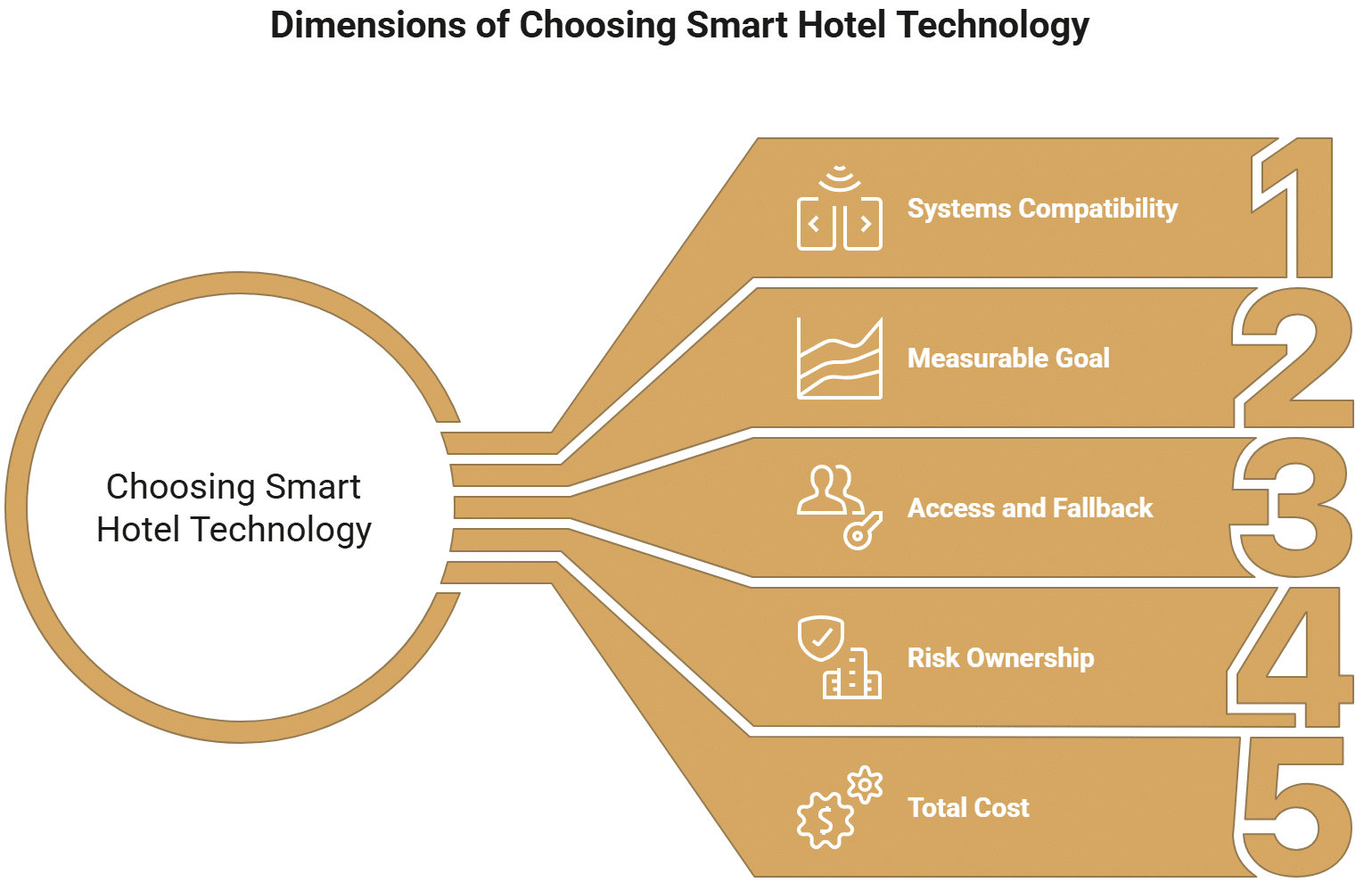
Hotels should choose smart hotel technology by testing fit before features. The Revfine SMART Fit Check is an editorial framework for comparing products consistently; it is not an external certification. Treat every no answer in the assessment as an uncounted cost, an implementation risk, or both.
| SMART Check | Question to Ask | Evidence to Require |
| Systems compatibility | Does it exchange the required events with the PMS, room controller, network, and service systems already in use? | A live demonstration, named integrations, data-flow map, and outage behavior |
| Measurable goal | Which guest or operating problem will improve, and how will the hotel know? | Current baseline, pilot target, reporting method, and accountable owner |
| Access and fallback | Can every guest and staff member complete the essential task without the preferred digital channel? | Physical or staffed alternative, accessibility test, and downtime procedure |
| Risk ownership | Who manages security, privacy, patches, support, data deletion, and product end of life? | Contract terms, device inventory, update schedule, incident process, and retention rules |
| Total cost | What will the technology cost across its useful life? | Hardware, licenses, installation, integration, network, training, support, replacement, and exit costs |
Run a limited pilot before a full rollout. Include different room types, record support calls and guest complaints, test network failure and manual recovery, and approve expansion only when the technology performs reliably. Choose one primary outcome for the pilot, then set a baseline and target.
For independent hotels, the strongest first investment usually removes a recurring cost or manual task and already integrates with the PMS. Energy controls, service-request workflows, and mobile access often offer a clearer business case than showpiece room features. Require remote software updates and references from comparable properties before signing a contract.
For the order in which to install these technologies, see our guide to smart hotel solutions.
Smart Hotel Room: What Are the Benefits for Hotel Owners and Guests
In the article “Smart Hotel Room; What Are the Benefits for Hotel Owners and Guests,” you will learn more about how smart hotel systems can benefit hotel owners and guests alike.
Video: Example of a smart hotel room
Video: Smart Hotel Technology- Las Vegas Hotels Go High Tech
Hotel Automation: Benefits, Tools, and Trends
Are you curious about hotel automation? Maybe you’re planning to upgrade your basic PMS to a more advanced solution, and you want to understand how automated systems can be integrated into modern packages. Perhaps you’re curious about digital check-ins or keyless entry for your guests. Maybe you’re struggling in the hospitality staffing crunch and looking for ways to automate some of your hotel operations.
If so, you’ll want to read “Hotel Automation: Benefits, Tools, and Trends” right now. You’ll learn everything you need about hotel automation and how it can help you.
Smart Hotel Technology Trends FAQs
Appreciating the role of smart hotel technology is the best way to leverage the unique benefits associated with your hotel. Not only will you enhance your brand’s reputation, but you can rest assured in the knowledge that guests are being provided with a truly memorable experience.
Did You Like This Article About Smart Hotel Technology?
You might also be interested in the following articles:
- Hotel Energy Solution: Save Money and The Planet
- Hotel Innovations; Different Ways to Revolutionize Your Hotel Business
- Hotel Door Locks: The Main Lock System Types and Their Benefits
More Tips to Grow Your Business
Revfine.com is the leading knowledge platform for the hospitality and travel industry. Professionals use our insights, strategies, and actionable tips to get inspired, optimize revenue, innovate processes, and improve customer experience.Explore expert advice on management, marketing, revenue management, operations, software, and technology in our dedicated Hotel, Hospitality, and Travel & Tourism categories.
This article is written by:

Hi, I am Martijn Barten, founder of Revfine.com. With 20 years of experience in the hospitality industry, I specialize in optimizing revenue by combining revenue management with marketing strategies. I have successfully developed, implemented, and managed revenue management and marketing strategies for individual properties and multi-property portfolios.



People while on vacation tend to choose hotels for a stay that suits their needs and the one which has a lot to offer. The smart hotel technology will definitely be a boon for the hotel industry, as people will enjoy staying in smart hotels. The points that you have mentioned are very informational and helpful. Thank you for sharing.