

Guest Acquisition Cost (GAC), commonly called Customer Acquisition Cost (CAC), is the total cost a hotel spends to win a booking or a guest, including commissions, advertising, booking fees, and incentives. It matters because room revenue growth means little when the cost of buying that demand climbs faster. Most properties measure only part of it.
Key Takeaways:
|
Table of Contents:
What Is Guest Acquisition Cost (GAC/CAC)?
Guest Acquisition Cost tells you what your hotel spends to create a new customer relationship. Commissions are part of that number, but stopping at commission understates what acquiring demand actually costs.
You can include OTA and agency fees, paid search, metasearch, sales activity, booking technology, payment processing, loyalty incentives, and the share of marketing labor directly attributable to acquisition.
HSMAI’s Profit-Oriented Revenue Management framework shows that Customer Acquisition Cost includes more than just distribution commissions. It can include third-party fees, transaction costs, loyalty expenses, and marketing and sales costs.
Anders Johansson, CEO of Demand Calendar and one of the authors of HSMAI’s profit-oriented revenue work, later summarized the commercial problem:
“It’s no longer enough to know where bookings are coming from. Commercial leaders must understand what each booking truly costs.”
That is why GAC belongs beside “hotel revenue management” and your broader “revenue management KPIs”, rather than living only inside a marketing report.
Video: What Is Guest Acquisition Cost? The Hidden Revenue Opportunity Attractions Miss
How Do You Calculate Guest Acquisition Cost in Hotels?
The correct formula depends on what you are trying to measure.
For a true new-customer metric:
GAC = Total Acquisition Spend ÷ Number of New Guests Acquired
For channel or campaign efficiency:
Cost Per Booking = Channel Acquisition Spend ÷ Bookings Generated
Do not combine those two without labeling them. A repeat guest making a third direct reservation creates a booking, but your hotel did not acquire a new customer.
Consider a hypothetical 120-room independent hotel in Lisbon’s Chiado district. During one month, it generates €396,000 in room revenue across 1,150 reservations.
The hotel spends €55,500 in total to attract and process these bookings. This includes:
- €38,000 in commissions paid to OTAs and other booking partners
- €9,000 on paid search and metasearch advertising
- €2,700 on loyalty discounts and special promotions
- €2,500 on sales and agency-related costs
- €3,300 on booking fees, transaction charges, and payment processing
Its cost per booking is €48.26. Now assume those reservations came from 880 unique guests, of whom 700 were new customers. Its GAC per new guest is €79.29. Those numbers answer different questions.
The €48 figure helps you compare the economics of generating reservations. The €79 figure tells you what it costs to create a new guest relationship that could produce future stays.
Calculate both. The per-booking figure tells you what to negotiate, and the per-guest figure tells you where to invest.

Jacopo Focaroli, CEO & Founder, The Host“Shifting the focus to the “cost of acquisition” sounds a bit like the elephant in the room; that’s a great question when it comes to evaluating expenses like marketing costs, distribution fees, commissions, and operational expenses. The cost of acquisition allows for a comprehensive evaluation of the financial impact of each booking source. By including that, hotels can gain a clearer understanding of the return on investment (ROI) for each distribution channel. By considering this cost, hotels can optimize resource allocation and distribution strategies. Furthermore, evaluating the cost of acquisition assists us in analyzing the long-term value of customers acquired through different channels. Understanding the lifetime value and repeat booking potential helps hotels maximize revenue and profitability, and in short, hotels can make more informed decisions, optimize their distribution strategies, and maximize profitability.” Click here to learn more from our Hotel Marketing Expert Panel. |
The Guest Acquisition Cost Stack
Guest acquisition cost is made up of several different expenses, not just one cost. These expenses are often spread across marketing, sales, revenue, and finance departments. This can make it difficult for hotel teams to agree on the true cost of a booking.
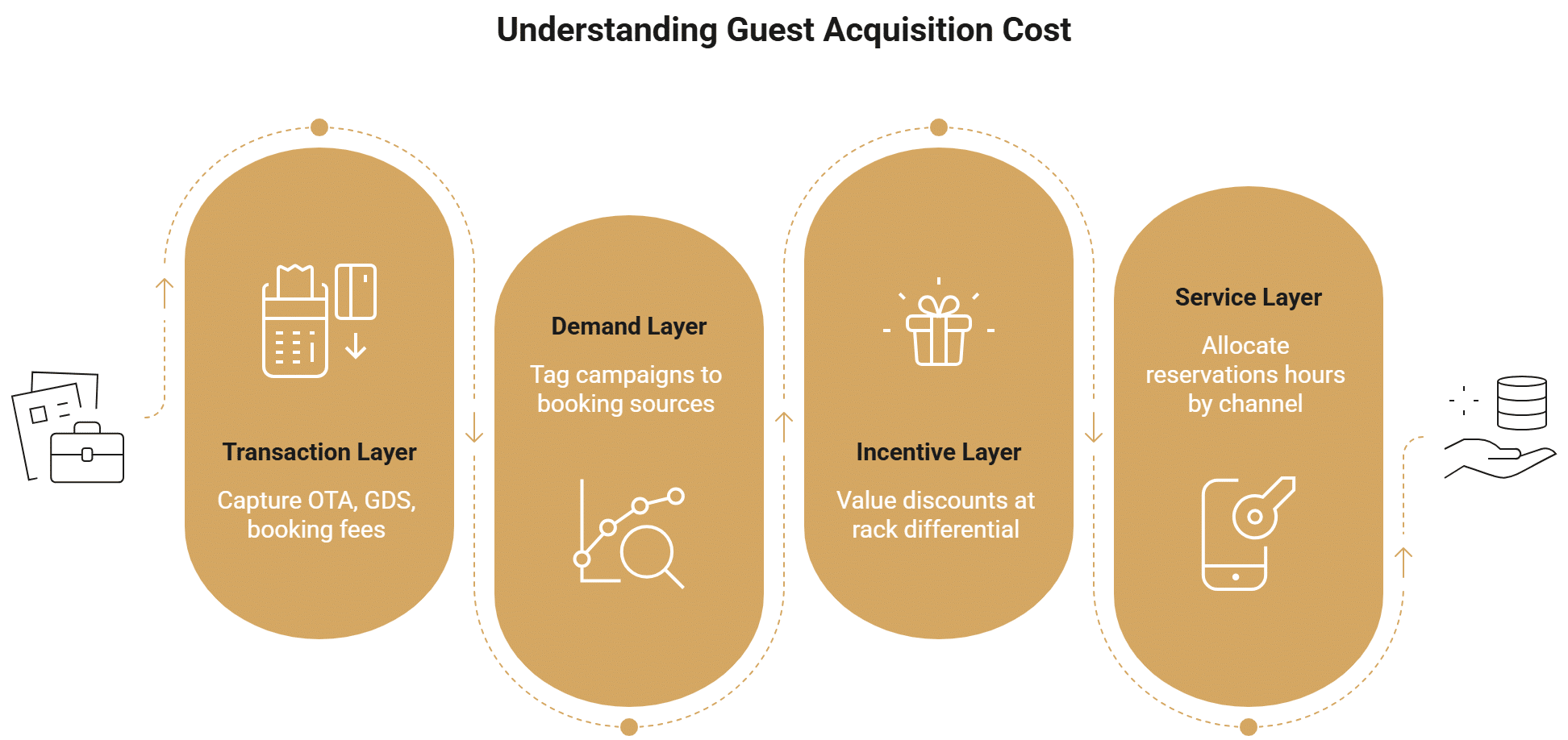
The Guest Acquisition Cost Stack groups these expenses into four clear layers. Looking at all four gives you a more accurate picture of what it really costs to acquire a guest.
| Layer | What it covers | Where it hides on the P&L | How to capture it |
| Transaction | OTA and travel agent commissions, GDS fees, booking engine fees, card processing | Rooms department expenses | Export commissions by channel from the PMS; add processor statements |
| Demand | Paid search, metasearch, social, content, SEO, agency retainers | Sales and marketing | Tag every campaign to a booking source before the quarter closes |
| Incentive | Member and loyalty discounts, added value inclusions, OTA promotion discounts | Split across rooms and F&B | Value the discount at rack differential, not at cost |
| Service | Reservations labor, call handling, brand standard costs attached to loyalty guests | Payroll and departmental expenses | Allocate reservations hours by channel volume |
The fourth layer is the one owners notice last. CBRE found that franchise-related fees at U.S. hotels grew 3.9 percent, with guest loyalty program charges rising the most within that category.
Loyalty is an acquisition cost, and hoteliers need to treat it as one.
What Does Guest Acquisition Cost Look Like by Channel?
Every channel has an acquisition cost. The difference is where that cost appears.
An OTA presents a visible commission. Direct demand spreads its costs across advertising, SEO, metasearch, website technology, CRM, booking-engine fees, and staff. Corporate demand can carry sales payroll, account management, GDS costs, and negotiated-rate concessions.
This is why “direct is free” is poor commercial accounting.
A channel comparison should therefore use the same structure for every source:
- Gross booking revenue
- Acquisition costs
- Net booking revenue
- Room nights
- New guests acquired
- Cost per booking
- GAC per new guest
- Repeat booking rate
- Ancillary contribution where available
A channel can be expensive and still valuable if it brings incremental guests your hotel could not economically reach itself.
What Is a Good Guest Acquisition Cost for a Hotel?
There is no universal GAC percentage that every hotel should target. A good acquisition cost is one that leaves enough contribution after acquisition and stay-related variable costs while supporting the property’s commercial objectives.
HSMAI’s Introduction to Profit-Oriented Revenue Management suggests that Customer Acquisition Cost can range from 15% to 25% of room revenue. Use this as a general reference, not a fixed target. The right acquisition cost depends on your hotel’s market, guest segments, booking channels, and property type.
A better benchmark is your own channel economics.
Consider two $250 bookings. Booking A costs $25 to acquire, while Booking B costs $55. Booking A looks better until you discover that Booking B is a new leisure guest who spends $120 in the restaurant and spa and returns directly six months later.
GAC without guest value can lead you to cut the wrong channel.
You can use three comparisons:
- GAC as a percentage of guest revenue
- Net revenue or contribution after acquisition cost
- GAC relative to Customer Lifetime Value
A rising GAC isn’t automatically a problem if higher-value guests are producing greater contribution. Rising GAC combined with flat guest value is the warning signal.
Video: How to Reduce Customer Acquisition Cost (CAC)?
Why Does Cutting Guest Acquisition Cost Sometimes Reduce Profit?
Keeping acquisition costs as low as possible should not be your main goal. The better goal is to increase the net revenue your hotel keeps after acquisition costs are deducted.
There are two reasons for this. First, removing rooms from OTAs on low-demand dates can reduce your visibility without bringing enough direct bookings to replace that demand.
Second, Cornell researchers found evidence of the billboard effect. This means that travelers may discover a hotel on an OTA and then book through the hotel’s own website. One early Cornell study found that total reservations increased by 7.5% to 26%, depending on the property. Later Cornell research found that the effect still exists, although researchers disagree about how large it is.
The decision rule is simple. Cut acquisition spend where the channel produces low margin, low repeat guests. Keep it where the channel produces demand you cannot source another way, and test the change on a limited date range before applying it across the year.
The Payback Stay Test
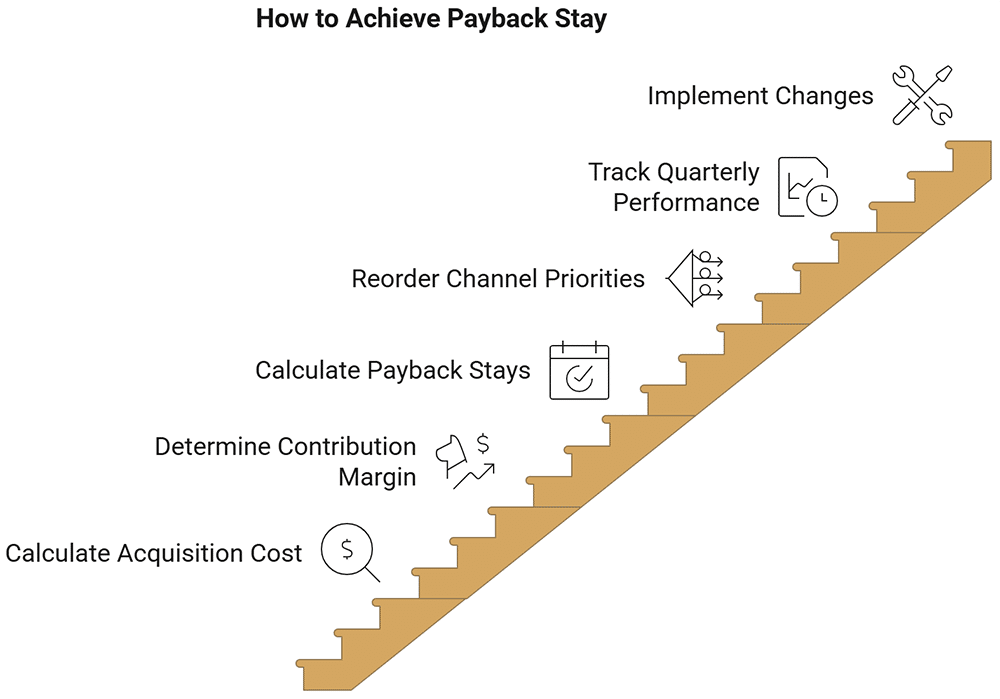
Per-booking acquisition cost answers how much you spent to get a reservation. The Payback Stay Test answers a commercial one: how many stays does it take to earn back what you paid to win this guest?
The calculation is simple. Divide the guest acquisition cost by the average contribution from one stay. Contribution means the revenue left after variable costs, such as housekeeping and guest supplies, are deducted.
For example, if you spend €90 to acquire a guest and earn €110 in contribution from each stay, you recover the acquisition cost during the first stay. If you spend €260 to acquire a guest through an OTA promotion and earn €110 per stay, it takes about three stays to recover that cost.
This helps you compare channels more clearly. A channel that recovers its acquisition cost in one stay may be worth more investment. A channel that needs several stays deserves a closer look, especially if guests rarely return.
CBRE found that agency commissions were one of the fastest-growing costs in U.S. hotel rooms departments. They increased by 6.0% per occupied room, while rooms revenue grew by 2.2%.
Robert Mandelbaum and Andrea Grigg of CBRE explained:
“Commissions are growing almost three times revenue-per-available room. Top-line softness is pushing hotels to rely more on third parties to generate revenue.”
Review payback stays by channel every quarter. If a channel takes longer to recover its acquisition cost, check its rates, discounts, targeting, and repeat booking performance.
What Does Guest Acquisition Cost Mean for Independent Hotels?
Independent hotels usually have fewer resources than large hotel groups. They may not have a central commercial team, strong bargaining power with booking partners, or a large loyalty program to support guest acquisition.
This means independent hotels need to focus on the areas they can control.
For example, a 60-room independent hotel may not be able to negotiate the same OTA commission rates as a hotel group with hundreds of properties. But it can improve its own marketing, email campaigns, repeat guest offers, and direct booking process.
Building a strong guest database can help reduce acquisition costs over time. Email marketing and repeat guest campaigns can bring guests back without paying high commissions for every new booking.
Set a clear limit for how much you are willing to spend to acquire each booking. Review this cost every month and avoid combining too many discounts, commissions, and promotions on the same reservation.
For hotels developing their marketing strategy, this guide to hotel marketing strategies explains different ways to attract guests and reduce reliance on expensive booking channels.
FAQs Related to Guest Acquisition Cost (GAC) in Hotels
Guest acquisition cost is the price of demand, and it decides how much of your room revenue survives to reach profit. Track it by channel and by guest, not by invoice. The properties that hold this number steady while rate grows are the ones whose owners see the improvement on the bottom line.
Did You Like This Article About Guest Acquisition Cost (GAC) in Hotels?
You might also be interested in the following articles:
- What Is CPOR in Hotels? Why Lower Isn’t Always Better
- What Is eNPS in Hotels? The Metric That Predicts Turnover
- What Is Average Length of Stay (ALOS) in Hotels?
More Tips to Grow Your Business
Revfine.com is the leading knowledge platform for the hospitality and travel industry. Professionals use our insights, strategies, and actionable tips to get inspired, optimize revenue, innovate processes, and improve customer experience.Explore expert advice on management, marketing, revenue management, operations, software, and technology in our dedicated Hotel, Hospitality, and Travel & Tourism categories.
This article is written by:

Hi, I am Martijn Barten, founder of Revfine.com. With 20 years of experience in the hospitality industry, I specialize in optimizing revenue by combining revenue management with marketing strategies. I have successfully developed, implemented, and managed revenue management and marketing strategies for individual properties and multi-property portfolios.


Leave A Comment