

Cost per Occupied Room (CPOR) measures the average operating cost associated with each hotel room sold. It helps you determine whether room revenue is being converted efficiently into profit, rather than being absorbed by labor, supplies, laundry, amenities, utilities, and other rooms-department costs.
Key Takeaways:
|
Table of Contents:
What Does Cost per Occupied Room (CPOR) Mean in Hotels?
Cost per Occupied Room (CPOR) is a hotel performance metric that measures the average cost associated with selling and operating an occupied room. It answers a question no revenue metric addresses: what did it cost you to deliver the room a guest just paid for?
HSMAI defines CPOR as total rooms-department cost divided by the number of rooms sold. Labor is usually one of the biggest parts of this cost. CBRE Hotels Research estimates that labor makes up around 55 to 60% of total rooms-department costs, while other expenses include commissions, laundry, guest supplies, and complimentary food and beverages.
That composition explains why CPOR moves. When housekeeping hours per room creep up, or wage rates rise, CPOR rises with them, whatever you do about amenity purchasing. Since payroll drives the number, our guide to “hotel labor cost management” is the place to start once you know what your CPOR is doing.
How Do You Calculate Cost per Occupied Room?
The CPOR calculation is simple. The main challenge is deciding which room-related costs you will include.
Formula: CPOR = Total Room-Related Operating Costs / Number of Occupied Rooms
Consider a 120-room independent hotel in Porto running at 65 percent occupancy through October. That’s 2,418 occupied room nights across the month:
120 rooms × 31 days × 65% occupancy = 2,418 occupied room nights
If the hotel spends €96,720 on room-related operating costs:
€96,720 ÷ 2,418 = €40 CPOR
This means the hotel spends an average of €40 to operate each occupied room.
Calculate CPOR monthly instead of relying only on an annual figure. An annual CPOR averages away the shoulder season months where your cost per room night quietly doubles because payroll didn’t flex with occupancy.
Video: How to Calculate Cost Per Occupied Room?
Which Costs Should Be Included in CPOR?
Hotels do not always calculate CPOR in exactly the same way. This means two hotels can report the same CPOR while including different expenses.
The best approach is to decide which rooms-department costs your hotel will include, document them clearly, and use the same definition every month.
Typical CPOR costs can include:
- Housekeeping and laundry labor, including contract cleaning
- Front desk and reservations labor allocated to rooms
- Linen, terry, and replacement cycles
- Guest amenities, toiletries, and in-room consumables
- Cleaning products and housekeeping supplies
- Guest room utilities where submetering allows
- Commissions and channel costs, where you want a delivered cost view
- Routine room maintenance and turn costs
Hotel accounting standards can change where certain expenses are recorded. For example, the 12th Revised Edition of the Uniform System of Accounts for the Lodging Industry (USALI) became mandatory on January 1, 2026. It moved in-room entertainment expenses from the Rooms Department to Information and Telecommunications and added a Rooms account for loyalty program member benefits.
The rule is simple: choose your CPOR cost categories, write them down, and keep using the same ones. A consistent CPOR trend is more useful than a detailed calculation that changes from month to month. To see what sits inside the housekeeping half of that number, our breakdown of “hotel room cleaning strategies” maps the tasks to the cost.
Why Is CPOR Important for Hotel Profitability?
CPOR is important because cost growth has been outrunning revenue growth, and rooms metrics hide it. CBRE found that expenses above gross operating profit rose 4.1 percent in 2024 while total hotel revenues grew just 2.3 percent across its survey sample.
This means a hotel can post record RevPAR in that environment and still hand its owner a worse P&L than last year.
CPOR helps you spot this problem earlier. Because it can be calculated every month using data you already have, you can see when room costs are rising before the problem becomes more visible in GOPPAR or the full profit and loss statement.
For the wider view of where margin leaks across the whole operation, our guide on “how to improve your hotel profit margin” works through the other lines on the same statement.
The CPOR Coverage Test
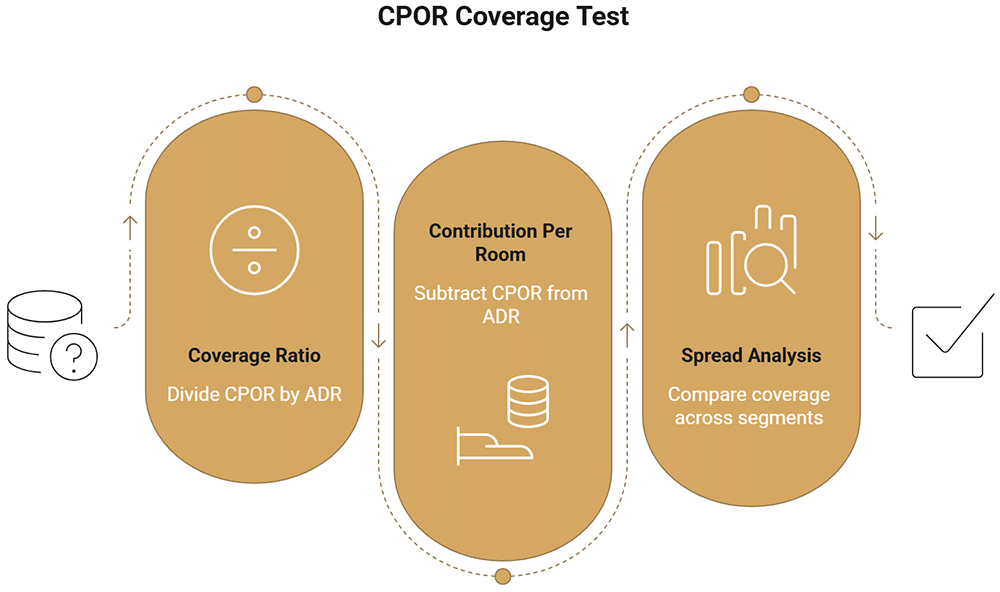
Knowing your CPOR is 40 euros tells you almost nothing on its own. What turns it into a decision is measuring it against what the room earns. We call this the CPOR Coverage Test, and it runs three checks.
Check 1: Coverage Ratio
Divide CPOR by ADR.
For example, the Porto hotel has a CPOR of €40 and an ADR of €110:
€40 ÷ €110 × 100 = 36%
This means around 36% of the average room rate is being used to cover the room’s operating cost.
Check 2: Contribution Per Occupied Room
Subtract CPOR from ADR.
€110 ADR – €40 CPOR = €70
This leaves €70 per occupied room before other hotel-wide operating costs are considered. This figure is useful when deciding whether a discounted booking, segment, or promotion is still worth accepting.
Check 3: The Spread
Run both checks by room type, segment, and channel. The gap between your strongest and weakest coverage is where your next decision sits, and it’s usually wider than operators expect.
The objection to all this is fair. Coverage answers it by producing an accept or reject threshold, not another dashboard tile.
How Does CPOR Compare With RevPAR, ADR, and GOPPAR?
Each metric answers a different question, and CPOR is the only one on the cost side of the ledger.
CBRE notes that rooms department expenses are highly variable and are therefore best analyzed on a dollars per occupied room basis rather than per available room.
| Metric | What it Measures | Denominator | Decision it Supports |
| ADR | Average room revenue earned per sold room | Occupied rooms | Pricing and positioning |
| RevPAR | How efficiently inventory converts to revenue | Available rooms | Rate and occupancy trade-offs |
| CPOR | Operating cost of servicing one sold room | Occupied rooms | Segment acceptance and cost control |
| GOPPAR | Operating profit generated per available room | Available rooms | Owner reporting and asset performance |
ADR tells you what guests are paying. RevPAR tells you how well your available rooms are producing revenue. CPOR tells you what each occupied room costs to operate. GOPPAR shows how much operating profit the hotel generates after costs are considered.
You need all four metrics to understand whether strong room revenue is actually turning into stronger profit.

Fabian Bartnick, Founder, Infinito“I don’t think so, at least not at a global scale. We need to move away from adding complexity, and instead, we need to simplify. We have no handle on RevPAR as an industry right now. In room revenue management, it will just be another metric that is there without any action attached to it. That is the fundamental issue: most new KPIs will not drive any new insights or actions.” Click here to learn more from our Hotel Revenue Management Expert Panel. |
What Is a Good CPOR for a Hotel?
There is no single CPOR that is good for every hotel.
A luxury resort will usually spend more on labor, amenities, laundry, and room servicing than a limited-service hotel. Costs also change depending on wages, room size, location, length of stay, and service standards.
For some market context, HotelData’s Q1 2026 report covering around 5,000 U.S. hotels reported labor costs of $46.79 per occupied room, with 2.105 labor hours per occupied room.
Use figures like this only as a reference, not as a target for your property.
Your benchmark is your own trend line and your own coverage ratio. If CPOR is flat and ADR is up, you’re gaining. If CPOR climbed 6 percent while ADR moved 2 percent, you have a problem regardless of what anyone else reports.
The Five Pressures That Push CPOR Higher
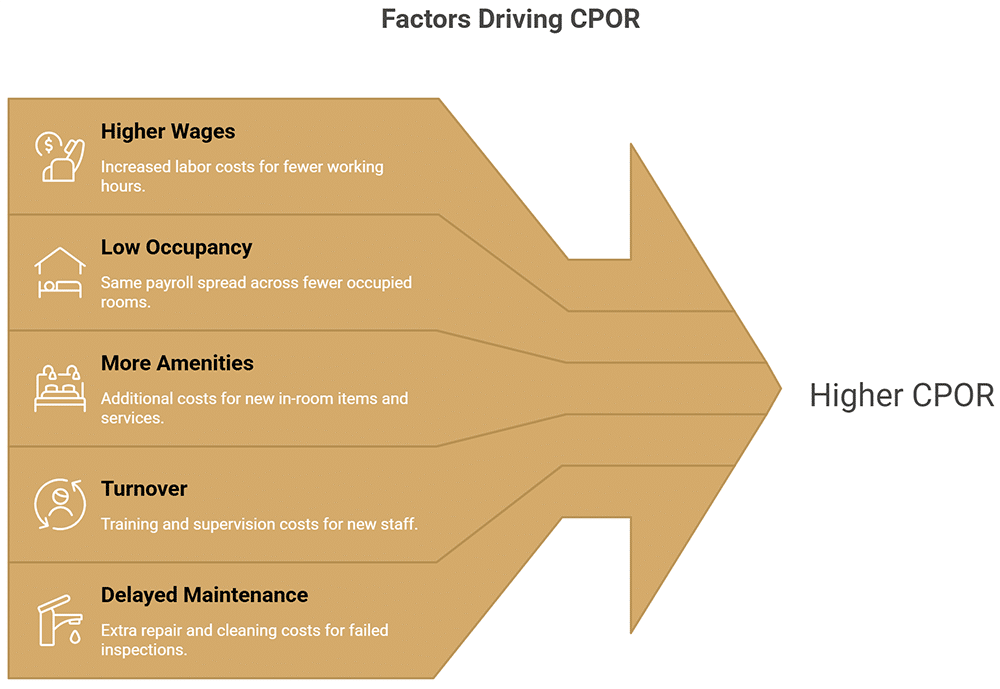
Five main factors can push Cost per Occupied Room higher. Labor and occupancy are easy to see, but staff turnover and delayed maintenance are often missed.
- Higher wages and labor hours. CBRE found that hours worked at the typical hotel in its sample were 7.4% lower than in 2019, while employee compensation was 22.1% higher. Hotels are therefore paying more for fewer labor hours.
- Low occupancy. Some room-department labor costs remain even when fewer rooms are sold. This means the same payroll is spread across fewer occupied rooms, which can push CPOR higher during slower months.
- More amenities and service standards. Every new in-room item, complimentary product, or service standard adds another cost to each occupied room.
- Turnover. Training a new room attendant costs hours of supervisor time and slows the whole floor for weeks.
- Staff turnover. New room attendants need training and supervision. They may clean fewer rooms while learning, which increases the labor cost per occupied room.
- Delayed maintenance. A room that fails inspection may need another repair or cleaning visit. That creates extra cost without generating extra room revenue.
Turnover and maintenance problems are easy to miss because they do not appear on the profit and loss statement under a line called “CPOR.” Yet both can increase the real cost of servicing a room.
How Can Hotels Reduce CPOR Without Hurting Guest Experience?
Cut the waste, not the product. J.D. Power reported that hotel guest satisfaction in North America increased by 13 points to 665 out of 1,000 in 2026. The study linked the improvement partly to investment in guest rooms, hotel upkeep, and service.
As Andrea Stokes, hospitality practice lead at J.D. Power, put it,
“In every hotel segment, guests are having better experiences due to positive interactions with hotel staff, higher quality food and beverage, and guest room improvements.”
The lesson is that the industry is winning on satisfaction by spending on the room, not by stripping it. So target the cost that never reaches the guest:
- Schedule housekeeping to the arrival and departure pattern, not to a flat daily headcount. Departures take longer than stayovers, and a Tuesday with 40 checkouts needs different cover than a Tuesday with 12.
- Audit your linen replacement cycle. Premature discard is one of the highest invisible costs in the rooms department.
- Consolidate amenity procurement across the year rather than ordering monthly at list price.
- Run preventive maintenance on a schedule. A room taken out of order for a two-hour fix costs less than the re-clean plus the review.
- Automate the administrative layer. Digital room assignment and inspection logging return supervisor hours to the floor without touching what the guest sees.
Set a service floor first, then optimize beneath it. If a lever risks your cleanliness scores, it isn’t a CPOR lever.
How Should Independent Hotels Track CPOR?
Independent hotels do not need a large finance team or expensive reporting system to track CPOR. A property management system (PMS) export, monthly accounts, and a spreadsheet are enough to build a useful monthly report.
| Step | What You Do |
| 1. Define inclusions | List which cost lines count, and freeze the list |
| 2. Pull volume | Export occupied room nights by month and room type from the PMS |
| 3. Pull cost | Take rooms department expenses from the trial balance |
| 4. Divide and chart | Calculate CPOR and coverage ratio, then plot 24 months |
The bigger challenge for independent hotels is timing. Final cost and profit figures may not be available until the accounting period closes.
A practical solution is to calculate a simpler labor-only CPOR every week using payroll data. Then reconcile it with the complete CPOR when monthly accounts are ready.
This matters even more for smaller hotels because one extra shift can have a larger effect on cost per room. CBRE describes hotel operating costs as behaving more like steps than a smooth line. For example, when a 60-room hotel adds another supervisor shift, that cost is spread across a much smaller number of rooms than it would be at a large property.
FAQs About CPOR in Hotels
Cost per occupied room turns your rooms department into a number you can act on, showing what each sold night consumes rather than what it earns. Track it monthly, judge it against your ADR rather than someone else’s benchmark, and split it by room type. The properties that do this stop guessing which bookings are worth having.
Did You Like This Article About CPOR in Hotels?
You might also be interested in the following articles:
- What Is Guest Acquisition Cost in Hotels? The Hidden Margin
- What Is RevPAM in Hotels and How Do You Calculate It
- What Is eNPS in Hotels? The Metric That Predicts Turnover
More Tips to Grow Your Business
Revfine.com is the leading knowledge platform for the hospitality and travel industry. Professionals use our insights, strategies, and actionable tips to get inspired, optimize revenue, innovate processes, and improve customer experience.Explore expert advice on management, marketing, revenue management, operations, software, and technology in our dedicated Hotel, Hospitality, and Travel & Tourism categories.
This article is written by:

Hi, I am Martijn Barten, founder of Revfine.com. With 20 years of experience in the hospitality industry, I specialize in optimizing revenue by combining revenue management with marketing strategies. I have successfully developed, implemented, and managed revenue management and marketing strategies for individual properties and multi-property portfolios.






Leave A Comment