

Hotel marketing is the discipline of creating, capturing, and retaining profitable guest demand for a hotel. It connects positioning, search visibility, distribution, content, reputation, direct booking, and guest relationships so the right traveler finds your property, understands its value, and chooses to book.
Key Takeaways:
|
Table of Contents:
- What Is Hotel Marketing?
- Why Has Hotel Marketing Changed?
- Where Should You Spend Your Hotel Marketing Budget?
- How Should Hotels Build Positioning and Content?
- How Should Hotel Marketing Turn Interest Into Direct Bookings?
- How Do OTAs, Metasearch, and Paid Media Fit Into Hotel Marketing?
- How Should Hotels Use CRM and First-Party Data?
- How Should You Measure Hotel Marketing Performance?
- What Should Independent Hotels Prioritize First?
- FAQs About Hotel Marketing
What Is Hotel Marketing?
Hotel marketing is the process of attracting the right guests, turning their interest into bookings, and building relationships that encourage them to return. It covers everything from brand positioning and search visibility to distribution, advertising, reputation, direct booking, and guest retention.
Advertising is only one part of hotel marketing. A strong hotel marketing approach starts with demand: who are you trying to attract, why should they choose your property, and where will they make their booking decision?
That question should guide where you spend your marketing budget.
What Does Hotel Marketing Actually Cover?
Hotel marketing has four main jobs:
- Demand Creation: Build awareness through branding, content, social media, public relations, partnerships, and destination storytelling.
- Demand Capture: Convert interest through search engine optimization, paid search, metasearch, OTA listings, and your booking engine.
- Demand Retention: Encourage repeat business through customer relationship management, email, loyalty programs, and guest offers.
- Demand Economics: Measure channel mix, commissions, acquisition costs, and the profitability of each booking.
The fourth area is especially important because a hotel can generate plenty of bookings and still spend too much to acquire them.
Individual tactics belong within a “hotel marketing strategy“. Hotel marketing decides how those tactics work together to attract profitable demand.
Why Has Hotel Marketing Changed?
The hotel booking journey is no longer a simple path from Google search to hotel website to booking. A traveler might discover your hotel on TikTok, compare it on an OTA, ask ChatGPT for alternatives, check Google reviews, visit your website, and return later through a search ad before booking.
That makes it harder to credit a booking to one marketing channel.
AI search is adding another discovery layer. Pew Research Center analyzed 68,879 Google searches and found that users clicked a traditional search result in 8 percent of visits when an AI summary appeared, compared with 15 percent when no summary appeared.
Your search rankings can stay strong while your website traffic falls.
Chris Nassetta, President and CEO of Hilton, expects AI to reshape travel distribution. He said:
“The internet changed all that, and the LLMs are going to change it again.”
But AI is not replacing traditional search or OTAs. Travelers use AI to research options while still relying on familiar websites and booking platforms to make reservations.
Xavi Amatriain, Chief AI and Data Officer at Expedia Group, summarized the challenge in its AI Trust Gap report:
“Travelers don’t have a technology problem with AI. They have a trust problem.”
For hotel marketers, visibility alone is no longer enough. Your website, Google presence, OTA listings, reviews, and third-party information should present consistent and trustworthy property details.
This is why SEO, reputation, distribution, content, and hotel GEO increasingly need to work together to help your property reach the traveler’s shortlist.
Where Should You Spend Your Hotel Marketing Budget?
Do not start by choosing a channel. Start by identifying where your hotel is losing demand. A property with strong website traffic but few bookings has a different problem from one with weak visibility or too much. The same marketing budget will produce very different results depending on which stage needs attention.
| What You See | Likely Problem | Where to Invest |
| Strong traffic but few bookings | Conversion | Booking engine, room pages, mobile experience |
| Weak overall demand | Reach | Paid media, metasearch, destination content |
| OTA dependency keeps increasing | Direct visibility | Branded search, reviews, listing accuracy |
| Guests rarely return | Retention | CRM, segmentation, post-stay communication |
| Bookings hold, but rates decline. | Positioning | Guest segments, offers, experience-led content |
For example, if your website already attracts qualified visitors but the booking engine loses them, spending more on paid advertising simply sends more people into a weak conversion path. Fix the booking experience first.
If total demand is low despite good conversion, the problem is different. That is when greater investment in search, social media, metasearch, partnerships, or destination content makes sense.
Your budget should therefore follow the commercial problem, not the marketing trend receiving the most attention.
For a deeper breakdown of allocation and acquisition costs, see our guide to hotel marketing budgets.
Video: Build a Hotel Marketing Plan | Hotel Marketing Strategies Guide Step-By-Step
How Should Hotels Build Positioning and Content?
Strong hotel content starts with clear positioning. If your hotel tries to appeal to every traveler, its marketing usually becomes too generic to give anyone a strong reason to choose it.
Consider a hypothetical 90-room independent hotel in Lisbon’s Chiado district. Describing it as a “stylish city hotel in a great location” gives travelers little reason to prefer it. Positioning it around walkable cultural weekends for couples interested in local dining and design creates a much clearer marketing direction.
That positioning could lead to neighborhood walking guides, restaurant recommendations, weekend itineraries, room videos, and content answering questions guests ask before choosing the area.
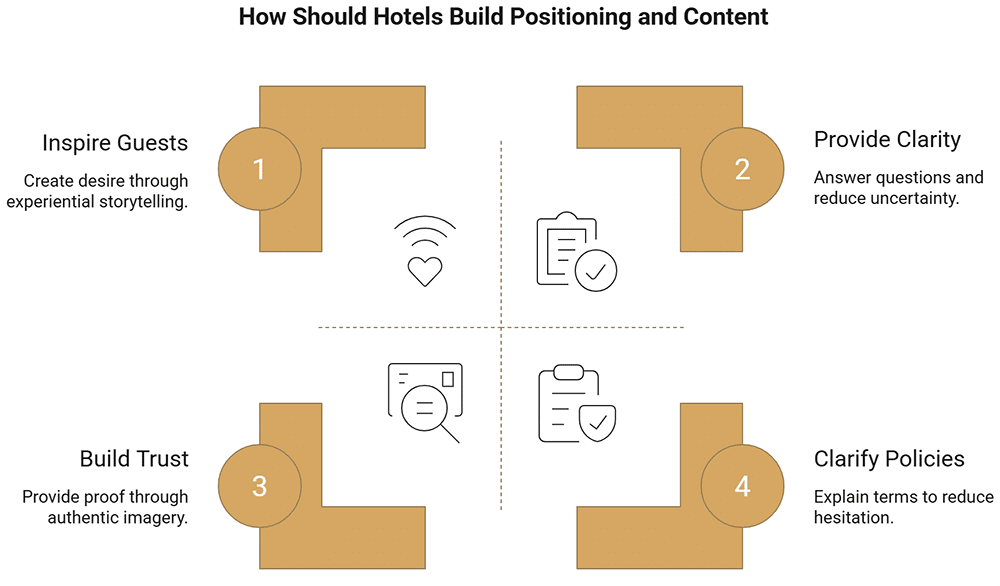
Every piece of hotel content should do at least one of four jobs:
- Create Desire: Show experiences travelers cannot understand from a room listing alone.
- Answer Questions: Cover parking, transfers, room capacity, accessibility, dining, and location.
- Reduce Uncertainty: Explain policies, room differences, cancellation terms, and what is included.
- Provide Proof: Use real imagery, reviews, local knowledge, and specific property details.
Content that does none of these is unlikely to influence a booking decision.
How Should Hotel Marketing Turn Interest Into Direct Bookings?
A hotel website is not a digital brochure. Its job is to turn existing interest into a booking.
Once travelers reach your website, they should quickly understand whether the hotel fits their trip, which room suits them, what is included, and why they should book directly. Unclear room descriptions, hidden policies, slow mobile pages, or a complicated booking engine can push an interested guest back to an OTA.
That pressure is strongest at smaller properties. In the HOTREC distribution study, 28 percent of hotels reported OTA shares between 30 and 49 percent, and one in five exceeded 50 percent, with reliance strongest among hotels under 20 rooms.
The weak tactic is permanent discounting. It reduces rates without solving why guests chose an intermediary, and it teaches returning guests to wait for the next offer.
Compete on value instead: flexible cancellation, breakfast, parking, room upgrades, easier booking changes, or exclusive packages. Trust matters alongside value, so clear policies, accurate photos, recent reviews, and secure payment options all reduce uncertainty before checkout.
Keep the booking path simple on mobile, where extra steps and slow-loading pages interrupt conversion fastest.
Direct bookings give you more control over the guest relationship and future communication. They aren’t automatically the most profitable bookings, so compare net revenue per booking rather than assuming. A reservation generated through expensive advertising can cost more to acquire than an OTA reservation earns away in commission.

Cory Falter, Partner, Lure Agency“Sell experience. Not space. Use your sales team to educate prospects on how to host the best event possible. That’s your golden ticket to stand out from the sea of beautiful properties out there. Independent hotels, this is your chance to shine. Unlike branded chains, you have the flexibility to highlight what truly sets you apart: your team’s expertise on your website. Too many hotels are missing out on revenue by not showcasing their team’s knowledge. Many of our partners find that over half of their small meeting opportunities come from planners with little to no experience. These newbies have a ton of questions and need a guiding hand, but most hotel websites are geared towards seasoned planners who are ready to submit an RFP. Here’s a challenge:
Prospects want to work with people they trust. Encourage your sales team to share their expertise and personality on social media, especially on LinkedIn, which is rolling out a video feed tab similar to TikTok. It’s an incredible tool for subject matter experts to educate prospects. Sales get a whole lot easier when prospects already know who you are. So, be bold, be educational, and let your team’s expertise be the differentiator.” Click here to learn more from our Hotel Marketing Expert Panel. |
How Do OTAs, Metasearch, and Paid Media Fit Into Hotel Marketing?
OTAs, metasearch, paid media, and your hotel website serve different purposes within the same marketing system. The goal is not to choose one channel, but to use each where it creates the most value.
OTAs provide reach. They expose your hotel to travelers who may not know your property or search for it directly, which makes them useful for reaching new markets and generating additional demand.
Metasearch captures comparison demand. Platforms that display rates from several booking sources help travelers compare prices and can direct high-intent users toward your own booking engine.
Paid media creates or captures targeted demand. Search ads, social advertising, and other paid campaigns can support specific guest segments, offers, markets, or low-demand periods.
Your website converts demand you can own. It gives you greater control over the booking experience, guest data, communication, and future retention.
AI is not yet a booking channel. Booking Holdings disclosed on its second quarter 2026 earnings call that referral traffic from large language models, paid and unpaid combined, accounts for less than 1 percent of its total room nights.
Ewout Steenbergen, the company’s EVP and Chief Financial Officer, told analysts that
“At this moment, it’s still very minimal and is not really moving so much.”
The right channel mix depends on your market, guest segments, booking patterns, and acquisition costs. A balanced approach uses intermediaries for valuable reach while strengthening direct channels where they can compete effectively.
For a deeper look at channel selection, see our guide to hotel distribution channels.
How Should Hotels Use CRM and First-Party Data?
Customer relationship management (CRM) helps hotels turn individual bookings into longer-term guest relationships. Instead of treating every past guest the same, you can segment them by trip purpose, booking behavior, stay history, and stated preferences.
Consider a hypothetical 120-room coastal resort. A family that booked connecting rooms during school holidays should not receive the same follow-up offer as a couple who booked a spa package in February.
The family responds to school-holiday dates, larger room types, and activity packages. The couple may be more interested in quiet midweek stays, dining offers, and wellness experiences. One database, two entirely different offers, and no extra acquisition spend to reach either.
First-party data is what makes that split possible. CRM built on it supports:
- Repeat-stay offers
- Pre-arrival upselling
- Post-stay communication
- Loyalty campaigns
- Guest segmentation
- More relevant seasonal promotions
The goal is not to collect as much guest data as possible. Collect information you have permission to use and that can improve future communication.
The booking should start the next marketing cycle, not end the current one.
Even a smaller independent hotel can begin with simple segmentation and consistent post-stay communication before investing in more advanced CRM technology.
How Should You Measure Hotel Marketing Performance?
Hotel marketing performance should be measured by whether it generates valuable demand, not by impressions, clicks, or social engagement.
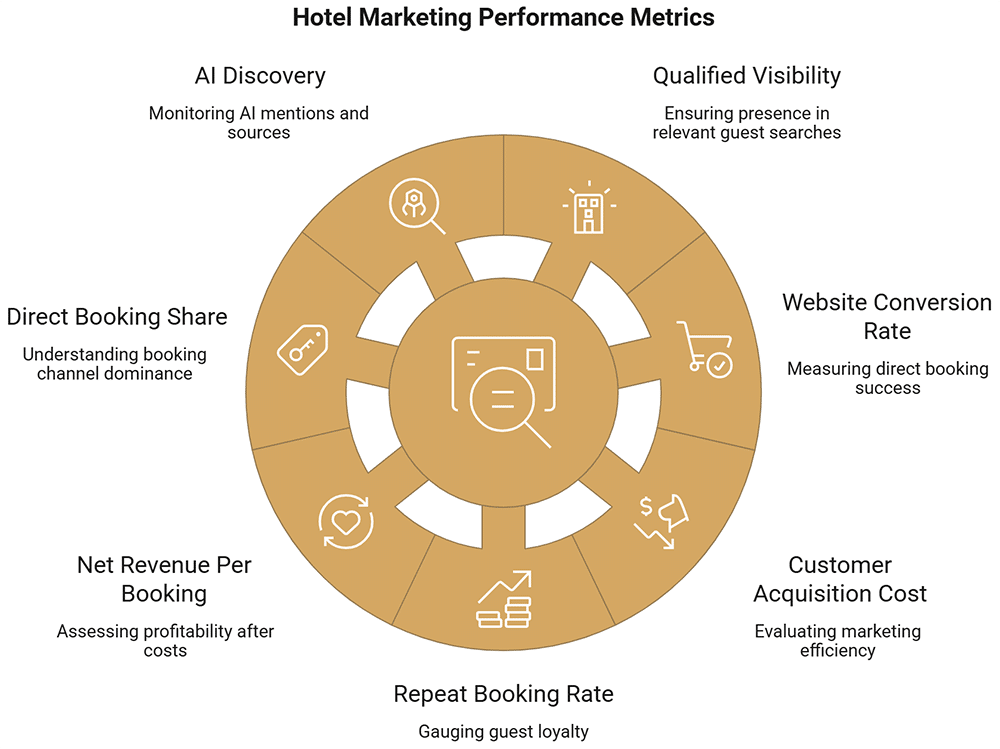
Five metrics give you a practical starting point:
- Qualified Visibility: Are you appearing where the guest segments you want are actually searching, comparing, and planning?
- Website Conversion Rate: What percentage of website visitors complete a direct booking?
- Customer Acquisition Cost: How much are you spending to generate each new booking?
- Net Revenue Per Booking: How much revenue remains after marketing and distribution costs are deducted?
- Repeat Booking Rate: How successfully are you turning previous guests into future bookings?
Direct booking share can provide useful context too. If direct reservations are growing but acquisition costs are rising even faster, the result is less profitable than it first appears.
Look at these metrics together rather than judging each channel separately. A social campaign may generate few immediate bookings but increase branded searches. Paid search may appear highly efficient because it captures travelers already looking for your hotel.
AI discovery creates another visibility layer. Hotels should periodically check whether AI assistants mention the property accurately and which sources they rely on, without replacing traditional SEO measurement.
What Should Independent Hotels Prioritize First?
Independent hotels should not copy the marketing structure of a global hotel brand with a smaller budget. Large groups can spread work across dedicated teams for CRM, paid media, SEO, loyalty, public relations, analytics, e-commerce, and sales.
An independent hotel needs fewer priorities and clearer ownership.
Start with this sequence:
- Choose Valuable Guest Segments. Focus on two or three groups that genuinely fit your property instead of marketing to everyone.
- Fix Your Property Information. Keep room details, amenities, policies, location information, and services consistent across your website, Google, and major booking platforms.
- Improve Direct Conversion. Make sure visitors can understand room differences, value, policies, and booking conditions without unnecessary friction.
- Own Local Knowledge. Publish useful information about your neighborhood, destination, events, transport, restaurants, and experiences that larger brands cannot describe as precisely.
- Build Basic Retention. Capture appropriate guest consent and create simple post-stay and repeat-guest communication.
- Review Performance Monthly. Compare channel costs, conversion, direct share, guest segments, and need periods together.
- Include AI Visibility in Existing Search Work. Treat it as an extension of discoverability, not as a separate marketing department.
For an independent property, specificity can be more valuable than scale. You may not be able to outspend a major chain, but you can explain your property better, understand local demand more deeply, and build stronger relationships with returning guests.
That is where smaller hotels can compete effectively.
FAQs About Hotel Marketing
Hotel marketing works best when every activity supports profitable guest demand, from discovery and positioning to booking and retention. Hotels that identify where demand is being lost can invest more effectively, strengthen direct relationships, and build a marketing mix that supports sustainable revenue growth.
Did You Like This Article About Hotel Marketing?
You might also be interested in the following articles:
- Discover Hotel Marketing Trends Reshaping the Future of Hospitality
- How Can Hotel Local Partnerships Drive More Bookings
- AI Agents for Hotel Marketing Are Picking Winners Already
More Tips to Grow Your Business
Revfine.com is the leading knowledge platform for the hospitality and travel industry. Professionals use our insights, strategies, and actionable tips to get inspired, optimize revenue, innovate processes, and improve customer experience.Explore expert advice on management, marketing, revenue management, operations, software, and technology in our dedicated Hotel, Hospitality, and Travel & Tourism categories.
This article is written by:

Hi, I am Martijn Barten, founder of Revfine.com. With 20 years of experience in the hospitality industry, I specialize in optimizing revenue by combining revenue management with marketing strategies. I have successfully developed, implemented, and managed revenue management and marketing strategies for individual properties and multi-property portfolios.


This is very useful and inspiring information. Thanks you for sharing!
Great article! Video marketing and Instagram pictures have become highly powerful tools for marketing in hotel industry. As new technologies, like aerial drones emerge, people’s expectations regarding the quality of pictures of properties are also increasing. Also notable, is how data science is being used to attract millennials. Voice-assisted room controls and facial recognition check-in processes are only just the beginning of what the hotel industry is looking towards.
Hotel marketing has a key role to play in helping you to attract bookings and optimise revenue. For the most part, your marketing messages are how customers will become aware of your hotel and also how they will understand your values and unique selling proposition. Of course, to optimise your marketing, you need to be aware of the latest trends. However, hotel marketing trends have also changed as a result of the outbreak of COVID. In this article, you can learn about both the more general trends within hotel marketing, as well as those that are influenced by a coronavirus.
Good hotel marketing information for business starters within the hotel industry.
Very good information about hotel marketing! tnx