

Market Penetration Index (MPI) measures how your hotel’s occupancy performs against a competitive set, market, or submarket. An MPI above 100 means your property is capturing more than its expected occupancy share, but the number only becomes commercially useful when you read it alongside rate, RevPAR, and competitive-set quality.
Key Takeaways:
|
Table of Contents:
What Is Market Penetration Index (MPI) in Hotels?
Market Penetration Index is a hotel benchmarking KPI that answers one question: did you capture your share of the occupancy available in your competitive set? An index of 100 means yes, exactly. Anything above means you took more than your share, and anything below means a competitor took it instead.
CoStar’s STR Benchmark glossary defines MPI as a hotel’s occupancy performance relative to an aggregated grouping of hotels, historically described as “fair share”, with 100 as the neutral point.
The word “penetration” is misleading, which is why the term causes trouble. This isn’t market penetration in the marketing sense of share of total addressable demand. It’s occupancy share against a small group of hotels you selected.
CoStar lists Occupancy Index as a separate glossary entry that resolves to the same definition and the same formula. If your report says Occ Index and your owner says MPI, you’re discussing one number.
How Do You Calculate Market Penetration Index?
The Market Penetration Index formula is:
MPI = Hotel Occupancy ÷ Competitive Set Occupancy × 100
CoStar and HSMAI both use this calculation for hotel MPI. Consider an independent hotel running at 84 percent occupancy against a competitive set running at 80 percent.
The MPI formula gives:
84 ÷ 80 x 100 = 105 MPI
An MPI of 105 means the hotel captured more than its expected occupancy share relative to that competitive group.
Now imagine the hotel achieved only 72 percent occupancy against the same 80 percent competitive-set occupancy:
72 ÷ 80 x 100 = 90 MPI
The property is now capturing less than its expected occupancy share. Don’t confuse the raw percentage point gap with the index result. At 84 percent against 80 percent, you’re four percentage points ahead, but your MPI is 105, not 104.
Calculate MPI for the same period you’re being questioned about, and match the comparison window exactly. A month-to-date figure and a running 12-month figure answer different questions, and presenting one when the owner asked for the other is how credibility gets lost in a review meeting.
Our guide to “the most used revenue management KPIs” covers the underlying occupancy calculation in more detail.
Video: Market Penetration Index: The Metric Hotels Don’t Use
Why MPI Is Not Your Occupancy Rate
This confusion appears in published hotel guidance, including examples where a hotel selling 90 of 100 rooms is described as having an MPI of 90. That is the occupancy rate. MPI would require knowing what the comp set sold that night. The two numbers move independently, and that’s the useful part.
Your occupancy can fall while your MPI rises, which happens whenever the market falls faster than you do. A drop from 78 percent to 70 percent looks like failure until the comp set turns out to have dropped from 80 to 68, putting your MPI above 100 for the first time in the quarter.
The reverse is more dangerous. Occupancy climbing from 68 to 74 percent reads as a win in a monthly report, but if the comp set went from 70 to 82, you lost ground in a rising market, and nobody flagged it.
Occupancy tells you how full you were. MPI tells you whether that was good.
What Is a Good MPI for a Hotel?
An MPI of 100 is the reference point, not a target every hotel should beat by a set margin. CoStar describes 100 as expected occupancy share, with results above representing more than expected share and results below representing less.
That gives you three basic interpretations:
- MPI below 100: Your hotel is capturing less occupancy than the benchmark group.
- MPI of 100: Your hotel is achieving its expected occupancy share.
- MPI above 100: Your hotel is capturing more than its expected occupancy share.
The mistake is inventing a rule such as “110 is a good hotel MPI.”
An MPI of 112 could be excellent if ADR and RevPAR remain strong. The same 112 could indicate aggressive discounting if your rates sit far below the competitive set.
Trends are important as much as level. Moving from 82 to 96 may represent meaningful progress even though the hotel has not yet crossed 100. Falling from 125 to 105 still leaves you above expected share, but signals lost relative momentum. A useful MPI is one read against your own history, competitive set, and pricing performance.
Video: How to Create Your Hotel Competitive Set? MPI, ARI, RGI
How Do You Read MPI Alongside ARI and RGI?
MPI answers only one question: Are you winning occupancy share? It does not tell you whether you are winning on rate or room revenue.
CoStar defines ARI as ADR performance against the aggregated group and RGI as RevPAR performance, both on the same fair share basis with 100 as neutral. Because RevPAR contains both occupancy and rate, RGI is the settling number.
| MPI and ARI Combination | What It Signals | What to Check First |
| MPI above 100, ARI below 100 | You bought occupancy share with rate | Whether discounting is displacing higher-rated business |
| MPI below 100, ARI above 100 | You’re priced above the set and selling less | Whether the rate premium is justified by product or position |
| Both above 100 | You’re taking share on volume and rate | Whether the comp set is soft enough to flatter you |
| Both below 100 | Position problem, not a pricing tactic | Product, distribution, reviews, and comp set accuracy |
The second row is the one hoteliers misread most. A high ARI with a weak MPI isn’t automatically wrong, because a rate premium that holds RGI above 100 is a strategy working exactly as intended.

Max Starkov, Adjunct Professor, Hospitality Technology, New York University“Today, every hotel in the world has not one, but THREE categories of direct competitors that should be taken into account in your revenue management practices, and you should benchmark your property against: Official Comp Set: This is your traditional comp set, included in the property’s dSTAR Report by STR or rate shopping report by Fornova. These reports provide real value by benchmarking how well your property is performing against the “official” competition. Unfortunately, monitoring and benchmarking only this “official” comp set is no longer sufficient. There are two additional categories of competitors that are after your property’s business 24/7, and their effectiveness in taking market share from your property quite often far exceeds that of your official comp set. Your property’s Digital Comp Set: These are properties that dominate the search engine results pages (SERPs) on the search engines for keyword terms that are very relevant to your property’s product. If you are a boutique hotel in downtown Houston, search Google using the keyword term “boutique hotel downtown Houston”. If you are a 4-star hotel near Hyde Park in London, do the same and search Google for “4-star hotels near Hyde Park in London”. Do a similar exercise if you are a hotel with a rooftop bar in Manhattan. Or a spa hotel on the Magnificent Mile in Chicago. Your property’s Short-term Rental Competitors: Short-term/Vacation rentals now constitute almost one third of reservations for accommodations in your area. In 2020, Airbnb and Vrbo accounted for 29% of total lodging revenue in the U.S., Europe, and elsewhere. So, in addition to monitoring and benchmarking your “classic” and digital competitors, you should monitor Airbnb’s, Vrbo’s, and other vacation rental properties in your market closely. Research and identify the rental properties in your neighborhood, and what their typical amenities and features are.” Click here to learn more from our Hotel Marketing Expert Panel. |
The Competitive Set Integrity Test
Here’s the structural weakness nobody wants to say out loud: you choose your own competitive set, so MPI is the benchmarking index you can most easily flatter. Add two weaker properties and your MPI improves without a single additional room sold.
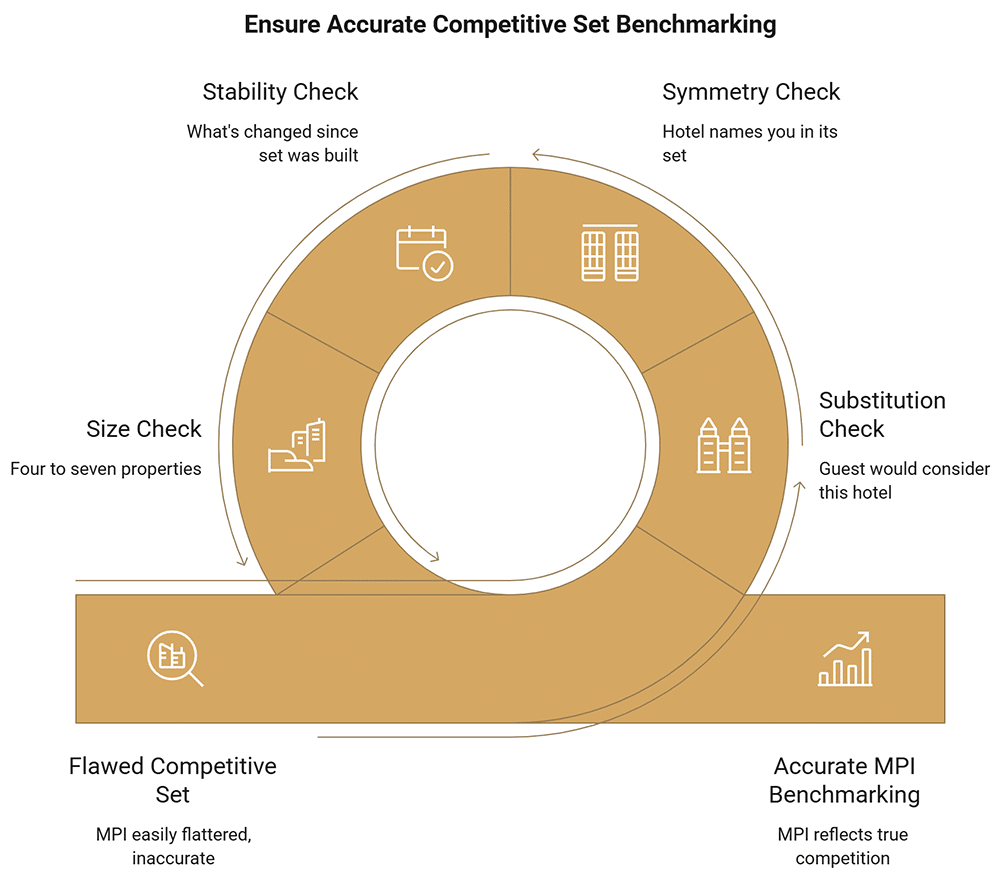
Run your set through four checks before you trust any index built on it.
- Substitution. Would a guest comparing options actually consider this hotel instead of yours? Booking substitution matters, not brochure similarity.
- Symmetry. Would that hotel name you in its comp set? Asymmetry means you’re benchmarking up or down rather than across.
- Stability. What’s changed since you built the set? New supply, a renovation, a rebrand, or a closure all shift the baseline underneath your index.
- Size. Four to seven properties is the working range. Too few and one competitor’s renovation distorts everything; too many and you’re measuring the submarket, not your competition.
Fail Substitution, and your MPI is measuring the wrong contest. Fail Stability, and it is measuring last year’s contest.
Review the set twice a year, and write down why each property is in it. That written rationale is what protects you when an owner asks why your MPI improved in a quarter when your occupancy didn’t.
What Causes a Low Market Penetration Index (MPI)?
A low MPI means you’re capturing less occupancy than the comparison group. It doesn’t tell you why, and the gap between those two things is where revenue managers lose money.
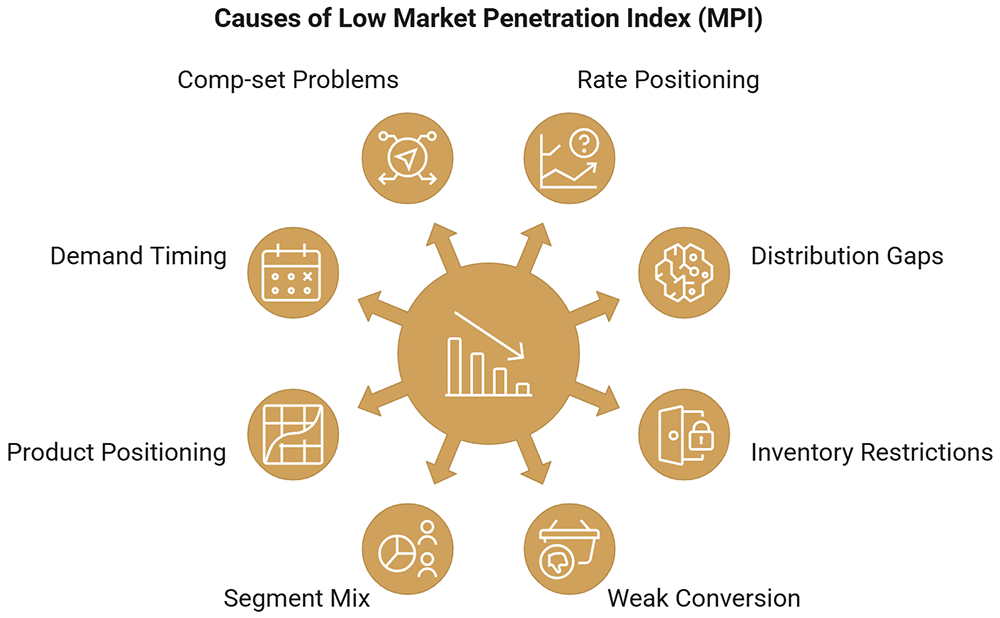
Diagnose before you reprice. Eight causes account for most sustained MPI weakness:
- Rate Positioning: Your pricing may be too high for the value guests perceive.
- Distribution Gaps: Competitors may have stronger OTA, GDS, corporate, or direct visibility.
- Inventory Restrictions: Minimum stays, closed channels, or room-type controls may block demand.
- Weak Conversion: Guests see your property but choose a competitor.
- Segment Mix: Your hotel may be underrepresented in a growing corporate, group, or leisure segment.
- Product Positioning: Reviews, facilities, room condition, or location perceptions may reduce demand.
- Demand Timing: Weakness may occur only on specific weekdays or seasons.
- Comp-set Problems: Your benchmark may no longer reflect your real competitors.
Only two of those eight are solved by discounting. That’s why cutting ADR shouldn’t be the automatic response to an MPI of 92. Work the list in order of reversibility. Restrictions and distribution gaps can be fixed this week, segment mix takes a quarter, and product positioning takes a capital plan.
What Should You Do When Your MPI Drops?
First, check whether your hotel’s performance actually fell or whether your competitive set changed. A hotel reopening after renovation or a new competitor entering the market can lower your MPI even when your own occupancy stays stable.
Next, look beyond the overall MPI. Compare your occupancy, ADR, and RevPAR position with individual competitors where benchmarking data allows it. The same MPI of 96 can mean very different things depending on where your hotel ranks within the comp set.
Then break the result down by day of the week and guest segment. If MPI is weak only from Monday to Thursday, the problem may be corporate or group demand rather than room pricing.
Only change rates after identifying the cause. If weekday MPI is low but your ARI remains above 100, stronger sales or distribution activity may be a better response than discounting.
How Can Independent Hotels Track and Improve MPI?
You don’t need a cluster revenue team to use MPI well. You need a credible comparison set, a repeatable reporting rhythm, and one person who owns the response.
Build a weekly scorecard with nine lines: your occupancy, comp set occupancy, and MPI; your ADR, comp set ADR, and ARI; your RevPAR, comp set RevPAR, and RGI. Nine numbers, one page, same format every week. Then split MPI by day of the week, because the monthly figure is where share loss hides.
Consider a 70-room independent averaging an MPI of 101 for the month. On that number, the property looks correctly positioned, and nobody investigates. Break it apart, and Friday and Saturday run 118 while Sunday through Tuesday sit at 78.
That changes the response entirely. You don’t need a property-wide discount; you need weekday demand, and those are different budgets pointed at different buyers.
CoStar’s STAR reports formalize this with a Day-of-Week Revenue Opportunity measure, which quantifies the revenue gap for each day of the week between your property and the strongest performer in your comp set. If you have access to it, it turns a share gap into a euro figure you can put in front of an owner.
Kelsey Fenerty, manager of analytics at STR, made the underlying point at the Hotel Data Conference in Nashville:
“The United States is not a monolith, and not all hotels are going to perform the same. It’s why we have comp sets. That’s why, no matter what the headlines, no matter what the news articles are saying, no matter what we say even, you have to run this all through the lens of your own property or portfolio.” Source
For an independent property with limited commercial resources, that’s the practical value of MPI. It tells you which dates and segments are actually losing share, so the effort you can afford goes where it can change the result.
FAQs About Market Penetration Index (MPI) in Hotels
Market Penetration Index (MPI) shows whether your hotel is capturing its expected share of occupancy, but winning occupancy alone is not the goal. Read MPI with ARI, RGI, and a credible competitive set, then use the result to diagnose where demand is being lost before changing price or distribution.
Did You Like This Article About Market Penetration Index (MPI) in Hotels?
You might also be interested in the following articles:
- What Is RevPAR?
- What Is RevPAM in Hotels and How Do You Calculate It
- What Is eNPS in Hotels? The Metric That Predicts Turnover
More Tips to Grow Your Business
Revfine.com is the leading knowledge platform for the hospitality and travel industry. Professionals use our insights, strategies, and actionable tips to get inspired, optimize revenue, innovate processes, and improve customer experience.Explore expert advice on management, marketing, revenue management, operations, software, and technology in our dedicated Hotel, Hospitality, and Travel & Tourism categories.
This article is written by:

Hi, I am Martijn Barten, founder of Revfine.com. With 20 years of experience in the hospitality industry, I specialize in optimizing revenue by combining revenue management with marketing strategies. I have successfully developed, implemented, and managed revenue management and marketing strategies for individual properties and multi-property portfolios.





Leave A Comment