


Space tourism has moved from speculation to limited commercial service, but access remains rare, expensive, risky, and highly selective. This guide explains today’s flight types, active companies, the booking process, costs, safety rules, environmental concerns, and the projects worth watching next.
Key Takeaways:
|
Table of Contents:
- What Is Space Tourism?
- How Big Is the Space Tourism Market?
- How Has Space Tourism Changed?
- What Types of Space Tourism Are Available?
- Which Space Tourism Companies Should You Know?
- 5 Space Tourism Companies That Fly Private Passengers Today
- Space Tourism Companies That Did Not Make It
- How Much Does Space Tourism Cost?
- What Is the Environmental Impact of Space Tourism?
- What Does Space Tourism Mean for Travel and Hospitality Businesses?
- How Safe and Regulated Is Space Tourism?
- How Will Space Tourism Look in the Future?
- Live Video: Watch the Earth From NASA Space Station
- How to Book a Ticket for a Space Flight
- How to Book Your Space Hotel
- Space Tourism FAQs
What Is Space Tourism?
Space tourism is private space travel that people pay for themselves. It is also called personal spaceflight or commercial human spaceflight. It includes short suborbital flights, longer orbital trips, and possible future journeys beyond Earth’s orbit.
The main difference is not simply the altitude. A private passenger pays for the trip, while the operator must explain the risks and obtain the passenger’s written consent.
In the United States, Congress created a temporary “learning period” in 2004. During this period, the Federal Aviation Administration (FAA) cannot introduce broad safety rules for people traveling aboard commercial spacecraft. The learning period is scheduled to end on January 1, 2028. After that date, the FAA may begin proposing new passenger-safety rules.
This deadline could strongly influence the future of space tourism. Companies currently selling seats operate under rules that may change after 2028.
How Big Is the Space Tourism Market?
Space tourism is only a small part of the wider space economy, and there is no reliable public total for tourism alone.
The OECD’s Space Economy at a Glance reports USD 544.3 billion in commercial space revenue, up 13%, on the Space Foundation’s measure. It also cites a European Space Agency estimate of EUR 564 billion, up 7%. The two use different methods.
These totals cover the whole space economy. Much of the value comes from satellites, communication, navigation, Earth observation, manufacturing, launch services, and ground equipment. The figures should not be presented as the size of space tourism.
Passenger numbers give a clearer picture of tourism’s current scale. In January 2026, Blue Origin said New Shepard had completed 38 flights in total and carried 98 people above the Kármán line.
Space tourism is real, but it remains a small and irregular market.
How Has Space Tourism Changed?
Space tourism has grown unevenly. Orbital missions continue, while the main suborbital services are paused or between vehicles.
Dennis Tito became the first widely recognized paying space tourist when he visited the International Space Station in 2001. Other private travelers followed, but orbital flights remained rare and expensive.
Blue Origin later created the most active suborbital passenger program. On January 30, 2026, however, the company paused New Shepard flights for at least two years while redirecting resources to its lunar program.
Virgin Galactic completed VSS Unity’s final commercial flight in June 2024. It is developing Delta-class spacecraft and now targets February 2027 for its next commercial service.
Private orbital missions have continued through Axiom Space and SpaceX. Axiom completed four missions to the space station between April 2022 and July 2025. NASA has since selected Axiom, Vast, and Voyager Technologies for three further missions.
Plans beyond Earth orbit have been less successful. Yusaku Maezawa canceled dearMoon in June 2024 because the project had no clear near-term launch schedule.
What Types of Space Tourism Are Available?
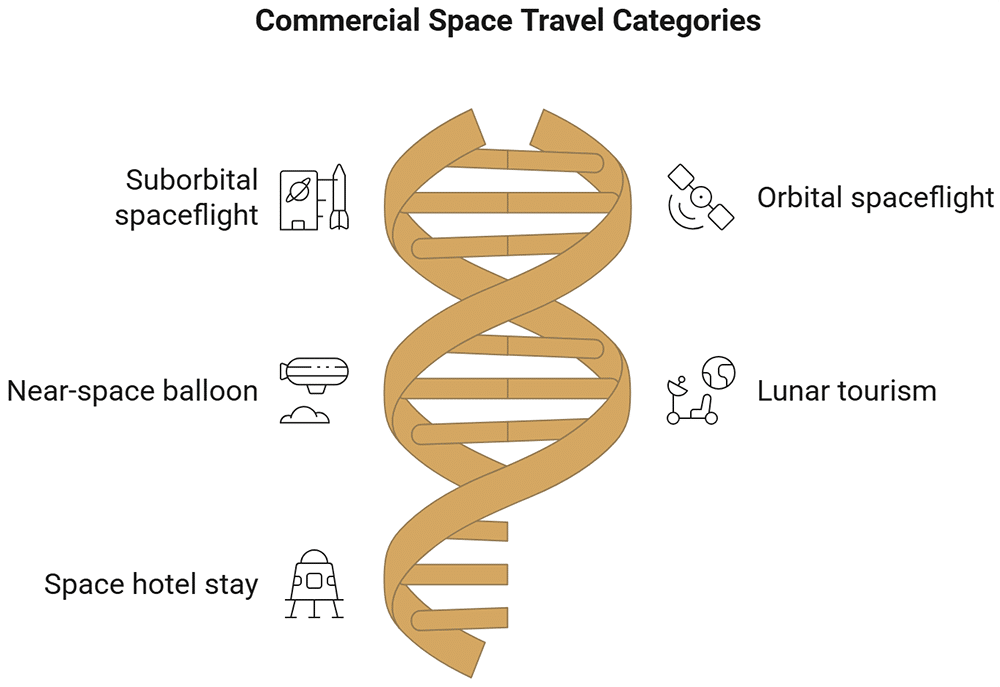
Five categories are commonly discussed. Only suborbital and orbital flights have carried private passengers, and access to both remains limited.
| Type | What the Traveler Experiences | Typical Duration | Current Status |
| Suborbital spaceflight | A climb to space, several minutes of free-fall, Earth views, and a return without orbiting | Minutes in space within a longer flight program | Proven, but currently paused. Blue Origin stopped flights in January 2026; Virgin Galactic targets February 2027 |
| Orbital spaceflight | Repeated orbits, continuous microgravity, intensive operations, and a stay of days or weeks | Several days or longer | Proven but rare; missions are arranged through specialist providers and partners. |
| Near-space balloon | A slow ascent to the stratosphere and a dark-sky, curved-horizon view | Several hours | A high-altitude tourism category, but not spaceflight or weightlessness |
| Lunar tourism | A flight around, into orbit around, or toward the Moon | Several days or longer | No scheduled consumer tourism service |
| Space hotel stay | An overnight stay in an orbital commercial station | Several days or longer | No ordinary hotel-style product is available to book |
The main commercial distinction is between suborbital and orbital travel. Suborbital flights provide a short experience with a few minutes of weightlessness. Orbital missions require extensive preparation, last several days, and are arranged as complete expeditions.
Which Space Tourism Companies Should You Know?
Company status changes quickly. This table separates completed operations from future plans and does not treat a target date as a confirmed departure.
| Company | Role and Experience | Current Status | Public Price or Booking Route |
| Blue Origin | Operates the reusable New Shepard suborbital rocket and capsule | Completed 38 New Shepard missions and carried 98 people. Flights are paused for at least two years from January 30, 2026 | No current public fare or flight availability |
| Virgin Galactic | Operates air-launched suborbital spaceplanes and is developing its six-seat Delta-class vehicles | VSS Unity completed its final commercial flight in June 2024. Delta-class service is targeted for February 2027 | A $750,000 ticket release sold out. Future prices and availability should be confirmed. |
| SpaceX | Provides Falcon 9 and Crew Dragon transportation for private orbital missions | Proven transport provider for free-flying private missions and all four completed Axiom missions | No standard retail fare or public consumer schedule |
| Axiom Space | Designs and manages private astronaut missions to the International Space Station. | Four missions completed. Ax-5 is targeted no earlier than January 2027 | Bespoke inquiry and mission planning with no standard public fare |
| Vast | Private astronaut mission organizer and commercial station developer | Selected by NASA for the sixth private ISS mission, targeted no earlier than summer 2027 | No public passenger price or booking schedule |
| Voyager Technologies | Private mission organizer and developer of the proposed Starlab station | Selected by NASA for the seventh private ISS mission, targeted no earlier than 2028 | No public passenger price or booking schedule |
| Space Adventures | Broker and mission arranger with a history of private Soyuz flights to the ISS | Arranged nine Soyuz missions for private clients. Its public website does not list a current departure date. | Inquiry only. Travelers should confirm the vehicle, operator, date, and full price. |
5 Space Tourism Companies That Fly Private Passengers Today
The concept of space tourism is growing in popularity all the time, and there are a growing number of businesses engaging in activities within the space tourism industry. For those hoping to one day visit space as a private astronaut, the following companies may offer the best chance of achieving that dream.
1. Virgin Galactic
Virgin Galactic is developing Delta-class spacecraft for suborbital passenger and research flights. VSS Unity completed its final commercial mission in June 2024, so the company is currently between fleets. On August 12, 2026, Virgin Galactic moved its first Delta commercial service to February 2027 to allow more time for systems installation.
A captive-carry test was targeted for October 2026, with a second vehicle planned for March 2027. Its latest sales tranche was oversubscribed and sold out at USD 750,000 per seat. These dates remain company targets and depend on successful testing. Travelers should wait for confirmed flight availability before treating February 2027 as a departure.
Video: Space Tourism Company Virgin Galactic In Space For The Second Time
You can read more detailed information about Virgin Galactic in the article “Virgin Galactic: Information About Virgin Space Flights”.
2. SpaceX
SpaceX supplies launch vehicles and Crew Dragon spacecraft for private orbital missions. Dragon carried Inspiration4 in 2021, Polaris Dawn in 2024, Fram2 in 2025, and all four completed Axiom missions. NASA records that Polaris Dawn included the first commercial spacewalk. SpaceX does not publish a normal consumer timetable or individual seat price.
Private flights are arranged as complete missions rather than airline-style bookings. Starship is intended for missions beyond low Earth orbit, but it has not carried people, and no consumer lunar flight has a public departure date. SpaceX is therefore best described as a transport provider for private orbital missions rather than a regular tourism retailer.
Video: Space Tourism Company SpaceX Interplanetary Transport System
You can read more detailed information about SpaceX in the article “SpaceX Information: Rockets, Spacecrafts and Spaceflights”.
3. Blue Origin
Blue Origin operated New Shepard as a reusable suborbital passenger system. The autonomous capsule seats six, and the complete journey lasts about 11 minutes, including several minutes above the Kármán line. On January 30, 2026, Blue Origin announced that flights would pause for no less than two years while resources moved to its lunar program. By then, New Shepard had completed 38 flights, carried 98 people, and built a multi-year customer backlog.
The company did not link the pause to an accident, but it has not published a restart date beyond the minimum period. Blue Origin also does not publish a standard fare. New Shepard is a proven tourism vehicle, but it is not currently available for departure.
Video: Space Tourism Company Blue Origin – Millions of People Living and Working in Space
For more detailed information about Blue Origin, you can read the article “Blue Origin: Information About Blue Origin Space Flights”.
5. Axiom Space
Axiom Space organizes private astronaut missions to the International Space Station. It completed four missions between April 2022 and July 2025 using SpaceX Crew Dragon spacecraft. NASA has ordered a fifth mission for no earlier than January 2027. These crews conduct science, outreach, and commercial work, and some participants are sponsored by national governments. The experience is closer to a managed expedition than a holiday.
Axiom handles training, mission planning, research support, and the onboard program, while SpaceX provides transport. The company is also developing Axiom Station. Manufacturing of its first module is underway, but no Axiom module is in orbit, and current mission prices are negotiated privately.
5. Space Adventures
Space Adventures pioneered orbital tourism by arranging Dennis Tito’s 2001 visit to the International Space Station. It does not own rockets or spacecraft. Instead, it brokers seats and coordinates training and mission support with transport providers. The company says it has arranged nine private spaceflights on Russian Soyuz spacecraft, including Yusaku Maezawa and Yozo Hirano’s 2021 mission.
Its website continues to advertise space station and circumlunar experiences, but the listings are inquiry-based. It provides no current public departure date or fixed price. The company has a genuine flight history, but an online inquiry form should not be treated as proof that a seat is ready to launch.
Video: Space Adventures – a View Like This
Space Tourism Companies That Did Not Make It
The failures are more instructive than the survivors, because they fail the same way.
1. Orion Span
The company announced the Aurora Space Station in 2018. It was to be a six-person orbital hotel, priced at $9.5 million for a twelve-day stay, and the company took deposits against it. It never signed a launch contract and never began construction. The company shut down and refunded the deposits.
2. Space Perspective
Space Perspective is the most recent and most cautionary case, because it did almost everything right. It designed and built its own capsule, flew a complete uncrewed mission profile to roughly 100,000 feet in September 2024, and sold more than 1,600 seats. It still ran out of runway before commercial service and was absorbed by a competitor. Technical success did not translate into a business.
3. Galactic Suite Design
Based in Barcelona, Galactic Suite Design marketed an orbital hotel from 2007. In November 2009, its CEO Xavier Claramunt said the hotel would open in 2012. Three nights were priced at $4.4 million and included a two-month training course. He said 43 people had reserved a place, and that an anonymous billionaire had granted the company $3 billion. Guests were to launch on a Russian rocket from a Caribbean island. No hotel was built, and no launch contract was ever confirmed.
Video: Space Tourism Company Galactic Suite space resort GSSR 3.0
4. The Golden Spike Company
The Golden Spike Company announced commercial flights to the surface of the Moon in December 2012. It was not short on credibility. Alan Stern ran it, and former Apollo flight director Gerry Griffin chaired the board. The numbers were the problem. Missions after the first were costed at about $1.5 billion each, and the first needed $7 to $8 billion in advance sales before it could fly. The company commissioned a lunar lander study in 2013 and was still promising missions in 2014. It never flew.
Video: Space Tourism Company Golden Spike Announcement
5. XCOR Aerospace
The company announced the Lynx in 2008, a two-seat suborbital spaceplane designed to take off from a runway, and expected a prototype by 2015. In 2016, it laid off about half its staff and shelved the Lynx to concentrate on a rocket engine contract with United Launch Alliance. It laid off the remaining staff in June 2017 and filed for Chapter 7 bankruptcy that November. The prototype was never finished.
Video: Space Tourism Company XCOR Aerospace
What the Failures Have in Common
The common thread is not engineering. Every one of these companies could describe a plausible vehicle. What none of them could do was turn that description into a financed mission with a launch contract and a date.
Golden Spike needed $7 billion before it could fly once. Galactic Suite claimed a $3 billion backer who never materialized. XCOR abandoned its own spaceplane to chase supplier work that paid the bills. Customer deposits are never large enough to close that gap, which is why deposits taken are the weakest possible evidence that a flight will ever happen.
How Much Does Space Tourism Cost?
There is no reliable universal price because the products are not comparable and most providers do not publish a current retail fare.
Virgin Galactic offers the clearest recent benchmark. Its 2026 tranche was priced at $750,000 per person and sold out. CEO Michael Colglazier said in the company’s business update that it “was oversubscribed and booked out ahead of schedule.”
Blue Origin does not publish a standard New Shepard ticket price. Orbital missions do not have a public package price on the Axiom, NASA, Vast, or Voyager mission pages reviewed for this update.
An orbital quote may include spacecraft transport, months of training, mission management, medical checks, spacesuits, accommodation, insurance requirements, research support, and use of station resources. The final contract may also allocate costs for a delay or canceled launch.
Before paying a deposit, a traveler should request a dated and itemized quote that confirms:
- The spacecraft, launch provider, destination, and expected mission length
- Training, medical, insurance, accommodation, and companion travel costs
- Taxes, currency, payment schedule, and any price adjustment clause
- Refund, transfer, delay, and cancellation terms
- What happens if the vehicle or destination is not ready
What Is the Environmental Impact of Space Tourism?
The answer depends on the vehicle, fuel, flight profile, altitude, ground operations, manufacturing, and reentry. A claim about exhaust alone is not a complete lifecycle assessment.
Blue Origin states that New Shepard’s hydrogen-and-oxygen engine produces water vapor and no carbon emissions during combustion. However, upper-atmosphere water vapor, nitrogen oxides formed at high temperatures, vehicle production, and ground activity still need to be considered.
A study led by Robert Ryan modeled rocket launch and reentry emissions. The researchers stressed that rockets release pollutants directly into upper layers of the atmosphere. Their speculative routine-tourism scenario found possible climate and ozone effects, especially from soot-producing fuels. The result is a warning about scale, not a measured footprint for every passenger or vehicle.
Travelers and tourism businesses should ask operators for current, vehicle-specific lifecycle data. Reusability, a low-carbon fuel claim, or a short flight does not by itself prove that a product has a low environmental impact.
What Does Space Tourism Mean for Travel and Hospitality Businesses?
Space tourism is too small to transform mainstream hospitality today, but it can create high-value demand around launch sites and training centers. Travelers may need long, flexible stays, private transport, secure meeting space, specialist food, wellness support, family hosting, and media management.
Hotels and destination organizations should design around uncertainty. A launch package needs flexible dates, clear cancellation rules, extended-stay options, and coordination with the operator’s security and transport plan. Properties should not advertise an unconfirmed launch or imply an official partnership without written permission.
Content teams also need stricter labels than conventional travel pages. Mark every offer as operating, sold out, paused, scheduled, in testing, or conceptual. Show the date checked. Distinguish spaceflight from near-space balloons. Link price and safety claims to the operator or regulator, not to an old roundup.
How Safe and Regulated Is Space Tourism?
Space tourism carries risks that ordinary airline passengers do not accept. These include high acceleration, vibration, cabin pressure problems, launch or reentry failure, landing hazards, motion sickness, and medical events in a remote environment. Orbital participants also face longer exposure to microgravity and space radiation.
For U.S.-licensed flights, 14 CFR 460.45 requires an operator to explain known and unknown hazards in writing. The participant must be told that the U.S. government “has not certified the launch vehicle … as safe” for carrying people. The operator must provide a chance to ask questions and obtain signed, written consent.
This informed-consent framework is different from airline passenger protection. It does not mean there is no regulation. It means travelers should not interpret a launch license as a government safety endorsement for the passenger vehicle.
Rules, medical standards, waivers, and liability arrangements vary by country and mission. A buyer should obtain independent legal, medical, and insurance advice for a contract of this size and risk.
How Will Space Tourism Look in the Future?
The next phase will depend on vehicle testing and a small number of dated mission targets rather than broad market forecasts.
Virgin Galactic targets a captive-carry test in October 2026 and its first Delta commercial service in February 2027. Axiom Mission 5 is targeted no earlier than January 2027. NASA lists Vast’s first private space station mission for no earlier than summer 2027 and Voyager Technologies’ mission for no earlier than 2028.
Blue Origin’s minimum two-year pause means New Shepard service will not return before early 2028 unless the company changes its published plan. No restart date has been announced. Axiom Station and Vast’s Haven-1 are being developed, but neither is an operating hotel or normal booking option.
Lunar tourism remains more distant. Starship has not carried people, dearMoon was canceled, and no provider reviewed for this article publishes a confirmed consumer lunar departure.
Progress should be measured through completed tests, licenses, signed mission orders, and flown passengers. Company targets can change because of engineering work, funding, regulation, launch availability, or changes to the International Space Station schedule.
Live Video: Watch the Earth From NASA Space Station
For most people, space tourism is still out of reach. Fortunately, you can already admire the Earth from space through the live feeds from NASA.
Video: Earth From Space Seen From The ISS
How to Book a Ticket for a Space Flight
As space tourism becomes a more realistic prospect, there is growing anticipation among those who wish to enjoy the trip of a lifetime. So how close are we to making the trip into outer space, and what is the process like for booking a commercial space flight?
Read our article, “Space Flight: How to Book a Ticket into Space”, for more information on offerings from SpaceX, Virgin Galactic, Blue Origin, and Boeing, along with information on how you can actually book your seat on a spacecraft.
How to Book Your Space Hotel
The concept of space tourism opens up the possibility of not only traveling into space but staying there. Already, there are a number of proposals for space hotels and accommodations for tourists, including Orion Span’s luxury space hotel and even the International Space Station (ISS), which the first space tourist visited.
Check out “Space Hotel: How to Book a Hotel in Space”, where you can obtain more details about the various proposals for overnight stays in space, along with important info on how to book your stay.
Space Tourism FAQs
Space tourism is real, but it is not yet a regular travel product. Private orbital missions continue, while the main suborbital providers are paused or developing new vehicles. Prices remain high, booking routes are limited, and target dates can move. Travelers and hospitality businesses should distinguish completed flights from future plans. Before treating an offer as available, confirm the operator, vehicle, date, price, safety disclosures, and refund terms through current primary sources.
Did You Like This Article About Space Tourism?
You might also be interested in the following articles:
- Aerospace Companies: List of Aircraft and Spacecraft Manufacturers
- Space Industry: The No. 1 Guide into Space!
- Airline Industry: All You Need to Know About The Airline Sector
- Everything You Need to Know About the Cruise Industry
More Tips to Grow Your Business
Revfine.com is the leading knowledge platform for the hospitality and travel industry. Professionals use our insights, strategies, and actionable tips to get inspired, optimize revenue, innovate processes, and improve customer experience.Explore expert advice on management, marketing, revenue management, operations, software, and technology in our dedicated Hotel, Hospitality, and Travel & Tourism categories.
This article is written by:

Hi, I am Martijn Barten, founder of Revfine.com. With 20 years of experience in the hospitality industry, I specialize in optimizing revenue by combining revenue management with marketing strategies. I have successfully developed, implemented, and managed revenue management and marketing strategies for individual properties and multi-property portfolios.
Let’s go to the Moon :)